
Index funds are defined as passively managed investment vehicles that track broad market indices like the S&P 500 or MSCI World, and they are the single best investment structure for digital nomads. The core reasons why index funds suit nomads come down to three factors: low fees, global diversification, and minimal management time. Unlike active funds, index funds do not require you to monitor markets across time zones or maintain a relationship with a local financial advisor. For nomads who move between countries, change tax residencies, and earn irregular income, that simplicity is not a luxury. It is a financial necessity.
Why index funds suit nomads as a low-cost investment choice
The fee gap between index funds and active funds is the most underrated wealth factor for nomads. Low-cost index funds charge expense ratios as low as 0.03% to 0.10% annually, while actively managed funds typically charge 0.5% or higher. That difference compounds dramatically over 30 years. A nomad investing $500 per month who saves 0.5% annually in fees retains tens of thousands of dollars more by retirement.
For nomads, this matters even more than it does for settled investors. Your income is variable. A slow client month, a visa delay, or a relocation cost can disrupt cash flow fast. Keeping fees low preserves capital during those gaps. Financial experts recommend a 6–12 month emergency fund for nomads precisely because income variability is higher than in traditional employment. Low fund fees mean more of your money stays invested and working, even when contributions temporarily slow.

Pro Tip: When comparing funds, check the total expense ratio, not just the headline fee. Some funds add transaction costs or currency conversion charges that erode returns silently.
| Fund type | Typical expense ratio | 30-year impact on $100,000 |
|---|---|---|
| Broad index fund | 0.03%–0.10% | Minimal drag on returns |
| Active managed fund | 0.5%–1.5%+ | Significant capital erosion |
| Target-date fund | 0.10%–0.75% | Moderate drag |
How do index funds provide geographic and currency diversification for nomads?
Concentration risk from holding assets exclusively in one country or currency is the biggest threat to nomad wealth. A broad global index fund solves this by spreading your exposure across hundreds or thousands of companies in dozens of countries. If the economy in your current base country struggles, your portfolio does not collapse with it.
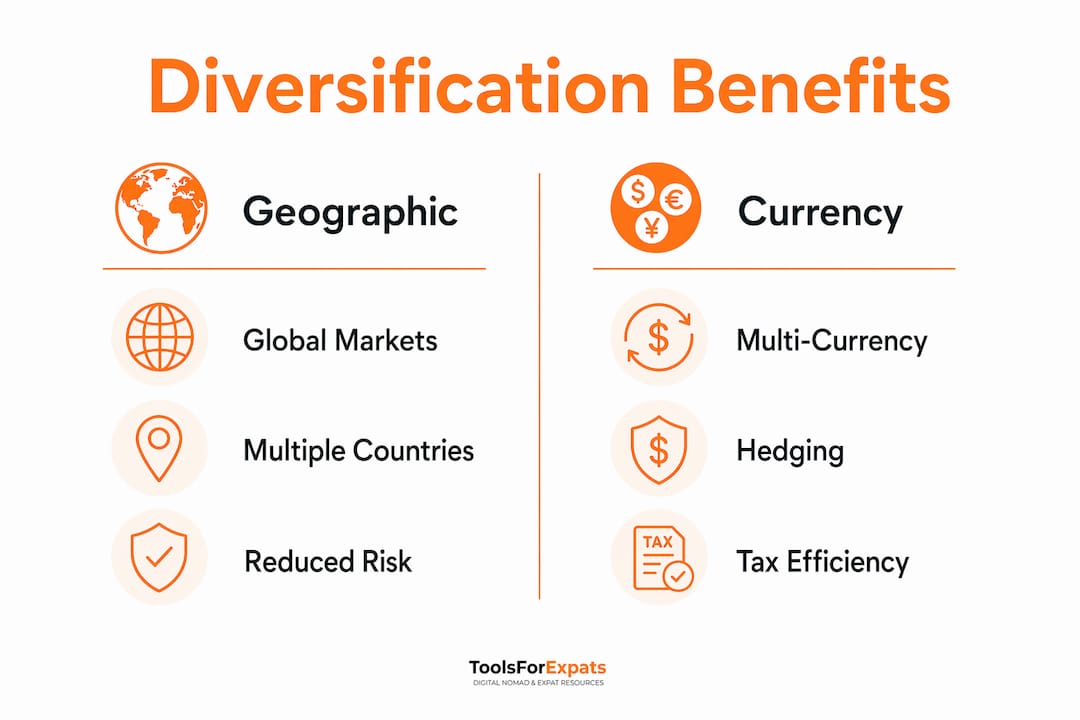
Currency diversification works alongside geographic diversification. When you hold a global equity index fund, your assets are spread across USD, EUR, GBP, JPY, and other major currencies. That mix buffers you against the kind of localized currency shock that can wipe out purchasing power overnight. Nomads who hold all their savings in a single currency tied to their current country of residence carry a risk that most traditional investors never face.
For non-US nomads, UCITS ETFs domiciled in Ireland are the most tax-efficient structure available. Irish-domiciled UCITS ETFs benefit from Ireland's broad tax treaty network, which reduces dividend withholding taxes compared to US-domiciled funds. This is a structural advantage that compounds over decades, not just a minor administrative detail.
- Global equity index funds give you exposure to thousands of companies across North America, Europe, Asia, and emerging markets in a single holding.
- UCITS ETFs are regulated under European Union law and widely accessible to non-US investors through international brokers.
- Irish domicile reduces dividend withholding tax from as high as 30% (for US-domiciled funds) to 15% or lower through treaty benefits.
- Currency basket exposure protects your portfolio from single-country economic or political shocks.
Pro Tip: If you are a non-US nomad, prioritize UCITS ETFs over US-domiciled ETFs. The tax savings on dividends alone can add up to thousands of dollars over a decade.
Why is simplicity and passive management critical for nomad investors?
Passive, globally diversified index funds remove the need for active market tracking, which is the defining advantage for nomads operating across multiple time zones. You cannot reliably monitor earnings reports, rebalance positions, or react to market news when you are crossing borders, dealing with visa paperwork, or working from a café in a different country each month. Passive investing removes that pressure entirely.
Automation is the mechanism that makes passive investing work for nomads. Without an employer automatically deducting pension contributions from your paycheck, you must replicate that forced savings yourself. The most effective method is a structured, automated monthly transfer into your investment account. Here is a practical system that works:
- Set a fixed monthly contribution amount. Choose a number you can sustain even in slow income months. Consistency beats size.
- Automate the transfer on payday. Schedule the transfer to your brokerage account the same day income arrives, before you spend it on anything else.
- Use a two-account system. Keep a primary account for living expenses and a separate brokerage account for investments. Separating these accounts prevents investment capital from being spent during high-cost relocation periods.
- Avoid checking your portfolio daily. Passive investing works because you stay in the market through volatility. Frequent checking leads to emotional decisions that destroy returns.
- Review quarterly, not weekly. A quarterly check is enough to confirm contributions are landing and allocations are roughly on target.
The FIRE (Financial Independence, Retire Early) framework adapts well to nomad income patterns. The 4% withdrawal rule states that once you have saved 25 times your annual expenses in a diversified portfolio, you can withdraw 4% annually and sustain that for 30 or more years. For nomads living in lower-cost countries, that target is often more achievable than it sounds.
What structural and tax considerations do nomads face with index funds?
Nomad financial success depends far more on early structural choices around residency and brokerage than on picking the right fund. You can hold the world's best index fund and still lose a significant portion of returns to avoidable taxes or brokerage restrictions if you get the structure wrong.
Tax residency is the first decision. Your tax residency determines which country has the right to tax your investment income and capital gains. Many nomads mistakenly assume that living nowhere means being taxed nowhere. That is rarely true. Most countries have rules that establish tax residency based on days spent or economic ties. Establishing clear tax residency in a jurisdiction with favorable investment tax treatment is a foundational step, not an afterthought.
Brokerage account selection is the second critical decision. International-friendly brokers maintain account access even after you change tax residencies. Brokers tied to a single country's residency requirements can freeze or force liquidation of your account when you move. That forced liquidation can trigger unexpected capital gains taxes at the worst possible time. Choosing a broker that explicitly supports global clients protects your portfolio continuity across moves. For more on structuring your accounts across borders, the guide on offshore account options for nomads covers the key decisions in detail.
| Factor | US-domiciled ETFs | UCITS ETFs (Ireland-domiciled) |
|---|---|---|
| Dividend withholding tax | Up to 30% for non-US residents | 15% or lower via tax treaties |
| Regulatory framework | SEC (US) | EU UCITS regulations |
| Accessibility for non-US investors | Restricted in many countries | Widely available globally |
| Estate tax risk | Applies to non-US holders | Generally not applicable |
How can nomads practically build and maintain an index fund portfolio?
Building a portfolio as a nomad starts with knowing your numbers. Use a cost of living calculator to establish your actual monthly expenses across the countries you rotate through. That baseline tells you how much you need to save and what your FIRE target looks like in real terms.
A practical fund allocation for most nomads looks like this:
- 70%–80% global equity index fund. A single fund tracking the MSCI World or FTSE All-World index covers thousands of companies across developed and emerging markets.
- 20% bond index fund. Bonds reduce portfolio volatility during market downturns, which matters when your income is already variable.
- 6–12 months of expenses in cash. This emergency buffer sits outside the market entirely. Nomads need a larger buffer than traditional employees because income gaps, relocation costs, and visa fees can arrive without warning.
Rebalancing keeps your allocation on target. Once or twice a year, check whether your equity and bond split has drifted significantly from your target. If equities have grown to 90% of your portfolio after a strong market run, sell a portion and move it to bonds to restore balance. This process takes less than an hour per year and prevents your risk level from creeping higher than you intended.
Sticking to the plan during market downturns is the hardest part. When markets drop 20% or 30%, the instinct is to sell and wait for recovery. That instinct is wrong. Nomads who automate contributions and manage money across multiple accounts consistently outperform those who try to time the market. The data on this is clear: time in the market beats timing the market, every time.
Pro Tip: Set up automatic rebalancing if your broker supports it. Even an annual manual rebalance takes less than 30 minutes and significantly improves long-term risk-adjusted returns.
Key Takeaways
Index funds are the most practical wealth-building tool for digital nomads because low fees, global diversification, and automation work together to protect and grow capital across borders.
| Point | Details |
|---|---|
| Low fees compound over decades | Choose funds with expense ratios of 0.03%–0.10% to retain significantly more capital over 30 years. |
| UCITS ETFs reduce tax drag | Irish-domiciled UCITS ETFs lower dividend withholding tax to 15% or less for non-US nomads. |
| Automation replaces employer pensions | Set up automatic monthly transfers to replicate the forced savings of traditional employment. |
| Brokerage choice protects continuity | Use international-friendly brokers that maintain access after tax residency changes. |
| Emergency fund stays outside the market | Keep 6–12 months of expenses in cash to avoid selling investments during income gaps. |
The structural decision most nomads get wrong
Most nomads I have observed spend hours debating which index fund to buy and almost no time on the structural decisions that actually determine their returns. The fund choice matters far less than the brokerage, the domicile, and the tax residency. A nomad holding a perfectly good MSCI World ETF through the wrong broker, in the wrong domicile, with no clear tax residency can lose a larger percentage of returns to friction costs than the fund's entire expense ratio.
The second mistake I see constantly is treating the emergency fund as optional. Nomads with irregular income who invest every spare dollar into the market are one bad month away from being forced sellers at the worst time. Selling investments to cover a visa fee or a medical bill during a market downturn is a wealth-destroying event that takes years to recover from. The 6–12 month cash buffer is not conservative. It is the foundation that makes the rest of the portfolio possible.
The most encouraging thing about index fund investing for nomads is how little active work it requires once the structure is right. You set the accounts, automate the contributions, choose a simple two-fund or three-fund portfolio, and then largely leave it alone. The nomad retirement planning decisions that feel complex upfront become genuinely simple once the structure is in place. Patience and consistency do more for nomad wealth than any amount of market research.
— Jay
ToolsForExpats tools for nomad financial planning
Planning your finances as a nomad means knowing your numbers before you invest. ToolsForExpats offers free calculators built specifically for digital nomads and expats, covering living costs, budget planning, and city comparisons across dozens of destinations.
Use the nomad cost calculator to find your real monthly baseline across the cities you rotate through. The cost comparison tool lets you stack two cities side by side to see exactly where your money goes further. Both tools are free, require no account, and give you the concrete numbers you need to set a realistic savings rate and FIRE target. When your budget is clear, your investment plan becomes straightforward.
FAQ
What are index funds and why do nomads use them?
Index funds are passively managed funds that track a market index like the S&P 500 or MSCI World. Nomads use them because they require minimal management, charge low fees, and provide global diversification without needing a local financial advisor.
What expense ratio should nomads look for in an index fund?
Target funds with expense ratios between 0.03% and 0.10% annually. Fees above 0.5% significantly erode returns over a 30-year investment horizon.
Are UCITS ETFs better than US ETFs for non-US nomads?
Yes. Irish-domiciled UCITS ETFs reduce dividend withholding tax to 15% or lower for non-US investors, compared to up to 30% for US-domiciled ETFs, making them the more tax-efficient choice for most nomads.
How much emergency fund do nomads need before investing?
Financial experts recommend 6–12 months of living expenses held in cash outside the market. This buffer protects nomads from being forced to sell investments during income gaps or relocation costs.
How do nomads automate index fund contributions without an employer?
Nomads replicate employer pension contributions by setting up automatic monthly transfers from their primary bank account to a brokerage account. Using a two-account system, separating income from investment capital, prevents spending money earmarked for investing.