
A digital nomad emergency fund is a dedicated liquid savings reserve covering six to twelve months of essential living expenses, designed specifically to protect against income gaps, medical crises, and sudden travel disruptions. Unlike a standard savings account, this fund exists outside your travel budget and operates as your financial floor when everything else fails. The standard personal finance advice of three to six months rarely applies here. Freelancers and remote workers face income variability, visa complications, and healthcare costs that demand a larger, more accessible buffer. This guide walks you through calculating your target, storing it correctly, and building it consistently despite irregular earnings.
How to build your digital nomad emergency fund: calculating the right size
The first step to building a nomad emergency fund is separating your essential expenses from everything else. Essential expenses are the costs you cannot skip: housing, food, health insurance, connectivity, and transportation. Non-essentials like dining out, tours, and co-working upgrades come second and should never factor into your fund calculation.
Your target fund size depends directly on your nomad style. Fund targets range from $2,500 to $12,000 depending on travel style and location. That range reflects three distinct nomad profiles:

| Nomad style | Monthly essentials | 6-month target | 12-month target |
|---|---|---|---|
| Budget nomad | ~$1,000 | $6,000 | $12,000 |
| Mid-range nomad | ~$2,000 | $12,000 | $24,000 |
| High-cost nomad | ~$3,500+ | $21,000 | $42,000 |
Most nomads starting out should aim for the six-month figure first, then extend to twelve months once income stabilizes. The ToolsForExpats nomad cost calculator helps you estimate monthly living expenses by city, which makes this calculation far more precise than guessing.
Beyond the baseline, add a 15 to 20 percent buffer on top of your calculated total. This covers costs that fall outside normal monthly spending: emergency flights home, replacing a stolen laptop, or covering a deductible when your insurance kicks in slowly. Budget nomads often underestimate these one-off costs, which is exactly why so many end up raiding their travel funds during a crisis.
Use this simple formula to get your personal target:
- Step 1: List all essential monthly expenses (housing, food, insurance, data, transport)
- Step 2: Multiply that total by six or twelve
- Step 3: Add 15 to 20 percent as a buffer for unexpected one-off costs
- Step 4: Set that number as your savings milestone
Where should you store your emergency fund as a nomad?
Storage strategy matters as much as the savings amount itself. An emergency fund that is locked in a fixed-term deposit or tied to a single bank card is not actually accessible in a crisis. The goal is liquidity combined with stability.
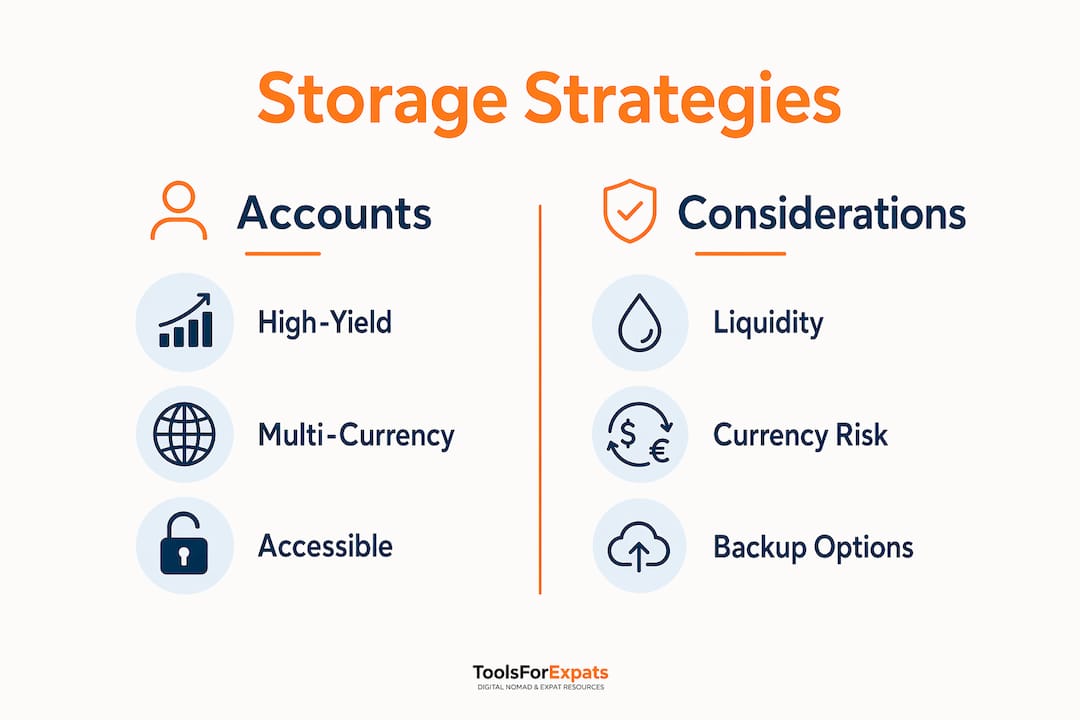
Practitioners recommend a 70/20/10 fund split: 70 percent in a high-yield home-country savings account, 20 percent in a digital multi-currency account, and 10 percent as physical cash in a stable currency like USD or EUR. This structure gives you growth on the bulk of your savings while keeping a meaningful portion instantly accessible anywhere in the world.
Pro Tip: Open accounts with at least two separate banking networks, such as Wise and a traditional home-country bank. If one card is frozen or lost abroad, you still have full access to your funds through the other.
Here is how the three storage layers compare:
| Account type | Best for | Key advantage | Key risk |
|---|---|---|---|
| Home-country high-yield savings | Bulk fund storage | Earns interest, FDIC/FSCS protected | Slower international transfers |
| Multi-currency digital account (e.g., Wise, Revolut) | Accessible travel buffer | Instant access, low FX fees | Not always insured |
| Physical cash (USD/EUR) | Ultimate backup | Works when cards fail | Can be lost or stolen |
Holding funds in local currency while traveling is a real risk. Currency volatility in emerging markets can erode your fund's value quickly, and local bank accounts can be frozen or restricted when you leave the country. Keeping the majority of your fund in USD or EUR protects its real value regardless of where you are based. For more on why nomads use offshore structures for this purpose, the guide on why nomads open offshore accounts covers the practical reasoning in detail.
Carrying multiple cards from different banks and networks is non-negotiable. One card may be blocked by a fraud alert, declined by a local ATM network, or simply lost. Backup cards from different providers ensure you are never completely cut off from your savings.
Step-by-step strategies to build your fund despite variable income
Irregular income is the defining challenge of nomad financial planning. The solution is not waiting for a good month to save. It is building a system that saves automatically regardless of how much comes in.
-
Apply the profit-first method. Divert 20 to 25 percent of every payment received directly into your emergency savings account before spending anything else. Treat it like a tax you pay yourself first.
-
Set up a separate tax account simultaneously. Put aside 25 to 30 percent of income for taxes in a dedicated account. This prevents you from accidentally spending tax money and then raiding your emergency fund to cover the bill at year-end.
-
Automate transfers on payment day. Most digital banks allow you to set up automatic percentage-based transfers. When a client pays you, the split happens without any manual action. Automation removes the temptation to delay saving during slow months.
-
Use milestone-based motivation. Break your total target into smaller milestones: $1,000, then $3,000, then $6,000. Each milestone represents a real level of protection. Reaching $1,000 means you can cover a flight home. Reaching $3,000 means you can handle a medical deductible. Progress feels tangible when you frame it this way.
-
Schedule a monthly money date. A monthly financial review habit prevents lifestyle inflation and keeps your savings on track. Spend 30 minutes reviewing income, expenses, and fund balance. Adjust your savings rate if income has changed.
Pro Tip: Label your emergency savings account something specific like "Freedom Fund" or "Crisis Buffer" rather than just "Savings." Behavioral research consistently shows that named accounts are raided less frequently than generic ones.
The most common mistake nomads make is treating the emergency fund as a flexible pool. Emergency funds must stay separate from travel and lifestyle budgets. A discounted flight deal is not an emergency. A new camera is not an emergency. Define your criteria in writing before you need to use the fund, so the decision is already made when stress is high.
Managing currency risk, travel emergencies, and real-world scenarios
Even a well-funded emergency reserve fails if it is not structured to handle the specific crises nomads face. The most common scenarios worth planning for are medical emergencies, sudden repatriation, tech failure, and income loss from illness.
58 percent of independent workers experienced income loss due to health issues while traveling, and only 22 percent had suitable insurance coverage. That gap is exactly what your emergency fund exists to fill. Travel insurance and health insurance are your primary protection, but they do not cover everything upfront.
Many hospitals in Southeast Asia, Latin America, and Eastern Europe require full payment before treatment begins. Insurance reimbursement can take weeks. Your emergency fund must be liquid enough to pay out of pocket immediately, with reimbursement following later.
Funds must be accessible within 24 hours to be genuinely useful in a medical crisis. This is why fixed deposits and investment accounts do not qualify as emergency fund storage, regardless of their interest rates.
Here are the specific scenarios your fund should be ready to cover:
- Medical costs: Deductibles, upfront hospital payments, prescriptions not covered by insurance
- Emergency flights: Last-minute tickets home for family emergencies or visa issues, which can cost two to four times normal fares
- Tech replacement: A stolen or broken laptop can cost $800 to $2,000 and represents a direct threat to your income
- Visa complications: Overstay fines, legal fees, or the cost of relocating to a new country quickly
- Lost income buffer: Two to four weeks of living expenses while recovering from illness or resolving a work disruption
Pairing your emergency fund with solid health insurance coverage is the most effective way to reduce the total amount your fund needs to cover. Insurance handles the large bills; your fund handles the gaps, the upfront costs, and the income loss.
Key takeaways
A well-structured digital nomad emergency fund requires the right size, the right storage, and a consistent saving system that works even when income is unpredictable.
| Point | Details |
|---|---|
| Calculate your target precisely | Multiply essential monthly expenses by six to twelve, then add a 15 to 20 percent buffer. |
| Use the 70/20/10 storage split | Keep 70% in a home-country high-yield account, 20% in a multi-currency account, and 10% as physical cash. |
| Save 20 to 25 percent of every payment | Apply profit-first allocation automatically on the day income arrives to build the fund consistently. |
| Keep the fund strictly separate | Never use emergency savings for travel deals, gear upgrades, or lifestyle expenses. |
| Pair the fund with insurance | Insurance covers large medical bills; the fund covers upfront costs, deductibles, and income gaps. |
Why most nomads get this wrong (and what I've learned from it)
I have watched a lot of nomads build what they call an emergency fund and then spend it within six months on things that were not emergencies. The problem is not discipline. It is definition. When you do not decide in advance what qualifies as an emergency, every inconvenience starts to feel like one.
The shift that actually works is treating the fund as untouchable infrastructure, the same way you treat your passport. You do not sell your passport for a good deal. You do not dip into your emergency fund for a flight sale. That mental separation is harder to build than the savings themselves, but it is the part that makes the whole system function.
The other thing I have seen consistently is that nomads who automate their savings from day one build their funds faster than those who plan to save "what is left over." There is never anything left over. Automation is not a convenience. It is the only method that actually works with irregular income.
If you are just starting out, do not let the full target number intimidate you. A $1,000 fund is meaningfully better than zero. Build to $3,000, then $6,000. Each level gives you a real, specific type of protection. The nomad income backup plan guide pairs well with this approach if you want to think beyond the emergency fund to full income resilience.
The fund is not a restriction on your freedom. It is what makes the freedom sustainable.
— Ceyhun
Plan your emergency fund with free nomad tools
Building a solid emergency fund starts with knowing your actual numbers, and that is exactly where ToolsForExpats can help.
The ToolsForExpats cost of living calculator lets you estimate monthly expenses by city, so you can calculate your six or twelve-month fund target with real data instead of guesses. The cost comparison tool helps you compare living costs across multiple locations, which is especially useful if you are deciding where to base yourself while building your savings. All tools on ToolsForExpats are free, require no account, and are built specifically for digital nomads and expats planning their financial lives abroad.
FAQ
How much should a digital nomad emergency fund cover?
A digital nomad emergency fund should cover six to twelve months of essential expenses. Target amounts range from $2,500 to $12,000 or more depending on your travel style, location, and monthly costs.
What is the best account type for storing a nomad emergency fund?
The most effective approach is a split: 70 percent in a high-yield home-country savings account, 20 percent in a multi-currency digital account like Wise or Revolut, and 10 percent as physical cash in USD or EUR.
How do I save consistently with irregular freelance income?
Divert 20 to 25 percent of every payment directly into a dedicated emergency savings account before spending anything else. Automating this transfer on payment day removes the temptation to delay saving during slow months.
Does travel insurance replace the need for an emergency fund?
No. Travel and health insurance are your primary protection, but many hospitals require upfront payment before insurance reimbursement arrives. Your fund covers deductibles, gaps in coverage, and income loss during recovery.
Can I use my emergency fund for non-urgent travel costs?
No. Emergency funds are strictly for stability and survival, not lifestyle expenses or travel opportunities. Define your emergency criteria in writing before you need to use the fund to avoid making emotional decisions under pressure.