
A nomad income backup plan is defined as a structured combination of independent income streams and a liquid emergency fund designed to protect your finances when any single revenue source fails. For digital nomads and remote workers, income variability is not a hypothetical risk. It is the default condition. Katharine Gallagher's income optionality framework makes this clear: a genuine backup requires streams that fail independently, not just streams with different names. Add IRS estimated tax obligations for 2026 freelancers, currency volatility, and the reality that most nomads rely on one or two clients, and the case for building a remote work income plan before you need one becomes undeniable.
How to create a nomad income backup plan: assess your dependency first
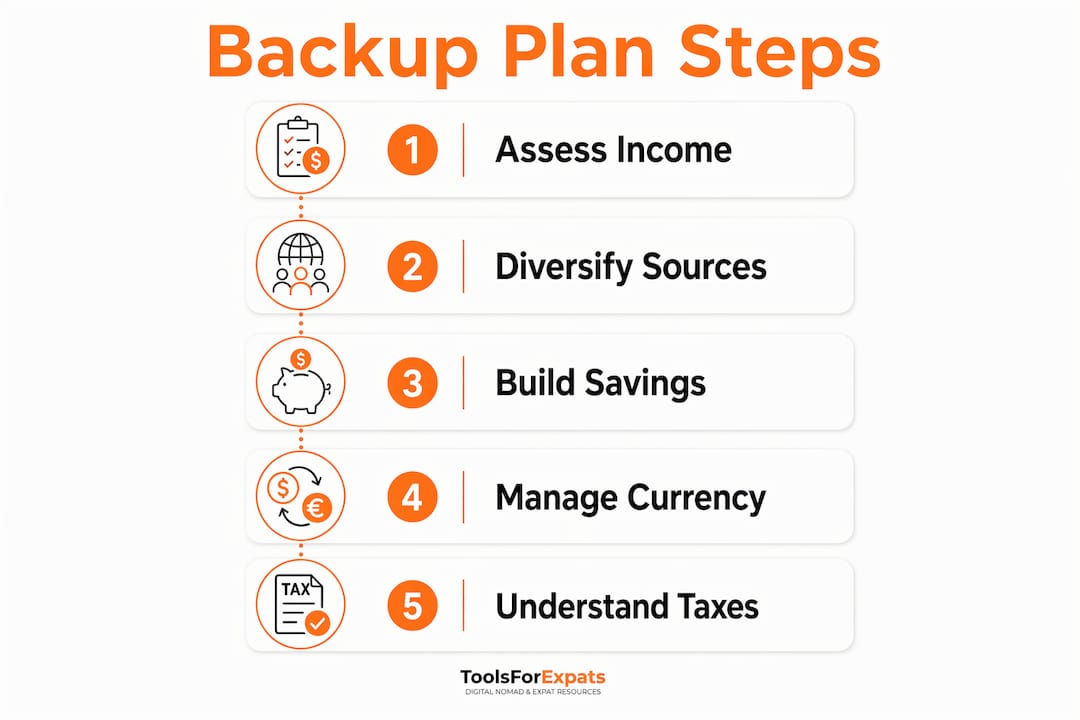
The first step in any digital nomad income strategy is measuring how concentrated your income actually is. Most nomads underestimate this. If 80% of your monthly revenue comes from one client, one platform, or one contract type, you do not have diversified income. You have one income source with a side project attached.
Start by listing every income source you had in the past six months and calculating what percentage each one contributed to your total earnings. Then ask one critical question for each source: what single event would eliminate it? A client going out of business, a platform changing its algorithm, a visa expiring, or a contract not renewing are all real failure triggers. If two of your income sources share the same failure trigger, they are not independent backups. They are the same risk wearing different labels.
Here are the key risk factors to evaluate for each income source:
- Client concentration: Does one client represent more than 40% of your income?
- Platform dependency: Are you reliant on a single marketplace like Upwork, Fiverr, or Toptal for lead generation?
- Contract type: Are all your contracts short-term project work with no retainer stability?
- Geography: Does your income depend on being in a specific country or timezone?
- Skill overlap: Do all your services draw from the same narrow skill set, making them vulnerable to the same market shift?
Once you map this out, you will likely find one or two clear concentration points. Those are your starting targets for building a backup. A simple spreadsheet updated monthly works well for tracking income composition over time. Tools like Google Sheets or Notion are sufficient for this purpose.
Pro Tip: Set a monthly calendar reminder to update your income composition tracker. Fifteen minutes of review each month gives you early warning before a concentration problem becomes a cash flow crisis.
What income streams actually reduce risk for nomads?
Income optionality requires that your secondary stream fails independently from your primary one. This is the distinction most freelancers miss. Adding a second writing client when you already have three writing clients is not diversification. It is more of the same risk. A genuine backup income stream operates in a different market, serves a different client type, or generates revenue through a completely different mechanism.
Here is a practical framework for building independent supplementary income as a nomad:
-
Start with skills you already have. The fastest path to a second income stream is monetizing something you do well but have not packaged for sale. A developer who writes internal documentation could sell technical writing services. A marketing consultant could create a paid course or template pack. No new skills required, just a new delivery format.
-
Apply the stacked lanes model. Keep a core retainer plus a smaller project pipeline running simultaneously. The retainer provides predictable monthly income. The project pipeline builds relationships and fills revenue gaps. Together, they create a more stable cash flow than either alone.
-
Build passive income where it makes sense. Digital products such as Notion templates, Gumroad guides, or Teachable courses generate revenue without active time investment once created. The upfront work is real, but the ongoing return is genuinely independent from your client work.
-
Own your channels. A newsletter, a personal website, or a LinkedIn audience you have built directly reduces your dependency on third-party platforms. If Upwork changes its fee structure or a platform shuts down, your owned audience stays with you.
-
Prepare a proof pack before you need it. A ready-to-sell proof pack includes your portfolio links, a clear service menu with pricing, and your payment terms. When income drops suddenly, you can send this to a new prospect within minutes rather than spending days assembling materials under pressure.
The value of a second income stream is highest when your primary income is still stable. Building under pressure produces rushed, underpriced work. Building from a position of stability lets you be selective and strategic.
Pro Tip: Commit to 5 to 10 hours per week on your secondary income stream while your primary income is healthy. That pace is sustainable and builds real momentum without burning you out.

You can also explore digital nomad networking as a direct pipeline for new income streams. Referrals from trusted peers in your network consistently outperform cold outreach for landing new clients quickly.
How much emergency cash do nomads actually need?
An emergency fund for a nomad is not the same as one for a salaried employee with fixed monthly expenses. Nomads typically need 6 to 12 months of essential expenses saved, compared to the standard 3 to 6 months recommended for people with stable employment. The difference accounts for income variability, unexpected travel costs, visa fees, and the higher cost of healthcare without employer coverage.
The table below shows how to calculate your personal emergency fund target:
| Expense category | Monthly estimate | 6-month target | 12-month target |
|---|---|---|---|
| Housing and accommodation | $1,200 | $7,200 | $14,400 |
| Food and daily living | $600 | $3,600 | $7,200 |
| Health insurance | $200 | $1,200 | $2,400 |
| Travel and transport | $300 | $1,800 | $3,600 |
| Software and tools | $100 | $600 | $1,200 |
| Total baseline | $2,400 | $14,400 | $28,800 |
These are illustrative figures. Your actual numbers will vary by location, lifestyle, and health needs. The point is to calculate your real baseline, not a rough guess.
Multi-currency management reduces the risk of exchange rate swings wiping out part of your buffer. Splitting savings across USD, EUR, and a local currency where you spend most of your time is a practical approach. Wise and Revolut both support multi-currency accounts with low conversion fees, making this straightforward to set up.
A staged savings approach works well for building the buffer without disrupting your current cash flow. Start by targeting one month of expenses saved, then extend to three, then six. Each stage gives you a meaningful safety net while the next stage is being built. This staged method lets you absorb short-term income shocks without sacrificing longer-term financial goals.
Pro Tip: Automate a savings transfer on the same day you receive client payments. Even 10% of each payment directed to a separate account builds your buffer steadily without requiring willpower.
For a detailed look at how your budget compares across different cities, the nomad budget breakdown at ToolsForExpats is a practical starting point.
What tax rules apply to nomad backup income in 2026?
Tax compliance is a direct component of financial stability for nomads. Ignoring it does not make the obligation disappear. It creates penalties that drain the buffer you worked to build.
The key 2026 tax rules every nomad with backup income should know:
- Estimated tax payments: Remote workers owing $1,000 or more in federal income tax after withholding and credits must make quarterly estimated payments using IRS Form 1040-ES. Missing these payments triggers an underpayment penalty, even if you pay in full at year-end.
- Safe harbor rules: To avoid underpayment penalties in 2026, you must pay either 90% of your current year tax liability or 100% of your prior year liability, whichever is smaller. If your prior year adjusted gross income exceeded $150,000, the threshold rises to 110% of the prior year amount.
- Backup withholding threshold: The backup withholding threshold for contractors increased to $2,000 in 2026, up from the previous $600 threshold. Backup withholding applies at a 24% rate once cumulative payments from a single payer reach that amount without a valid W-9 on file.
- W-9 documentation: Collect a completed W-9 from any contractor you pay, and submit your own W-9 to any client paying you. Missing documentation triggers automatic 24% withholding on your payments.
- Annualized income installment method: If your income is uneven across quarters, IRS Form 2210 with Schedule AI lets you calculate estimated payments based on actual income earned each period rather than equal quarterly installments. This prevents overpaying in low-income quarters.
Understanding your tax residency status directly affects which rules apply to your backup income. Nomads who split time across multiple countries often have complex residency situations that change their filing obligations significantly.
Key takeaways
A reliable nomad income backup plan requires independent income streams, a properly sized emergency fund, and proactive tax compliance working together as a system.
| Point | Details |
|---|---|
| Measure income concentration | Calculate each source as a percentage of total income and identify shared failure triggers. |
| Build truly independent streams | Secondary income must fail independently from your primary source, not just differ in label. |
| Size your emergency fund correctly | Nomads need 6 to 12 months of essential expenses saved, not the standard 3 to 6 months. |
| Prepare a proof pack in advance | Portfolio links, service menu, and payment terms ready to send reduce recovery time after income loss. |
| Stay current on 2026 tax rules | Quarterly estimated payments and proper W-9 documentation prevent penalties that erode your financial buffer. |
Why I think most nomads build their backup plan backwards
When I started building a secondary income stream, I made the same mistake most people do. I waited until my primary income felt shaky before taking it seriously. By then, I was building under pressure, accepting lower rates than I should have, and rushing through client onboarding that deserved more care. The result was a backup that technically existed but was not strong enough to actually carry me.
The lesson I took from that experience is simple: the best time to build a backup is when you do not need one. When your primary income is stable, you have the patience to be selective, the time to build a proof pack properly, and the confidence to price your work correctly. That window is the one most nomads waste.
I also learned that tax compliance is not a separate topic from income planning. It is part of the same system. One year of missed estimated payments cost me more in penalties than I had saved in two months of disciplined budgeting. Keeping a simple record of quarterly income and setting aside 25 to 30% for taxes from every payment is not glamorous, but it protects everything else you are building.
The emergency fund piece took me the longest to get right. I kept treating it as a goal to reach rather than a system to maintain. Once I automated a fixed transfer on every payment receipt day, the buffer grew without me having to think about it. That shift from willpower to automation made the biggest practical difference.
— Ceyhun
Plan your nomad finances with free tools from ToolsForExpats
Building a solid financial safety net for travelers starts with knowing your real numbers, and that means understanding what your expenses actually look like across different countries and cities.
ToolsForExpats offers a full suite of free nomad calculators designed specifically for expats and digital nomads. Use the cost of living comparison tool to see how your emergency fund target changes when you move between locations, or run your numbers through the nomad cost calculator to build a city-specific budget. If you are aligning your income strategy with visa timelines, the visa eligibility checker covers more than 20 countries and requires no account to use. Every tool is free, fast, and built for the way nomads actually live and plan.
FAQ
What is a nomad income backup plan?
A nomad income backup plan is a structured financial strategy combining at least one independent secondary income stream with a liquid emergency fund sized for variable income. The goal is to maintain financial stability when any single income source fails.
How many income streams do nomads need for real security?
Two genuinely independent income streams plus a 6 to 12 month emergency fund provides meaningful security for most nomads. The streams must have different failure triggers, not just different client names or platforms.
How do I avoid underpayment penalties on backup income in 2026?
Pay either 90% of your current year tax liability or 100% of your prior year liability in quarterly estimated payments using IRS Form 1040-ES. If your prior year income exceeded $150,000, the safe harbor threshold rises to 110%.
What is a proof pack and why does it matter?
A proof pack is a ready-to-send document set including your portfolio, service menu, and payment terms. Having it prepared before you need it means you can approach new clients immediately after income loss rather than spending days assembling materials under pressure.
How should nomads handle multi-currency emergency funds?
Split savings across two or three currencies that match where you earn and spend most. Services like Wise or Revolut make this practical with low conversion fees, reducing the risk that exchange rate shifts quietly erode your buffer.