
Most digital nomads discover the hard way that freedom and balance are not the same thing. You can work from a beach in Thailand or a café in Lisbon and still feel completely burned out by Thursday. If you want to maintain work life balance nomadically, the answer is not more willpower. It is better systems. This guide walks you through the exact frameworks, routines, and boundary strategies that help you protect your personal time without sacrificing your income or your adventures.
Table of Contents
- Key takeaways
- Setting up your nomadic lifestyle for balance
- Building time-zone adaptive daily routines
- Physical and digital boundary architecture
- Maintaining wellbeing and social connection
- Troubleshooting common balance challenges
- My honest take on nomadic work-life balance
- Tools to support your nomadic balance
- FAQ
Key takeaways
| Point | Details |
|---|---|
| Routines beat freedom | Balance is built through routines that protect focus and recovery, not by assuming freedom creates balance automatically. |
| Slow travel stabilizes everything | Staying 4 to 8 weeks per location reduces transit stress and gives your routines time to take hold. |
| Boundaries need architecture | Spatial, temporal, and digital separation are the three pillars that prevent work from bleeding into your personal time. |
| Financial clarity reduces stress | Knowing your monthly costs removes a major source of anxiety that quietly erodes balance. |
| Shutdown rituals close the loop | A 10-minute end-of-day ritual stops work from following you mentally into your evenings. |
Setting up your nomadic lifestyle for balance
Before any routine or boundary strategy will work, you need the right foundation. Most digital nomad work life balance advice skips this step entirely and jumps straight to productivity hacks. That is a mistake.
Choose your environment deliberately
The single biggest lever you have is where you choose to work and live. Slow travel, staying 4 to 8 weeks per location, dramatically reduces the mental overhead of constant transitions. When you are not packing every week, your routines stabilize. Your sleep improves. Your work output gets more consistent.
Coworking spaces are worth the cost, even if you have a decent setup at your accommodation. They create a physical separation between work and rest that a shared apartment or hotel room simply cannot replicate. Many nomads underestimate how much their productivity and mental health improve once they stop working from their bed.
Pro Tip: When you arrive in a new city, spend your first day scouting two or three coworking spaces or cafés with reliable Wi-Fi before committing to one. Having a backup location prevents a single connectivity issue from derailing your entire week.
Financial planning as a balance tool
Financial stress is one of the most overlooked threats to work life harmony for digital nomads. When you are anxious about money, you take on too much work, skip recovery time, and lose the ability to say no. Getting clear on your actual monthly costs removes that pressure.
Digital nomad hubs typically cost between $1,000 and $1,800 monthly for a comfortable lifestyle, with significant variation by region. Using a nomad cost calculator before you commit to a destination helps you set realistic income targets and avoid the trap of working constantly just to cover an unexpectedly expensive city.
Visa planning matters too. Some countries offer flexible work arrangements for nomads through dedicated visa programs. Montenegro's digital nomad visa, for example, allows up to two years of residency with a renewal option after a six-month gap. Knowing your legal status in advance removes a major background stressor that quietly drains mental energy.
Building time-zone adaptive daily routines
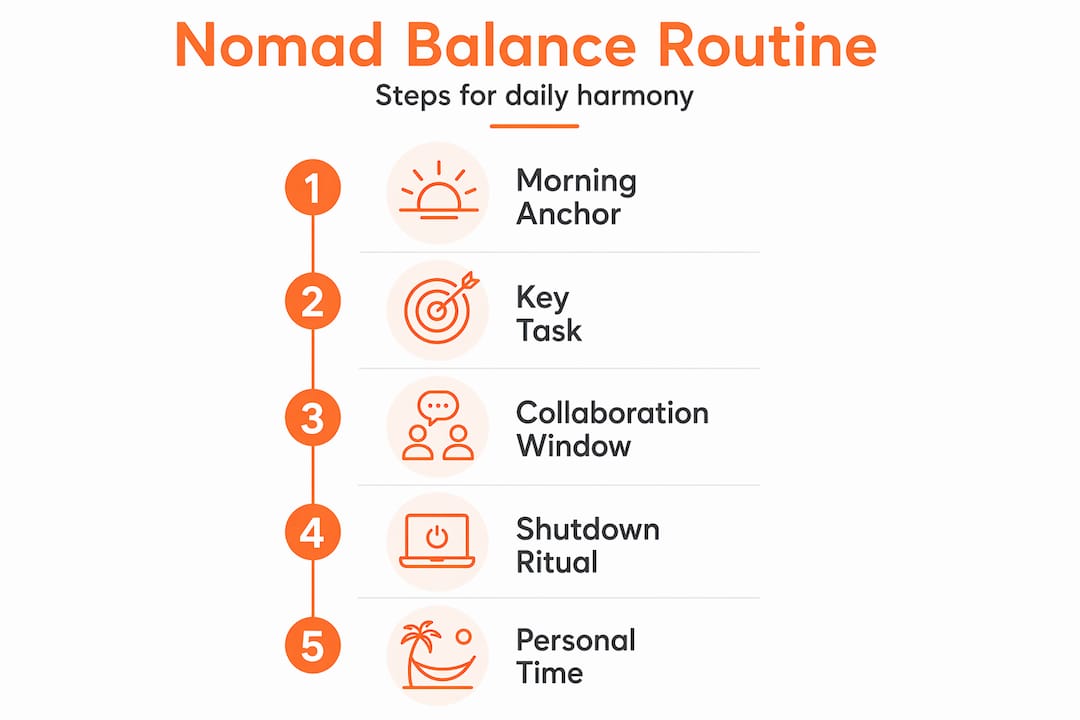
Here is the core insight most nomads miss: successful nomads maintain routine functions rather than fixed clock times. Your morning anchor, your deep work block, your shutdown ritual — these should happen in the same sequence every day, even if the clock says something different after a time zone shift.
Follow this sequence to build a time-zone adaptive daily structure:
-
Morning anchor (30 minutes). Start every workday with the same two or three activities in the same order. This could be coffee, a short walk, and a five-minute task review. The specifics matter less than the consistency. Your brain learns to shift into work mode through the ritual, not the clock.
-
Priority planning (15 minutes). Before opening email or Slack, write down your top three outcomes for the day. This protects your attention from being hijacked by other people's urgencies the moment you start work.
-
Deep work block (90 minutes minimum). A 90-minute deep work block is the minimum threshold for meaningful progress on complex tasks. Schedule this block when your energy is highest, typically in the first half of your workday, and protect it from meetings and messages.
-
Communication window (60 to 90 minutes). Batch all your messages, calls, and collaborative work into a defined window. Remote-first teams use core collaboration hours to protect the majority of the day for focused work. You can apply the same logic independently.
-
Shutdown ritual (10 minutes). Write tomorrow's top three tasks, close all tabs, and physically put your laptop away. Consistent shutdown rituals reduce evening mental rumination by closing the cognitive loop on unfinished work.
On travel days, simplify this structure rather than abandon it. Do your morning anchor, complete one meaningful task, and give yourself permission to treat the rest of the day as transitional. Trying to maintain full productivity on a travel day is how you arrive at your next destination already depleted.
Pro Tip: Use a time zone overlap calculator to identify your true collaboration windows with clients or teammates. Knowing exactly when you need to be available makes it much easier to protect the rest of your day for focused work and personal time.
Physical and digital boundary architecture
The Boundary Architecture Method organizes your separation strategies into three categories: spatial, temporal, and digital. Each one addresses a different way that work bleeds into personal life on the road.
Spatial boundaries are about your physical environment. Packing away your work gear after hours creates a psychological signal that the workday is over. If your laptop is visible on the desk, your brain stays partially in work mode. Put it in your bag. Close the bag. That simple act works better than most people expect.

Temporal boundaries are about your schedule. Set specific start and end times for your workday and treat them like appointments with a client you cannot cancel. When you manage work while traveling, the temptation to "just check one more thing" after hours is constant. A hard stop time, paired with your shutdown ritual, is what prevents that creep.
Digital boundaries are where most nomads struggle most. Here is a practical approach:
- Turn off all work notifications after your shutdown ritual.
- Use separate browser profiles for work and personal browsing.
- Set your work communication apps to do-not-disturb outside your communication window.
- Keep work email off your personal phone if possible.
Pro Tip: Offline-first workflows protect your productivity and your peace of mind. Store key documents in local markdown files, use offline-capable task managers, and do not let Wi-Fi variability become a source of daily anxiety. Build your system to function without a connection, and treat the internet as a bonus.
Maintaining wellbeing and social connection
Sustainable digital nomad work life balance requires more than good scheduling. Your body and social life need the same intentional attention you give your calendar.
- Micro-breaks every 60 to 90 minutes. Stand up, move around, look at something 20 feet away. These breaks are not wasted time. They restore the mental clarity that keeps your afternoon as productive as your morning.
- Real meal rituals. Eating at your desk while working is one of the fastest ways to blur the line between work time and personal time. Sit away from your screen for at least one meal per day. Treat it as a genuine break, not a multitasking opportunity.
- Scheduled movement. Block 30 to 45 minutes of physical activity into your calendar the same way you block a client call. Morning walks, gym sessions, or a swim at a local pool all count. Movement is one of the most effective tools for managing stress and maintaining energy across time zones.
- Proactive social scheduling. Isolation is a real risk when you are balancing travel and work. Schedule video calls with friends or family at least twice a week. Join local expat meetups or coworking events. Social connection does not happen automatically on the road. You have to plan for it.
Pro Tip: Sleep is your most underrated productivity tool when crossing time zones. Avoid screens for 30 minutes before bed, keep your sleep schedule consistent within a one-hour window even after flights, and use blackout curtains or a sleep mask in unfamiliar accommodations. Good sleep makes every other balance strategy work better.
Troubleshooting common balance challenges
Even with solid systems in place, you will hit rough patches. Knowing how to identify and respond to them is what separates nomads who sustain balance long-term from those who burn out within six months.
Watch for these signs that your work-life balance is slipping:
- You feel guilty taking time off, even on weekends.
- Your workday regularly extends two or more hours past your planned end time.
- You have stopped doing activities you used to enjoy in new cities.
- You feel constantly tired despite getting enough sleep.
When you notice these signs, the goal is gentle recalibration, not a complete overhaul. Adjust one variable at a time. Tighten your shutdown ritual. Reduce your communication window. Take one afternoon off without conditions.
| Challenge | Quick fix | Long-term solution |
|---|---|---|
| Work creep past end time | Set a phone alarm as a hard stop | Redesign your task list to fit actual work hours |
| Isolation and loneliness | Join one local event this week | Build regular social commitments into your calendar |
| Productivity loss on travel days | Reduce expectations, do one task | Plan simpler work on known travel days |
| Burnout from overcommitment | Take one full day off immediately | Audit your client load and set firmer boundaries |
Do a quarterly review of your balance systems. Ask yourself what is working, what has slipped, and what one change would have the biggest positive impact. This review habit is what keeps your approach adaptive rather than rigid.
My honest take on nomadic work-life balance
I have watched a lot of people start the nomadic lifestyle convinced that the freedom itself would solve their balance problems. It almost never does. In my experience, the nomads who thrive long-term are the ones who treat their routines with the same seriousness they treat their travel plans.
What I have learned is that the real enemy of balance is not overwork. It is the absence of clear transitions. When you do not have a commute to mark the beginning and end of your workday, you have to manufacture those transitions deliberately. The shutdown ritual, the physical separation of work gear, the morning anchor — these are not productivity tricks. They are psychological infrastructure.
I also think slow travel is dramatically underrated as a balance strategy. Treating travel and work with equal seriousness means giving yourself enough time in each place to actually settle in, build a routine, and experience the city as a resident rather than a tourist. That is where the nomadic lifestyle actually becomes sustainable. Hopping cities every week sounds exciting until you realize you have not had a single normal week in three months.
The best advice I can offer is this: design your life first, then fit your work into it. Not the other way around.
— Ceyhun
Tools to support your nomadic balance
Planning the practical side of nomadic life well is one of the most effective things you can do to protect your work-life balance. When your finances, visa situation, and city choice are sorted, you free up enormous mental energy for the things that actually matter.
ToolsForExpats offers a free suite of tools built specifically for this. Use the nomad city quiz to find destinations that match your work-life priorities, from cost of living to internet quality. Check your visa eligibility across 20+ countries before you commit to a move. And use the cost comparison tool to see exactly how your budget stretches in different cities. Everything on ToolsForExpats is free, requires no account, and takes minutes to use. Less guesswork means less stress, and less stress is the foundation of everything else.
FAQ
What is the biggest mistake nomads make with work-life balance?
The most common mistake is assuming that freedom automatically creates balance. Successful nomads build time-zone adaptive routines with consistent morning anchors, deep work blocks, and shutdown rituals rather than relying on willpower alone.
How long should I stay in one place to maintain balance?
Staying 4 to 8 weeks per location gives your routines time to stabilize and significantly reduces the mental fatigue that comes from constant transitions.
How do I stop work from taking over my evenings?
Use a consistent shutdown ritual of about 10 minutes at the end of each workday. Shutdown rituals reduce task rumination by closing the cognitive loop on unfinished work, making it much easier to mentally disconnect after hours.
What should I do when my schedule gets disrupted by travel?
Simplify your routine rather than abandon it. Complete your morning anchor and one meaningful task, then give yourself permission to treat the rest of the travel day as transitional. Trying to maintain full output on a travel day is a reliable path to arriving at your destination already exhausted.
How do I manage client communication across time zones?
Identify your true overlap hours using a time zone calculator, then batch all communication into a defined window. Intentional meeting scheduling protects the rest of your day for focused work and genuine personal time.