
Most people hear "nomad capitalist" and picture someone working from a beach while dodging taxes. That picture is wrong on almost every level. The what is nomad capitalist concept question deserves a real answer: it's a structured, legal framework for organizing your citizenship, residency, business, banking, and lifestyle across multiple countries to maximize personal freedom and financial efficiency. It has nothing to do with evasion and everything to do with deliberate, informed choices. This guide breaks down the origins, the mechanics, the real benefits, and the honest challenges so you can decide whether this path makes sense for you.
Table of Contents
- Key takeaways
- What is the nomad capitalist concept and where it came from
- Tax optimization strategies at the core
- Lifestyle and global citizenship benefits
- Practical challenges and what they actually cost
- How to get started as a nomad capitalist
- My honest take on where this is all heading
- Plan your global life with free tools from ToolsForExpats
- FAQ
Key takeaways
| Point | Details |
|---|---|
| Rooted in Flag Theory | Nomad Capitalism builds on a 1960s framework that separates citizenship, residency, and business across jurisdictions. |
| Legal tax optimization | The goal is to reduce tax liability through strategic residency, not to evade taxes illegally. |
| Substance matters now | Paper-only offshore setups no longer work; genuine physical presence and economic activity are required. |
| Costs are real | Professional advisory fees start around $10,000, and ongoing compliance adds to that figure. |
| No universal blueprint | Your passport, income type, and family situation all shape which strategy works best for you. |
What is the nomad capitalist concept and where it came from
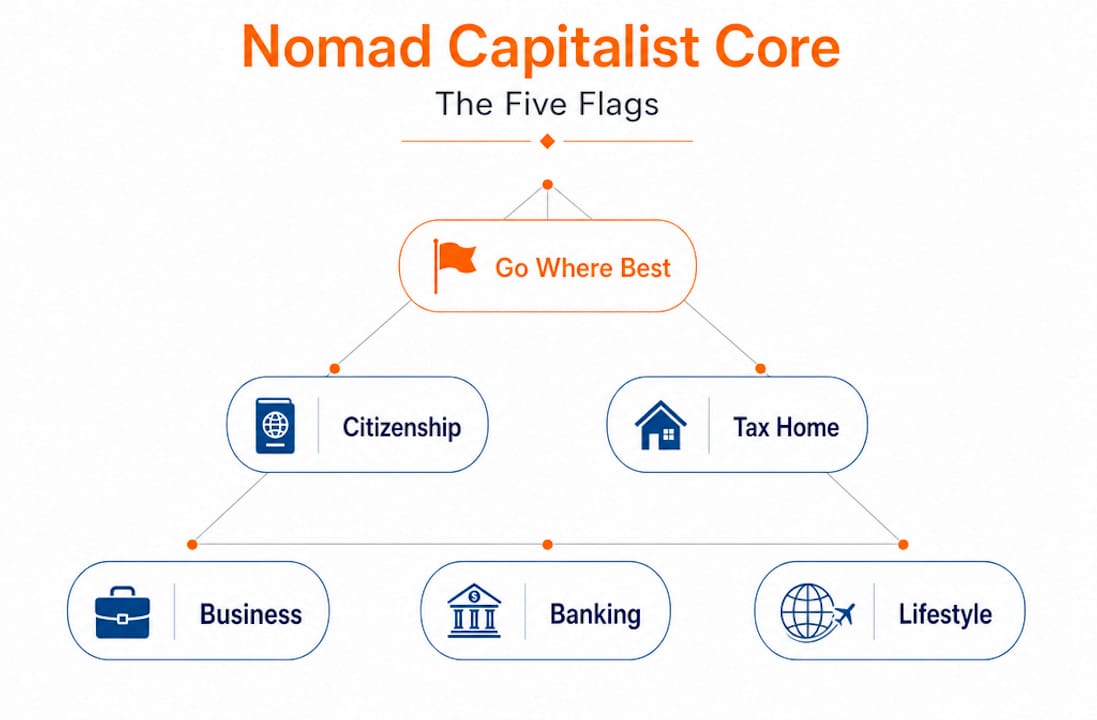
The nomad capitalist concept did not appear overnight. Its intellectual roots trace back to a framework called Flag Theory, developed by financial writer Harry Schultz in the 1960s. The core idea was radical for its time: instead of accepting one country's rules by accident of birth, you could plant legal flags across multiple jurisdictions to optimize each dimension of your life separately.
The original theory identified five flags:
- Citizenship from a country that does not tax you on worldwide income or that offers strong diplomatic protection.
- Tax residency in a jurisdiction with low or zero income tax on foreign-sourced earnings.
- Business incorporation where the regulatory and tax environment suits your industry.
- Asset custody in stable, privacy-respecting financial centers outside your home country.
- Lifestyle location where you actually want to live, eat, and raise a family.
The key insight is that these five flags do not have to belong to the same country. Most people accept that they do by default, never questioning whether the arrangement actually serves them. Nomad Capitalism asks you to question all of it.
The philosophy is often summarized as "go where you're treated best." That phrase sounds simple, but it represents a meaningful shift in thinking. Instead of loyalty to a single nation by obligation, you build a global structure based on deliberate choice. This is what separates Nomad Capitalism from plain digital nomadism. A digital nomad moves around for experience or cost savings. A nomad capitalist builds systems-driven sovereignty through legal and financial architecture that persists whether they're in Lisbon or Kuala Lumpur.
Pro Tip: When exploring Flag Theory, start by mapping which of your five flags currently causes the most friction, whether that's a high tax rate, a weak passport, or poor banking access. Fixing that one flag first typically delivers the biggest impact.
Tax optimization strategies at the core
Tax optimization is the most misunderstood part of nomad capitalism basics, and also the most consequential. To understand why it matters, you first need to know how different countries tax their citizens and residents.
Most countries use a residency-based tax system. Under this model, you pay taxes in the country where you live. Move to Portugal, establish genuine residency, and Portugal taxes your income. Leave, and that obligation largely ends.
The United States and Eritrea are the two notable exceptions. Both countries tax by citizenship, meaning an American living in Dubai still owes U.S. taxes on worldwide income regardless of where they live or earn. This single fact creates the biggest structural challenge for American nomad capitalists and is why U.S. citizens often face a harder path than European or Asian passport holders.
Here is a quick comparison of the two main tax frameworks:
| Tax system | Who it applies to | Key implication for nomad capitalists |
|---|---|---|
| Citizenship-based taxation | U.S. citizens, Eritrean citizens | Worldwide income taxed regardless of residency; renunciation sometimes considered |
| Residency-based taxation | Most countries | Tax obligations end or reduce once you establish residency elsewhere |
| Territorial taxation | Panama, Costa Rica, Hong Kong, others | Only local income taxed; foreign income often fully exempt |
Nomad capitalists who operate under residency-based systems can often reduce their tax burden dramatically by establishing legal residency in low-tax or territorial tax countries like Georgia, Paraguay, the UAE, or Malta. This is not a loophole. It is the legal operation of each country's domestic tax law.
Offshore companies and foreign bank accounts play a supporting role, but they are not a solution on their own. Since around 2018, genuine economic substance has been required to justify offshore structures. The OECD's Common Reporting Standard has made financial transparency the global norm, meaning banks and governments now share account information automatically. A shell company with no real activity will not hold up under scrutiny.
Pro Tip: If you're considering a tax residency change, count your actual days carefully. Many countries use the 183-day rule combined with additional tests like "center of vital interests" to determine residency. Spending 182 days somewhere does not automatically protect you if your family, home, and business ties remain elsewhere.
Lifestyle and global citizenship benefits
Beyond the tax math, the nomad capitalist lifestyle explained in full involves meaningful improvements to how you experience daily life and how protected you are against political or economic disruptions.
Second citizenship is one of the most sought-after elements of the strategy. Here is what it actually provides:
- Visa-free travel to a broader range of countries, reducing friction for business and personal movement.
- An insurance policy against instability in your home country. Many nomad capitalists pursue dual citizenship precisely because of what it protects against, not just what it enables.
- Access to better banking and investment options that are restricted to citizens of certain countries.
- Residency rights in blocs like the European Union, which offers freedom of movement across dozens of countries for citizens of any EU member state.
Passport strength matters enormously here. Not all passports offer equal access, and visa rules directly affect how practical the nomad capitalist lifestyle is to maintain. Someone with a strong EU passport and someone with a passport from a developing country face completely different levels of friction when attempting the same strategy.
The lifestyle dimension also means choosing where to live based on what you actually value: climate, culture, healthcare quality, cost, and community. Many nomad capitalists spend extended periods in their chosen residency country rather than constantly hopping between destinations. This matters both for legal compliance and for personal wellbeing. The shift from reactive traveler to proactive global citizen is one the most experienced practitioners in this space consistently describe as the turning point in their planning.

Practical challenges and what they actually cost
Understanding nomad capitalists means being honest about the friction involved. The strategy works, but it is not cheap, simple, or static.
Here are the real challenges you should plan for before getting started:
- Professional fees are significant. Comprehensive advisory plans from specialized consultancies typically start around $10,000, and that figure does not include ongoing accounting, legal compliance, or renewal costs across multiple jurisdictions.
- Regulations keep changing. What worked in 2015 often does not work in 2026. Jurisdictions shift their rules, remove favorable programs, or increase substance requirements with little notice. Nomad Capitalism requires continuous adaptation, not a one-time setup.
- Substance requirements are now strictly enforced. After the OECD's transparency push, simply registering a company abroad is no longer sufficient. You need real business activity, local directors, or genuine operational presence to justify the structure.
- Privilege is a real variable. Your passport strength, income level, and nationality dramatically affect which strategies are open to you. The same plan that works cleanly for a German entrepreneur may be legally complex or costly for a Nigerian or Indian passport holder.
- Family situations add complexity. Spouses, children, and aging parents all affect where you can realistically plant your flags, and ignoring these factors leads to plans that look good on paper but fall apart in practice.
Pro Tip: Before paying for any advisory service, organize your full financial picture first. Know your income sources, your current tax exposure, and your passport options. Advisors can help you optimize an existing picture, but they cannot build a strategy from vague information.
How to get started as a nomad capitalist
Getting started does not require moving immediately or setting up offshore companies on day one. It requires a clear framework and honest self-assessment. Here is a practical sequence to follow:
- Audit your current situation. List your citizenship, current tax residency, income sources, and existing business structures. Identify which jurisdiction creates the most friction today.
- Establish your priorities. For most people, tax residency change delivers the most immediate benefit. For others, a second passport or stronger banking access is the urgent need. Rank your flags.
- Research destination countries. Use a visa eligibility checker to understand which countries offer residency or digital nomad visa programs suited to your income and nationality. Compare cost of living using a city cost calculator to stress-test your budget assumptions.
- Find qualified, specialized advisors. General accountants and immigration lawyers often lack the cross-jurisdictional knowledge this strategy requires. Seek professionals who specialize in international tax and multi-citizenship planning.
- Build a staged mobility plan. You do not need all five flags set up at once. Start with the one or two changes that address your biggest current problem, then build from there over one to three years.
- Review and update regularly. Tax treaties change, visa programs come and go, and your personal situation evolves. Schedule an annual review with your advisors to keep your structure current and compliant.
The individual circumstances that shape the best configuration vary widely. Income type, family structure, risk tolerance, and existing passport all matter. There is no universal answer, which is exactly why the staged approach works better than trying to optimize everything at once.
My honest take on where this is all heading
I've spent years watching how people approach global mobility, and what I've noticed is that the most successful nomad capitalists are not the ones who obsess over hacks. They're the ones who treat their global structure like a long-term business plan.
What I've learned is that the backlash against unstructured nomadism is actually healthy. People burning through visa runs, living in short-term rentals with no legal footing, and convincing themselves that perpetual travel is a tax strategy ended up exhausted, non-compliant, or both. The shift toward genuine residency, real substance, and deliberate planning is making the whole space more credible.
My honest concern is that a lot of content online frames Nomad Capitalism as accessible to anyone with a laptop. In reality, passport strength and income scale are critical factors, and glossing over them does readers a disservice. If you hold a weak passport or earn below a threshold where advisory fees make financial sense, the strategy looks very different than it does for a high-earning entrepreneur with an EU or US passport.
That said, I think freedom and structure are genuinely compatible. The nomad capitalist mindset, applied honestly and with professional support, creates a life where you're making deliberate choices rather than accepting defaults. That shift in perspective alone has real value, regardless of how many flags you end up planting.
— Ceyhun
Plan your global life with free tools from ToolsForExpats
If reading this has you thinking seriously about your own global mobility strategy, the next step is getting clear on the numbers and the options before you spend a dollar on advisory fees.
ToolsForExpats offers a full suite of free expat tools designed specifically for this kind of planning. Use the city cost calculator to compare living costs across dozens of cities and test whether your income actually works in your target country. Check your eligibility across 20+ countries with the visa eligibility checker. Not sure which city suits your lifestyle priorities? The best nomad city quiz helps you match destination to your personal and professional needs. No account required, no cost, no catch.
FAQ
What is the nomad capitalist concept in simple terms?
The nomad capitalist concept is a legal strategy for structuring your citizenship, tax residency, business, banking, and lifestyle across multiple countries to maximize personal freedom and reduce tax liability. It is based on Flag Theory, which was formalized in the 1960s.
Is nomad capitalism legal?
Yes. Nomad Capitalism relies entirely on legal tax residency changes, legitimate business structures, and official citizenship or residency programs. It is distinct from tax evasion, which is illegal. Proper legal and tax counsel is required to stay compliant as regulations evolve.
How much does it cost to implement a nomad capitalist strategy?
Professional advisory services for a full nomad capitalist plan typically start around $10,000, not including ongoing compliance costs. Budget planning and visa research tools, like those at ToolsForExpats, are free and useful for early-stage planning.
Does nomad capitalism work for Americans?
It is more complex for Americans because the U.S. uses citizenship-based taxation, meaning U.S. citizens owe federal taxes on worldwide income regardless of where they live. Strategies still exist, including foreign earned income exclusions and tax treaty benefits, but renunciation of citizenship is sometimes considered by those seeking a complete exit.
What countries are popular for nomad capitalist tax residency?
Popular choices include Georgia (flat 1% tax on small business income), Paraguay (territorial tax system), the UAE (zero personal income tax), Malta (favorable non-domiciled resident programs), and Panama (territorial taxation). The best option depends entirely on your nationality, income type, and lifestyle priorities.