Understanding how nomad communities form challenges nearly everything most people assume about mobile lifestyles. Nomads are not unorganized wanderers moving randomly across the earth. Whether you are studying the cooperative herding groups of Mongolia or the coworking villages of Madeira, the same truth holds: community formation among nomads is deliberate, structured, and deeply human. This article unpacks the social, cultural, and logistical mechanics behind forming nomadic groups, both ancient and modern, so you can understand what actually holds these communities together.
Table of Contents
- Key takeaways
- How nomad communities form: traditional roots
- Modern digital nomad communities
- Social dynamics and challenges in community formation
- Traditional vs. modern nomad communities compared
- Practical steps for joining or building a nomad community
- My take on autonomy and belonging in nomad life
- Plan your nomad life with the right tools
- FAQ
Key takeaways
| Point | Details |
|---|---|
| Kinship drives traditional formation | Traditional nomad groups form around family ties, shared labor, and cultural rules governing migration and resources. |
| Infrastructure accelerates modern bonding | Government-backed nomad villages with community managers dramatically speed up social integration for digital nomads. |
| Small groups build the deepest trust | Groups of 6 to 10 people, not large networks, consistently produce the strongest connections in both traditional and modern contexts. |
| Repeated contact is non-negotiable | Meaningful community requires frequent, low-stakes interaction, which nomads must actively create rather than stumble into. |
| Slower travel changes everything | Staying two to three months in one place produces significantly deeper relationships than moving every few weeks. |
How nomad communities form: traditional roots
The oldest nomad communities did not form by accident. They grew from necessity, specifically the need to survive in environments where no single family could manage alone.
Kinship as the foundation
In traditional pastoral societies, the basic building block is the family unit. Extended kinship ties then connect families into bands, clans, and eventually tribes. The Mongolian khot ail is one of the clearest examples of this process at work. These flexible groups consist of 2 to 10 families who cooperate on herding, seasonal migration, shearing, childcare, and food processing. They have operated this way since at least the 12th century. The group is not fixed forever. Families join or leave based on need, proximity, and relationship quality, which makes the structure resilient rather than rigid.
The Sámi reindeer herders of northern Scandinavia developed a parallel model called the siida, a small cooperative group managing shared grazing territories. Like the khot ail, the siida relies on informal agreements and personal trust rather than written contracts. Traditional nomadic groups across the world use communal resource management through cultural agreements rather than individual ownership, which means the community itself is the infrastructure.
Cultural rules as social glue
What keeps these groups functional over generations is not just shared work. It is shared rules. Migration timing, grazing rights, conflict resolution, and marriage customs all operate through cultural traditions that every member understands. These traditions reduce friction and allow rapid decision-making without formal governance. Historically, institutions like amanat allowed nomadic societies to preserve peace through flexible personal guarantees rather than rigid treaties, enabling fast adaptation when political or environmental conditions shifted.
Pro Tip: If you are researching traditional nomadic structures, focus on the labor-sharing arrangements rather than just migration patterns. The work cooperation is what actually holds the community together.
- Groups form around shared labor needs, not just shared geography
- Cultural rules replace formal governance in managing resources and conflict
- Membership is flexible, based on trust and mutual benefit
- Marriage ties extend community networks beyond immediate family
- Seasonal cycles create predictable moments of gathering and regrouping
Modern digital nomad communities
The origins of nomad communities in the digital age look very different on the surface. There are no herds to manage and no seasonal grazing routes to coordinate. But the underlying social mechanics are strikingly similar: people moving through the world need structured cooperation to avoid isolation.

The infrastructure problem
Digital nomads face a structural challenge that traditional nomads solved through kinship. When you arrive in a new city knowing no one, the default social environment offers almost nothing. Cafes and coworking spaces provide proximity but not connection. Nomads must create and participate in regular events to generate the repeated interactions that real friendships require. Without that effort, you can spend months in a city and still feel completely alone.
This is exactly the problem that government-backed nomad villages are designed to solve. Madeira's digital nomad village hosts 80 to 100 nomads at any given time, with a Facebook community exceeding 3,000 members. The village employs community managers whose entire job is organizing events, facilitating introductions, and making sure newcomers feel included from day one. That structural advantage removes the exhausting burden of social organizing from the individual.
Hybrid governance and settled nomadism
One of the more interesting developments in modern nomad lifestyle dynamics is what researchers call "settled nomadism." This model blends mobile living with hybrid governance, where temporary residents participate in community leadership alongside permanent local leaders. Rather than creating a segregated expat bubble, the model integrates nomads into the social fabric of a place. You get the freedom of mobility without the social cost of being permanently on the outside looking in.
Pro Tip: When evaluating a destination for community potential, check whether it has a dedicated community manager or organized nomad program. That single factor predicts your integration speed better than almost anything else.
- Coworking spaces provide proximity but need programming to create real connection
- Community managers are the single biggest accelerant for nomad social integration
- Government-backed programs signal long-term infrastructure commitment
- Online groups supplement in-person community but cannot replace it
- Hybrid governance models reduce the expat bubble effect significantly
Social dynamics and challenges in community formation
Understanding what creates nomadic communities also means understanding what tears them apart. The social dynamics of nomad life are genuinely different from settled life, and pretending otherwise leads to frustration.
The frequency problem
In a settled neighborhood, you run into the same people at the coffee shop, the gym, and the grocery store without planning any of it. Those low-stakes, repeated encounters are the raw material of friendship. Nomads lack this structural advantage, which means every social connection requires deliberate effort. The result is a paradox: nomads often have hundreds of acquaintances across dozens of countries but struggle to find someone to call in a crisis.
The emotional cost of this reality is real. Constant departure creates a kind of guardedness. You start to wonder whether investing in a new friendship makes sense when you will both be gone in three weeks. That guardedness, left unchecked, produces exactly the isolation you were trying to escape.
Here are four strategies that actually work for building community in nomad settings:
- Stay longer. Two to three months in one place produces dramatically deeper relationships than two to three weeks. Familiarity and trust need time to develop.
- Return to the same places. Revisiting a city or coworking space where you already have weak ties converts those weak ties into real friendships faster than starting fresh somewhere new.
- Become the organizer. Hosting a weekly dinner, a language exchange, or a group hike puts you at the center of social gravity. You stop waiting for community to find you.
- Build both local and nomad friendships. Local friendships provide stability and cultural depth. Nomad friendships provide understanding and shared context. You need both.
"The loneliness of nomad life is not about being alone. It is about being surrounded by people who are all about to leave, including yourself." This captures why intentional community building is not optional. It is the only thing that makes the lifestyle sustainable long-term.
Traditional vs. modern nomad communities compared
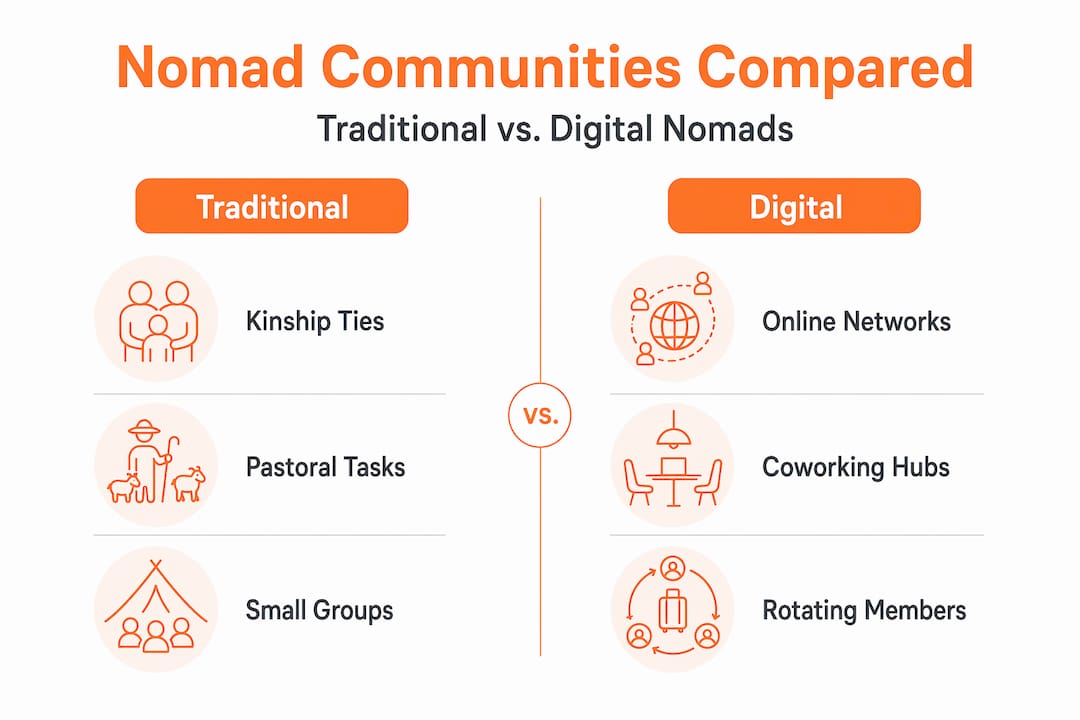
Seeing both models side by side clarifies the surprising continuities in how mobile societies develop across very different contexts.
| Feature | Traditional nomads | Modern digital nomads |
|---|---|---|
| Group size | 2 to 10 family units | 6 to 100 individuals |
| Social foundation | Kinship and marriage ties | Shared work and lifestyle |
| Governance | Cultural traditions and elder authority | Community managers and hybrid local integration |
| Resource sharing | Herds, labor, grazing land | Coworking spaces, event costs, knowledge |
| Migration pattern | Seasonal, ecologically driven | Preference-driven, visa-dependent |
| Community formation speed | Slow, generational | Fast with infrastructure, slow without it |
| Conflict resolution | Personal guarantees and cultural norms | Community guidelines and social pressure |
The most striking similarity is the role of small groups. Both traditional pastoral and digital nomad communities find that tight cohorts of 6 to 10 people produce the trust and connection that large anonymous networks cannot. The khot ail and the coworking cohort are solving the same human problem with culturally specific tools.
Practical steps for joining or building a nomad community
Whether you are drawn to the community building in nomad cultures out of curiosity or personal need, the path forward is clearer than it might seem.
- Choose destinations with existing infrastructure. Cities and villages with active nomad programs, coworking spaces, and community events give you a head start. Use the best nomad city quiz to match your priorities to the right destination.
- Commit to a minimum stay. Six weeks is the floor. Three months is where real community starts to form. Plan your budget accordingly using a cost of living calculator before you commit.
- Participate before you feel ready. Show up to the event before you know anyone. Introduce yourself before you feel comfortable. Community does not form while you wait for the right moment.
- Use digital platforms strategically. Facebook groups, Slack communities, and WhatsApp threads are tools for coordinating in-person interaction, not substitutes for it.
- Respect local culture. The most sustainable nomad communities integrate with local residents rather than existing parallel to them. Learn basic language, support local businesses, and participate in neighborhood life.
Pro Tip: Check your visa eligibility for your target destination early. A visa that only allows 30-day stays will undermine every community-building effort you make, no matter how intentional you are.
My take on autonomy and belonging in nomad life
I have spent years thinking about why so many people choose the nomad lifestyle and then quietly struggle with it. The answer almost always comes back to community. Or rather, the absence of it.
The misconception that nomads lack structure is not just wrong. It is the opposite of reality. The most successful nomadic communities I have observed, from Mongolian herding groups to Madeira's village model, are built on more deliberate social architecture than most settled neighborhoods ever achieve. The difference is that nomads cannot rely on proximity to do the work for them.
What I find genuinely moving about this history is the continuity. A Mongolian family joining a khot ail and a software developer joining a coworking village in Portugal are solving the same problem: how do you build trust and belonging when your life does not stay still? The answer, in both cases, involves small groups, shared labor or shared purpose, and repeated contact over time.
The emotional toll of constant mobility is real, and I think the nomad community often underestimates it. Hybrid models, slower travel rhythms, and intentional infrastructure are not compromises. They are the conditions that make the lifestyle actually work. If you are considering the nomad path, the question is not whether you can handle being alone. It is whether you are willing to do the work of building connection from scratch, repeatedly, in unfamiliar places. That is a different kind of courage than most people expect.
— Ceyhun
Plan your nomad life with the right tools
Building a meaningful nomad community starts before you book your flight. Knowing where to go, how long you can afford to stay, and whether your visa allows it are the logistical foundations that make everything else possible.
ToolsForExpats offers a free suite of calculators and tools designed specifically for digital nomads and expats making these decisions. You can check your visa eligibility across 20+ countries, calculate your cost of living for extended stays, and find destinations that match your community priorities. Every tool is free and requires no account. The loneliness risk calculator is particularly useful for nomads evaluating how their current travel pattern affects their social wellbeing. Head to ToolsForExpats and start planning a stay that actually gives community a chance to form.
FAQ
How do nomad communities form in traditional societies?
Traditional nomad communities form around kinship ties, shared labor, and cultural rules governing migration and resource use. Small family groups cooperate on tasks like herding and childcare, creating bonds that grow into larger clan and tribal structures over time.
What makes digital nomad communities different from traditional ones?
Digital nomad communities form through intentional infrastructure like coworking spaces and organized events rather than kinship. The social foundation is shared lifestyle and work rather than family ties, but the need for small, trust-based groups remains the same.
How long does it take to build real community as a nomad?
Staying two to three months in one location produces meaningfully deeper relationships than shorter stays. Repeated contact over time is the primary driver of real friendship, which means commitment to a place matters more than any single social event.
What role do community managers play in nomad villages?
Community managers organize events, facilitate introductions, and help newcomers integrate quickly. This removes the burden of social organizing from individuals and significantly accelerates the formation of genuine connections within the group.
Can you build community as a nomad without a formal village program?
Yes, but it requires more effort. Strategies include hosting regular gatherings, returning to familiar locations, staying longer in each place, and using online groups to coordinate in-person interaction rather than replace it.