
Most people assume the nomadic lifestyle is a bargain. Sell your stuff, buy a one-way ticket, and live like a king for $800 a month. The reality is messier. Understanding what a nomad budget breakdown actually looks like — across all expense categories, regions, and hidden costs — is the foundation of a financially stable life abroad. Skipping this step is exactly why so many nomads burn through their savings faster than expected. This article gives you the full picture so you can plan with confidence, not guesswork.
Table of Contents
- Key takeaways
- What is a nomad budget breakdown, really?
- How location changes everything
- Hidden costs that wreck nomad budgets
- How to actually manage your nomad budget
- Tools that make budget planning easier
- My take on the nomad budget reality
- Plan your budget with free nomad tools
- FAQ
Key takeaways
| Point | Details |
|---|---|
| Budget varies widely by region | A comfortable monthly budget ranges from $1,200 to $3,000+ depending on your location and lifestyle choices. |
| Six core categories drive most spending | Accommodation, food, workspace, transport, insurance, and discretionary costs account for nearly all nomad expenses. |
| Hidden costs catch most people off guard | Visa fees, legal costs, and the "social tax" from new-city spending can add hundreds to your monthly total. |
| Slow travel reduces overall costs | Staying in one place for three to six months lowers both flight expenses and accommodation costs significantly. |
| Build a financial runway before you go | A six-month emergency fund is the minimum buffer every nomad should have before leaving home. |
What is a nomad budget breakdown, really?
A nomad budget breakdown is a structured look at every dollar you spend monthly while living abroad, organized by category. It goes far beyond just rent. Average comfortable budgets run from $1,200 to $3,000+ per month depending on region and lifestyle, and knowing how that money splits across categories is what separates people who thrive from people who panic at the end of each month.
Here are the core categories and their typical share of a nomad budget:
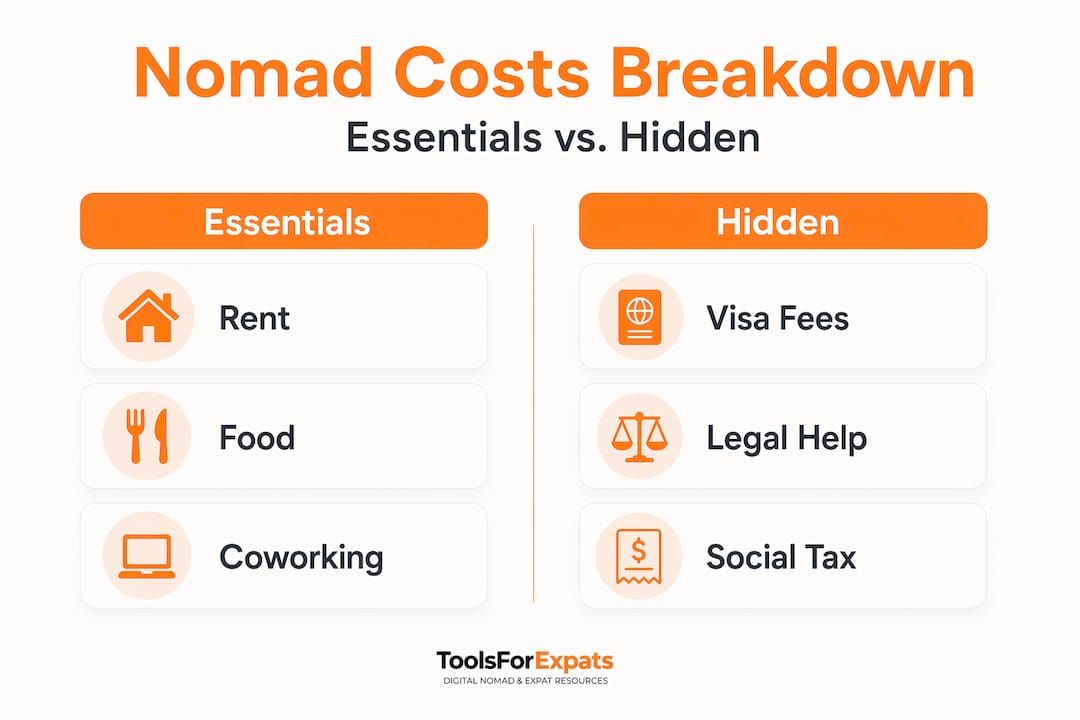
- Accommodation (30–45%): Your single largest expense. This includes short-term rentals, guesthouses, co-living spaces, or month-to-month apartments. In Bali, you can find a private room for $190 to $380 monthly. In Lisbon or Barcelona, expect two to three times that.
- Food and dining (15–25%): The gap between cooking and eating out is enormous. Street food in Chiang Mai can cost $2 per meal. A trendy café meal in the same city runs $15 or more. Cooking half your meals at home is one of the fastest ways to cut this category.
- Workspace and internet (5–10%): Coworking memberships typically run $80 to $200 per month. If you work from cafés, budget for daily purchases plus occasional coworking day passes. Reliable high-speed internet is non-negotiable for most nomads.
- Transportation (5–10%): Local transport like motorbikes, tuk-tuks, buses, and metro cards is usually cheap. Flights between destinations are where this category spikes hard.
- Health and travel insurance (3–5%): This is not optional. According to detailed annual spending reports, health spending accounts for about 20% of total nomad expenditure when you include wellness and medical costs. A basic international health policy runs $50 to $150 per month depending on age and coverage.
- Discretionary and emergency funds (15–25%): Entertainment, day trips, new gear, and unexpected expenses fall here. Under-budgeting this category is one of the most common mistakes nomads make.
Pro Tip: Set your discretionary budget based on your destination, not your home country habits. New environments spark new spending. Budget 20% above what you think you'll spend in your first month somewhere new.
How location changes everything
Your geographic choice is the single biggest lever in your nomadic lifestyle budget. The same quality of life costs drastically different amounts depending on where you are.
| Region | Accommodation/month | Food/month | Coworking/month | Total estimate |
|---|---|---|---|---|
| Southeast Asia (e.g., Bali, Chiang Mai) | $300–$600 | $200–$400 | $80–$150 | $1,200–$1,800 |
| Southern Europe (e.g., Lisbon, Valencia) | $700–$1,200 | $400–$700 | $120–$200 | $1,800–$2,800 |
| Latin America (e.g., Medellín, Mexico City) | $400–$800 | $250–$500 | $80–$180 | $1,400–$2,200 |
Spain illustrates this point sharply. Regional cost variation in Spain reaches 45% between cities, with monthly rentals ranging from €550 in smaller cities to €1,200 or more in Madrid or Barcelona. That is not a rounding error. It is the difference between a budget that works and one that quietly drains you.
Visa and residency costs also vary considerably by region. Spain's Digital Nomad Visa and Portugal's D8 Visa both require minimum monthly income proof and mandatory health insurance coverage, adding a layer of fixed costs that purely budget-focused nomads often overlook when choosing a base.
You can use the ToolsForExpats cost of living comparison tool to see how your target cities stack up before you commit to a destination.
Hidden costs that wreck nomad budgets
The myth of cheap nomadic life persists partly because people see the rent and ignore everything else. Here is what trips people up most often.
- Visa fees: Application costs range from $50 to $500 or more depending on the country. Some visas require legal assistance, which can add $500 to $1,500 in legal fees on top of the application itself.
- Frequent flights: Hopping cities every two weeks sounds exciting. It is also expensive. Rapid city-hopping can add $500 to $800 per month in flight costs alone. If you are doing this regularly, you are effectively spending an extra rent payment just on movement.
- The social tax: Every new city comes with a burst of curiosity spending. New restaurants, new experiences, new gear you convince yourself you need. This lifestyle inflation is real and budget-specific research shows it catches most nomads off guard.
- One-time relocation costs: Security deposits, initial setup purchases, SIM cards, adapter purchases, and storage for items left at home all add up. Nomads frequently underestimate these one-time fees, which can easily total $300 to $600 when entering a new country.
- Tax obligations: Comprehensive fiscal planning, including taxes and residency fees, is as important as managing daily costs. Many nomads discover their tax situation is complex only after they have already moved.
Pro Tip: Budget a dedicated "new destination" fund of $300 to $500 every time you move to a new country. Think of it as your setup fee. It removes the budget shock of arrival costs and keeps your regular monthly tracking clean.
How to actually manage your nomad budget
Good intentions without a system produce poor results. Here is a practical framework for managing digital nomad expenses over the long term.
-
Split your budget into fixed and variable layers. Your fixed layer includes accommodation, insurance, subscriptions, and any loan payments. Your variable layer covers food, transport, entertainment, and discretionary items. Tiered budgeting like this lets you adapt quickly when you move to a higher-cost region without losing track of your baseline.
-
Track every transaction, not just big ones. Daily coffee, co-working day passes, and convenience store purchases seem minor but compound fast. Use a dedicated expense tracking app and log entries same-day. Weekly reviews catch drift before it becomes a problem.
-
Build your financial runway before you leave. A six-month financial runway is the minimum. This is not an emergency fund in the traditional sense. It is your buffer against delayed client payments, unexpected medical costs, and the months when income dips while expenses do not.
-
Use travel rewards strategically. Signing up for airline and hotel loyalty programs, and paying expenses on travel reward credit cards, can meaningfully reduce flight and accommodation costs over time. This is not about gaming systems. It is about making predictable spending work harder for you.
-
Commit to slow travel. Staying three to six months per location is the single most effective cost-reduction strategy available to nomads. You unlock monthly rental discounts of 20 to 40%, reduce flight spending dramatically, and eliminate the constant setup costs of arrival.
-
Review your budget every month without exception. Comparing your plan to your actual spending reveals patterns. Maybe food is always over budget in beach towns. Maybe you spend almost nothing on transport in walkable cities. These patterns help you plan future destinations better.
Tools that make budget planning easier
Knowing the categories is only half the work. You need real, city-specific data to build a budget that reflects your actual destination, not a national average. A few categories of tools make this significantly easier.
- Cost of living calculators by city: These give you granular monthly estimates for accommodation, groceries, coworking, and transport in specific cities rather than broad regional guesses. The ToolsForExpats nomad cost calculator lets you pull these numbers by city before you commit.
- Moving and relocation budget planners: These help you estimate one-time setup costs on top of your monthly living expenses. The ToolsForExpats moving abroad budget calculator is built specifically for international moves and accounts for deposit, setup, and transition costs.
- Visa eligibility checkers: Knowing whether you qualify for a digital nomad visa in your target country is part of travel budget planning. Some visas carry mandatory insurance requirements or income thresholds that directly affect your budget structure.
- Destination matching quizzes: If you are flexible on location, tools that match your budget and lifestyle preferences to specific cities help you find places where your money genuinely goes further.
Using data-driven tools removes the guesswork that leads to budget miscalculations and lets you walk into a new destination with a realistic financial plan already built.
My take on the nomad budget reality
I have worked with hundreds of nomads and expats planning their finances abroad, and the single thing I see go wrong most consistently is the underestimation of complexity. Not just the cost, but the complexity.

A lot of people build their budget around rent and food and call it done. What I have learned is that the categories nobody plans for, including visa renewals, legal paperwork, spontaneous flights to avoid visa expiry, and the slow creep of lifestyle inflation, are what separate nomads who build real financial stability from those who are constantly scrambling.
The part that surprised me most early on was how much the "social tax" compounds in high-turnover cities. Every new arrival triggers a fresh round of exploration spending. When I started treating this as a budget line item instead of pretending it would not happen, my monthly tracking immediately became more honest and more useful.
Slow travel changed my outlook more than any tool or spreadsheet. Three months in one place teaches you where the cheap grocery stores are, which cafés have reliable WiFi, and which neighborhoods are overpriced. That knowledge is worth hundreds of dollars a month.
The most liberating financial decision I made was building a six-month runway before moving. Not because I needed it, but because it changed how I made decisions. You spend differently when you are not anxious about money. You negotiate better, you choose destinations based on value instead of desperation, and you actually enjoy the lifestyle you built all of this for.
— Ceyhun
Plan your budget with free nomad tools
If you have gotten this far, you already know that a solid nomad budget breakdown requires real data, not estimates pulled from outdated forum posts. ToolsForExpats was built specifically to give you that data for free, without needing to create an account.
Start with the nomad cost calculator to get city-specific monthly living cost estimates across accommodation, food, workspace, and transport. Then use the moving abroad budget calculator to factor in relocation and setup costs. If you are evaluating specific countries, the visa eligibility checker at ToolsForExpats covers 20+ countries and helps you understand income and insurance requirements before you apply. All tools at ToolsForExpats are free, fast, and ready to use right now.
FAQ
What does a typical digital nomad budget include?
A typical nomad budget covers accommodation, food, coworking and internet, transportation, health insurance, and discretionary spending. Hidden costs like visa fees and one-time relocation expenses should also be included.
How much money do you need to live as a digital nomad?
Most nomads need between $1,200 and $3,000 per month to live comfortably, depending on their region and lifestyle. Southeast Asia runs cheaper, while Southern Europe or Latin America in major cities costs significantly more.
What are the most overlooked costs in a nomad budget?
Visa application fees, legal assistance costs, and the "social tax" of increased spending in new cities are the most commonly missed items. Frequent flights from city-hopping can also add $500 to $800 per month unexpectedly.
How do you track digital nomad expenses effectively?
The most effective approach is to split your budget into fixed and variable layers, log every transaction daily, and review your actual versus planned spending every month without skipping.
Is slow travel actually cheaper for digital nomads?
Yes. Staying three to six months in one location reduces costs significantly through long-term rental discounts and fewer flights, making it the most practical strategy for nomads trying to stretch their budget.