
Nomad retirement planning is the process of building a financially portable, location-independent retirement strategy that sustains your lifestyle without a fixed home base. It combines income management, international healthcare coverage, tax optimization across multiple jurisdictions, and the flexibility to move between countries as your needs evolve. About 24% of Americans now desire this kind of retirement without a fixed location, and the infrastructure supporting it, from digital nomad visas to international brokerage accounts, has never been more accessible. Whether you are planning a full nomadic lifestyle retirement or a semi-nomadic model with a home base, the financial and legal groundwork looks very different from traditional retirement planning.
What is nomad retirement planning and its core financial components?
Nomad retirement planning treats your wealth as portable and untethered from any single country, which is the defining difference from conventional retirement strategies. Wealth must remain globally accessible to preserve long-term growth and avoid trapping capital in country-specific financial products. This means using internationally accessible brokerage accounts, such as those offered through Interactive Brokers or Charles Schwab's international division, rather than products tied to a single tax jurisdiction.
Your income sources in a nomadic retirement typically include portfolio withdrawals, Social Security benefits, and optional part-time consulting or freelancing. Blending part-time work with retirement reduces the pressure on portfolio withdrawals and extends the life of your savings significantly. This hybrid approach is especially common among the 11% of U.S. digital nomads aged 55 or older, who leverage deep professional expertise to generate income while traveling.

Budgeting for retirement on the move requires planning for variable costs that traditional retirees rarely face. Accommodation costs swing widely between destinations, visa fees recur regularly, and flights add up faster than most people estimate. Currency diversification, holding reserves in USD, EUR, and occasionally a local currency, protects your purchasing power when exchange rates shift against you.
Key financial building blocks for nomad retirement planning include:
- Globally accessible brokerage accounts that allow withdrawals and investments from any country
- Tax-advantaged accounts such as IRAs and Solo 401(k)s, managed with awareness of foreign tax implications
- An emergency fund covering six to twelve months of expenses, held in a liquid, internationally accessible account
- Flexible withdrawal strategies that adjust to your location's cost of living rather than a fixed monthly draw
- Currency reserves in at least two major currencies to reduce exchange rate exposure
Pro Tip: Open a Charles Schwab or Interactive Brokers account before you leave your home country. Both allow international withdrawals with low or no fees, and setting them up as a non-resident is significantly harder than doing so while still at a domestic address.
How does healthcare planning work for nomadic retirees?
Healthcare is the largest variable cost risk for nomads as they age, and it demands more planning than almost any other element of a nomadic lifestyle retirement. Traditional Medicare does not cover medical expenses outside the United States, which means U.S. retirees abroad must replace it entirely with private international coverage. This is not a gap you can patch with travel insurance. It requires a dedicated international health insurance policy.
International travel medical insurance costs approximately $150 per month for basic coverage, with comprehensive plans running considerably higher depending on your age and pre-existing conditions. That figure should be treated as a fixed line item in your retirement budget, not an optional expense. Plans from providers like Cigna Global, Allianz Care, and AXA PPP International offer varying levels of coverage, and comparing them annually is worth the time.
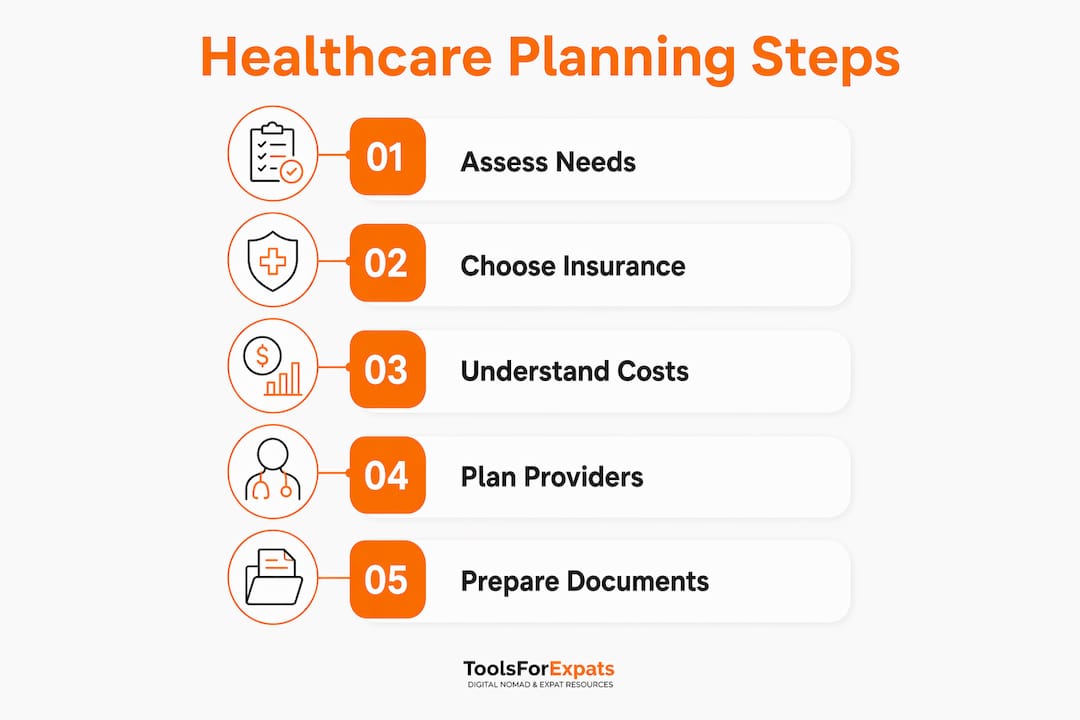
Long-term care is the healthcare challenge most nomadic retirees underestimate. Planning must include provisions for aging in place or assisted living as travel ability declines, according to Jill Fletcher of Cary Street Partners. Countries like Portugal, Thailand, and Mexico offer high-quality private healthcare at a fraction of U.S. costs, making them popular bases for semi-nomadic retirees who want predictable medical access.
Practical healthcare considerations for nomadic retirees:
- Review your international health plan annually as coverage needs change with age
- Choose destinations with strong private healthcare infrastructure, particularly for extended stays
- Maintain a dedicated health reserve fund separate from your emergency fund, sized to cover a major medical event
- Understand your plan's exclusions, especially around pre-existing conditions and emergency evacuation
- Research health insurance options specific to digital nomads and expat retirees before committing to a destination
Pro Tip: If you plan to spend significant time in one country, check whether you qualify for that country's national health system as a legal resident. Portugal's SNS and Spain's public health system, for example, are accessible to legal residents and can dramatically reduce your insurance costs.
What are the different nomadic retirement lifestyle models?
The two primary models for retirement planning for travelers are the full nomad and the semi-nomad, and they carry meaningfully different financial and logistical profiles. Understanding which model fits your life determines how you structure everything from your visa strategy to your healthcare coverage.
| Factor | Full nomad | Semi-nomad |
|---|---|---|
| Home base | None | Fixed base part of the year |
| Annual travel cost | Higher, frequent flights and accommodation changes | Lower, fewer moves and longer stays |
| Visa strategy | Visa runs, tourist stays, multiple short-term visas | Long-term residency visa or retirement visa |
| Healthcare access | International insurance only, variable quality | Combination of international insurance and local system |
| Typical profile | Retirees under 65, high energy, flexible | Retirees 60+, seeking community and stability |
| Financial complexity | High, constant currency and cost changes | Moderate, more predictable monthly expenses |
Nomadic retirement often combines optional part-time work, slower travel, and geographic arbitrage, which means living in lower-cost countries to stretch retirement savings further. A retiree spending $2,500 per month in Chiang Mai, Thailand, lives at a standard comparable to spending $5,000 or more in a U.S. city. That gap is the financial engine behind the nomadic retirement model.
The transition from full-nomad to semi-nomad is common as retirees age and prioritize community and healthcare stability over constant movement. Most people who start as full nomads settle into a semi-nomadic rhythm within three to five years, anchoring to one or two favorite locations while still traveling seasonally. Planning your finances to support both models from the start gives you the flexibility to make that shift without a financial disruption.
What tax and legal considerations matter for nomadic retirees?
Tax residency is the most legally complex aspect of nomad retirement planning, and getting it wrong is expensive. When you stop being a tax resident of your home country without establishing clear residency elsewhere, you can end up in a situation where multiple countries claim the right to tax your income. The U.S. taxes its citizens on worldwide income regardless of where they live, which makes tax residency planning a non-negotiable part of any American's nomadic retirement strategy.
Key tax and legal considerations include:
- Foreign Earned Income Exclusion (FEIE): Allows qualifying Americans abroad to exclude a portion of earned income from U.S. taxes, but it does not apply to investment income or Social Security
- Tax treaties: The U.S. has tax treaties with dozens of countries that can reduce or eliminate double taxation on specific income types; check treaty terms for your target destinations
- Exit tax risks: Renouncing U.S. citizenship or long-term permanent residency triggers an exit tax on unrealized gains above a threshold; consult a cross-border tax attorney before making this decision
- Offshore accounts and FBAR: Foreign bank accounts above $10,000 must be reported annually via FinCEN Form 114; failure to file carries severe penalties
- Country-specific investment products: Avoid locking retirement savings into country-specific pension or investment products that restrict access if you move. Globally accessible accounts prevent capital from becoming trapped
Common tax mistakes made by nomadic retirees include failing to track days spent in each country, missing FBAR deadlines, and assuming a tourist visa means no tax obligations. Hiring a cross-border tax specialist, such as those at Greenback Expat Tax Services or Bright!Tax, is one of the highest-return investments you can make in your nomadic retirement planning.
How to start nomad retirement planning and avoid common pitfalls
Starting your nomadic retirement plan begins with a clear picture of what you want your daily life to look like, not with spreadsheets. Once you have a lifestyle vision, the financial and logistical planning follows naturally from it.
- Define your lifestyle model. Decide whether you want full nomadic freedom or a semi-nomadic base. This single decision shapes your visa strategy, healthcare plan, and budget structure.
- Audit your current finances. Calculate your net worth, identify all income sources including Social Security projections, and determine your monthly withdrawal needs at different cost-of-living levels.
- Test destinations before committing. Spend 12 to 18 months in slow travel mode visiting candidate locations before buying property or establishing formal residency. Real spending and real climate always differ from what a spreadsheet predicts.
- Set up internationally portable finances. Open globally accessible brokerage and bank accounts, consolidate accounts where possible, and establish a multi-currency emergency fund.
- Secure international health insurance. Do this before you leave your home country, as some plans are easier to obtain while you still have a domestic address.
- Consult a cross-border tax professional. Get clarity on your tax residency obligations before your first full year abroad, not after.
Maintaining a fixed home in the U.S. adds hidden costs that can undermine the financial benefits of mobility. Redirecting those resources, property taxes, maintenance, and insurance, directly fuels your nomadic freedom. The most common pitfall is keeping a foot in both worlds financially without committing to either, which produces the costs of both without the full benefits of either.
Pro Tip: Use ToolsForExpats' nomad city quiz to shortlist retirement destinations before your test-drive period. It filters by cost of living, climate, healthcare quality, and visa accessibility, saving you months of manual research.
Key takeaways
Nomad retirement planning requires portable wealth, international healthcare coverage, and clear tax residency to sustain a location-independent lifestyle long-term.
| Point | Details |
|---|---|
| Define your lifestyle model | Choose full nomad or semi-nomad early, as this shapes every financial and legal decision. |
| Make wealth portable | Use globally accessible accounts like Interactive Brokers to avoid trapping capital in one country. |
| Budget for healthcare first | International insurance costs around $150/month at minimum and must be treated as a fixed expense. |
| Test before committing | Spend 12 to 18 months in slow travel to validate real costs and lifestyle fit before buying property. |
| Get cross-border tax advice | U.S. citizens owe taxes on worldwide income; a specialist prevents costly compliance mistakes. |
What I've learned about planning a retirement that actually moves with you
The biggest mistake I see people make when researching nomadic retirement is treating it as an extended vacation rather than a professional lifestyle shift. The retirees who thrive are the ones who approach the complexity with the same rigor they brought to their careers. They track their spending, review their insurance annually, and stay ahead of visa deadlines. The ones who struggle are those who assume the lifestyle will manage itself.
The semi-nomadic model is underrated. Most articles focus on the romance of constant movement, but the retirees I find most satisfied have anchored to one or two places they genuinely love, then travel from there. It reduces decision fatigue, builds real community, and makes healthcare planning far more manageable. Freedom does not require constant motion.
Healthcare planning deserves more attention than it gets in most financial planning conversations. The gap left by Medicare outside the U.S. is not a minor inconvenience. It is a structural risk that needs a structural solution, and the sooner you build that into your budget, the more confident you will feel about the whole plan.
My honest advice: start with your lifestyle vision, then work backward to the finances. Most people do it the other way around and end up with a financially sound plan that does not actually reflect how they want to live.
— Ceyhun
Plan your nomadic retirement with free tools from ToolsForExpats
Nomad retirement planning involves a lot of moving parts, and having the right tools makes the process far less overwhelming.
ToolsForExpats offers a free suite of calculators and planning resources built specifically for expats and digital nomads. Use the cost of living comparison tool to compare monthly expenses across potential retirement destinations side by side. The digital nomad visa checker covers 20+ countries and shows your eligibility in minutes. For budget planning, the moving abroad budget calculator helps you map out relocation and ongoing costs before you commit. Everything on ToolsForExpats is free and requires no account to access.
FAQ
What is nomad retirement planning?
Nomad retirement planning is the process of designing a financially portable retirement strategy that supports a location-independent lifestyle, combining income management, international healthcare, tax planning, and visa strategy across multiple countries.
Does Medicare cover you if you retire abroad?
Traditional Medicare does not cover medical expenses outside the United States. Nomadic retirees must replace it with international private health insurance, which costs approximately $150 per month for basic coverage.
How much money do you need to retire as a nomad?
The amount varies by destination and lifestyle model, but geographic arbitrage makes nomadic retirement viable on budgets that would not sustain retirement in the U.S. A semi-nomadic retiree in Southeast Asia or Southern Europe can live well on $2,000 to $3,500 per month.
What is the biggest tax risk for American nomadic retirees?
The U.S. taxes citizens on worldwide income regardless of residency, so failing to establish a clear tax strategy before retiring abroad can result in double taxation. Working with a cross-border tax specialist before your first full year abroad is the most effective way to avoid this.
How long should you test a destination before committing?
Experienced nomads recommend spending 12 to 18 months in slow travel mode across candidate locations before buying property or establishing formal residency, as real costs and lifestyle fit often differ significantly from initial estimates.