
Location independence is the ability to perform your professional work entirely without being tied to a specific physical location. Unlike a standard remote job, which may still require you to work specific hours or stay within a certain country, true location independence gives you full control over where, when, and how you work. Over 35 million people worldwide now identify as location independent professionals. That number reflects a genuine structural shift in how work relates to geography, not just a pandemic trend. Mobile technology, cloud infrastructure, and a growing network of digital nomad visa programs across more than 67 countries have made this lifestyle practically accessible for the first time in history.
What does location independent mean, and how is it different from remote work?
Location independence and remote work are related but not the same thing. A remote worker typically works from home or a coworking space, often under employer rules that require fixed hours, a specific country of residence, or regular check-ins. A location independent professional controls their work environment and schedule without those constraints.
The clearest way to see the difference is through autonomy. Remote employees often trade a physical office for a home office. Location independent workers trade a fixed address for geographic freedom. The distinction matters because many people assume getting a remote job automatically makes them location independent. It usually does not.
Digital nomads sit within the location independent category but represent a specific lifestyle choice. They actively move between countries or cities while working. Not every location independent professional travels constantly. Some choose to live in one affordable city abroad for years. The freedom is in having the option to move, not the obligation to do so.

Many firms adopt remote-first policies but still maintain geographic controls through tax compliance rules, employment law, or security policies. That contractual layer is what separates a remote employee from a truly location independent entrepreneur or freelancer.
| Factor | Remote worker | Location independent professional |
|---|---|---|
| Work location | Usually fixed country or region | Anywhere with internet |
| Schedule | Often employer-defined hours | Self-determined |
| Employer control | High | Low to none |
| Visa/tax responsibility | Employer managed | Self-managed |
| Travel freedom | Limited | Full |
What tools and setup do you need to work location independently?
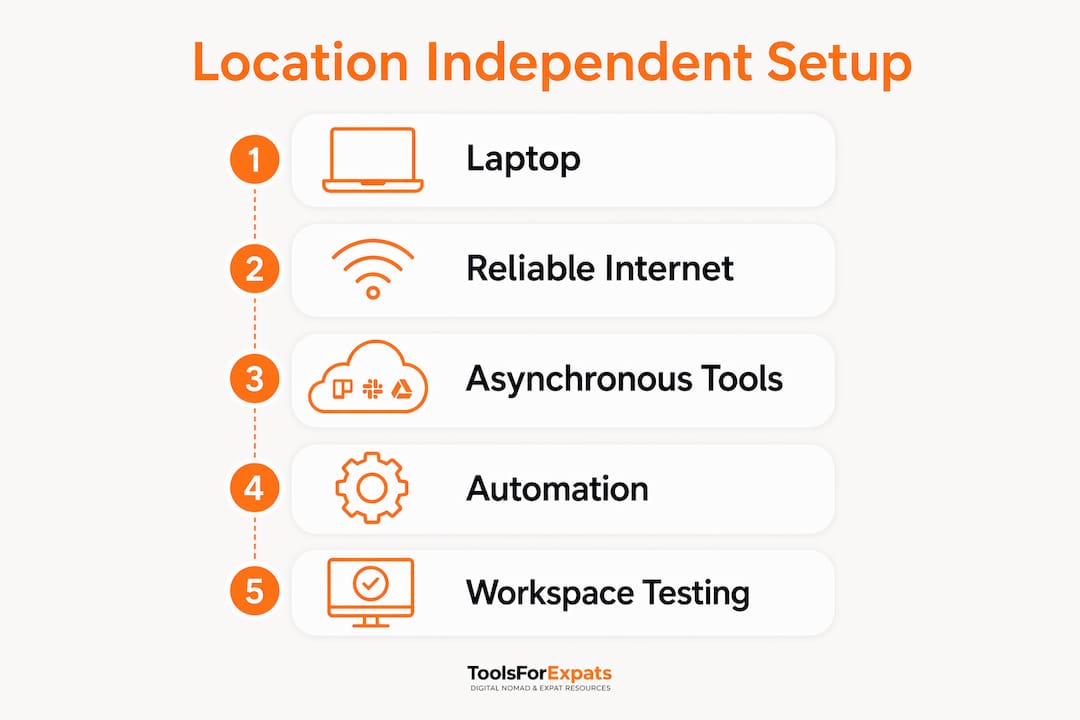
The foundational tools for location independence are a laptop, reliable internet, asynchronous workflows, and automation for administrative tasks. These four elements let you function fully without being physically present anywhere specific. Without them, you are still dependent on a fixed location even if your employer calls the arrangement "remote."
Asynchronous communication is the most underrated requirement. When your team or clients span multiple time zones, real-time meetings become a bottleneck. Tools like Loom for video messaging, Notion for shared documentation, and Slack with clear async norms replace the need for everyone to be online at the same time. Synchronous office-bound work structures are fundamentally incompatible with true location independence.
Cloud infrastructure handles the rest. Google Workspace, Dropbox, and similar platforms keep your files accessible from any device in any country. Payment processors like Wise or Stripe let you receive income internationally without a local bank account. Accounting tools like FreshBooks or Wave handle invoicing and tax records without requiring a physical accountant.
Here is the core setup most location independent professionals rely on:
- Laptop: A reliable, lightweight machine (MacBook Air and Lenovo ThinkPad X1 Carbon are popular choices)
- Internet backup: A local SIM with data plus a portable hotspot for redundancy
- Communication: Slack, Notion, or Basecamp for async team coordination
- Finance: Wise for international transfers, Stripe or PayPal for client payments
- Cloud storage: Google Drive or Dropbox for file access anywhere
- Automation: Zapier or Make to handle repetitive admin tasks without manual effort
Pro Tip: Before committing to a destination, test your workflow for two weeks from a coworking space in your home city. If you can operate fully without going into an office, you are ready to move.
How does location independence reshape your career and lifestyle?
Location independence changes the economic logic of your career. Location independent workers boost productivity by 4.4% when freed from geographic constraints. That gain comes from reduced commute time, fewer interruptions, and the ability to design a work environment that suits you personally.
The lifestyle impact goes beyond productivity. When you can live anywhere, you can choose locations based on cost of living, climate, culture, or community rather than proximity to an office. A software developer earning a U.S. salary while living in Lisbon or Chiang Mai can dramatically increase their savings rate without taking a pay cut. Location independent workers spend over 35% of their income locally in their temporary home destinations, which means their presence genuinely benefits local economies too.
Career fields that lend themselves naturally to this lifestyle include:
- Software development and engineering — fully deliverable via code repositories and async reviews
- Content creation and copywriting — output-based work with no location requirement
- Graphic and UX design — file-based deliverables work across any time zone
- Consulting and coaching — video calls replace in-person meetings
- E-commerce and digital product sales — income runs even while you sleep
The lifestyle also carries real challenges. Without structure, the freedom can feel disorienting. Successful practitioners emphasize building stable anchors like a consistent morning routine, a home base city, or a regular community rather than chasing constant novelty.
"Location independence is not an escape from obligation. It is a tool to enhance life quality through well-structured anchors." — from research on sustainable nomadic lifestyles
Roughly 80% of digital nomads report high satisfaction with income and autonomy compared to typical remote workers. That satisfaction correlates with intentional structure, not with how many countries they visit per year.
How to start building a location independent lifestyle
Moving toward location independence is a process, not a single decision. These steps give you a clear path forward without requiring you to quit your job tomorrow.
-
Audit your current work. List every task you do in a week. Identify which ones require physical presence and which do not. Most knowledge workers find that 80% or more of their tasks are fully portable.
-
Identify your income model. Freelancing, running a digital product business, or negotiating a fully remote contract with your employer are the three main paths. Each has different tax and visa implications.
-
Research visa options early. Digital nomad visas enable stays from six months to several years in countries like Portugal, Estonia, and Costa Rica. Use ToolsForExpats' visa eligibility checker to see which programs you qualify for based on your income and nationality.
-
Build your async workflow before you leave. Switch your communication habits to async tools. Document your processes. Set clear deliverable expectations with clients or employers. This step alone separates people who thrive from those who struggle.
-
Plan your financial infrastructure. Open a Wise or Revolut account for international transfers. Research tax residency rules for your target country. Use a cost of living calculator to set a realistic monthly budget before you commit to a destination.
-
Create your anchors. Choose a home base city for at least three to six months. Join a coworking space or local community group. Stability within freedom is what makes the lifestyle sustainable long-term.
Pro Tip: Estonia's digital nomad visa is one of the most straightforward programs for non-EU professionals. It allows stays of up to a year and requires proof of remote income above a set threshold. Read the full breakdown of Estonia's program before applying.
Key Takeaways
Location independence gives you full geographic freedom, but it requires deliberate structure, the right tools, and a clear income model to work sustainably.
| Point | Details |
|---|---|
| Definition clarity | Location independence means working without geographic restriction, not just working from home. |
| Remote work distinction | Remote employees often face location mandates; location independent professionals do not. |
| Core tools required | A laptop, async workflows, cloud storage, and automation form the non-negotiable foundation. |
| Lifestyle anchors matter | Sustainable practitioners build stable routines and home bases rather than traveling constantly. |
| Visa planning is critical | Over 67 countries offer digital nomad visas; research eligibility before choosing a destination. |
Freedom works better with a plan
The most common mistake I see people make is treating location independence as a personality trait rather than a professional structure. They romanticize the idea of working from a beach in Bali, then discover that spotty Wi-Fi, time zone chaos, and no community make the whole thing miserable within three months.
What actually works is treating geographic freedom as a tool. You use it deliberately. You pick a base that serves your work and your life, not just your Instagram feed. You build routines that travel with you. You invest in relationships, both professional and personal, that do not depend on physical proximity.
The professionals I respect most in this space are not the ones who have visited 40 countries in a year. They are the ones who have lived well in three or four places over five years, built real income, and maintained genuine friendships across time zones. That is the version of location independence worth building toward.
Rootlessness is a real risk when you skip the anchor-building phase. The fix is not to stop traveling. The fix is to be intentional about what grounds you, whether that is a recurring home base, a consistent work schedule, or a community you return to. Freedom and structure are not opposites. They work best together.
— Jay
Plan your location independent life with ToolsForExpats
If you are seriously considering this lifestyle, the planning phase is where most people lose momentum. Comparing costs across cities, checking visa eligibility, and building a realistic budget all take time when you are doing it manually.
ToolsForExpats makes that research faster and free. The digital nomad cost calculator breaks down monthly expenses by city so you can compare Lisbon against Medellín against Chiang Mai in minutes. The visa eligibility checker covers 20+ countries and tells you exactly which programs match your income and passport. There is also a best nomad city quiz that matches your lifestyle priorities to real destinations. No account required, no paywalls, just practical tools built for people making real decisions.
FAQ
What does location independent mean in simple terms?
Location independence means you can work and earn income from anywhere in the world without being tied to a specific office, city, or country. Your work is fully portable.
Is location independence the same as being a digital nomad?
Not exactly. Digital nomads are a subset of location independent professionals who actively travel between locations. You can be location independent and stay in one city abroad for years.
What jobs are best suited for a location independent lifestyle?
Software development, copywriting, graphic design, online consulting, and digital product sales are the most common fields. Any output-based role with no physical presence requirement qualifies.
Do I need a special visa to live location independently abroad?
Yes, if you plan to stay in a country for more than a tourist visa allows. Over 67 countries now offer digital nomad visas that legally cover remote workers living abroad for six months to several years.
What is the biggest challenge of location independence?
Rootlessness and isolation are the most common long-term challenges. Building stable anchors like a home base, a consistent routine, and a local community prevents burnout and keeps the lifestyle sustainable.