
Setting up remote work abroad means legally living and working overseas with the right visa, tax compliance, employer agreement, and tools for productivity. This is not simply a matter of packing a laptop and booking a flight. You need to satisfy immigration law, manage tax residency in two countries, secure employer approval, and build a workspace that keeps you performing at full capacity. Services like Deel and Boundless, along with digital nomad visa programs in Portugal, Spain, and the UAE, have made this process far more accessible than it was even three years ago. Done right, working remotely from another country is one of the most rewarding professional arrangements available today.
What visas and work permits do you need to set up remote work abroad?
Tourist visas do not permit remote work legally in most countries. Working on a tourist visa exposes you to fines, visa cancellation, or deportation. This is the single most common mistake remote workers make when moving abroad, and it is entirely avoidable.
The correct path is a digital nomad visa or a formal work permit. Digital nomad visas explicitly authorize you to live in a country while working remotely for a foreign employer or clients. Many countries now offer these visas with stays of 6 to 12 months, requiring proof of income and valid health insurance. Countries with active programs in 2026 include:
- Portugal (D8 Visa): Requires proof of monthly income around €3,040 and private health insurance.
- Spain (Digital Nomad Visa): Targets non-EU remote workers with income above €2,646 per month.
- UAE (Remote Work Visa): One-year renewable visa requiring a minimum monthly income of $3,500.
- Greece (Digital Nomad Visa): Offers a 12-month stay with a reduced income tax rate for qualifying applicants.
- Estonia (Digital Nomad Visa): A pioneer program allowing stays up to 12 months with straightforward online applications.
Each program has its own income threshold, health insurance requirement, and documentation checklist. Research your target country's official immigration portal before applying, since requirements change frequently.
Pro Tip: Use the ToolsForExpats visa checker to compare eligibility across 20+ countries in minutes, without creating an account.
How to manage tax residency when working remotely internationally
Tax residency is the most legally consequential part of any international remote work setup. The 183-day rule determines tax residency in most countries. Spending more than 183 days in a calendar year in a foreign country typically triggers local tax residency, requiring you to report worldwide income to that country's tax authority.

This creates a real risk of double taxation. Your home country may still consider you a tax resident if you maintain ties there, such as a home, bank accounts, or family. Tax treaties can prevent double taxation, but they require careful compliance and timely filing in both countries. Ignoring this is not a minor oversight. Penalties for non-compliance can include back taxes, interest, and in some cases, criminal charges.
Here is what you need to track and manage:
- Day count records: Log every entry and exit date using a spreadsheet or a dedicated app. This is your primary defense in any tax audit.
- Income documentation: Keep records of all invoices, payslips, and contracts organized by tax year and country.
- Tax treaty status: Confirm whether your home country and host country have a bilateral tax treaty and understand which country gets primary taxing rights.
- Local filing deadlines: Many countries require you to file a local tax return even if you owe nothing, once you cross the residency threshold.
| Tax situation | What to do |
|---|---|
| Under 183 days abroad | Likely remain a tax resident of your home country only |
| Over 183 days in one country | Register as a tax resident and file locally |
| Dual residency risk | Invoke the tax treaty tiebreaker rules |
| No treaty between countries | Consult a cross-border tax professional immediately |
Pro Tip: Read the ToolsForExpats guide on tax residency before you book your flights. Understanding your exposure early saves significant money and stress later.
What legal and employer considerations affect international remote work?
Your employer's position matters as much as your own. Employer concerns are a major barrier to approving remote work abroad, and most employees underestimate how complex the situation looks from the company's side. Before you relocate, you need explicit written approval from your employer, not just a verbal agreement.
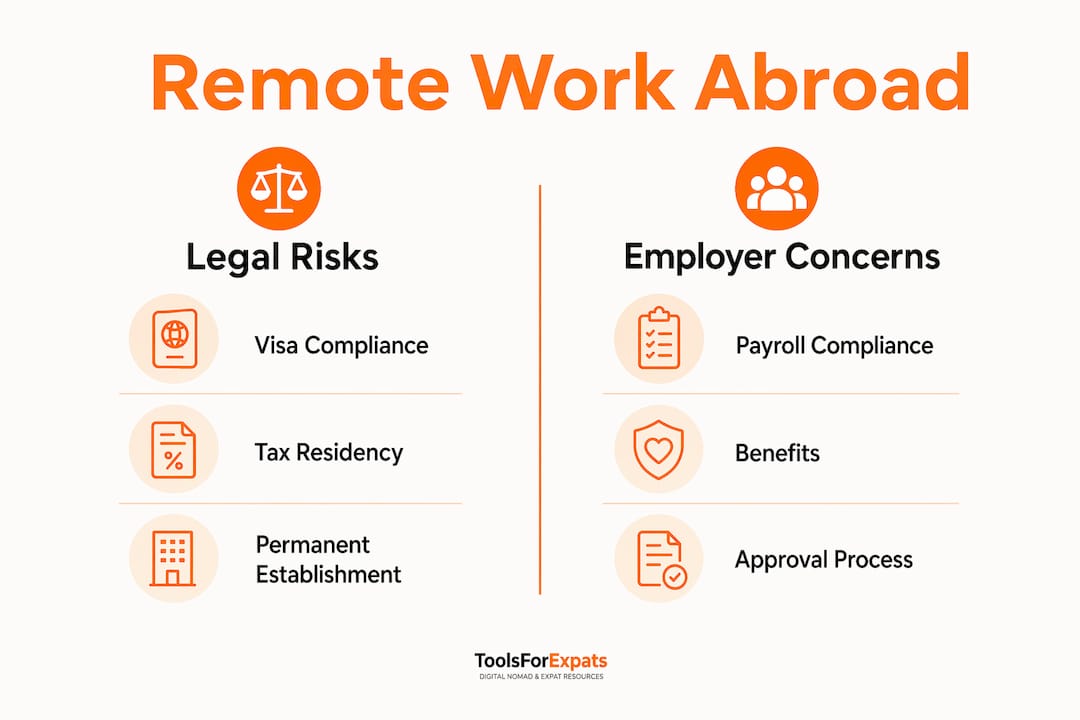
The biggest legal risk for your employer is permanent establishment. An employee working abroad without proper authorization can trigger a tax presence for the company in that country, meaning the company may owe corporate taxes there. This is a serious financial and legal exposure that causes many employers to refuse international remote work requests outright.
Worker classification is the second major issue. About 30% of US employers have misclassified at least one worker, leading to penalties. If you are reclassified as a local employee in your host country, your employer may suddenly owe local payroll taxes, social contributions, and statutory benefits they were not budgeting for.
Employer of Record (EOR) services solve both problems. An EOR like Deel or Boundless becomes the legal employer in the host country, handling payroll, tax withholding, and benefits compliance on behalf of your actual employer. This removes the permanent establishment risk and keeps worker classification clean.
"Using EORs can empower remote workers to live abroad compliantly without burdening their employer with complex local rules." — Boundless
When approaching your employer, come prepared with a written proposal that includes your target country, visa type, duration, time zone overlap plan, and a note on how an EOR can handle compliance. This turns a scary unknown into a manageable process for your HR team.
What tools and communication strategies support remote work abroad?
Productive remote work from a foreign location depends on three things: the right technology stack, clear communication agreements, and a dedicated workspace. Get all three right and your location becomes irrelevant to your output.
- VPN: A reliable VPN like NordVPN or ExpressVPN protects your data on public networks and lets you access region-restricted work systems. This is non-negotiable if you work in finance, legal, or healthcare.
- Collaboration platforms: Slack for async messaging, Zoom or Google Meet for video calls, and Notion or Confluence for documentation keep distributed teams aligned without requiring everyone online simultaneously.
- Time zone management: Use a time zone overlap calculator to identify your core overlap hours with your team. Protecting two to three hours of shared availability daily prevents the communication gaps that derail projects.
- Reliable internet backup: A local SIM with a data plan from providers like Airalo or a local carrier gives you a mobile hotspot when your primary connection fails. Never rely on a single internet source for client calls or deadlines.
- Dedicated workspace: A consistent physical workspace, whether a home office corner, a coworking space like WeWork or a local independent space, or a quiet café, signals to your brain that work mode is active. This boundary matters more abroad, where novelty competes with focus.
27% of remote employees struggle to disconnect from work due to poor boundaries. This number rises when you are living in an exciting new country and the lines between tourism and work blur. Set a hard stop time, communicate it to your team, and honor it.
Pro Tip: Establish a written communication charter with your manager before you leave. Agree on response time expectations, meeting windows, and escalation paths. This single document prevents most remote work friction.
How to choose the best country for your remote work setup
Choosing where to work remotely is not just about beautiful scenery. The right destination balances visa accessibility, cost of living, internet reliability, and the presence of a local remote work community. Countries like Portugal, Spain, Estonia, and Singapore offer digital nomad visas and strong remote ecosystems in 2026.
Here is how to evaluate any destination before committing:
- Visa availability: Does the country offer a digital nomad visa or a long-stay option that covers your intended duration?
- Cost of living: Can your income sustain your lifestyle there? Lisbon and Tallinn are significantly cheaper than Singapore or Zurich for comparable quality of life.
- Internet quality: Check Speedtest Global Index data for average speeds in your target city. Bali and Medellín, for example, have strong nomad communities but variable internet quality outside major coworking hubs.
- Time zone compatibility: A 10-hour difference from your employer's headquarters makes synchronous collaboration extremely difficult. Aim for destinations within 5 to 6 hours of your team.
- Remote work community: Cities with established coworking spaces, nomad meetups, and expat networks reduce isolation and accelerate local knowledge sharing.
Use the ToolsForExpats nomad city quiz to match your personal priorities against destination profiles. It factors in cost, climate, visa options, and community strength to give you a ranked shortlist rather than an overwhelming list of possibilities.
Key takeaways
Successfully setting up remote work abroad requires a legal visa, tax compliance in both countries, employer approval with permanent establishment protection, and a technology setup that keeps you productive across time zones.
| Point | Details |
|---|---|
| Visa compliance is non-negotiable | Tourist visas do not cover remote work; apply for a digital nomad visa before relocating. |
| Track the 183-day rule | Exceeding 183 days in a country triggers local tax residency and worldwide income reporting. |
| Protect your employer with an EOR | Employer of Record services like Deel or Boundless eliminate permanent establishment risk. |
| Build a communication charter | Agree on tools, response times, and overlap hours with your team before you leave. |
| Choose destinations strategically | Prioritize visa access, internet quality, cost of living, and time zone overlap over lifestyle appeal alone. |
What I've learned from watching remote workers get this wrong
I have seen a consistent pattern in how remote workers approach moving abroad: they plan the lifestyle first and the compliance second. They book the apartment in Lisbon, tell their manager they are "working remotely for a few months," and only start researching visas and taxes after they have already crossed the border. That sequence creates real problems.
The workers who do this well flip the order entirely. They start with the legal framework, confirm employer support, and then choose the destination. It sounds less exciting, but it means you arrive with confidence rather than anxiety. You are not wondering whether your visa is valid or whether your employer is about to pull the plug.
The other thing I have noticed is that people dramatically underestimate how much their employer's comfort level matters. Employers often fear the complexity of remote work abroad more than employees realize. Coming to that conversation with a prepared proposal, including an EOR solution, changes the dynamic completely. You are no longer asking for a favor. You are presenting a managed solution. That framing gets approvals that vague requests never would.
Finally, avoid the common digital nomad tax mistakes that catch people off guard in their first year abroad. Tax compliance is not glamorous, but getting it right is what makes the whole arrangement sustainable long-term.
— Ceyhun
Plan your remote work abroad setup with ToolsForExpats
Setting up your remote work abroad arrangement involves a lot of moving parts, and having the right tools makes the planning process far less overwhelming.
ToolsForExpats offers a free suite of calculators and tools built specifically for remote workers and digital nomads. Use the cost of living comparison tool to see exactly how far your income stretches in Lisbon versus Tallinn versus Chiang Mai. Check your visa eligibility across 20+ countries in one place. Run your budget through the nomad cost calculator before you commit to a destination. Everything on ToolsForExpats is free, requires no account, and is designed to give you clear answers fast.
FAQ
What is a digital nomad visa?
A digital nomad visa is a legal permit that allows remote workers to live in a foreign country while working for employers or clients based elsewhere. Countries including Portugal, Spain, the UAE, and Estonia offer these visas with stays ranging from 6 to 12 months.
Does working abroad trigger tax residency?
Yes, in most countries. Spending more than 183 days in a calendar year in a foreign country typically triggers local tax residency, requiring you to report worldwide income to that country's tax authority.
Can my employer refuse my request to work abroad?
Yes, and many do. Employers face payroll, employment law, and benefits compliance burdens when employees move abroad, plus permanent establishment tax risks. An Employer of Record service can resolve most of these concerns and significantly improve approval odds.
What tools do I need to work remotely from another country?
The core toolkit includes a VPN, collaboration platforms like Slack and Zoom, a time zone overlap calculator, a reliable mobile data backup, and a dedicated workspace. These tools together keep your output consistent regardless of location.
How do I avoid double taxation when working overseas?
Check whether your home country and host country have a bilateral tax treaty, track your days in each country carefully, and file tax returns in both jurisdictions as required. A cross-border tax professional is worth the cost if you plan to stay abroad for more than six months.