
Most digital nomads assume that hopping between countries keeps them off every tax authority's radar. That assumption has cost people tens of thousands of dollars in back taxes, penalties, and unexpected audits. Digital nomad tax residency explained simply comes down to one rule: where you live determines your tax obligations, not what visa you hold. Whether you spend three months in Portugal, four in Thailand, or two in Mexico, each country has its own tests to determine whether you owe them taxes. Understanding how those tests work before you travel is what separates nomads who thrive financially from those who scramble at tax time.
Table of Contents
- Key Takeaways
- What defines tax residency and why it matters
- How countries determine your tax residency
- How U.S. digital nomads handle worldwide tax obligations
- Managing tax residency across multiple countries
- Common mistakes that create unexpected tax problems
- My honest take on tax residency for nomads
- Plan your nomad finances with ToolsForExpats
- FAQ
Key Takeaways
| Point | Details |
|---|---|
| Visa status does not equal tax residency | Holding a digital nomad visa does not exempt you from a country's local tax obligations. |
| The 183-day rule is nearly universal | Spending more than 183 days in most countries typically triggers full tax residency there. |
| U.S. citizens pay taxes worldwide | American nomads must file federal returns regardless of where they live, though exclusions apply. |
| Double taxation can be avoided | Tax treaties and foreign tax credits exist specifically to prevent paying taxes in two countries at once. |
| Day tracking is non-negotiable | Inaccurate day counts can invalidate exclusion claims and trigger unexpected tax bills. |
What defines tax residency and why it matters
Tax residency is the legal status that determines which country has the right to tax your income. It is entirely separate from your citizenship, your passport, and the visa you used to enter a country. Most people understand that a tourist visa does not make them a tax resident. The problem arises with digital nomad visas, which many nomads mistakenly treat as a tax-free pass.
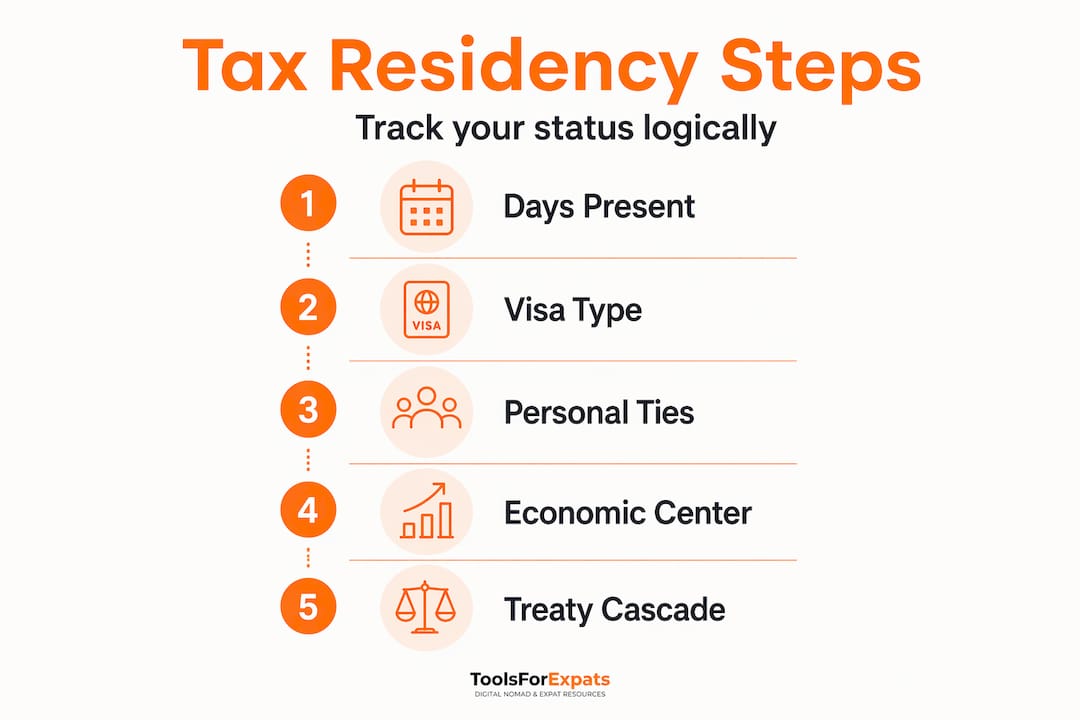
Countries generally use a combination of four criteria to assess whether you are a tax resident:
- Days present: The most common threshold is 183 days in a calendar year or tax year.
- Permanent home: If you maintain a home available to you in a country, many jurisdictions will consider you resident there, even if you spend fewer days.
- Center of vital interests: Where your family lives, where your bank accounts are, and where your business operates all count here.
- Habitual abode: Which country do you return to most frequently, even if you do not own property there?
None of these criteria operate in isolation. A country's tax authority might find you resident based on just one factor, which is why understanding each one matters.
Pro Tip: Keep a dedicated travel spreadsheet tracking every entry and exit date for every country you visit. Include visa type, duration, and purpose of stay. This record becomes your first line of defense if any tax authority questions your residency status.
Tax residency also determines whether you file and pay taxes on worldwide income or only on local income. Most countries tax residents on global earnings. Non-residents are typically taxed only on income sourced within that country. That distinction can represent a dramatic difference in your total tax bill.
How countries determine your tax residency
No two countries use identical tests, but most share common frameworks. Understanding the major ones will prepare you for most situations you will encounter.
Here are the key tests used internationally:
- The 183-day physical presence test. The most widely applied rule: spend more than 183 days in a country within a calendar or tax year and you are generally considered a tax resident. This is the threshold used across most of Europe, Asia, and Latin America.
- The U.S. Physical Presence Test for FEIE. For American nomads, this test requires 330 full days outside the United States within any 12-month period. Days when you partially cross back into the U.S. do not qualify as full days abroad, which is a critical detail people miss.
- The Bona Fide Residence Test. This U.S.-specific test takes a less mechanical approach. Instead of counting days, it asks whether you genuinely established residence in a foreign country for an entire tax year. Authorities consider your intent, lifestyle, and documented ties to that country.
- Country-specific tests like the UK Statutory Residence Test. The UK applies one of the most detailed frameworks in the world. The UK Statutory Residence Test uses automatic tests and a sufficient ties test, weighing factors like accommodation availability, family presence, work location, and number of days in the UK. Different rules apply for those arriving to the UK versus those leaving it.
| Test | Who It Applies To | Key Threshold |
|---|---|---|
| 183-day rule | Most countries | 183+ days in tax year |
| U.S. Physical Presence Test | U.S. citizens abroad | 330 full days outside U.S. in 12 months |
| Bona Fide Residence Test | U.S. citizens abroad | Full tax year as genuine foreign resident |
| UK Statutory Residence Test | UK residents/leavers | Days plus ties system |
| OECD treaty tie-breaker | Dual residency disputes | 4-step cascade resolution |
When two countries both claim you as a resident, the OECD treaty tie-breaker cascade kicks in. It follows four steps in strict order: first, which country has your permanent home; second, which has your center of vital interests; third, where is your habitual abode; fourth, your nationality. Authorities cannot skip steps in the order they prefer.

Pro Tip: If you are spending significant time in a country that has a tax treaty with your home country, download that treaty and find the residency article. Most are publicly available and written in plain enough language to understand the tie-breaker rules that apply to your specific situation.
How U.S. digital nomads handle worldwide tax obligations
American nomads face the most complex situation in the world of international taxation. The United States is one of only two countries that taxes its citizens on worldwide income regardless of where they live. You could spend 365 days in Bali and still owe the IRS a federal tax return.
Here is what U.S. nomads need to manage:
- Foreign Earned Income Exclusion (FEIE). If you qualify under either the Physical Presence Test or the Bona Fide Residence Test, you can exclude up to $132,900 of foreign-earned income from federal income tax for the 2026 tax year. This exclusion does not eliminate all tax obligations.
- Self-employment tax persists. Even if the FEIE eliminates your income tax liability, self-employment tax of 15.3% still applies to net earnings. That tax covers Social Security and Medicare contributions and surprises many first-time nomads who thought they were fully covered.
- FBAR filing requirements. If your foreign bank accounts hold more than $10,000 in aggregate at any point during the year, you must file a FinCEN 114, commonly called an FBAR. This is separate from your tax return and carries severe penalties for non-compliance.
- State tax obligations. Some U.S. states aggressively pursue state income tax from expats unless you properly change your domicile before leaving. California, Virginia, South Carolina, and New Mexico are known for asserting continued residency based on lingering ties like a driver's license, voter registration, or property.
Pro Tip: Before leaving the U.S. long-term, formally change your domicile to a state with no income tax, such as South Dakota, Wyoming, or Florida. This single step can save thousands of dollars annually and prevents state tax authorities from claiming you as a resident.
Record keeping is your strongest defense. Track every day you spend outside the U.S. using a dedicated app or spreadsheet. Note border crossing times and keep boarding passes, hotel receipts, and lease agreements. The IRS can audit FEIE claims years after filing.
Managing tax residency across multiple countries
Many nomads spend time in two, three, or even four countries in a single year. That creates a real risk of triggering residency obligations in multiple places at once. Owning property, having family, or maintaining business ties can create permanent home or center of vital interests claims even if you spend fewer than 183 days in a country.
Here is how to reduce multi-jurisdictional exposure:
- Establish one clear primary residence. Choose a country you plan to spend the most time in and formalize that relationship through official registration, a local bank account opened intentionally, and a lease agreement.
- Monitor days carefully in secondary countries. Keep your stays under 183 days in any country where you do not want to trigger residency. Build buffer time into your planning.
- Use tax treaties proactively. The OECD tie-breaker rule was designed to resolve exactly these conflicts. If two countries both claim you, the treaty determines which one wins. Having strong documentation for your primary residence gives you a clear argument in that cascade.
- Claim foreign tax credits. If you do pay tax in a foreign country, foreign tax credits generally allow you to offset that amount against your home country tax bill. This is how dual taxation is prevented in practice.
- Be careful with leases and property. Even renting a flat for a few months in a country like Germany or France can be interpreted as having a permanent home available to you, which is one of the key residency factors under OECD principles.
If you are exploring Greece as a base and want to understand local tax residency standards before committing, the digital nomad guide for Greece offers practical grounding on what to expect.
Common mistakes that create unexpected tax problems
Most tax problems nomads face are entirely avoidable. They usually trace back to one of these errors:
- Assuming a digital nomad visa eliminates tax obligations. Visa status does not equal tax residency. Local tax authorities apply their own tests regardless of what visa you entered on.
- Miscounting physical presence days. Especially for American nomads relying on the 330-day rule, partial travel days do not count. Many people invalidate their entire FEIE claim by being off by a handful of days.
- Ignoring the center of vital interests test. The center of vital interests is subjective and covers family location, economic ties, and social connections. Nomads who maintain strong home-country ties while traveling are more vulnerable than they realize.
- Failing to file required forms. Missing an FBAR, a Form 2555 for FEIE, or a state tax return is not a minor oversight. Penalties for late or missing filings can exceed the original tax owed.
Pro Tip: Consult a tax professional who specializes in expat or international tax law before your first full year abroad. One session can identify residency risks you would never spot on your own, and the cost is almost always less than the penalties you might face later.
My honest take on tax residency for nomads
I have worked with enough nomads to know that the tax residency question is one where overconfidence causes the most damage. People spend enormous energy researching the best countries for digital nomads and almost no energy understanding the tax implications for remote workers in those same places.
The center of vital interests test is the part that catches people off-guard most often. It sounds abstract until a tax authority points out that your partner still lives in your home country, your business bank account is there, you own a car there, and your parents' address is still your mailing address. Suddenly you have a residency dispute on your hands even if you spent only 90 days there. I have seen this exact situation drag on for two years.
What I have found actually works is treating tax residency as a planned decision rather than a default outcome. You choose where you want to be resident. You take the steps to establish that residency clearly. You document it thoroughly and review it annually. The nomads who handle this well are not necessarily the ones with the simplest situations. They are the ones who take it seriously early.
Online tax filing for nomads has gotten much easier, but it has not eliminated the need for professional advice when your situation spans multiple jurisdictions. The tools are better. The responsibility for getting it right is still yours.
— Ceyhun
Plan your nomad finances with ToolsForExpats
Understanding your tax residency is only one piece of the financial puzzle when you live and work abroad. Knowing your actual cost of living, choosing the right country, and keeping your budget realistic are just as critical to staying financially healthy.
ToolsForExpats offers a full suite of free expat tools and calculators built specifically for digital nomads and expats at every stage of their move. Use the digital nomad visa checker to clarify which countries offer visa options that align with your residency goals. Run the nomad cost calculator to see how your target destinations compare on day-to-day expenses, factoring in the tax obligations you now understand more clearly. Everything is free, no account required, and designed to give you real answers fast.
FAQ
Does a digital nomad visa make you a tax resident?
No. Visa status does not determine tax residency. Each country applies its own residency tests based on days present, permanent home, and other factors regardless of the visa you hold.
How many days can you stay in a country without becoming a tax resident?
Most countries use a 183-day threshold as the primary trigger for tax residency, though some use shorter periods or additional criteria like permanent home availability.
Can you be taxed in two countries at once?
Yes, but most countries have tax treaties that use the OECD tie-breaker cascade to determine which country has the primary right to tax you, and foreign tax credits prevent you from paying the same tax twice.
Do U.S. digital nomads have to file taxes every year?
Yes. U.S. citizens must file federal returns reporting worldwide income every year regardless of location. However, qualifying nomads can exclude up to $132,900 of foreign-earned income using the FEIE for the 2026 tax year.
What is the most common mistake nomads make about tax residency?
Assuming their digital nomad visa exempts them from local tax obligations. Tax authorities apply residency tests independently of visa type, and failing to recognize that distinction is the most frequent source of unexpected tax bills.