
A nomad visa is a residence permit that allows remote workers to live legally in a foreign country while working for employers or clients based outside that host country. Officially called a digital nomad visa or temporary residence permit for digital nomads in most government documentation, this visa category solves a real legal problem: tourist visas prohibit extended stays, and standard work visas tie you to a local employer. Countries including Spain, Portugal, Slovenia, Cyprus, Moldova, and Thailand have each created dedicated pathways for remote workers who want legal long-term residence without entering the local labor market. If you are planning to relocate and work remotely abroad, understanding what a nomad visa covers, and what it does not, is the most important first step you can take.
What is a nomad visa and who qualifies?
A nomad visa is defined as a residence permit for remote workers who are employed or contracted by entities outside the host country and perform their work remotely via information and communication technologies. Slovenia's official government definition captures the core legal element precisely: a digital nomad is someone who works for a foreign employer or client, remotely, with no access to the local labor market. That last clause matters more than most applicants realize.
The term "digital nomad" describes anyone who earns income remotely while living in a country other than where their employer or clients are based. A software developer contracted to a U.S. startup while living in Lisbon fits the definition. A freelance designer with clients in Germany while based in Tbilisi fits it too. What does not qualify is working for a local company in the host country, even if the work is technically done on a laptop.
The defining legal element across all nomad visa programs is remote work for foreign entities without accessing the host country's labor market. This distinguishes the digital nomad visa from a standard work permit, which authorizes local employment, and from a tourist visa, which prohibits any work at all. Knowing this distinction upfront saves you from applying to the wrong program entirely.

What are the typical eligibility requirements for a nomad visa?
Most countries structure their eligibility requirements around five core categories. Meeting all five is non-negotiable in the vast majority of programs.
- Proof of remote work for a foreign entity. This means a contract, employer letter, or client agreement that explicitly names a company or individual based outside the host country. Moldova requires proof of continuity of remote work via IT for foreign legal entities, not just a bank statement showing income.
- Stable income above a minimum threshold. Income thresholds vary widely by country. Portugal's D8 visa requires roughly €3,280 per month, while Moldova and Slovenia set lower bars. The income must demonstrably come from foreign sources.
- Valid health insurance. Coverage must typically be valid in the host country for the full duration of your stay. Many countries specify minimum coverage amounts.
- Clean criminal record. A background check from your home country or country of prior residence is standard. Some countries require apostille certification.
- Proof of accommodation. A rental agreement, property deed, or confirmed booking for your initial stay is required in most programs, including Cyprus's digital nomad visa scheme.
The documentation trap most applicants fall into is focusing almost entirely on income proof while underestimating the remote work evidence requirement. Many applicants underprepare the proof of foreign-source remote work, which is often the reason applications stall or get rejected. Your contract needs to specify the foreign entity, the nature of the work, and ideally confirm that the work is performed via information technologies.
Pro Tip: Gather your remote work documentation first, before anything else. Pull together signed contracts, client invoices from the past six months, and any employer letters that confirm your role is fully remote and tied to a foreign company. Income statements alone will not be enough.
How does the nomad visa application process work?
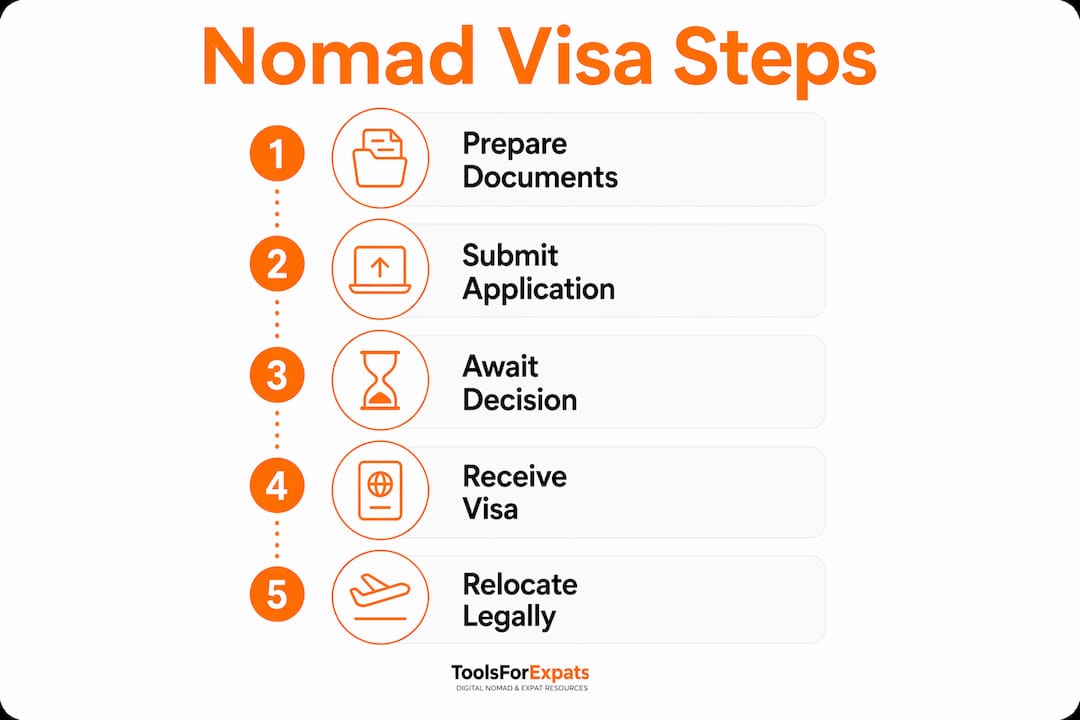
The application process follows a predictable structure across most countries, though the specific steps and timelines differ. Here is what you can generally expect:
- Determine your application entry point. If you are outside the host country, you apply at the country's diplomatic or consular post in your home country or country of residence. Slovenia and Moldova both route initial applications through diplomatic posts abroad. If you are already legally residing in the host country on another visa, some countries allow in-country applications at local administrative units.
- Compile and submit your full document package. This includes all eligibility documents: proof of remote work, income evidence, health insurance, criminal record clearance, accommodation proof, and a completed application form. Some countries require certified translations of foreign-language documents.
- Wait for assessment and approval. Processing times vary from two weeks to three months depending on the country and the volume of applications. Moldova's migration authority handles assessment with variable timelines, so building buffer time into your plans is wise.
- Receive your temporary residence permit. Upon approval, you receive a residence permit card or stamp that specifies the duration of your authorized stay and any conditions attached to it.
- Plan your renewal or reapplication strategy before your permit expires. This step is where many nomads get caught off guard. Slovenia's permit cannot be extended and requires a six-month gap before reapplication. That means you need to plan your next move well before your permit runs out.
Pro Tip: Set a calendar reminder three months before your permit expires. If your chosen country does not allow extensions, research your next destination or alternative visa category early. Waiting until the last month creates real legal risk.
What are the main benefits and limitations of a nomad visa?
A nomad visa offers genuine advantages over both tourist visas and standard work permits, but it comes with real trade-offs worth understanding before you commit.
Key benefits:
- Legal long-term residence. Tourist visas in most countries cap stays at 90 days within a 180-day window. A nomad visa gives you up to one year of legal residence, sometimes renewable, without the need to leave and re-enter.
- Right to work remotely without restriction. You can work your full schedule for your foreign employer or clients without violating your visa terms, which is not the case on a tourist visa.
- Family reunification options. Some countries extend favorable policies to nomad visa holders' families. Slovenia, for example, allows family members to apply for residence alongside the primary applicant, which makes it a practical option for nomads traveling with a partner or children. Understanding how a nomad spouse visa works is worth researching early if this applies to you.
- Access to local services. Legal residence typically grants access to banking, local SIM registration, and in some cases public services that are unavailable to tourists.
Key limitations:
- Heavier documentation requirements compared to tourist visas mean the application process takes real time and preparation.
- Non-extendable permits in countries like Slovenia create mandatory gaps in legal residence that require careful planning.
- No local employment is permitted. If you take on a local client or employer, you violate your visa terms.
- Holding a nomad visa does not automatically resolve your tax residency status. Legal presence and tax residence are separate questions, and getting this wrong has real financial consequences.
Which countries offer nomad visas and how do they compare?
Over 50 countries now offer some form of remote work visa or digital nomad visa. The programs below represent the most established and most applied-for options in 2026.
| Country | Min. Monthly Income | Permit Duration | Extendable? | Notable Feature |
|---|---|---|---|---|
| Portugal | ~€3,280 | 1 year | Yes (renewable) | Path to permanent residency |
| Spain | ~€2,646 | 1 year | Yes, up to 5 years | EU Schengen access |
| Slovenia | Varies | Up to 1 year | No (6-month gap) | Family reunification included |
| Cyprus | Varies | 1 year | Yes | IT-sector focus |
| Moldova | Varies | 1 year | Renewable | Lower income threshold |
| Thailand | ~$80,000/year | 5 years (LTR visa) | Yes | Long-term stability |
Portugal and Spain attract the highest volume of applicants from North America and the UK, largely because of their EU access, established expat communities, and relatively clear application processes. Slovenia and Cyprus appeal to applicants who want lower cost of living with EU-based legal frameworks. Moldova is gaining traction among applicants who want a straightforward process with lower income requirements. Thailand's Long-Term Resident visa targets higher earners but offers exceptional duration and stability.
Regional trends show Southeast Asia and Eastern Europe expanding their nomad visa programs fastest, driven by competition for remote worker spending and the economic benefits of attracting high-income foreign residents. If you want to compare your eligibility across multiple countries at once, the nomad visa checker at ToolsForExpats covers 20-plus countries with document guidance built in.
Key takeaways
A nomad visa is a legal residence permit for remote workers that requires proof of foreign-source employment, stable income, health insurance, and a clean criminal record, with permit durations, renewal rules, and income thresholds varying significantly by country.
| Point | Details |
|---|---|
| Core legal definition | A nomad visa authorizes residence for remote workers employed by foreign entities, not local ones. |
| Documentation depth | Proof of remote work for a foreign entity is as critical as income proof. Many applications fail here. |
| Renewal planning | Non-extendable permits like Slovenia's require you to plan your next status change months in advance. |
| Tax risk is separate | Holding a nomad visa does not resolve tax residency. Monitor duration and activity carefully. |
| Country comparison matters | Income thresholds, permit length, and renewal rules differ enough to make country selection a strategic decision. |
What I've learned from watching nomad visa applications go wrong
The most common mistake I see is treating a nomad visa application like a tourist visa extension. People gather their bank statements, book a flight, and assume the paperwork will sort itself out. It does not. The documentation standard for a nomad visa is closer to a mortgage application than a travel form, and the applicants who sail through are the ones who treat it that way from day one.
The renewal trap is the second-biggest issue. Slovenia's six-month gap rule catches people completely off guard. They spend a year building a life in Ljubljana, and then realize they have to leave for six months before they can reapply. If you are serious about a specific country, read the renewal policy before you apply, not after you arrive.
The tax question is the one most people avoid until it becomes urgent. OECD guidance makes clear that remote work can create taxable presence depending on duration and the nature of your activity. A nomad visa gives you legal residence. It does not give you a tax strategy. If you are staying anywhere for more than six months, get proper advice on digital nomad tax residency before you file anything.
What I genuinely respect about the nomad visa category is that it creates a real legal framework for a way of working that was previously invisible to immigration systems. That is worth something. But the framework only protects you if you use it correctly, and that means preparing thoroughly, planning renewals early, and not ignoring the tax side of the equation.
— Ceyhun
Plan your nomad visa move with ToolsForExpats
Knowing which nomad visa fits your situation is the first practical step, and ToolsForExpats makes that step much faster.
The visa eligibility checker at ToolsForExpats covers 20-plus countries, walks you through document requirements, and helps you identify which programs you realistically qualify for based on your income and work setup. Once you know your target country, the cost of living calculator lets you estimate monthly expenses by city so your budget reflects reality, not assumptions. For the full financial picture of relocating, the moving abroad budget tool covers one-time relocation costs alongside ongoing living expenses. All three tools are free, require no account, and are built specifically for people planning exactly what you are planning.
FAQ
What is the difference between a nomad visa and a tourist visa?
A tourist visa prohibits any form of work and typically limits stays to 90 days. A nomad visa is a residence permit that legally authorizes remote work for foreign employers or clients and allows stays of up to one year or more.
How much income do you need for a nomad visa?
Income requirements vary by country. Portugal requires approximately €3,280 per month, Spain requires roughly €2,646, and countries like Moldova set lower thresholds. The income must come from foreign sources, not local employment.
Can my spouse join me on a nomad visa?
Some countries allow family members to apply for residence alongside the primary nomad visa holder. Slovenia explicitly includes family reunification provisions in its digital nomad permit program, making it one of the more family-friendly options available.
Does a nomad visa affect my taxes?
A nomad visa grants legal residence but does not determine your tax residency status. OECD guidance confirms that remote work can create taxable presence depending on duration and activity, so separate tax planning is necessary. Review the common tax mistakes digital nomads make before you file.
Can a nomad visa be renewed?
Renewal policies differ by country. Portugal and Spain allow renewals and even pathways to permanent residency. Slovenia does not allow extensions and requires a six-month gap before reapplication. Always check the renewal terms of your specific country before applying.