
Digital nomads build sustainable income from a mix of active work, digital products, creator revenue, e-commerce, and investments. Active digital nomads typically earn a median monthly income between $2,500 and $6,000, with higher earners often reaching $8,000 or more by combining income streams strategically. The key is picking the right 2–3 types of nomad income streams for your skills and timeline, then layering in semi-passive options as you grow.
Here's a quick map of every major category:
- Freelancing and remote jobs — best for immediate cash; suits anyone with a marketable skill
- Content creation — best for long-term audience leverage; takes 6–18 months to pay meaningfully
- Digital products and courses — best for scalable, semi-passive income once validated
- Affiliate marketing and ad revenue — best as a complement to content; low effort once traffic exists
- E-commerce and product sales — best for product-minded nomads willing to manage operations
- Online teaching and tutoring — best for fast cash with a teachable skill, especially languages
- Investments and passive income — best as a revenue floor once you have capital to deploy
- Asset and rental income — best for property owners who want hands-off management
- Gig work and microtasks — best for bridge income between bigger projects
Most successful nomads run what's called an income stack: 1–2 active streams for cash flow, 2–3 semi-passive streams for growth, and an investment component for stability. Before going full-time, financial advisors recommend hitting a revenue floor at 1.5× your anticipated living costs plus a 30% buffer, sustained for at least three months.
1. Freelancing and remote jobs pay fastest when you specialize
Freelancing is the most direct path to nomad income. You trade deliverables or hours for money, and the barrier to entry is low if you already have a skill. The real upgrade comes when you move from one-off projects to retainer agreements, where a client pays a fixed monthly fee for ongoing work.

Platforms like Upwork and Fiverr serve different purposes. Upwork connects you with longer-term contracts and hourly engagements, making it better for building retainer relationships. Fiverr works well for packaged, fixed-price services where buyers come to you. Neither replaces direct outreach, but both give beginners a starting point with built-in trust signals.
Realistic earnings for beginners run $25–$75/hour in writing, design, and virtual assistance. Specialized developers, UX designers, and SEO strategists regularly charge $80–$150/hour, with top-tier full-stack developers billing $100–$250/hour. Time to first dollar is typically 1–4 weeks if you apply consistently. U.S. freelancers owe self-employment tax (currently 15.3% on net earnings) and must report all income, including payments received through Stripe or PayPal, on Schedule C.
First steps:
- Pick 1–2 niche services you can deliver without hand-holding
- Build a three-piece portfolio (real or spec work)
- Set a clear rate structure (hourly or project-based)
- Apply to 5–10 jobs per day on Upwork or pitch 3–5 direct prospects weekly
- Convert your first repeat client into a monthly retainer
The systems that remove time dependence are retainers and productized services: a fixed scope, a fixed price, and a repeatable delivery process. Tools like Notion, Slack, and Linear let you run client work fully asynchronously, which matters when you're crossing time zones every few weeks.
2. Content creation builds long-term leverage but requires patience
Content creation is one of the most popular digital nomad income ideas, and also one of the most misunderstood. The revenue isn't from the content itself — it's from the audience the content builds, which you then monetize through multiple channels.
The main revenue paths:
- Ad revenue (RPM): YouTube and blog ad revenues depend on CPM or RPM rates, which vary according to niche and audience size.
- Sponsorships: Brand sponsorships vary widely in payment based on audience size and authority in a niche.
- Affiliate links: Embedded in content; commissions vary from 5% to 40%+ depending on the product category
- Fan subscriptions: Platforms like Patreon let audiences pay monthly for exclusive content or community access
- Direct product funnels: Content drives traffic to your own courses, templates, or coaching offers
YouTube works as an awareness engine: videos rank in search, build trust, and funnel viewers toward higher-margin offers. Patreon works as a recurring revenue layer for creators who already have an engaged audience. The combination of content plus email list consistently outperforms ad-only monetization because email gives you a direct line to your audience that no algorithm can cut off.
Timeline to meaningful income is honest: expect 6–12 months before ad revenue covers coffee, and 12–24 months before sponsorships become predictable. The creators who accelerate this pick a specific niche (nomad finance, language learning, remote tech) rather than broad lifestyle content. Repurpose every long-form piece into short clips, newsletters, and social posts to multiply reach without multiplying work.
3. Digital products and courses scale without trading more hours
The appeal of digital products is simple: you build something once and sell it repeatedly. An ebook, a Notion template, a Canva pack, or a structured online course can generate revenue at 2 AM while you're asleep in Lisbon. The catch is that passive income is front-loaded work — the "passive" part only kicks in after you've built, validated, and launched.
Platforms like Teachable and Thinkific handle course hosting, student management, and payment processing. For simpler digital downloads, Gumroad is faster to set up. Stripe and PayPal handle payments across all of them, and both generate transaction reports you'll need for U.S. tax filing.
Startup costs vary widely. A Notion template takes a weekend and costs nothing beyond your time. A structured video course takes 2–3 months of production and might cost $200–$500 in equipment and software. Pricing matters: hyper-specific courses and niche templates convert better than broad, general ones. Notion templates priced at $19–$49 sell well because buyers know exactly what they're getting.
Pro Tip: Before building a full course, validate demand with a free lead magnet or a presale. If 50 people download your free checklist on the topic, you have evidence someone will pay for the full version. If nobody opts in, pivot before you spend three months filming.
Early sales are often modest, but a well-positioned digital product with consistent promotion can reach $2,000–$5,000/month within a year. Keep all invoices and sales reports — the IRS treats digital product income as ordinary business income, and your payment processor reports are your primary documentation.
4. Affiliate marketing works best when you promote what you already use
Affiliate marketing fits naturally into a nomad income stack because it monetizes content or email you're already producing. You recommend a product, a reader clicks your link and buys, and you earn a commission. No inventory, no customer service, no fulfillment.
The income model depends on traffic and conversion. An email newsletter with 5,000 engaged subscribers can generate $2,500–$5,000 per sponsored issue at $25–$50 CPM, but affiliate commissions for nomad services often pay 30–40% recurring rates depending on the program.
Why essential nomad services convert better:
- VPNs, travel insurance, and coworking passes solve problems your audience faces daily
- Readers trust recommendations that match their actual lifestyle
- Affiliate programs for essential nomad services like VPNs and travel insurance may offer substantial recurring commissions, with payout rates commonly as high as 30–40% on recurring sign-ups.
Pro Tip: Never rely on a single affiliate program or one ad platform. Build 2–3 complementary partnerships across different product categories. If one program changes its commission structure (it happens), your income doesn't collapse.
Time to meaningful affiliate income often requires several months to build traffic or an audience, tied directly to how long it takes to build traffic or an audience. The fastest path is combining affiliate links with an email list, since email subscribers convert at significantly higher rates than cold search traffic. ToolsForExpats uses this model itself, partnering with services for international payments, eSIM data, and healthcare that its nomad audience genuinely needs.
5. E-commerce and product sales require logistics planning for nomads
E-commerce is a legitimate nomad income source, but the logistics require more thought than purely digital streams. The model you choose determines how location-independent your operation actually is.
Shopify powers a standalone storefront and integrates with dozens of fulfillment partners. Amazon FBA (Fulfilled by Amazon) handles storage, packing, and shipping in exchange for fees, making it more hands-off once your products are in Amazon's warehouse. Etsy suits handmade, vintage, or digital goods and brings built-in buyer traffic. Print-on-demand (POD) services like Printful or Printify connect to Shopify or Etsy and handle production and shipping automatically — you only create designs.
For nomads, POD and third-party fulfillment are the practical choices. Holding inventory while traveling is a logistical headache; dropshipping and POD eliminate it entirely. Startup costs range from near-zero for a POD Etsy shop to $500–$2,000 for a Shopify store with initial product testing. Stripe and PayPal handle payments across all major platforms.
The honest tradeoffs: margins on physical products are thinner than on digital ones, customer service needs are real, and platform algorithm changes can hit revenue quickly. The nomads who make e-commerce work long-term hire virtual assistants for customer service and use automation tools for order management, so the store runs without their daily attention. Scalability is real, but it requires building systems before it becomes genuinely passive.
6. Online teaching and tutoring generates fast cash with a teachable skill
Teaching online is one of the fastest ways to earn as a nomad because the barrier to entry is low and demand is consistent. ESL instruction, skills tutoring, and coaching are all viable, and each has a different earnings ceiling.
Typical earnings by category:
- ESL tutoring rates vary based on platform and whether students are private or marketplace-based.
- Skills tutoring rates vary widely depending on subject and tutor experience.
- Business or career coaching rates vary greatly based on experience and engagement terms.
Scheduling is the main operational challenge. Working across time zones means early mornings or late evenings if you're teaching students in the U.S. or Europe from Southeast Asia. The fix is block-scheduling: offer fixed time slots rather than open availability, and sell packages (four sessions per month) rather than one-off bookings. This reduces calendar chaos and creates predictable recurring income.
Pro Tip: Use Calendly connected to Stripe to automate booking and payment collection. Students book a slot, pay upfront, and you receive a confirmation. No back-and-forth, no chasing invoices.
The scaling path is clear: move from 1:1 sessions to pre-recorded lessons, group cohorts, or membership tiers. A tutor earning $60/hour with 20 students per week earns about $4,800/month in active income, while a group program at $97/month with 50 members can also reach similar monthly earnings with fewer live hours. Platforms like Teachable or a simple Stripe-powered membership site make the transition straightforward.
7. Investments and passive income create a revenue floor over time
Investment income is the most genuinely passive option on this list, and also the one that requires capital before it pays anything meaningful. Think of it as a floor, not a foundation — something that adds stability to an income stack rather than replacing active work.
Common instruments for nomads include dividend ETFs (SCHD and VYM are frequently cited examples), broad index funds, REITs, peer-to-peer lending, and crypto staking. Investment portfolios can generate passive income that adds financial stability, but amounts vary widely based on portfolio size and yield.
For U.S. filers, dividend income is taxable in the year received, and crypto staking rewards are treated as ordinary income at the time of receipt. Both require accurate recordkeeping; your brokerage and exchange will issue 1099 forms, but you're responsible for reconciling them. Consult a CPA familiar with nomad tax situations before making significant allocation decisions.
A reasonable allocation guideline: put 5–15% of your assets into income-generating investments early on, and increase that percentage as your active income grows. The goal is a revenue floor that covers basic living costs even if your active streams slow down temporarily.
8. Rental and asset income can be semi-passive with the right management
Owning property while traveling sounds contradictory, but short-term rental income is a real nomad income stream for those who already own real estate or are willing to invest in it. The key word is "managed" — without a property manager, you're a remote landlord fielding maintenance calls at midnight.
How the model works:
- List the property on short-term rental platforms (Airbnb-style marketplaces) for higher nightly rates
- Hire a local property management company to handle check-ins, cleaning, and maintenance
- Property managers typically charge 20–30% of rental revenue for full-service management
- Net income depends on location, occupancy rates, and your mortgage or ownership costs
Local regulations are the biggest variable. Many U.S. cities have restricted or banned short-term rentals in residential zones, and rules change frequently. Research your city's specific ordinances before listing. Rental income must be reported on your U.S. federal return (Schedule E), and you'll need records of all income and expenses for deductions.
This model suits nomads who already own property and want to offset costs while traveling, or those with enough capital to purchase a rental property specifically for this purpose. It's not a quick-start option — the upfront capital requirement and regulatory complexity make it a longer-term play. For nomads without property, the other streams on this list offer faster and lower-risk entry points.
9. Gig work and microtasks bridge income gaps quickly
Gig work is the fastest way to earn money as a nomad, and also the least scalable. Microtask platforms, short-term contract marketplaces, and on-demand apps let you pick up paid work within hours of signing up. The tradeoff is that income is unpredictable and entirely dependent on your active time.
Common gig categories for nomads include paid user testing, short-term data tasks, micro-consulting, quick design or writing jobs, and remote customer support shifts. These pay anywhere from a few dollars per task to $50–$100 for a short consulting call. None of them build toward anything larger on their own.
The smart use of gig work is as bridge income: something to cover a slow month while a bigger stream ramps up, or a way to test a new skill before committing to it as a primary service. Relying on gig platforms as your main income source creates platform risk — if the platform changes its policies or your account gets flagged, the income disappears overnight. Use gigs tactically, and prioritize building at least one or two scalable streams alongside them.
How to choose and combine streams: a 90-day starter plan
Picking the right mix of remote work income sources comes down to four variables: your available time, your starting capital, your existing skills, and how quickly you need cash. Here's a practical framework.
Decision framework:
- Need cash within 30 days? Start with freelancing, tutoring, or gig work. These pay fastest.
- Have a skill and 3–6 months? Add a digital product or affiliate content strategy alongside active work.
- Have capital ($10,000+)? Allocate a portion to dividend ETFs or index funds as a long-term floor, targeting yields of about 3–4% for $3,000–$4,000 annually on $100,000.
- Already earning consistently? Layer in a semi-passive stream (course, affiliate site, or POD store).
Recommended income stack: 1–2 active streams (freelancing or tutoring) for immediate cash flow + 1 semi-passive stream (digital product or affiliate content) for growth + an investment component for stability.
90-day starter plan:
- Week 1–2: Audit your skills. Pick one active service you can sell immediately. Set up profiles on Upwork or Fiverr, and create a simple portfolio page.
- Week 3–4: Land your first paid client or student. Deliver excellent work. Ask for a testimonial.
- Month 2: Identify one semi-passive stream that aligns with your active work (a template, a short course, or an affiliate blog post). Validate with a free lead magnet before building.
- Month 3: Automate billing with Stripe or PayPal. Set up a basic project management system (Notion works well). Begin building your email list. Use the ToolsForExpats nomad cost calculator to model your 1.5× revenue floor for your target city.
U.S. tax checklist for nomads:
- Register as self-employed and file Schedule C for freelance/business income
- Pay estimated quarterly taxes (IRS Form 1040-ES) to avoid underpayment penalties
- Keep all receipts, invoices, and Stripe/PayPal transaction reports
- Report crypto staking rewards as ordinary income in the year received
- Report rental income on Schedule E
- Consult a CPA who specializes in expat or nomad tax situations before your first full year of nomad income
For building a nomad income backup plan and setting an emergency fund target, the ToolsForExpats budget tools give you a city-by-city cost baseline to work from.
Quick tools and platforms cheat-sheet
| Income Stream | Typical Platforms | Payment Processors | Best When |
|---|---|---|---|
| Freelancing | Upwork, Fiverr, direct contracts | Stripe, PayPal | You need income within 30 days |
| Content creation | YouTube, Patreon, Substack | Stripe, PayPal | You're building a long-term audience |
| Digital products | Teachable, Thinkific, Gumroad | Stripe, PayPal | You have a validated topic and 2–3 months to build |
| Affiliate marketing | Your blog, newsletter, YouTube | N/A (commissions paid by programs) | You have consistent traffic or an email list |
| E-commerce | Shopify, Etsy, Amazon FBA | Stripe, PayPal | You're product-minded and want scalable operations |
| Online teaching | ESL marketplaces, Calendly + Stripe | Stripe, PayPal | You have a teachable skill and want fast recurring income |
| Investments | Brokerage accounts (U.S.-based) | N/A | You have capital and want a passive floor |
| Rental income | Airbnb-style platforms | Direct deposit | You own property and have a management solution |
| Gig work | Microtask marketplaces, short-term platforms | PayPal, direct | You need bridge income quickly |
Setup priorities:
- Set up Stripe and PayPal accounts before you need them — verification takes time
- Optimize your Upwork or Fiverr profile for a specific niche keyword, not a broad skill category
- Avoid over-relying on a single marketplace; build a direct client pipeline in parallel
One security note: a reliable VPN, a password manager, and travel insurance are non-negotiable for nomads managing financial accounts across multiple countries. For gear recommendations that support remote work, the digital nomad gear checklist covers the essentials.
Key Takeaways
The most resilient nomad income strategy combines one active stream for immediate cash with one semi-passive stream for growth, built on a 1.5× revenue floor before you go full-time.
| Point | Details |
|---|---|
| Start active, add passive | Lead with freelancing or tutoring for fast cash, then layer in digital products or affiliate content. |
| Validate before you build | Test demand with a free lead magnet or presale before investing months in a course or product. |
| Hit the 1.5× revenue floor | Maintain a revenue floor at 1.5× your anticipated living costs plus a 30% buffer for at least three months before going full-time. |
| Automate early | Set up Stripe or PayPal and a Notion-based workflow before your client load grows. |
| ToolsForExpats for planning | Use the free nomad cost calculator to model your revenue floor by city before committing to a plan. |
The mistake most new nomads make with income streams
The most common pattern among nomads who struggle financially isn't picking the wrong stream. It's picking too many at once. Trying to run a freelance practice, launch a course, build an affiliate blog, and manage an Etsy shop simultaneously is a reliable way to make slow progress on all four and real progress on none.
What actually works is focus plus systems. Pick one active stream and get it to a median monthly income of $2,500–$6,000 before adding anything else. Then build one semi-passive stream that complements it — ideally one that repurposes work you're already doing. A freelance copywriter who writes client content can repurpose that expertise into a paid newsletter or a Notion template pack without starting from scratch.
The other thing that separates sustainable nomads from those who burn out is recurring revenue. A retainer client, a monthly membership, or a subscription product changes your financial psychology entirely. You stop starting each month at zero. Automate billing through Stripe, document your delivery process so it can run without you, and treat your income stack like a business, not a collection of side projects.
ToolsForExpats helps you plan your income stack before you commit
Knowing which income streams to pursue is only half the equation. The other half is understanding what your actual cost of living will be in the cities you're considering, so your revenue targets are grounded in reality rather than guesswork.
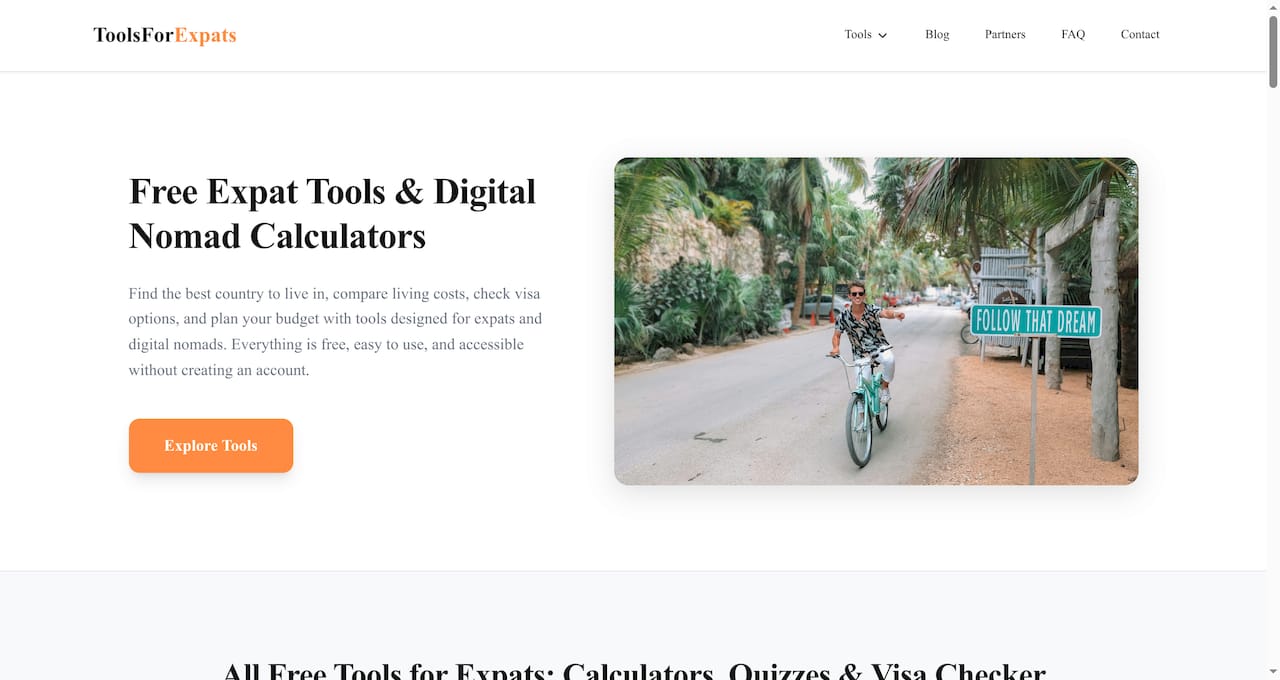
ToolsForExpats offers a suite of free planning tools built specifically for nomads and expats. The cost of living comparison tool lets you compare monthly expenses across cities side by side, so you can calculate a realistic 1.5× revenue floor for Chiang Mai versus Lisbon versus Mexico City. The visa eligibility checker tells you which countries offer digital nomad visas and whether you qualify, before you book a long-term stay. No account required, no fees, no paywalls. Try the nomad cost calculator now and build your income plan on real numbers.
Further reading and authoritative tools
- How Digital Nomads Actually Make Money (SG Nomad Wealth) — comprehensive breakdown of remote employment, freelancing, and online business models with 2026 income data
- 50 Digital Nomad Business Ideas (IdeaProof) — detailed earnings ranges and startup costs for 50 specific nomad business models
- How to Build Passive Income While Traveling (SG Nomad Wealth) — practical guide to front-loaded passive income strategies and automation
- Essential Passive Income Strategies for Digital Nomads (Natouris) — covers affiliate commissions, digital products, and investment yields with specific figures
- Digital Nomad Passive Income Guide (DigitalNomad.gg) — income stack framework and semi-passive stream recommendations
- Digital Nomad Business Models (Martin Ebongue) — revenue floor rules and risk management for full-time nomads
- ToolsForExpats Free Calculators and Visa Checker — cost of living comparisons, nomad budget calculators, and visa eligibility tools for planning your income targets by city
This article is general information, not tax or financial advice. U.S. filers should confirm current rules with the IRS or consult a qualified CPA for their specific situation.