
Remote passive income is defined as earning money from assets or systems you build once, which then generate revenue with little ongoing daily effort. Understanding how passive income works remotely is the difference between trading hours for dollars indefinitely and building financial independence that travels with you. The best remote passive income streams fall into two broad categories: digital asset creation (courses, ebooks, templates) and investment-based income (dividends, real estate crowdfunding). Remote workers hold a structural advantage here. Skipping the daily commute frees up 234 hours per year on average. That time is your raw material.
What are the main models for generating passive income remotely?
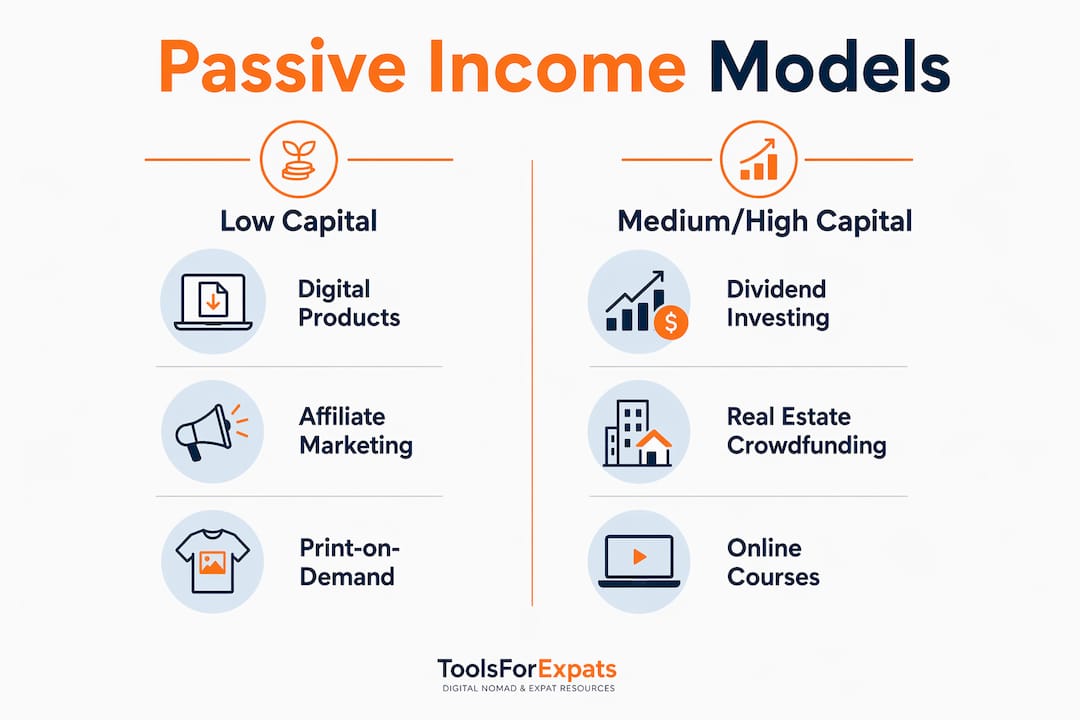
Remote passive income is not one strategy. It is a family of distinct models, each with different capital requirements, skill demands, and timelines.
Digital products are the highest-return entry point for most freelancers and entrepreneurs. A well-built online course, ebook, or template library can generate $10,000+ in revenue over two years from roughly 20 hours of initial creation work. That math works out to an effective rate of $500 per hour. Digital products also carry near 100% profit margins after launch, since there is no inventory or shipping cost.

Dividend investing works differently. You deploy capital into dividend-paying stocks or index funds, and those holdings pay you quarterly. The catch is scale. Generating $500 per month in dividend income requires $120,000–$200,000 in invested capital, depending on the yield. This model suits people who already have savings to deploy, not those starting from zero.
Real estate crowdfunding lets you invest in property projects remotely through online platforms, without owning or managing physical property. It sits between dividend stocks and direct real estate in terms of risk and return. For a deeper look at how these property investment models compare, the structure matters as much as the return rate.
Affiliate marketing and niche content work by building an audience around a specific topic, then earning commissions when readers buy products you recommend. This model requires consistent content output upfront but can generate steady monthly income once a site or channel gains traction.
Print-on-demand and stock content (photos, music, video clips, design assets) let you upload creative work once and earn royalties each time someone purchases it. The income per sale is modest, but the catalog compounds over time.
Pro Tip: Pick one model and build it to $500 per month before adding a second stream. Spreading effort across three models simultaneously is the most common reason beginners stall out.
| Model | Capital needed | Effort to start | Time to first income |
|---|---|---|---|
| Digital products | Low | High | 3–6 months |
| Dividend investing | High | Low | Immediate (after capital deployed) |
| Real estate crowdfunding | Medium | Low | 1–3 months |
| Affiliate marketing | Low | High | 6–18 months |
| Print-on-demand | Low | Medium | 1–4 months |
How long does it realistically take to build remote passive income?
Patience is the skill most passive income guides forget to teach. Building stable remote passive income realistically takes 12–24 months before revenue becomes consistent enough to rely on. That timeline surprises people who expect faster results, but it reflects how digital audiences, search rankings, and product reputations actually grow.
The timeline varies by model. Here is how the progression typically looks:
- Months 1–3: Research, create, and publish your first asset. This is the highest-effort phase. Expect zero or near-zero income.
- Months 4–6: Refine based on early feedback. Run basic marketing. Income may trickle in but rarely covers meaningful expenses yet.
- Months 7–12: Traffic and sales begin compounding if you have stayed consistent. Digital products and affiliate sites often see their first meaningful revenue here.
- Months 12–24: Revenue stabilizes. You can start reinvesting earnings into a second stream or scaling the first.
- Month 24+: With two assets performing, you have the foundation of a diversified remote income system.
Investment-based streams like dividends skip the content-building phase but require capital to be in place first. The compounding effect still takes years to produce life-changing income at typical yield rates.
"Remote passive income is the shift from trading time daily to building assets that compound value over time. The goal is not to stop working. It is to make your past work keep paying you."
Avoiding burnout during the build phase matters as much as the strategy itself. Time-boxing your passive income work to two focused hours per day prevents it from cannibalizing your active income or personal life.
What effort, skills, and capital do you need to start?
The core trade-off in every passive income model is simple: you pay with time or you pay with money. Most people starting out have more time than capital, which points them toward digital content creation and affiliate marketing. Those with savings already built may find passive investment approaches more efficient.
| Strategy | Capital required | Primary skill needed | Ongoing maintenance |
|---|---|---|---|
| Online course or ebook | $0–$500 | Writing, teaching, or design | Updates every 6–12 months |
| Affiliate content site | $100–$500/year | SEO, writing, niche research | Weekly content for first year |
| Dividend portfolio | $50,000+ | Financial research, patience | Quarterly rebalancing |
| Real estate crowdfunding | $1,000–$10,000 | Due diligence | Minimal after investment |
| Print-on-demand | $0–$200 | Graphic design or photography | Catalog expansion |
Skills matter as much as capital. Digital product creators need to write clearly, teach effectively, or design well. Affiliate marketers need to understand search intent and content structure. Investors need patience and basic financial literacy. None of these are gatekept skills. All of them are learnable, and many freelancers already have them from client work.
Platform dependency is a real risk. Building an owned audience through an email list or personal brand gives you control that no single platform can take away. An algorithm change on a content platform or a policy shift on a marketplace can cut income overnight. Your email list cannot be deplatformed.
Pro Tip: Before investing in any passive income model, calculate your minimum viable income target. Knowing you need $1,500 per month to cover your living costs abroad helps you choose the right model and set a realistic timeline.
How do you scale and diversify remote passive income streams?
Scaling passive income remotely is about building systems, not just adding more products. The 1+2 model is the most practical framework for remote workers: maintain one active income source (your freelance work or remote job) while building two passive assets simultaneously. This keeps financial pressure low while you build.
Diversification between digital assets and investments protects you from single-point failures. If your course sales slow during a market shift, dividend income or affiliate commissions can buffer the gap. The goal is not to have ten streams. It is to have two or three that are genuinely healthy.
Automation is what turns a side project into a real system. Key areas to automate include:
- Email sequences: Set up a welcome series and product promotion emails that run without you.
- Payment and delivery: Use platforms that handle transactions, file delivery, and receipts automatically.
- Content scheduling: Batch-create social or blog content and schedule it weeks in advance.
- Analytics alerts: Set threshold alerts so you only check metrics when something changes, not daily.
Cross-platform leverage compounds your reach. A single piece of research can become a blog post, a YouTube video, a newsletter issue, and a social thread. Each format reaches a different audience and feeds traffic back to your core asset. Experienced remote earners caution against spreading too thin across too many streams at once. Depth in one channel beats shallow presence in five.
If you are planning to earn remotely from another country, understanding your visa options is a prerequisite. The digital nomad lifestyle in 2026 has expanded significantly, with more countries offering structured visa pathways for location-independent earners.
| Scaling stage | Focus | Key action |
|---|---|---|
| Stage 1: $0–$500/month | Validation | Build and sell one digital asset |
| Stage 2: $500–$2,000/month | Optimization | Improve conversion, grow email list |
| Stage 3: $2,000+/month | Diversification | Add second stream, automate first |
Key Takeaways
Remote passive income works by converting upfront time or capital into assets that generate ongoing revenue, with realistic timelines of 12–24 months before income becomes stable and dependable.
| Point | Details |
|---|---|
| Timeline is 12–24 months | Expect a year or more before passive income becomes consistent and meaningful. |
| Digital products offer the best ROI | Twenty hours of creation work can generate $10,000+ over two years with near-zero overhead. |
| Capital scales investment income | Generating $500 per month in dividends requires $120,000–$200,000 in invested capital. |
| Own your audience | Build an email list to protect income from platform policy changes or algorithm shifts. |
| Use the 1+2 model | Keep one active income source while building two passive streams to reduce financial pressure. |
The part most guides skip entirely
Most passive income content sells you on the outcome and glosses over the maintenance. I have seen this pattern repeatedly: someone builds a solid course or affiliate site, earns well for six months, then watches revenue drop because they stopped updating the content. Profitable digital assets require regular updates and ongoing marketing to stay relevant. "Set and forget" is a myth that costs people real money.
The readers who succeed are the ones who treat passive income like a business, not a lottery ticket. They pick one model that matches their existing skills. A copywriter builds an ebook or email template pack. A developer builds a software tool or plugin. A photographer uploads to stock libraries. They are not starting from scratch. They are productizing what they already know.
My honest recommendation: start with a nomad income backup plan before you go all-in on passive income. Having a clear financial floor, knowing your minimum monthly costs, and having one reliable active income source removes the desperation that leads to poor decisions. Passive income built from a position of stability grows faster than passive income built from panic.
The goal is not to stop working. The goal is to build assets that work when you are not.
— Jay
Planning your remote income life with ToolsForExpats
Building passive income remotely is only half the equation. Knowing where to live, what it costs, and whether you qualify for a digital nomad visa shapes how far your income actually goes.
ToolsForExpats offers a free suite of calculators and tools built specifically for remote workers and expats. Use the nomad cost calculator to compare your monthly expenses across cities and find where your passive income stretches furthest. Check your eligibility for over 20 digital nomad visa programs with the visa eligibility checker. Every tool is free, requires no account, and gives you real numbers to plan with. When your income is location-independent, your cost of living becomes a variable you can control.
FAQ
What is the fastest remote passive income stream to start?
Digital products like ebooks, templates, or mini-courses are the fastest to launch, often generating first sales within weeks of publication. They require low capital and use skills most freelancers already have.
How much money do I need to start earning passive income remotely?
You can start with under $500 using digital products or affiliate content, but investment-based streams like dividend portfolios require $120,000–$200,000 to generate $500 per month in income.
Does passive income affect my digital nomad visa eligibility?
Visa requirements vary by country, but most digital nomad visas require proof of a minimum monthly income from remote sources, which passive income can satisfy if it meets the threshold. Check specific country requirements before applying.
How do I protect my passive income from platform shutdowns?
Build an owned email list and personal brand alongside any platform-dependent income. An email list gives you direct access to your audience regardless of what any single platform does.
Can I build passive income while working a full-time remote job?
Yes. The 1+2 model is designed for exactly this situation: maintain your active remote job while building two passive assets on the side, using the 234 hours per year you save by not commuting.