
Expense tracking is the practice of systematically recording and analyzing every dollar you spend to gain real control over your finances. For digital nomads, this practice is not optional. Travel costs can vary by as much as 400% depending on destination, season, and lifestyle choices. Without a clear record of where your money goes, you are making financial decisions based on guesswork. Tools like YNAB, Expensify, and NomadWallet exist precisely because nomads need structured financial visibility across currencies, countries, and constantly shifting cost environments. This guide explains why nomads track expenses, how to do it effectively, and what you gain beyond a simple spreadsheet.
Why nomads track expenses: the core benefits
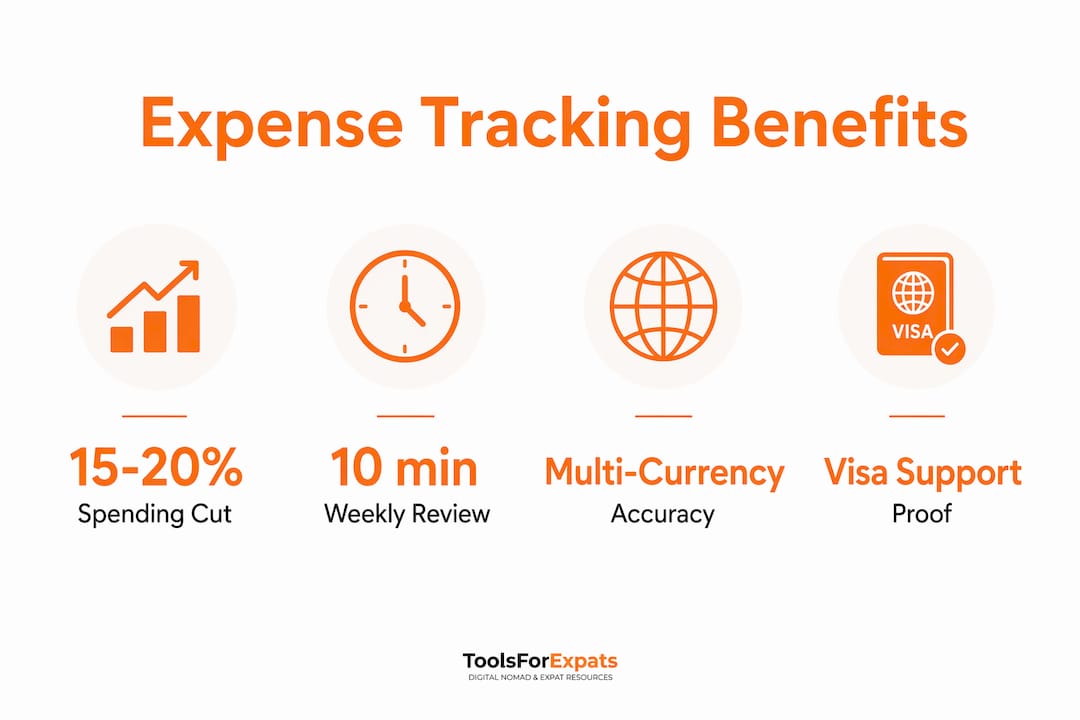
Tracking expenses creates a behavioral shift that budgeting alone cannot. Studies show that tracking reduces spending by 15–20% on average. That reduction does not come from willpower. It comes from visibility.
Most people discover $200–$500 in monthly spending leakage within the first 30 days of tracking. For nomads, that leakage often hides in forgotten SaaS subscriptions, automatic renewals billed in foreign currencies, and small daily purchases that feel insignificant in the moment. Seeing those numbers in one place triggers a natural loss-aversion response. You correct the behavior without feeling deprived.
Here are the core benefits nomads consistently report after building a tracking habit:
- Behavioral correction without restriction. Making invisible losses visible encourages behavioral change more effectively than a strict budget. You spend less because you see more.
- Emergency fund clarity. Experts recommend nomads maintain 3 to 6 months of expenses in liquid savings. You cannot build that fund accurately without knowing your real monthly baseline.
- Subscription and fee detection. Nomads using multiple banking apps, VPNs, cloud storage services, and travel tools accumulate recurring charges fast. Tracking catches these before they compound.
- Cost fluctuation awareness. When you move from Lisbon to Chiang Mai to Medellín, your cost of living shifts dramatically. Tracking gives you a real comparison across destinations, not just estimates from travel blogs.
- Long-term financial planning. Monitoring correlates with 40% higher savings rates in studies of 12,000 people. That kind of compounding advantage matters when you have no employer pension or automatic savings plan.
"Tracking is not about restriction. It is about knowing the truth of your financial life so you can make decisions from a position of strength, not anxiety."
Building this habit early protects you from the most common nomad financial trap: arriving in a new country with a vague sense of your budget and leaving with a depleted account and no clear explanation of why.
How do expense tracking and budgeting differ for nomads?
Tracking and budgeting are two distinct financial practices. Confusing them is one of the most common mistakes nomads make. Tracking records what you actually spent. Budgeting plans what you intend to spend. Both matter, but tracking must come first.

Without tracking, budgeting is guesswork that is often off by 30% or more. A nomad who budgets $2,000 per month for Southeast Asia without tracking data from a previous stay is essentially estimating. That estimate rarely accounts for visa fees, co-working day passes, airport transfers, or the extra week in a hotel when an apartment falls through.
Here is how the two practices work together in a practical nomad workflow:
- Track first for 30 days. Record every transaction in every currency without filtering or categorizing. This gives you a raw data baseline.
- Categorize your spending. Group transactions into nomad budget categories like housing, food, transport, work tools, health, and entertainment.
- Identify your real averages. Calculate your actual monthly spend per category across two or three locations.
- Build your budget from that data. Set realistic limits based on what you have actually spent, not what you hope to spend.
- Track against the budget going forward. Use your tracking app to flag when you are approaching a category limit.
This sequence turns raw transaction data into a financial decision-making tool. Skipping step one and jumping straight to budgeting produces a plan with no foundation.
Pro Tip: Set up a weekly 10-minute review of your tracked expenses. Catching a problem at $50 is far easier than catching it at $500.
What are the practical challenges of tracking costs as a nomad?
Nomads face tracking challenges that most personal finance guides ignore entirely. Multi-currency transactions, unreliable internet, and security risks on public networks all create friction that can derail even a motivated tracker.
Multi-currency accuracy
Manual currency conversions introduce errors that compound over time. The correct approach is to track in original currency with automated foreign exchange rate updates. Apps like Expensify and Finny pull daily FX rates and convert automatically. This keeps your records audit-ready and eliminates the rounding errors that distort your real spending picture.
Dynamic Currency Conversion is a specific trap to watch. When a merchant or ATM offers to charge you in your home currency instead of the local one, the exchange rate applied is almost always worse than your bank's rate. Always pay in local currency and let your tracking app handle the conversion.
Banking structure for nomads
Successful nomads adopt a hub-and-spoke banking model to manage multi-currency spending. A primary home account acts as the hub, holding your savings and receiving income. Multi-currency fintech accounts like Wise or Revolut serve as spokes for daily spending in local currencies. This structure reduces transaction fees and keeps your tracking data cleaner because each account has a defined purpose.
| Challenge | Weak approach | Strong approach |
|---|---|---|
| Multi-currency transactions | Manual conversion at time of entry | Automated FX pull in original currency |
| Banking fees | Single home bank card abroad | Hub-and-spoke with Wise or Revolut |
| Data security | Tracking on public Wi-Fi without protection | VPN plus password manager on all devices |
| Subscription tracking | Reviewing charges monthly | Weekly audit with a dedicated category |
Security on the road
Security breaches via public Wi-Fi can expose your financial data and trigger fraudulent charges. Use a reputable VPN whenever you access banking or expense apps on shared networks. A password manager like 1Password or Bitwarden adds another layer of protection by generating and storing unique credentials for every financial account.
Pro Tip: Enable two-factor authentication on every financial app you use. A compromised expense tracker is a direct window into your banking activity.
How does tracking support visa applications and tax filing?
Expense tracking delivers value well beyond personal budgeting. Organized financial records are a practical asset when you apply for digital nomad visas, file taxes across jurisdictions, or negotiate rates with clients.
Many countries now offer digital nomad visa programs, including Portugal, Spain, Costa Rica, and Thailand. Most require proof of consistent income and financial stability. Clean, categorized expense records demonstrate that you manage your finances responsibly. They show a clear picture of your monthly outgoings, which supports your case when authorities assess whether you can sustain yourself without drawing on local resources. You can check your eligibility for over 20 countries using the nomad visa checker from ToolsForExpats.
Tax filing is another area where tracking pays off directly. Properly organized records can cut tax prep time from two weeks to under two hours. That is not a minor convenience. For nomads managing income from multiple clients across multiple countries, disorganized records can mean missed deductions, filing errors, and penalties.
Here is what well-tracked expense data does for you administratively:
- Tax deduction identification. Co-working fees, software subscriptions, travel between client locations, and home office costs are often deductible. Tracking captures these automatically when you use the right categories.
- Visa proof of funds. A clean 6-month expense report shows exactly what you spend and confirms you have the reserves to cover it.
- Freelance rate negotiation. Knowing your real cost of living in a given city gives you a concrete floor for your minimum acceptable rate. You stop guessing and start negotiating from data.
- Client invoicing accuracy. If you bill expenses to clients, tracked records with receipts eliminate disputes and speed up payment.
- Audit readiness. If a tax authority ever questions your filings, organized records with original currency amounts and automated FX conversions are far more defensible than reconstructed estimates.
Building an emergency fund alongside your tracking practice adds another layer of financial security, especially when visa applications or tax timelines create unexpected cash flow gaps.
Key Takeaways
Nomads who track expenses consistently spend less, save more, and handle administrative requirements with far less stress than those who rely on estimates.
| Point | Details |
|---|---|
| Tracking reduces spending | Monitoring expenses cuts spending by 15–20% through behavioral awareness, not willpower. |
| Tracking precedes budgeting | Build your budget from 30 days of real tracked data to avoid the 30% error margin of pure guesswork. |
| Multi-currency accuracy matters | Track in original currency with automated FX tools to keep records audit-ready and error-free. |
| Hub-and-spoke banking reduces friction | Use a primary account plus Wise or Revolut to simplify multi-currency tracking and cut fees. |
| Records serve legal and professional needs | Organized expense data speeds up tax filing, supports visa applications, and strengthens freelance negotiations. |
Why I think most nomads start tracking too late
Most nomads I have seen get serious about expense tracking only after a financial scare. A surprise tax bill, a visa rejection due to unclear financials, or a month where the account balance simply did not add up. By that point, they are reconstructing months of transactions from memory and bank statements, which is painful and inaccurate.
The nomads who build the habit before they need it are the ones who move through the lifestyle with genuine confidence. They know their real cost of living in Bali versus Berlin. They know exactly how much runway they have if a client disappears. They walk into visa appointments with clean documentation instead of scrambled spreadsheets.
What I find most interesting is that tracking does not feel restrictive once you start. It feels clarifying. You stop carrying a vague anxiety about money and replace it with actual numbers. That shift in mindset is worth more than any specific saving you identify. Adopt a digital tool early, whether that is YNAB, Expensify, or a purpose-built nomad app. Set it up before your next move, not after.
— Jay
Plan your nomad budget with free tools from ToolsForExpats
Knowing why financial tracking matters is the first step. Having the right tools to act on that knowledge is the second.
ToolsForExpats offers a full suite of free nomad financial tools built specifically for people managing expenses across borders. Use the cost of living calculator to estimate real monthly expenses in cities worldwide before you commit to a move. Compare destinations side by side, check visa eligibility, and plan your budget without creating an account. Every tool is free and ready to use right now.
FAQ
Why do nomads track expenses more carefully than regular travelers?
Nomads manage ongoing living costs across multiple countries, not just trip budgets. Travel costs can vary by 400%, making consistent tracking the only reliable way to maintain financial stability long-term.
What is the difference between tracking and budgeting for nomads?
Tracking records actual spending. Budgeting plans future spending. Tracking must come first because budgeting without real data is off by 30% or more on average.
Which apps do digital nomads use to track expenses?
YNAB, Expensify, and NomadWallet are widely used by nomads. The best choice supports multi-currency tracking with automated FX rate conversion to keep records accurate across destinations.
How does expense tracking help with digital nomad visa applications?
Most digital nomad visa programs require proof of financial stability. Clean, categorized expense records demonstrate consistent spending patterns and confirm you can support yourself without local employment.
How quickly does expense tracking improve your finances?
Most people identify $200–$500 in monthly spending leakage within the first 30 days of tracking. Studies of 12,000 people link consistent monitoring to 40% higher savings rates over time.