
Why routine matters for digital nomads
Routine is not the enemy of freedom. For digital nomads, it is the foundation that makes freedom sustainable. Without some consistent structure, the constant novelty of location-independent life quickly tips from exciting into exhausting.
The core reason why routine matters for nomads comes down to psychology. Structured daily patterns reduce anxiety and depression by creating predictability in an otherwise unpredictable lifestyle. When your environment changes every few weeks, your nervous system craves something stable to hold onto. A routine provides exactly that.
Here is what consistent daily habits deliver for nomads:
- Reduced anxiety and stress: Predictable patterns calm the nervous system before the day's uncertainty sets in.
- Stronger psychological resilience: Research from the Journal of the International Neuropsychological Society found that individuals who maintained structured daily routines scored significantly higher on psychological resilience assessments than those who did not.
- Better productivity: Automating low-stakes decisions preserves your cognitive energy for the work that actually matters.
- Improved work-life balance: A clear start and end to your workday prevents the blur between work and rest that plagues many remote workers.
- Long-term health: Keystone habits in your routine tend to cascade into improvements across sleep, nutrition, and exercise.
52% of digital nomads report increased anxiety linked to a lack of routine and social isolation. Building even a minimal daily structure directly addresses this.
The goal is not a rigid schedule. It is a reliable framework you can carry with you anywhere.

Why adapting your routine to new environments is harder than it sounds
The nomadic lifestyle creates a specific set of challenges that make routine-building genuinely difficult, not just a matter of discipline. Understanding these obstacles is the first step to working around them.
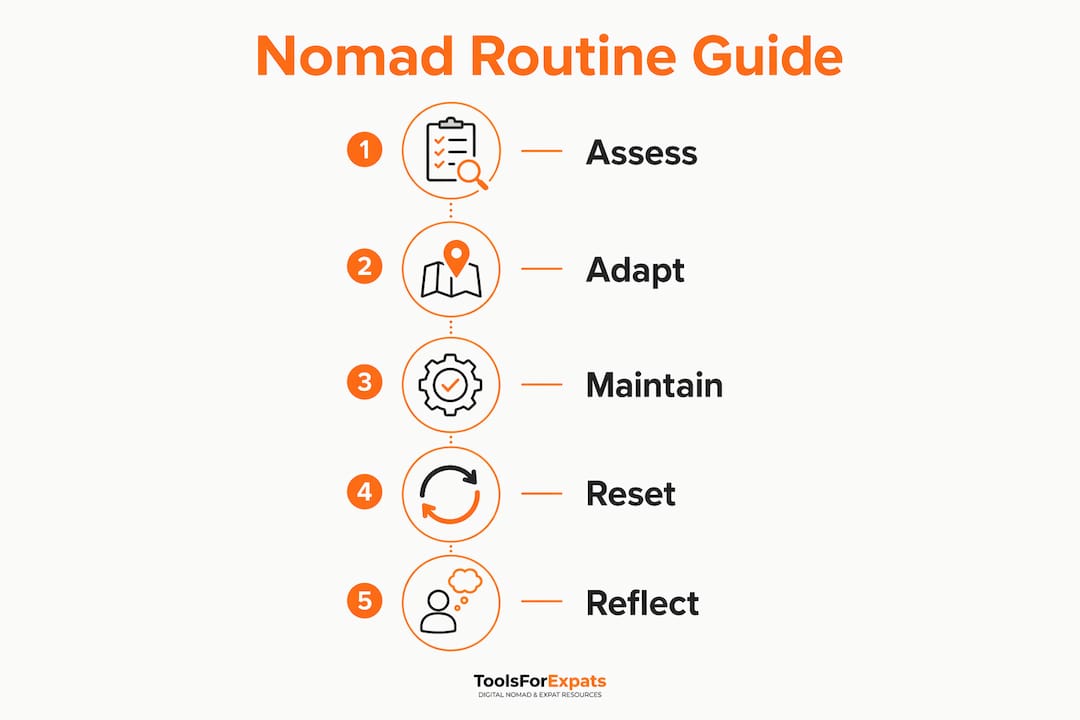
Mobility challenges place attachment, creating a sense of "placelessness" that can undermine your sense of stability and belonging. When you do not feel at home anywhere, it is hard to build habits that feel grounded.
The most common friction points nomads face:
- Environmental instability: A new city means a new workspace, new noise levels, new time zones, and new logistics. Each move resets the context your habits depend on.
- Blurred work-rest boundaries: Cafes, co-working spaces, and Airbnbs are not designed for the psychological separation between work and downtime that a dedicated home office provides.
- Income unpredictability: Irregular freelance or client income adds financial stress that competes directly with your mental bandwidth for habit formation.
- Social fragmentation: Shallow or rotating social connections make it harder to maintain the accountability structures that support consistent habits.
- Cognitive overload: Managing visas, accommodation, banking, taxes, and travel logistics across multiple countries is mentally exhausting before you even open your laptop.
The good news is that job stress and well-being challenges in nomadic work respond well to individual behavioral strategies. You do not need a perfect environment. You need a portable structure.
How to build a daily routine that actually travels with you
The most effective nomad routines are not elaborate. They are repeatable. Two or three consistent morning steps can calm your nervous system and preserve mental energy for high-stakes decisions later in the day. The simpler the ritual, the more likely it survives a new city.
A practical daily structure for nomads looks like this:
- Anchor your morning with 2–3 fixed actions: Coffee, a 10-minute walk, or five minutes of journaling. The content matters less than the consistency.
- Identify your keystone habit: One habit that, when done, tends to pull other positive behaviors along with it. For many nomads, exercise or meditation serves this role.
- Time-block your deep work: Protect a 2–3-hour window for your most demanding tasks before decision fatigue sets in. Elite professionals repeat rigid routines in trivial parts of their day specifically to protect mental energy for important work.
- Batch administrative tasks: Group emails, invoices, and logistics into one daily slot rather than letting them interrupt focused work throughout the day.
- Create a shutdown ritual: A brief, consistent end-of-day signal, like closing all tabs and writing tomorrow's top three priorities, helps your brain transition out of work mode.
Pro Tip: Set your morning routine before you arrive in a new city. Decide in advance which coffee shop or park you will use for your first week. Removing that one decision makes the whole routine easier to restart.
For deeper guidance on maintaining work-life balance as a nomad, the strategies above pair well with clear boundaries around your work hours.

Why monthly resets keep your finances and mental health on track
Daily habits handle the micro-level. Monthly check-ins handle everything else. A monthly reset is a structured, low-pressure review that keeps your finances, goals, and mental state aligned with where you actually are, not where you were three cities ago.
Here is what a solid monthly reset covers:
- Financial review: Reconcile income and expenses, check your budget against actual spending, and flag any upcoming tax obligations. Nomads managing income across multiple currencies or jurisdictions benefit especially from a consistent monthly bookkeeping habit.
- Mental health reflection: Spend 20–30 minutes journaling on what drained you, what energized you, and what you want more or less of next month. Routines act as stabilizing forces during financial or emotional hardship, and a monthly check-in is where you catch problems before they become crises.
- Routine audit: Ask honestly whether your current habits still fit your current location and workload. A routine built for Bali may not work in Berlin.
- Goal recalibration: Review your professional and personal goals. Adjust timelines without guilt. Nomadic life moves fast, and rigid goal-setting often creates unnecessary pressure.
- Digital and administrative tasks: Renew subscriptions you actually use, check visa expiration dates, and clear your inbox backlog. Use ToolsForExpats' visa eligibility checker to stay ahead of any upcoming travel or residency requirements.
The monthly reset is not about perfection. It is about staying intentional rather than reactive.
Signs your routine has stopped working and what to do about it
A routine that served you well in one season of nomadic life can quietly become a source of friction in another. Knowing when to adjust is as important as knowing how to build.
Watch for these signals:
- Persistent fatigue or burnout despite getting enough sleep, which often points to a routine that is too demanding or poorly timed.
- Missed goals week after week, which suggests your habits are not aligned with your actual priorities or energy levels.
- Dreading your own schedule, a clear sign that the routine has become rigid rather than supportive.
- Rising stress around routine tasks, which may indicate the routine no longer fits your current environment or workload.
- Loss of focus during work blocks, often caused by inadequate transition rituals between rest and deep work.
When you spot these signs, the fix is rarely to abandon structure entirely. Instead, simplify. Strip the routine back to its two or three most essential elements and rebuild from there. Digital nomad stress responds best to tailored, individual solutions rather than generic prescriptions, so treat your routine as a living document, not a fixed contract.
The mindset shift that helps most: think of your routine as a tool that works for you, not a standard you are failing to meet. Adjust it without guilt, and adjust it often.
What the science says about routines and mental health for nomads
The psychological case for routine is well-established, and it applies with particular force to people living in conditions of chronic uncertainty, exactly the conditions that define nomadic life.
Individuals who maintained structured daily routines during the COVID-19 pandemic, a period of intense environmental unpredictability, scored significantly higher on the Connor-Davidson Resilience Scale than those who did not, according to research published in the Journal of the International Neuropsychological Society. The effect held even after controlling for sleep duration.
Routine also protects cognitive performance through a well-documented mechanism: decision fatigue. Every choice you make, from what to eat to which task to tackle first, draws on a finite pool of mental energy. Automating trivial decisions through routine conserves that energy for the creative and strategic work that defines most nomad careers.
Researchers describe routine as "infrastructure for creativity." When the small stuff runs on autopilot, your executive function stays available for the problems that actually require it. For nomads, who face an unusually high volume of logistical decisions every day, this cognitive conservation is not a luxury. It is a professional advantage.
Placemaking research adds another layer. Nomads who build routines in new environments move from a state of "placelessness" to "placefulness" faster, integrating freedom with stability in a way that supports both productivity and psychological well-being. The routine becomes the home you carry with you.
Building emotional resilience through consistent daily patterns is one of the most practical investments a nomad can make in their long-term mental health.
What successful nomad routines actually look like in practice
Experienced digital nomads tend to share a few structural patterns, even when the specific content of their routines varies widely.
The "portable anchor" approach is common among long-term nomads. Rather than trying to replicate a full home routine in each new city, they identify two or three non-negotiable daily anchors, typically a morning ritual, a fixed work start time, and an evening wind-down, and let everything else flex around those. The anchors travel; the details adapt.
Time zone discipline is another recurring theme. Nomads who work with clients or teams in fixed time zones often build their entire day around a protected overlap window. Everything else, exercise, meals, exploration, gets scheduled around that constraint. The external deadline becomes the structure.
Weekly "admin days" appear frequently in how experienced nomads describe their routines. Designating one morning per week for logistics, invoicing, and planning keeps those tasks from bleeding into focused work time throughout the week. It also creates a predictable rhythm that feels more like a workday and less like constant firefighting.
Setting clear daily intentions each morning is a practice many experienced nomads credit for keeping their days purposeful rather than reactive, particularly when working from environments full of distractions.
The common thread across all of these approaches is that the routine serves the nomad's actual goals and energy patterns, not an idealized version of productivity. Understanding what the digital nomad lifestyle actually demands in 2026 makes it easier to build habits that hold up in the real world.
Plan your nomad life with free tools from ToolsForExpats
Building a sustainable routine is easier when your logistics are under control. ToolsForExpats offers a free suite of calculators and tools designed specifically for digital nomads and expats, covering budgets, cost of living comparisons, and visa planning. No account required.
Use the nomad cost calculator to build a city-specific budget, or explore the full free expat tools suite to plan your next move with confidence.
Key Takeaways
Routine is the single most effective tool digital nomads have for protecting mental health, sustaining productivity, and maintaining well-being across constantly changing environments.
| Point | Details |
|---|---|
| Routine reduces anxiety | 52% of digital nomads report increased anxiety linked to a lack of routine and social isolation. |
| Resilience and structure are linked | Nomads above average in routine adherence scored 71.1 on resilience assessments vs. 59.2 for those below average. |
| Simplicity beats complexity | Two or three consistent morning steps are enough to calm the nervous system and protect cognitive energy. |
| Monthly resets prevent drift | A monthly financial and mental health check-in keeps routines aligned with your current location and goals. |
| Adjust routines without guilt | When a routine stops working, strip it back to its core elements and rebuild rather than abandoning structure entirely. |