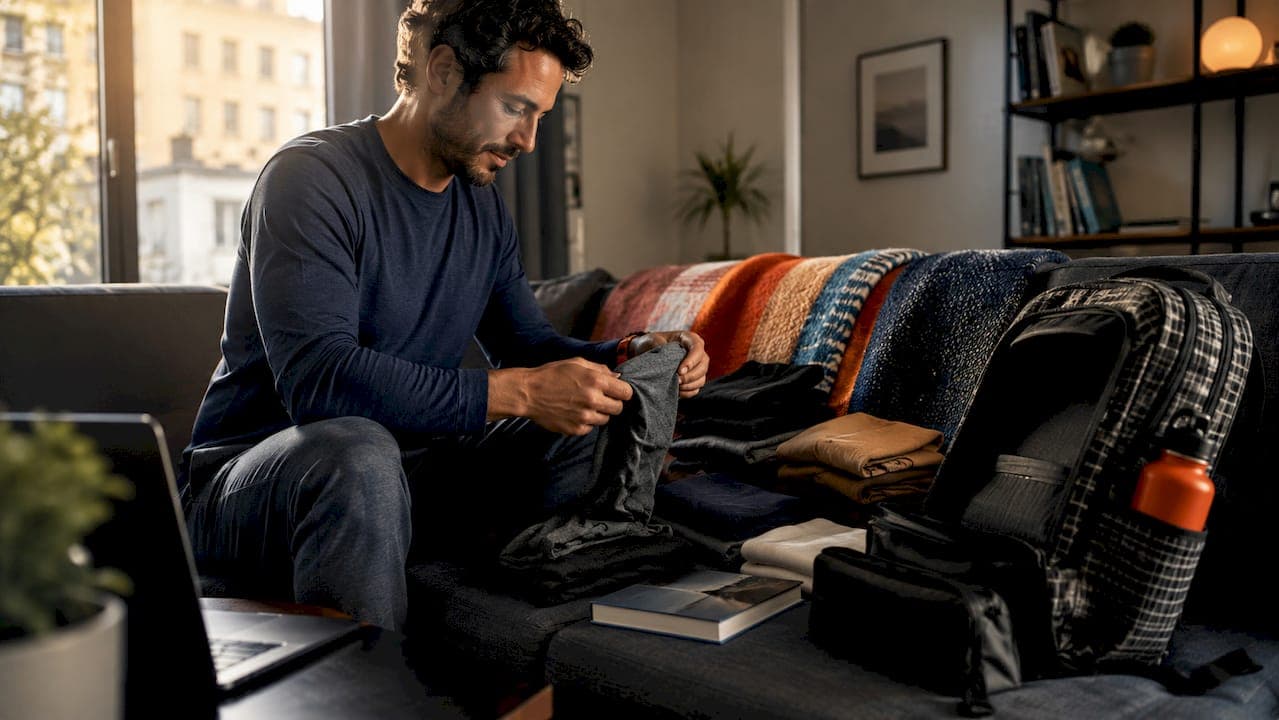
Nomad packing philosophy is a deliberate, context-driven system for carrying only what you genuinely need, built around mobility, versatility, and purposeful item selection rather than simply owning less. It combines minimalist packing strategy with practical frameworks like capsule wardrobes, carry-on-only constraints, and curated tech kits that support remote work across multiple destinations. Unlike generic travel advice, this philosophy treats your bag as a mobile operating system: every item earns its place by serving multiple functions, surviving diverse climates, and fitting within strict weight limits. If you are planning a nomadic lifestyle or your first extended trip, understanding this system will change how you think about everything you own.
What is nomad packing philosophy, and what principles define it?
Nomad packing philosophy is defined as a mindset and repeatable system that prioritizes intentional, context-aware item selection over volume reduction alone. The goal is not to pack as little as possible. The goal is to pack exactly what works, nothing more.
Several core principles hold this philosophy together:
- Minimalism with purpose. Every item must justify its weight by serving at least two functions. A merino wool shirt that works in a business meeting and a hiking trail earns its spot. A single-use formal blazer does not.
- Versatility through cross-compatibility. Clothing items must coordinate with each other. The Rule of 3 requires every garment to pair with at least three other items in your bag, maximizing outfit combinations without adding volume.
- Context awareness. Climate, local culture, shopping access, and dress expectations all shape what goes into your bag. A nomad heading to Southeast Asia packs differently than one based in Northern Europe in winter.
- Carry-on discipline. Keeping your total bag weight under 22 lb (10 kg) eliminates checked baggage fees, speeds up airport transitions, and gives you the freedom to take budget airlines without penalty.
- Durability over quantity. Multi-use, durable items replace single-purpose gear. One high-quality rain jacket replaces an umbrella, a windbreaker, and a light sweater.
Pro Tip: Before your next trip, lay out everything you plan to pack, then remove one third of it. You will almost certainly not miss those items, and your back will thank you.
The philosophy also extends to how you think about replenishment. Experienced nomads plan to do laundry every seven to ten days and buy consumables locally rather than packing for every possible scenario. This replacement mindset is what separates true nomad packing from generic minimalism.
How do capsule wardrobe systems like 4-3-2-1 translate the philosophy into practice?
The most practical tool for applying nomad packing philosophy to clothing is the capsule wardrobe system. A travel capsule typically contains 10 to 15 items total, built around a baseline formula that removes guesswork from packing decisions.
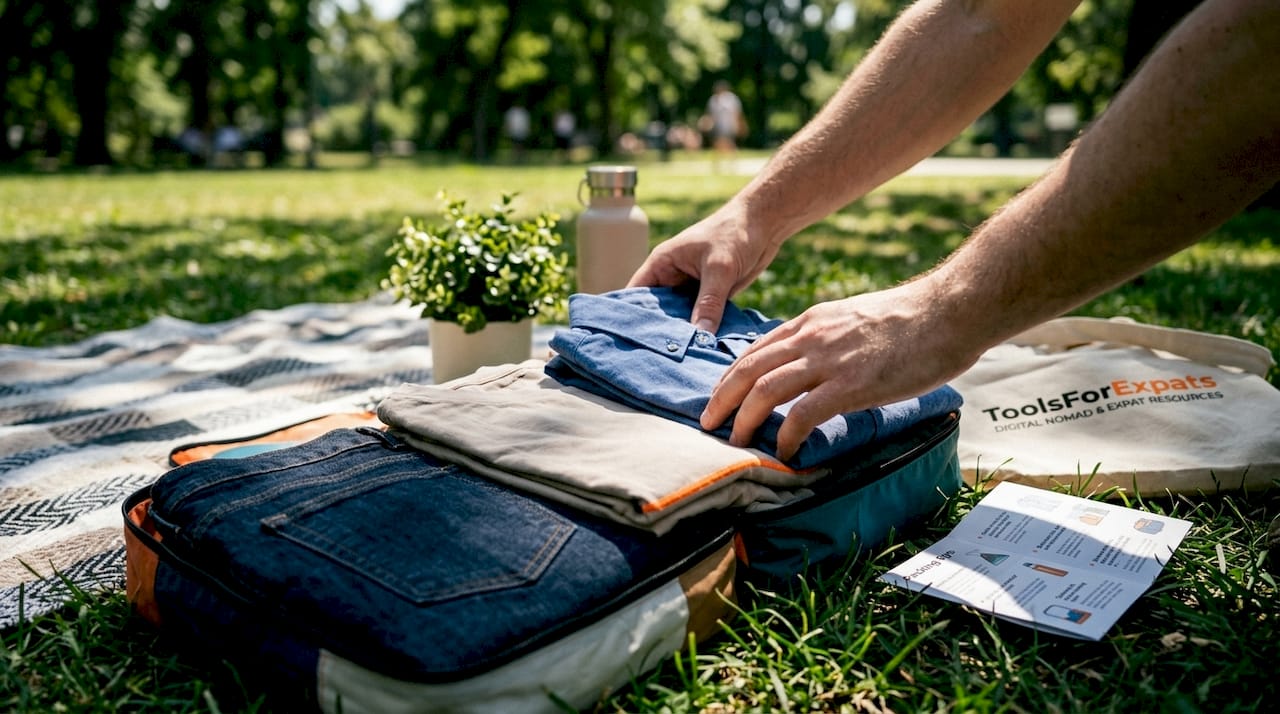
The 4-3-2-1 formula breaks down like this:
| Category | Count | Example items |
|---|---|---|
| Tops | 4 | 2 neutral tees, 1 button-down, 1 merino long-sleeve |
| Bottoms | 3 | 1 jeans, 1 chinos, 1 shorts or skirt |
| Layers | 2 | 1 light jacket, 1 packable rain shell |
| Wildcard | 1 | Dress, blazer, or specialty item for your destination |
| Shoes | 2 | 1 versatile sneaker, 1 sandal or dress shoe |
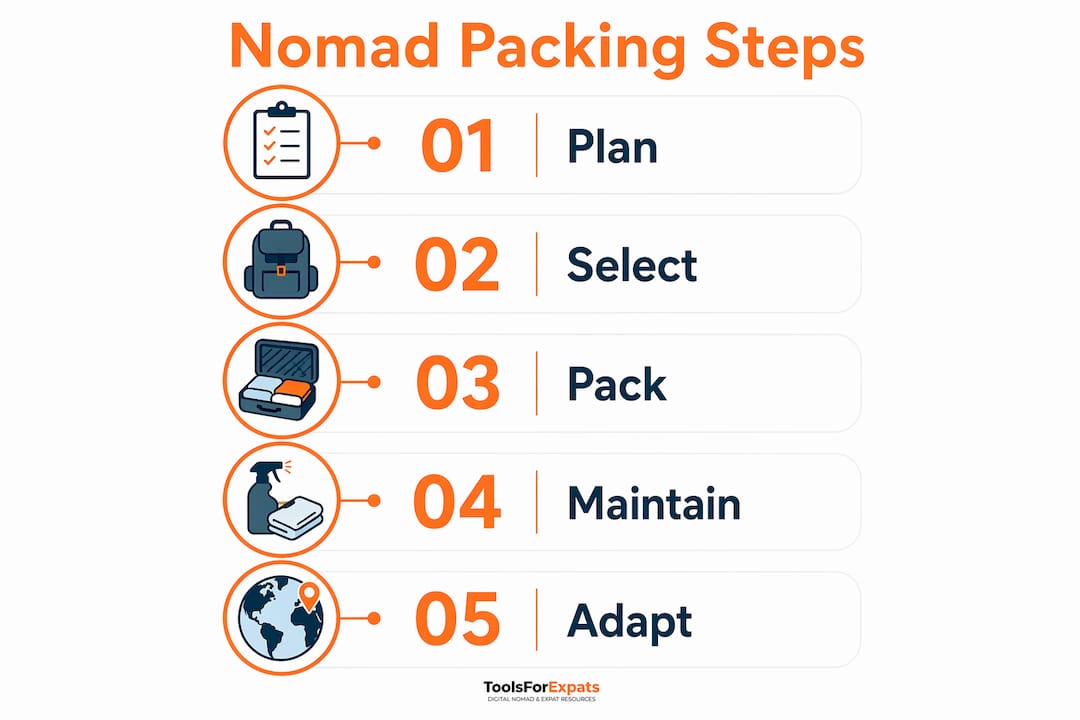
The older 5-4-3-2-1 method adds one extra item per category, which works for trips longer than three weeks or destinations with limited laundry access. For strict carry-on travel, the 4-3-2-1 formula is the tighter and more practical choice.
Cross-compatibility is the filter that makes either system work. Before adding any item, ask whether it pairs with at least three others already in your bag. If it does not pass that test, it does not make the cut. This single rule, known as the Rule of 3, prevents the common mistake of packing items that only work with one specific outfit.
Laundry frequency directly controls how many items you need. Nomadic Matt advises packing essentials only and relying on laundry or local purchases to maintain a manageable load. If you do laundry every seven days, you never need more than a week's worth of clothing. Most hostels, Airbnbs, and co-living spaces offer laundry access, and laundromats are available in virtually every city worldwide.
Pro Tip: Pack compression cubes organized by category (tops, bottoms, layers) rather than by outfit. This makes repacking after laundry faster and keeps your bag organized even after weeks on the road.
What tech gear is non-negotiable in the nomad packing philosophy?
For digital nomads, the tech kit is the most critical part of the bag. It is your mobile office, and it has to work reliably regardless of where you are. Core tech items that experienced nomads treat as non-negotiable include:
- A reliable laptop. This is your primary work tool. Weight matters: ultrabooks like the MacBook Air M-series or a lightweight Windows equivalent keep your bag under the carry-on limit without sacrificing performance. You can find a detailed breakdown of nomad gear essentials at ToolsForExpats.
- A universal travel adapter. One compact adapter that covers Type A, B, C, G, and I outlets replaces a collection of country-specific plugs.
- A USB-C power bank. Choose one that charges your laptop, phone, and earbuds simultaneously. Anker and Baseus both produce reliable options under 300g.
- Noise-cancelling headphones. Sony WH-1000XM5 or Bose QuietComfort 45 are the standard choices. They double as focus tools in noisy co-working spaces and cafes.
- An eSIM or local data plan. Physical SIM swapping is slow and unreliable. eSIM providers like Airalo or Lumo give you international connectivity in minutes.
- A VPN subscription. NordVPN or ExpressVPN protects your data on public Wi-Fi networks, which you will use constantly.
Remote worker packing prioritizes charger access and backup power above lightness alone. A dead laptop in a country with unreliable power grids is a productivity disaster. Pack a short USB-C cable, a wall charger, and a power bank as three separate items so you always have at least two charging options available.
Minimize cable clutter by choosing gear that shares the same charging standard. If your laptop, phone, headphones, and power bank all use USB-C, you carry one cable type instead of four.
How do climate, culture, and destination infrastructure shape your packing decisions?
The biggest mistake in nomad packing is treating it as universal minimalism. Context drives every packing decision, and experienced nomads adjust their systems based on four key factors before every trip.
Here is how to apply a context-driven approach:
- Assess the climate. A capsule for Bali in July looks nothing like one for Lisbon in January. Check average temperatures and rainfall for your specific travel window, not just the country's general reputation.
- Research cultural dress expectations. Temples in Thailand require covered shoulders and knees. Business meetings in Tokyo call for more formal attire than a co-working space in Medellín. Build one or two culturally appropriate items into your wildcard slot.
- Map local shopping access. Cities like Bangkok, Chiang Mai, and Mexico City have excellent markets where you can buy quality clothing cheaply. If your destination has strong retail infrastructure, you can pack lighter and buy locally. Remote or rural destinations require more self-sufficiency.
- Plan for infrastructure gaps. Frequent power outages in parts of Southeast Asia or Africa mean your power bank is not optional. Slow laundry turnaround in certain regions means packing a slightly larger clothing capsule.
- Avoid unlimited contingency lists. Experienced nomads plan for main failure points and outsource contingencies to laundry and local shopping rather than packing for every possible scenario.
Flexible systems consistently outperform fixed minimalist lists for long-term travel. A rigid "pack only 10 items" rule breaks down the moment you spend three months in a cold climate or attend a formal event. The philosophy gives you a framework, not a fixed inventory.
What are the real benefits of committing to the nomad packing philosophy?
Adopting this philosophy delivers concrete, measurable advantages beyond the satisfaction of a lighter bag.
- No checked baggage fees. Staying under 22 lb qualifies you for carry-on-only travel on most airlines, saving $30 to $80 per flight on budget carriers.
- Faster airport transitions. No baggage drop, no carousel wait, no lost luggage risk. You walk off the plane and go directly to your destination.
- Less decision fatigue. A curated capsule wardrobe eliminates the daily "what do I wear" calculation. Every item works with every other item, so getting dressed takes 60 seconds.
- Lower environmental impact. Lighter bags mean lower fuel consumption per passenger. Buying locally and avoiding fast-fashion impulse purchases reduces your overall consumption footprint.
- Greater lifestyle flexibility. When everything you own fits in one bag, you can change cities, countries, or continents with 24 hours' notice. That flexibility is the core promise of the nomadic lifestyle.
"Packing light works best when paired with a replacement strategy: bring less, plan laundry, and buy locally to avoid failure on the road." — Nomadic Matt
The emotional benefit is underrated. Travelers who adopt this philosophy consistently report lower pre-trip anxiety, fewer logistics headaches, and a stronger sense of control over their environment. When your possessions fit in one bag, your life feels genuinely portable.
Key takeaways
Nomad packing philosophy works because it replaces volume-based minimalism with a context-driven system built on versatility, carry-on discipline, and purposeful tech selection.
| Point | Details |
|---|---|
| Context over minimalism | Adjust your capsule for climate, culture, and shopping access at each destination. |
| Use the 4-3-2-1 formula | Build a 10 to 15 item clothing capsule with cross-compatible pieces that follow the Rule of 3. |
| Tech is your mobile office | Pack a laptop, universal adapter, power bank, eSIM, and VPN as non-negotiables. |
| Stay under 22 lb | Keeping your carry-on below 22 lb eliminates fees and speeds up every airport transition. |
| Plan for laundry and local buying | Pack for 7 to 10 days, then rely on laundry and local markets to stay minimal long-term. |
Why I think most people misunderstand what "packing light" actually means
I spent years watching travelers pack a single carry-on and still feel overwhelmed at every destination. The bag was small, but the system was wrong. They had packed for a fantasy version of their trip rather than the actual one.
The shift that changed everything for me was separating the philosophy from the checklist. The philosophy asks: "What do I actually need to function well here?" The checklist is just the output of answering that question honestly. When I started applying the 4-3-2-1 capsule system with real cross-compatibility testing, I stopped second-guessing my bag entirely.
The hardest part is not removing items. It is resisting the urge to add "just in case" items that address fears rather than real needs. A second pair of dress shoes "just in case" of a formal event is almost never justified. One versatile shoe that works for 80% of situations is always the right call.
My practical advice: update your system after every trip, not before. Note what you never used, what you wished you had, and what broke or wore out. That post-trip audit is worth more than any packing list you find online. Over time, your system becomes genuinely personal and genuinely reliable. For nomads thinking about work-life balance on the road, a well-dialed packing system removes one major source of friction from an already complex lifestyle.
— Ceyhun
Plan your nomad life beyond the bag with ToolsForExpats
Packing is just one piece of the nomadic lifestyle puzzle. Choosing the right destination, understanding your visa options, and budgeting accurately are equally important decisions that can make or break your experience abroad.
ToolsForExpats offers a full suite of free nomad tools designed to help you plan every dimension of your move. Use the nomad cost calculator to estimate monthly expenses in cities like Chiang Mai, Lisbon, or Medellín before you book a flight. Compare living costs side by side with the cost comparison tool to find destinations that fit your budget. No account required, no paywalls. Just practical tools built for people who take the nomadic lifestyle seriously.
FAQ
What is nomad packing philosophy in simple terms?
Nomad packing philosophy is a context-driven system for selecting only the items you genuinely need, organized around capsule wardrobes, carry-on limits, and essential tech gear. It prioritizes versatility and mobility over simply owning fewer things.
How many clothes should a nomad pack?
Most experienced nomads pack a capsule of 10 to 15 clothing items built on a 4-3-2-1 formula (4 tops, 3 bottoms, 2 layers, 1 wildcard, 2 shoe pairs) and rely on laundry every 7 to 10 days to keep the load manageable.
What is the Rule of 3 in nomad packing?
The Rule of 3 requires every clothing item in your bag to pair with at least three other items, maximizing outfit combinations without adding extra pieces. It is the core filter used in one-bag capsule wardrobe systems.
What tech gear do digital nomads consider non-negotiable?
Digital nomads prioritize a reliable laptop, universal travel adapter, USB-C power bank, noise-cancelling headphones, an eSIM or local data plan, and a VPN subscription as the foundation of their mobile office setup.
Does packing light mean buying things abroad?
Yes. A replacement strategy is central to the nomad packing philosophy. Nomadic Matt and other experienced long-term travelers recommend packing essentials only and relying on local markets and laundry services to fill gaps, rather than packing for every possible scenario before you leave.