
Mastermind groups are small, structured peer groups designed to give digital nomads accountability, strategic insight, and emotional support that location-independent life rarely provides on its own. Understanding why nomads join mastermind groups starts with one uncomfortable fact: seven out of ten high-achieving founders face imposter syndrome and isolation. That number reflects a reality most nomads recognize immediately. The standard term for this format is "peer advisory group," and whether you call it that or a mastermind, the function is the same: a small, committed circle that holds you accountable, challenges your thinking, and keeps you grounded when your zip code changes every few months.
Why nomads join mastermind groups: the core motivations
The nomadic lifestyle creates a specific kind of loneliness. You meet interesting people constantly, but those connections rarely go deep. Most nomads describe their social world as wide and shallow, full of acquaintances and short-term travel friends who disappear after a week in Lisbon or Chiang Mai.
Mastermind groups solve that problem directly. They provide the kind of stable, recurring peer contact that builds real trust over time. Experts recommend stable connections with 3–5 core people rather than broad, low-depth networking. That recommendation exists because depth, not breadth, drives both mental health and professional growth.
The motivations nomads report most often include:
- Accountability: A group that checks in on your goals every two weeks is harder to ignore than a personal to-do list.
- Strategic clarity: Members report faster decision-making when they can pressure-test ideas with peers who have no stake in the outcome.
- Emotional safety: Nomads need a space to discuss failures, fears, and doubts without professional consequences.
- Imposter syndrome relief: Hearing that other high performers share the same doubts normalizes the experience and reduces its grip.
- Structured progress: Without an office or manager, external structure becomes self-imposed. A mastermind group provides that structure without the corporate overhead.
The digital nomad lifestyle amplifies all of these needs. When your environment changes constantly, a consistent peer group becomes one of the few fixed points in your professional life.
Pro Tip: Before joining any group, write down the three specific outcomes you want from it. Accountability, strategic feedback, and emotional support each require different group formats. Knowing your priority helps you evaluate fit before committing.
How mastermind groups address the real challenges of nomadic life
Constant relocation creates a structural problem, not just a social one. Every time you move, you lose your local support network, your favorite coffee shop with reliable Wi-Fi, and the casual professional relationships that make work feel less isolated. Most nomads rebuild from scratch every few months.

Mastermind groups act as structural anchors for digital nomads, mitigating the social and mental health impacts of constant relocation. That framing matters. The group is not a nice-to-have social activity. It is infrastructure.
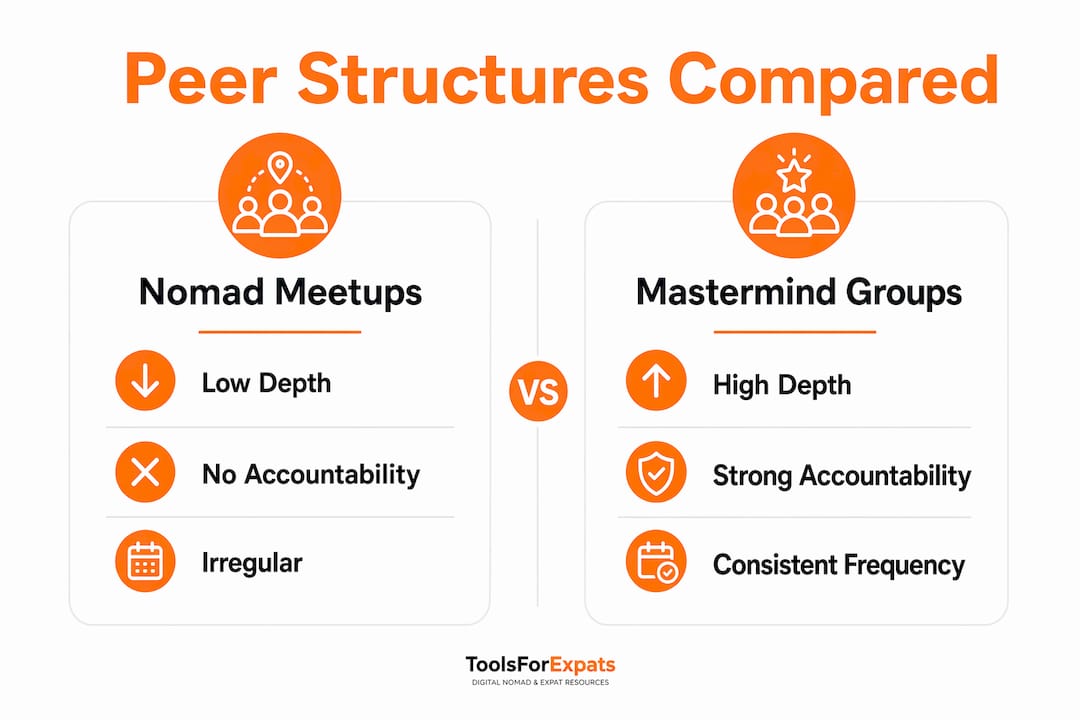
The contrast between mastermind groups and casual alternatives is significant:
| Format | Depth | Accountability | Frequency | Trust level |
|---|---|---|---|---|
| Nomad meetups | Low | None | Irregular | Minimal |
| Online forums | Low to medium | None | Asynchronous | Low |
| Mastermind groups | High | Structured | Regular | High |
| Coworking communities | Medium | Low | Variable | Medium |
Casual meetups accelerate client referrals and knowledge-sharing, but they do not replace the depth that a mastermind group provides. A forum thread cannot challenge your assumptions the way a peer who knows your business can.
The strategic benefits are concrete. Founders pivot entire revenue models based on group insights. They adjust funding strategies, catch blind spots before they become expensive mistakes, and compress years of trial and error into focused conversations. That compression effect is one of the most underrated advantages of joining a peer advisory group.
Pro Tip: Treat your mastermind group like a board of directors, not a support group. Bring a real problem to every meeting. The more specific your challenge, the more useful the feedback.
What makes an effective mastermind group for remote workers?
Not all mastermind groups deliver equal results. The structure and culture of the group determine whether it accelerates your growth or wastes your time.
High-value mastermind groups prioritize emotional safety and vulnerability, enabling members to openly discuss failures and fears. That safety does not happen automatically. It requires deliberate group design and consistent enforcement of confidentiality norms.
The characteristics that separate effective groups from ineffective ones fall into two categories:
Structural factors:
- Group size of 4–8 people. Smaller groups lack diverse perspectives; larger groups lose intimacy.
- Regular meeting cadence, typically every two weeks or monthly.
- A rotating facilitator or consistent agenda format to keep sessions focused.
- Clear accountability mechanisms, such as goal-setting at the end of each session and check-ins at the start of the next.
Cultural factors:
- Discretion as a non-negotiable norm. What is said in the group stays in the group.
- Constructive friction over positive affirmation. Mastermind groups are not mutual appreciation societies but rigorous environments where peers challenge assumptions.
- Diversity of expertise combined with shared values. A group of people who all do the same work will recycle the same blind spots.
- Commitment level that matches your own. One disengaged member degrades the experience for everyone.
Organic groups formed from prior connections in nomad hubs create more durable and trusting relationships than randomly assembled groups. Trust built through shared experience before the group forms gives the group a head start. Geographic arbitrage is secondary to shared work ethics and mutual respect.
The benefits of remote teams research reinforces this point: peer accountability structures improve clarity and confidence for remote professionals more reliably than solo accountability systems do.
How to find or build a mastermind group as a digital nomad
Finding the right group takes more effort than a Google search, but the process is straightforward if you approach it systematically.
-
Start with your existing network. The best mastermind groups grow from relationships that already have some trust. Identify three to five people you respect professionally and whose work challenges you. Reach out directly and propose a trial run of three sessions before committing to anything formal.
-
Use nomad hubs as sourcing grounds. Coworking spaces in Medellín, Tbilisi, Bali, and Lisbon regularly host events where you can identify potential group members. Nomad community structures often include informal peer groups that can be formalized with a simple agreement on meeting frequency and format.
-
Set expectations before the first meeting. Agree on confidentiality, attendance requirements, and the format for each session. A group that skips this step usually dissolves within three months.
-
Balance expertise diversity with value alignment. A freelance designer, a SaaS founder, and a remote consultant bring different skills but can share the same commitment to growth. Shared values matter more than shared industries.
-
Establish a minimum viable community first. Three key contacts for professional, practical, and social support form the foundation upon which deeper mastermind relationships grow. Build those contacts before you try to formalize a group.
-
Consider online-first formats. Video calls work well for nomads whose schedules and locations shift constantly. Asynchronous check-ins between sessions, using voice messages or short written updates, maintain momentum without requiring everyone to be in the same time zone.
Nomad networking for career growth consistently shows that the quality of your professional relationships determines the quality of your opportunities. A mastermind group is the most direct way to build that quality deliberately.
Key takeaways
Mastermind groups are the most effective peer structure for digital nomads because they combine accountability, emotional safety, and strategic depth in a format that travels with you.
| Point | Details |
|---|---|
| Isolation is structural | Nomads lose support networks with every move; mastermind groups replace that structure reliably. |
| Depth beats breadth | Stable connections with 3–5 trusted peers outperform wide, shallow networking for growth and mental health. |
| Emotional safety is non-negotiable | Groups that enforce confidentiality and vulnerability produce faster personal and professional progress. |
| Organic formation works best | Groups built from existing trust in nomad hubs outlast randomly assembled ones. |
| Constructive friction is the point | Effective groups challenge assumptions, not just validate them. |
The thing most people get wrong about mastermind groups
Most nomads I have observed wait too long to join or form a mastermind group. They treat it as a reward for reaching a certain level of success, something to pursue once the business is stable or the income is consistent. That logic is backwards.
The groups that deliver the most value are the ones you join when things are uncertain. That is exactly when you need outside perspective the most. A peer who has already navigated a pricing crisis or a visa complication can save you weeks of anxiety and hundreds of dollars in bad decisions.
The other common mistake is confusing a mastermind group with a networking event. Nomad networking builds real connections over time, but a mastermind group is a different commitment entirely. It requires showing up consistently, being honest about your struggles, and doing the work between sessions. Nomads who treat it casually get casual results.
My honest advice: find two or three people you already trust, propose a 90-day trial with a simple agenda, and see what happens. The bar to start is lower than you think. The upside is higher than most people expect.
— Jay
Planning your nomadic life alongside your peer group
Building a strong mastermind group is one part of thriving as a digital nomad. The other part is having the logistics handled so you can focus on the work and the people.
ToolsForExpats offers a full suite of free tools designed for exactly that. Use the digital nomad visa checker to confirm your visa options before your next move, or run a cost of living comparison to see which cities fit your budget. The nomad cost calculator breaks down expenses by city so you can plan with real numbers. All tools are free and require no account. When your logistics are clear, your mastermind conversations get sharper.
FAQ
What is a mastermind group for digital nomads?
A mastermind group is a small, structured peer group of 4–8 people who meet regularly to share accountability, strategic advice, and emotional support. For digital nomads, it serves as a stable professional anchor across changing locations.
How often should a nomad mastermind group meet?
Most effective groups meet every two weeks or monthly. Consistent frequency builds trust and keeps accountability mechanisms working between sessions.
Can mastermind groups work fully online for nomads?
Yes. Video-based groups work well for nomads in different time zones. Asynchronous check-ins between sessions, using voice notes or short written updates, maintain momentum without requiring geographic alignment.
How is a mastermind group different from a networking event?
Networking events build broad, shallow connections. Mastermind groups build deep, recurring relationships with structured accountability and confidentiality norms that networking events do not provide.
How do I find a mastermind group as a digital nomad?
Start with your existing network and identify two to five people you already respect. Nomad hubs and coworking spaces in cities like Medellín, Bali, and Tbilisi are strong sourcing grounds for potential members with shared values and work ethics.