
Networking as a digital nomad is not the chaotic, transactional ordeal most people fear. Understanding how nomad networking works means recognizing it as a deliberate, hybrid practice that combines focused online communities with authentic in-person meetups. You are not collecting business cards at a hotel conference room or cold-pitching strangers at a coworking space. You are building a web of real professional relationships that travel with you, grow over time, and generate the kind of referrals and collaborations that actually move careers forward. This article breaks down exactly how to do that, wherever you happen to be.
Table of Contents
- Key takeaways
- How nomad networking works as a hybrid model
- Keeping connections alive across constant moves
- Tools and connectivity that make networking reliable
- The mindset shift that changes everything
- My honest take on nomad networking
- Plan your nomad life with the right tools
- FAQ
Key takeaways
| Point | Details |
|---|---|
| Hybrid model is the foundation | Combine niche online communities with intentional in-person meetings to build lasting connections. |
| Stay longer to connect deeper | Spending around two months in a city produces significantly stronger professional ties than short visits. |
| Async tools bridge time zones | Short video messages and voice notes keep relationships warm without requiring real-time availability. |
| Mindset matters more than tactics | Generosity and genuine curiosity build trust far faster than any pitch script or networking formula. |
| Tools reduce friction | Reliable connectivity, a simple contact tracker, and the right apps prevent avoidable networking breakdowns. |
How nomad networking works as a hybrid model
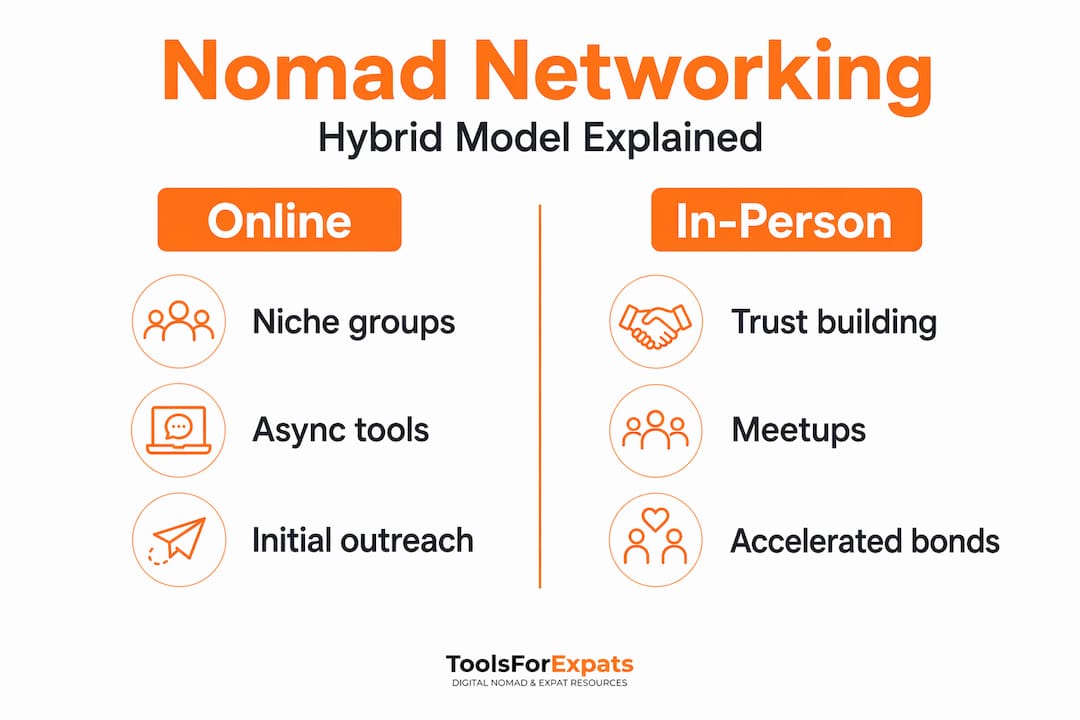
The phrase "nomad networking" is widely used in remote work circles, but the more precise professional term is location-independent professional networking, a hybrid practice that merges asynchronous digital communication with deliberate in-person relationship-building. Understanding this distinction matters because it tells you where to invest your energy.
Most people assume larger networks produce better results. That assumption is wrong for nomads. A small, engaged niche group of 100 people who share your professional context will generate more referrals, collaborations, and opportunities than a passive following of 10,000 who barely know what you do. Focused Slack groups, Discord servers built around specific skills or industries, and curated LinkedIn communities deliver the depth that generic social platforms simply cannot.
The online side of this hybrid model is where you maintain continuity between cities. It is where relationships stay warm even when you are on a flight to Lisbon or settling into a new neighborhood in Chiang Mai. Here is what makes online nomad networking actually effective:
- Join niche communities, not broad platforms. A Facebook group for SaaS founders traveling Southeast Asia beats a generic "digital nomad" subreddit with 200,000 passive members.
- Use asynchronous tools to transcend time zones. Loom videos, voice notes on WhatsApp, and recorded video messages let you share context-rich updates without scheduling a call across six time zones.
- Prioritize quality interactions. Comment thoughtfully, answer questions with specific experience, and share useful resources. Every contribution builds credibility.
- Let online connections fuel offline meetings. When you arrive in a new city, a quick message to community members in that city converts a digital contact into a real coffee or coworking session.
The in-person side is where trust accelerates. Face-to-face meetings with people you already know online skip the awkward "so what do you do?" phase entirely. You show up with context, a shared reference point, and a real reason to connect. Exploring how nomad communities form at a structural level helps you identify which local groups are worth attending versus which ones are simply networking theater.
Pro Tip: Before arriving in a new city, search your niche Slack or Discord channels for members based there. Reach out a week before you land with a specific message: "I'll be in Barcelona Oct 3-5, would love to grab coffee and hear about your work on X." Specificity converts strangers into meetings.
Keeping connections alive across constant moves
The most common failure point in nomadic networking is not making contacts. It is letting them go cold after two weeks when you move to the next city. Sustaining professional relationships across frequent location changes requires a small shift in how you organize your time and attention.

The single most useful habit you can adopt is what experienced nomads call the "slow-city" approach. Staying roughly two months in a single city, rather than hopping every ten days, gives you enough time for repeated encounters. Relationships deepen through repeated exposure, not one intense conversation. You run into the same people at the Tuesday coworking meetup, grab lunch, collaborate on something small, and suddenly you have a real professional ally in that city.
When longer stays are not possible, here is a practical system for maintaining relational momentum:
- Track contacts with lightweight notes. You do not need a formal CRM. A simple Notion page or even Apple Notes with each person's name, city, what they work on, and a personal detail or two is enough. The goal is to remember the conversation when you follow up two months later.
- Follow up with context. Generic "just checking in" messages fail. Short async video updates that reference something specific ("I finally tried the coworking space you recommended in Medellín, it was exactly right") feel personal and low-pressure.
- Create named invitations. Instead of "we should hang out next time," say "I'll be in Berlin in March. Want to do a working session at Sankt Oberholz on the 14th?" Specificity turns vague intentions into actual meetings.
- Blend formal and casual touchpoints. Attend structured nomad conferences for concentrated relationship-building, but also value the casual coffee shop encounter or the spontaneous coworking invite. Both matter.
- Return to cities you love. Returning to a place where you already have contacts is one of the highest-leverage moves in nomad networking. Repeated exposure in small groups consistently produces referrals and collaborative projects.
Pro Tip: Set a recurring monthly reminder to reach out to five contacts with a specific, personal message. It takes less than 20 minutes and keeps your network genuinely warm without requiring major effort.
Tools and connectivity that make networking reliable
No amount of strategy compensates for dropping off a video call mid-sentence or losing Wi-Fi access the morning of an important virtual meeting. The technical infrastructure you rely on is as much a part of your networking system as the communities you join.
Here is a practical breakdown of what you actually need:
- A reliable eSIM or local SIM strategy. Switching between local data plans or using a global eSIM service eliminates dead zones. Check out optimizing connectivity abroad for current guidance on staying connected across multiple countries.
- A VPN for consistent access. Some platforms restrict access by region. A VPN means your collaboration tools stay accessible regardless of where you are.
- Video and async communication apps. Zoom and Google Meet handle real-time calls well. Loom, Telegram voice notes, and Marco Polo cover the asynchronous layer. Use both.
- A stable coworking space or backup location. Coffee shop Wi-Fi is not a professional networking infrastructure. A paid coworking membership in each city you spend time in pays for itself in reliability alone.
| Tool type | Best for | Examples |
|---|---|---|
| Async video | Follow-ups, context-sharing | Loom, Marco Polo |
| Real-time calls | Relationship building, pitches | Zoom, Google Meet |
| Audio-forward platforms | Casual community engagement | LinkedIn Live Audio, Clubhouse |
| Contact tracking | Relationship continuity | Notion, Airtable, simple notes |
| Mobile connectivity | Reliable networking on the go | eSIM services, local SIMs |
Audio-forward platforms like LinkedIn Live Audio deserve special attention. Voice builds a sense of familiarity faster than text, and dropping into a live audio room around a topic you care about is one of the lowest-friction ways to start a genuine conversation with someone new. It is spontaneous, low-stakes, and surprisingly effective.
Your digital nomad city choice also affects your networking infrastructure more than people realize. Cities with strong coworking cultures, fast public Wi-Fi, and active expat communities give you far more natural networking opportunities than beautiful but isolated destinations.
The mindset shift that changes everything
Most conventional networking advice was designed for people with fixed offices, stable professional circles, and annual industry conferences. It does not translate well to the nomadic lifestyle. The old playbook, which emphasized access, volume, and transactional favor-trading, actively works against you when you are constantly meeting new people and leaving cities every few weeks.
Conventional networking systems fail by prioritizing access over demonstrated value. The shift you need to make is from "what can I get from this person" to "what can I genuinely contribute here." That sounds idealistic, but it is actually very practical. People remember the person who solved a problem, shared a useful contact, or offered a straight answer to a hard question. They forget the person who handed them a business card.
"Networking happens everywhere, not just at formal events. The nomad who shows up curious and present at a casual rooftop dinner will outperform the one who treats every conversation as a pitch opportunity." — How to network when you're a digital nomad
Here is what this looks like in practice:
- Lead with generosity. Share resources, make introductions, and contribute to community discussions before you ask for anything.
- Be genuinely curious. Ask people what they are working on and actually listen. Most professionals are starved for real conversation, not performative networking.
- Network everywhere. The coffee shop, the airport lounge, the WhatsApp group for your building, the coworking kitchen. Networking for remote workers happens in organic moments, not just scheduled events.
- Think in terms of trust, not transactions. Trust compounds over time. A contact you helped two years ago with no expectation of return is often the person who sends you your next major client.
The nomads who build genuinely strong professional networks are not the most extroverted ones. They are the most consistent and the most generous.
My honest take on nomad networking
I have watched a lot of people approach nomad networking as a volume game, and they almost universally burn out or end up with a long list of contacts who do not actually know them. In my experience, the biggest predictor of networking success is patience. Not hustle. Not the number of Slack communities you are in.
What has actually worked, for me and for the nomads I have spoken with over the years, is building what I think of as a small "town square." A handful of communities, maybe three or four, where you show up consistently, add real value, and become a recognizable presence. When people know your name and your work before you ever ask them for anything, opportunities arrive without you forcing them.
The hybrid approach matters more than most people admit. The online layer keeps relationships alive between cities. The in-person layer deepens them faster than any amount of messaging ever could. Neither alone is enough. But together, especially when you are thoughtful about career-focused networking and give relationships time to develop, they produce the kind of professional network that genuinely supports a location-independent life.
One more thing: do not underestimate logistics. A connection that could have led to a collaboration falls apart because you had no internet access, changed cities too quickly, or picked a destination with no coworking infrastructure. The practical planning side of nomad life directly affects your networking outcomes. Getting that right is not glamorous, but it is half the battle.
— Ceyhun
Plan your nomad life with the right tools
Building strong professional connections on the road is much easier when your logistics are sorted. When you are not stressed about whether your budget works in a new city or whether your visa allows a three-month stay, you have the mental bandwidth to actually show up fully in your networking conversations.
ToolsForExpats offers a free suite of tools built specifically for digital nomads and expats who want to plan smarter. Use the cost of living calculator to budget your stay in cities where you plan to invest serious networking time. Run your destination through the visa eligibility checker to confirm you can actually stay long enough to build real connections. And if you are still deciding where to base yourself, the best nomad city quiz helps you match your lifestyle and professional needs to the right destination. Everything at ToolsForExpats is free, requires no account, and works anywhere in the world.
FAQ
What is nomad networking?
Nomad networking, more formally called location-independent professional networking, is the practice of building and maintaining professional relationships while traveling across multiple cities or countries. It combines online community participation with in-person local meetups for sustainable connection-building.
How do nomads maintain connections when they travel frequently?
Staying in cities for around two months at a time, using asynchronous follow-up tools like short video messages, and tracking contacts with simple notes all help nomads maintain relational momentum despite frequent moves.
What online communities are best for nomad networking?
Niche communities focused on specific skills or industries consistently outperform large, generic groups. A focused group of 100 engaged professionals generates more real opportunities than a passive audience of thousands.
Does connectivity really affect networking success?
Yes, directly. Reliable Wi-Fi and mobile data are the foundation of consistent communication and relationship-building for digital nomads. Connectivity gaps cause missed calls, dropped conversations, and lost momentum with new contacts.
How long should I stay in a city to network effectively?
Research consistently points to roughly two months as the threshold where casual acquaintances begin to convert into real professional ties. Shorter visits can still be productive, but they require much more intentional follow-up to sustain the connections you make.