
A US LLC is defined as a limited liability company, a legal business structure that protects your personal assets from business debts while giving you global credibility and access to US payment platforms. Non-resident founders can form a US LLC entirely remotely, with no US citizenship, Social Security number, or physical visit required. When you set up an LLC for nomads, three key entities drive the process: the IRS for your Employer Identification Number (EIN), your chosen state government for formation filings, and a registered agent who holds your US address. Getting these three pieces right from the start saves you months of headaches.
Which US states are best for LLC formation for digital nomads?
State selection is the first real decision you make, and it has lasting consequences for cost, privacy, and compliance. Not every state treats non-resident LLC owners the same way.
Wyoming is the top choice for most digital nomads. Wyoming LLCs carry no franchise tax, member names are typically kept off public records, and the state processes filings in 1–2 business days. Those three factors together make it the most cost-effective and privacy-friendly option for remote founders.

Delaware is the traditional favorite for venture-backed startups because of its well-developed corporate law. However, it charges a minimum $300 annual franchise tax and requires a separate registered agent fee on top of that. For a solo nomad running a consulting or freelance business, that overhead rarely pays off.
New Mexico offers a lesser-known advantage: it does not require you to list member names in public filings at all. Formation fees are among the lowest in the country. The tradeoff is that New Mexico has less name recognition with international clients and banks compared to Wyoming or Delaware.
Here is a quick comparison of the three most popular states:
| State | Franchise Tax | Privacy | Formation Speed | Annual Fee |
|---|---|---|---|---|
| Wyoming | None | High | 1–2 business days | ~$60 |
| Delaware | $300 minimum | Medium | 1–3 business days | ~$300+ |
| New Mexico | None | Very high | 3–5 business days | ~$50 |
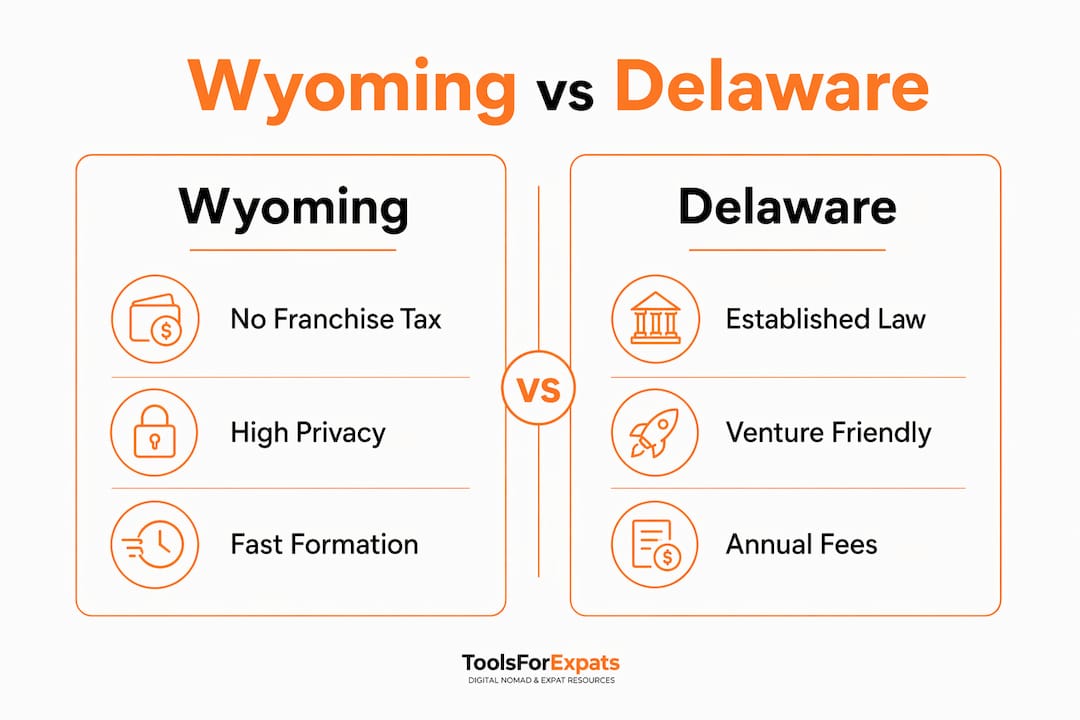
The bottom line: Wyoming wins for most nomads on cost and speed. Delaware makes sense only if you plan to raise outside investment.
Why do you need a registered agent for your LLC?
Every US LLC must have a registered agent with a physical street address in the state of formation. This is a legal requirement, not optional. As a non-resident, you cannot use a P.O. box, and you almost certainly do not have a US street address of your own.
Registered agent services cost between $50 and $300 per year and provide far more than just an address. A good service handles all of the following:
- Physical street address for state and IRS filings
- Mail scanning and forwarding so you receive government correspondence digitally
- Compliance alerts for annual report deadlines
- Privacy protection by keeping your personal address off public records
The IRS also requires a physical street address on your EIN application. A P.O. box is not acceptable, which means your registered agent's address does double duty: it satisfies both state formation requirements and federal tax registration.
When choosing a registered agent, prioritize services that offer a digital mailroom. You will receive legal notices, state correspondence, and IRS letters at that address. A service that only forwards physical mail by post creates delays when you are living in Bali or Lisbon. Look for one that scans and emails documents within 24 hours.
Pro Tip: Ask your registered agent whether their address is accepted by major fintech banks like Mercury. Some registered agent addresses trigger fraud flags with certain banks, which can delay your account opening.
If you need additional support navigating expat-specific legal and registration requirements, expat legal services can help bridge the gap between US formation requirements and your country of residence.
How do you file formation documents and get an EIN remotely?
The actual filing process breaks down into two parallel tracks: state formation and federal tax registration. Both are fully remote.
Filing your Articles of Organization
- Choose your state and confirm the filing fee (Wyoming charges $100 for online filings).
- Prepare your Articles of Organization. You need your LLC name, registered agent name and address, and the member or manager structure.
- Submit online through the state's Secretary of State website or through a formation service.
- Receive your Certificate of Organization by email, typically within 1–5 business days.
Applying for your EIN without a Social Security number
Non-residents cannot use the IRS online EIN application, which requires a US Social Security number or Individual Taxpayer Identification Number (ITIN). Your two options are:
| Method | Processing Time | Notes |
|---|---|---|
| Fax (Form SS-4) | 4–7 business days | Fastest option for non-residents |
| Mail (Form SS-4) | 4–6 weeks | Slowest but works from any country |
| Third-party service | Varies | Service submits on your behalf |
LLC formation including EIN issuance can be completed in as little as 1–10 business days when you use fax submission. That timeline assumes your Articles of Organization are already approved. Plan for the fax route unless you have weeks to spare.
The most common error on Form SS-4 is listing a P.O. box as the business address. Use your registered agent's street address instead. A second common error is misidentifying the LLC's tax classification. A single-member LLC owned by a non-resident is treated as a disregarded entity for US tax purposes, but it still carries federal reporting obligations.
How do you open a US bank account and stay compliant?
Banking is the step where most nomads hit a wall. Traditional US banks like Chase or Bank of America require in-person visits and often a US residential address. That rules out most non-residents immediately.
Fintech banks like Mercury and Relay offer fully remote account opening for non-US resident LLC owners. Both accept non-resident founders, require no minimum balance, and integrate with tools like Stripe, PayPal, and QuickBooks. To open an account remotely, you typically need:
- Your Certificate of Organization (or Certificate of Formation)
- Your EIN confirmation letter from the IRS
- A government-issued passport
- Your registered agent's address as the business address
Pro Tip: Apply for your bank account the same week your EIN arrives. Mercury and Relay both review applications manually for non-residents, and the process can take 1–2 weeks. Starting early keeps your business moving.
For a deeper look at the best banking options for your situation, the best banks for digital nomads guide covers the top fintech and traditional options in detail.
Ongoing compliance you cannot ignore
Forming the LLC is the easy part. Staying compliant is where non-residents most often get caught off guard. Penalties for non-compliance can reach $25,000 per violation, which makes this worth taking seriously.
Key annual obligations include:
- IRS Form 5472 and Form 1120: Required for foreign-owned single-member LLCs, even with zero US income. The deadline is March 15 for calendar-year filers.
- State annual report: Wyoming charges $60 per year. Missing this can result in your LLC being dissolved.
- Separate business bank account: Mixing personal and business funds can pierce your liability protection.
What are the most common mistakes nomads make with their LLC?
The biggest misconception about owning a US LLC as a non-resident is that it creates zero US tax liability. Owning a US LLC does not automatically exempt you from tax reporting. The IRS still requires information returns, and missing them triggers automatic penalties.
Forming a US LLC is straightforward. The real risk is treating it as a "set it and forget it" structure. Non-resident owners who skip Form 5472 face $25,000 penalties per missed filing. The LLC gives you protection and credibility, but only if you maintain it properly year after year.
Other frequent errors include:
- Choosing the wrong state based on name recognition rather than actual cost and compliance requirements
- Skipping professional formation help when the business has complex ownership or tax structures. DIY formation risks errors that professional services prevent from day one.
- Delaying banking setup until after the LLC is formed, which adds weeks to your timeline
- Using a personal address instead of a registered agent address on IRS forms
Avoiding these mistakes is straightforward once you know they exist. The common tax mistakes for nomads guide covers the IRS reporting traps in more detail if you want to go deeper.
Key Takeaways
Forming a US LLC as a digital nomad is fully achievable remotely, but staying compliant with IRS reporting requirements is what separates successful owners from those facing costly penalties.
| Point | Details |
|---|---|
| State selection matters | Wyoming offers the best combination of no franchise tax, privacy, and fast processing for most nomads. |
| Registered agent is mandatory | A physical US street address via a registered agent is required for both state filings and your IRS EIN application. |
| EIN by fax is fastest | Non-residents should submit Form SS-4 by fax for a 4–7 business day turnaround instead of waiting weeks by mail. |
| Fintech banks solve the banking gap | Mercury and Relay allow fully remote account opening with your EIN and formation documents. |
| IRS reporting is non-negotiable | Form 5472 and Form 1120 are required annually even with zero US income; penalties start at $25,000 per violation. |
The part most guides skip over
The formation process itself is genuinely simple. You can file Articles of Organization in Wyoming in under an hour, get your EIN by fax within a week, and open a Mercury account shortly after. What I have seen trip people up repeatedly is the gap between "I have an LLC" and "I am running a compliant LLC."
Most nomads form the entity, land their first client, and then forget the structure exists until tax season. That is when the Form 5472 problem surfaces. The IRS does not send reminders. Your registered agent will not file your federal returns. You are responsible for knowing the deadlines, and the penalties for missing them are not proportional to the size of your business.
My honest advice: spend as much time choosing your accountant as you do choosing your state. A CPA who specializes in non-resident US LLC compliance is worth every dollar. The formation fee is a one-time cost. A missed Form 5472 filing costs $25,000. That math is not complicated.
On the banking side, the fintech revolution genuinely changed the game for nomads. Mercury and Relay have made what used to be the hardest step into one of the easier ones. Apply the moment your EIN arrives. Do not wait until you have a client payment pending.
— Jay
Plan your LLC costs before you file
Knowing your formation costs is only part of the financial picture. You also need to understand how your LLC fits into your broader budget as a nomad, including living costs, visa fees, and tax obligations across the countries where you spend time.
ToolsForExpats offers a free suite of calculators built specifically for digital nomads and expats. Use the nomad cost calculator to compare living costs by city and plan your LLC operating budget against real-world expenses. The visa eligibility checker helps you align your travel plans with the countries where your LLC structure works best. All tools are free, require no account, and are available at ToolsForExpats.
FAQ
Can a non-US citizen form a US LLC?
Yes. Thousands of international founders form US LLCs annually without US citizenship, residency, or a Social Security number. The entire process is completed remotely.
Which state is best for a nomad LLC?
Wyoming is the best state for most digital nomads due to its no franchise tax policy, strong privacy protections, and 1–2 business day processing times.
Do I need to pay US taxes with a non-resident LLC?
Not necessarily on income, but you must file IRS Form 5472 and Form 1120 annually even with zero US-sourced income. Missing these filings triggers penalties starting at $25,000 per violation.
How long does it take to set up a US LLC remotely?
State formation takes 1–5 business days. An EIN via fax takes 4–7 business days. The full process from filing to EIN in hand typically takes 1–2 weeks.
Do I need a registered agent if I have a US address?
Yes. Every LLC must maintain a registered agent with a physical address in the state of formation, regardless of whether you personally have a US address.