
The best bank account for digital nomads combines multi-currency support, low foreign transaction fees, and global ATM access to make international money management practical and affordable. Traditional banks built for domestic use fail remote workers the moment they cross a border. Platforms like Wise, Charles Schwab, and Revolut have become the standard for location-independent professionals because they solve the three core problems: currency conversion costs, ATM access, and account flexibility. Getting your banking right before you leave saves real money and real stress.
What makes a bank ideal for digital nomads?
The right banking setup for remote workers rests on six features. Miss any one of them and you will pay for it, literally or logistically.
- Multi-currency accounts. You need to hold, send, and receive money in multiple currencies without converting every transaction. Wise holds 40+ currencies with real mid-market exchange rates and local bank details in several countries. That means clients can pay you like a local.
- Zero or low foreign transaction fees. Most traditional banks charge 1–3% on every foreign purchase. Those charges add up fast across a year of travel.
- Global ATM fee reimbursements. Cash is still king in much of Southeast Asia, Latin America, and parts of Eastern Europe. A card that refunds ATM fees worldwide removes a constant friction point.
- Strong mobile app. You manage everything remotely. An app that freezes cards, sends instant notifications, and supports multiple currencies is not optional.
- Backup cards on different networks. Carrying a Visa and a Mastercard on separate accounts protects you if one network goes down or a card gets frozen.
- Simple account opening. Some banks require a local address or in-person visit. The best options for nomads open fully online with standard ID verification.
Pro Tip: Open your banking accounts before you leave your home country. Proof of address requirements become much harder to satisfy once you are abroad.
1. Wise: best overall for multi-currency payments
Wise is the most widely recommended primary account for digital nomads regardless of nationality. It holds over 40 currencies and converts at the real mid-market rate with a transparent, low fee. You get local bank details for currencies including USD, EUR, GBP, AUD, and SGD, which means international clients can pay you without expensive wire transfers.
Wise is not a full bank in the traditional sense. It is an electronic money institution, which means deposits are not always covered by national deposit insurance schemes. For receiving client payments and managing day-to-day spending abroad, it is the strongest single tool available.
2. Charles Schwab: best US bank for ATM access
Charles Schwab Investor Checking is the gold standard ATM card for American nomads. Schwab reimburses 100% of worldwide ATM fees automatically every statement period with no cap or limits. That feature alone makes it indispensable in cash-heavy countries.
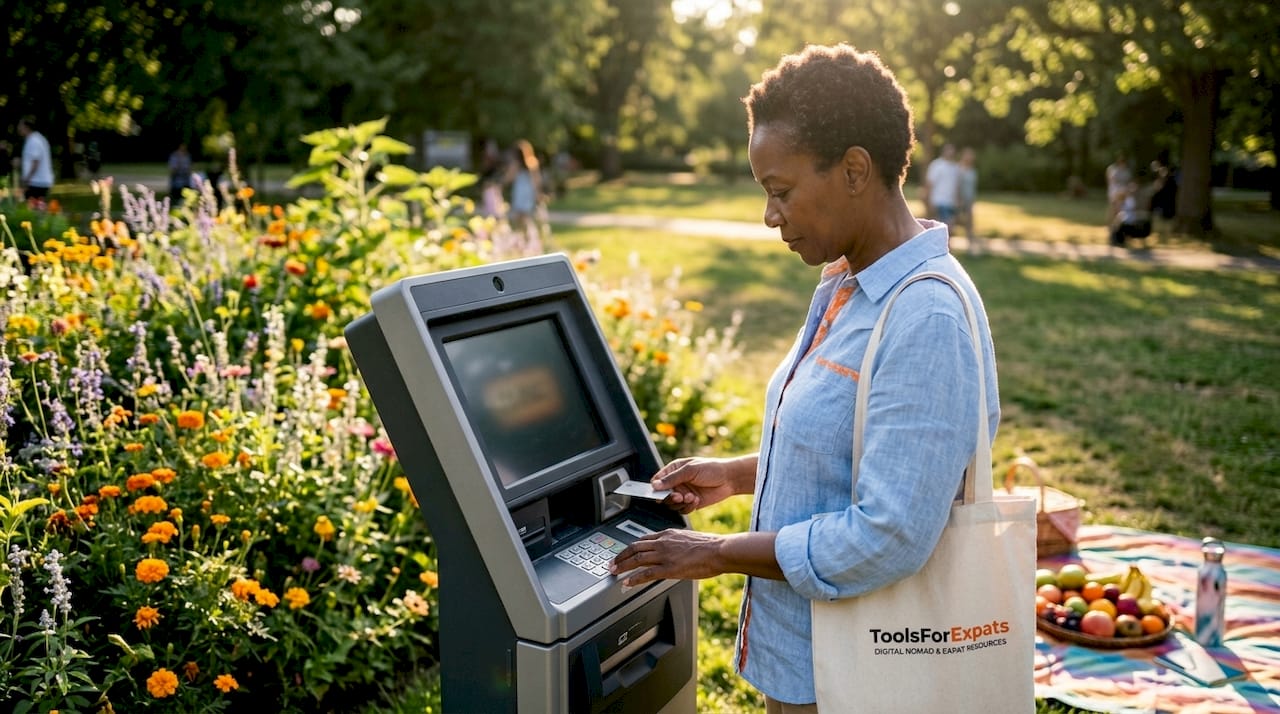
The account requires no minimum balance and charges no monthly or foreign transaction fees. For US citizens, this is the ATM card you carry everywhere. Pair it with Wise for currency management and you have a complete setup that avoids 2–4% hidden conversion fees.
3. Revolut: best for budgeting and EU nomads
Revolut offers fee-free currency exchange up to $1,000 per month on its free plan, making it a strong everyday card for European nomads. The app includes spending analytics, budget categories, and instant notifications that help you track expenses across currencies in real time.
Revolut premium plans add travel insurance, phone insurance, and higher fee-free ATM withdrawal limits. For nomads who travel frequently and want consolidated financial tools in one app, the paid tiers offer genuine value. The free plan works well as a secondary card for everyday EU spending.
4. N26: best for Eurozone residents
N26 is a fully licensed German bank with a European IBAN, which means it functions exactly like a local bank account across the Eurozone. For EU and EEA residents, this solves the proof of address problem that plagues many fintech accounts. You can receive salary payments, set up direct debits, and use it as a primary account.
N26 is mobile-first by design. The app is clean, fast, and handles most banking tasks without needing to visit a branch. Non-EU residents cannot open an N26 account, so this option is specifically for European nomads or those with EU residency.
5. Monzo: best backup card for UK nomads
Monzo is a UK-licensed digital bank that works well as a secondary card for British nomads. It offers fee-free spending abroad on the Mastercard exchange rate and instant spending notifications. The app also lets you create savings pots and set spending limits by category, which helps with digital nomad budget categories when you are managing money across multiple destinations.
Monzo is best used as a backup rather than a primary account. Its ATM fee-free limits abroad are capped, and it lacks the multi-currency holding features of Wise. Pair it with Wise for a complete UK nomad setup.
6. Payoneer: best for receiving international business payments
Payoneer is the preferred platform for freelancers and remote workers who receive payments from international clients, marketplaces, or agencies. It provides local receiving accounts in USD, EUR, GBP, JPY, CAD, AUD, and MXN, which means platforms like Upwork, Fiverr, and Amazon can pay you as if you were a local contractor.
Payoneer is not a full spending account. Fees for withdrawing to a local bank or spending on the card can be higher than Wise. The real value is on the receiving side. Use Payoneer to collect payments, then transfer to Wise or your home bank for spending and savings.
7. Bunq: best for multiple IBANs and FX flexibility
Bunq is a Dutch digital bank that stands out for offering multiple IBANs within a single account. You can hold accounts in different European currencies and switch between them without conversion fees up to your plan limits. For nomads who spend significant time across several European countries, this reduces friction considerably.
Bunq's subscription model means you pay a monthly fee rather than per-transaction charges. The higher-tier plans include travel insurance and metal cards. If you spend most of your time in Europe and want a bank that genuinely supports multi-country living, Bunq is worth the monthly cost.
How to build your nomad banking stack
The right combination of accounts depends on your citizenship and travel patterns. A single account is never enough. Relying on one bank abroad increases your financial risk significantly. Here is how to build a stack by profile:
- US citizens. Use Wise as your primary multi-currency account for payments and spending. Add Charles Schwab for unlimited ATM withdrawals worldwide. Keep your US home bank account active for tax residency and direct deposits.
- EU/EEA residents. Combine Wise with Revolut or N26. Wise handles international payments and non-EU currencies. Revolut or N26 covers your Eurozone spending and local bank details.
- UK nomads. Wise plus Monzo covers most situations. Wise manages currency conversion and international receiving. Monzo handles everyday UK-linked spending and acts as a backup card.
- Freelancers receiving international payments. Add Payoneer to any of the above stacks. Use it exclusively for collecting client payments, then move funds to Wise for spending.
Maintaining a home-country account is not optional for US citizens. FATCA regulations require foreign financial institutions to report accounts held by US persons, and many foreign banks simply refuse to open accounts for Americans. Your US bank account remains your financial anchor.
Pro Tip: Carry at least two cards on different networks, one Visa and one Mastercard. Store them in separate locations. If one card is frozen or lost, you have immediate access to funds without waiting for a replacement.
How to avoid hidden fees and banking pitfalls
Hidden fees are the biggest financial drain for nomads who have not optimized their banking setup. Knowing where they hide saves you hundreds of dollars per year.
- Dynamic currency conversion (DCC). When an ATM or merchant offers to charge you in your home currency instead of the local one, always decline. DCC rates are set by the merchant and are almost always worse than your card's rate.
- Traditional bank foreign transaction fees. A standard bank charging 3% on every foreign purchase costs $300 on $10,000 of spending. Switch to a fee-free card for all international purchases.
- ATM operator surcharges. Even with a fee-reimbursing card like Charles Schwab, some ATMs charge high operator fees. Use bank-branded ATMs where possible to keep those fees low.
- Premium plan traps. Revolut and Bunq offer premium tiers with real benefits. Only upgrade if you will actually use the insurance, higher ATM limits, or business features. Paying for features you do not use is its own kind of fee.
- Frozen cards abroad. Notify your bank before traveling to a new country, or use a fintech that does not require travel notifications. A frozen card in a country where you have no backup is a serious problem.
Building an emergency fund before you leave is just as important as choosing the right bank. Your banking setup handles daily transactions. Your emergency fund handles the unexpected.
Pro Tip: Check whether your destination is cash-heavy before you arrive. Countries like Vietnam, Cambodia, and Morocco still rely heavily on cash. In those places, unlimited ATM fee rebates from Charles Schwab are worth more than any other banking feature.
Key takeaways
The strongest banking setup for digital nomads combines a multi-currency fintech like Wise with a home-country bank offering unlimited ATM rebates, backed by at least one secondary card on a different network.
| Point | Details |
|---|---|
| Use Wise as your foundation | Wise holds 40+ currencies at mid-market rates and provides local bank details for receiving payments. |
| Add Charles Schwab for ATM access | Schwab reimburses 100% of worldwide ATM fees with no cap, making it essential for cash-heavy destinations. |
| Always carry two cards | Use cards on different networks (Visa and Mastercard) stored separately to avoid service interruptions. |
| Keep your home bank account | US citizens especially need a home account for tax residency and to navigate FATCA-related foreign bank restrictions. |
| Match your stack to your profile | EU residents benefit from N26 or Revolut. UK nomads do well with Monzo. Freelancers should add Payoneer for receiving payments. |
My honest take on nomad banking in 2026
After years of watching nomads make the same banking mistakes, the pattern is clear. Most people underestimate how much bad banking costs them and overestimate how complicated the fix is.
The Wise plus Charles Schwab combination is genuinely the gold standard for American nomads. I have used it across dozens of countries and the combination covers almost every situation. Wise handles the currency complexity. Schwab handles the cash. Together they eliminate the two biggest fee categories most nomads face.
What surprises people is how fast fintech is moving. Bunq and Revolut are adding features every quarter. What was a limitation six months ago may be solved today. That means your banking stack is not a one-time decision. Check your setup every six months and adjust.
The one thing I push back on is the idea that one perfect account exists. It does not. The nomads who manage their finances best treat banking like a nomad income backup plan: layered, redundant, and built for the unexpected. Two accounts minimum. Three is better. Spread across different institutions and networks.
Compliance matters too. Keeping a home-country account is not just about convenience. For US citizens, it is a legal and tax necessity. For everyone else, it is the safety net that makes the whole system work when something goes wrong abroad.
— Jay
ToolsForExpats has free tools to plan your finances abroad
Choosing the right bank is one piece of your financial picture as a nomad. Knowing what your money actually needs to cover in each city is the other piece.
ToolsForExpats offers free calculators and planning tools built specifically for expats and digital nomads. Use the nomad cost calculator to see exactly what your monthly expenses will look like in your next destination. Compare cities side by side with the cost of living comparison tool before you commit to a location. If you are still deciding where to go, the best nomad city quiz matches you to destinations based on your lifestyle and budget. No account needed. Everything is free.
FAQ
What is the best bank for digital nomads overall?
Wise is the most widely recommended primary account for digital nomads because it holds 40+ currencies at mid-market rates and provides local bank details for receiving international payments. Most nomads pair it with a home-country bank for ATM access.
Does Charles Schwab really reimburse all ATM fees worldwide?
Yes. Charles Schwab Investor Checking reimburses 100% of worldwide ATM fees automatically each statement period with no cap, no minimum balance, and no foreign transaction fees.
Can US citizens open foreign bank accounts as digital nomads?
FATCA regulations require foreign banks to report accounts held by US persons, and many foreign banks decline to open accounts for American citizens. Maintaining a US home bank account alongside Wise solves most banking needs without relying on a foreign institution.
How many bank accounts does a digital nomad need?
A minimum of two accounts on different networks is the standard recommendation. One account handles multi-currency payments and spending. The second provides ATM access or serves as a backup if the primary card is lost or frozen.
Is Revolut good enough as a standalone account for nomads?
Revolut works well as a primary account for EU-based nomads but has limitations as a standalone global solution. Its free plan caps fee-free currency exchange at $1,000 per month, and ATM withdrawals above the free-tier limit incur fees. Pairing it with Wise covers those gaps.