
What every remote worker abroad must file with the IRS
If you're a U.S. citizen or green card holder living overseas, you must file a U.S. tax return reporting your worldwide income every year, no matter where you live or who pays you. That obligation doesn't pause because you moved to Lisbon or Chiang Mai. The good news: several tools exist to reduce what you actually owe.
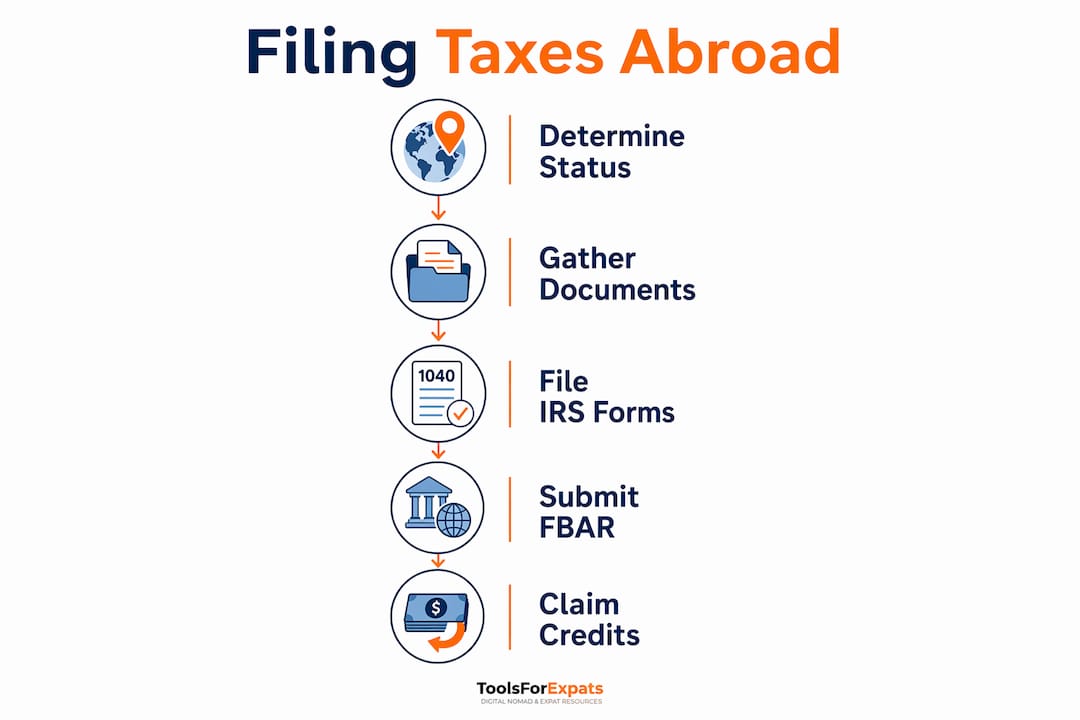
Here's what the core requirements look like:
- Annual Form 1040: Report all worldwide income regardless of where it was earned or which country's employer paid it.
- Foreign Earned Income Exclusion (FEIE): Exclude a significant amount of foreign earned income from U.S. federal tax by filing Form 2555.
- FBAR (FinCEN Form 114): Required if your foreign financial accounts exceeded $10,000 aggregate at any point during the year.
- Self-employment tax: If you're a contractor abroad, you still owe self-employment tax. The FEIE does not reduce this.
- Filing deadlines: You get an automatic two-month extension to file your return, but any tax owed is still due on the regular payment deadline. Interest accrues on unpaid balances from then.
A further extension to October 15 is available by filing Form 4868 by June 15. Those who need even more time to qualify under the bona fide residence or physical presence tests can request a discretionary extension to December 15.
How to qualify for the Foreign Earned Income Exclusion
The FEIE is the most powerful tax benefit available when you file taxes working remotely abroad, but you have to earn it. The IRS requires you to meet specific tests before you can claim it on Form 2555.
- Establish a tax home abroad. Your primary place of business or employment must be in a foreign country. You can't claim a U.S. city as your base and still qualify.
- Meet the Physical Presence Test. Spend at least 330 full days outside the U.S. during any 12-month period. Days in transit through the U.S. count against you, so track your travel carefully.
- Or meet the Bona Fide Residence Test. Be a genuine resident of a foreign country for an uninterrupted period covering a full tax year (January 1 through December 31 for calendar-year filers). This test is more subjective and considers your intent, visa type, and community ties.
- Earn income from personal services abroad. Passive income like dividends or rental income does not qualify for the FEIE. Only wages, salaries, and self-employment income earned through services performed overseas count.
- File Form 2555 with your 1040. Attach it to your return each year you claim the exclusion. You can also claim a foreign housing exclusion or deduction for qualifying housing costs above a base amount.
- Amend if you qualify late. If you file before meeting either test, report your full worldwide income. Once you qualify, file Form 1040-X to claim the FEIE retroactively.
Pro Tip: U.S. resident aliens (green card holders) can only use the Bona Fide Residence Test if they are citizens or nationals of a country that has an income tax treaty with the U.S. Otherwise, the Physical Presence Test is the only route.
What you need to know about FBAR filing
FBAR is a separate reporting requirement that trips up many remote workers. It has nothing to do with whether you owe tax or claim the FEIE. It's purely a disclosure obligation to the U.S. Treasury.
- Threshold: If the combined value of all your foreign financial accounts exceeded $10,000 at any single point during the calendar year, you must file.
- Form: FinCEN Form 114, submitted electronically through the BSA E-Filing System. It goes to the Treasury Department, not the IRS.
- Account types covered: Bank accounts, brokerage accounts, mutual funds held at foreign institutions, and certain foreign pension accounts.
- FBAR is independent of FEIE. Even if you exclude your entire income under the FEIE, FBAR still applies if your accounts cross the threshold.
- Deadline: April 15, with an automatic extension to October 15. No form is required to get the extension.
Penalties for missing FBAR can be steep, so don't treat it as optional. If you have accounts in multiple countries, add up all balances together when checking the $10,000 threshold. For more on why nomads open offshore accounts and what that means for reporting, the offshore accounts guide from ToolsForExpats covers the practical side well.

How tax residency and state taxes affect you while living overseas
Moving abroad doesn't automatically sever your U.S. state tax obligations. This is where many remote workers get caught off guard, and the rules vary significantly by state.
Your state of residence generally taxes all your income, regardless of where you earned it. Some states are aggressive about holding onto former residents. California and New York, for example, look at factors like where you keep a home, where your family lives, and where your professional licenses are registered. Simply leaving the country doesn't end their claim on your income if those ties remain.
Multi-state tax challenges get more complex when your employer is based in a state with a "convenience of the employer" rule. Connecticut, Delaware, Nebraska, New York, and Pennsylvania apply this rule, meaning if you work remotely for a company based there for your own convenience rather than employer necessity, that state may tax your income even if you never set foot there. You could end up owing taxes to both your state of residence and your employer's state.
Pro Tip: Document your departure date, lease termination, driver's license change, and voter registration update. States like California require clear evidence of domicile change before they stop taxing you.
Most states with income taxes offer a credit for taxes paid to another state, which prevents true double taxation in most cases. But if the second state has higher rates, you'll pay the difference. Establishing residency in a no-income-tax state like Florida or Texas before moving abroad is a common strategy for creating a clean break.
Converting foreign income to U.S. dollars: what the IRS requires
Every dollar of foreign income on your U.S. return must be reported in U.S. dollars. The IRS doesn't accept amounts in euros, pounds, or baht. The conversion requirement is straightforward in principle but demands consistent record-keeping in practice.
- Use the exchange rate at the time of receipt. For regular wages, this typically means the rate on each payday.
- Accepted methods: Daily spot rates, monthly averages published by the IRS or Treasury, or the rate on the specific payment date. Monthly averages are common for salaried workers.
- Keep dated records. Save pay stubs, bank statements, and any exchange rate documentation tied to each transaction.
- Inaccurate conversion is an audit risk. The IRS can challenge your reported amounts if your records don't support the rates you used.
Pro Tip: Apps like XE Currency or your bank's historical rate records can generate exportable logs of exchange rates by date. Export these at year-end and store them with your tax documents.
Free tools that make tax planning abroad much easier
Tax compliance while living overseas involves tracking deadlines, currencies, account balances, and multiple jurisdictions at once. The right tools reduce that complexity considerably.
ToolsForExpats offers a free suite of calculators and resources built specifically for remote workers and digital nomads. No account required.
- Moving Abroad Budget Calculator: Plan your relocation costs and ongoing expenses before you go, which feeds directly into your financial planning for estimated tax payments.
- Cost of Living Comparison Tool: Compare your current city against potential destinations to understand how your income will stretch and what your effective tax burden might look like in each location.
- Digital Nomad Visa Checker: Verify visa eligibility across 20+ countries, since your visa type directly affects your ability to establish bona fide residence for FEIE purposes.
- Expert blog resources: ToolsForExpats covers topics like common digital nomad tax mistakes, tax residency explained for 2026, and establishing a tax home abroad.
Many tax software tools lack support for expat-specific forms and foreign address input, which is why pairing free planning tools with a qualified international tax professional is often the most practical approach for complex situations.
How foreign tax credits help you avoid double taxation
If you pay income tax to the country where you work, you don't have to pay U.S. tax on that same income twice. The Foreign Tax Credit (FTC), claimed on Form 1116, gives you a dollar-for-dollar credit against your U.S. tax liability for foreign income taxes already paid.
The FTC is especially valuable in high-tax countries like Germany, the UK, or France, where local tax rates often exceed U.S. rates. In those cases, the FTC can eliminate your U.S. federal tax bill entirely on the covered income. For remote workers in low-tax or zero-tax countries like the UAE, the FEIE is usually the better choice since there's little or no foreign tax to credit.
You can't use both the FEIE and the FTC on the same income. Choosing between them depends on your host country's tax rate, your income level, and whether you're an employee or contractor. A tax professional familiar with international filing can model both scenarios for you.
How tax treaties can reduce what you owe
The U.S. has income tax treaties with more than 60 countries. These treaties can reduce withholding rates on certain types of income, prevent double taxation, and in some cases determine which country has the primary right to tax your earnings.
Treaties vary significantly in their terms. Some cover employment income directly; others focus on pensions, dividends, or royalties. To apply a treaty benefit on your U.S. return, you typically disclose the treaty position on your Form 1040 and may need to file Form 8833 if the benefit reduces your U.S. tax. Totalization agreements, which are separate from income tax treaties, cover Social Security and Medicare. The U.S. has these agreements with more than 30 countries, and they can exempt you from paying into both the U.S. and foreign social security systems simultaneously.
Do you still owe state taxes while living abroad?
The answer depends on your ties to your home state, not just your physical location. States use different standards to determine residency, and some are far more aggressive than others.
States generally tax you as a resident if you maintain a domicile there, meaning the place you intend to return to. Factors like owning a home, having a spouse or children there, keeping a car registered, or maintaining professional licenses all signal continued domicile. Simply renting out your home and leaving doesn't automatically break residency in states like California, New York, or Massachusetts.
If you've genuinely severed ties, document everything: the date you terminated your lease or sold your home, where you registered to vote, where you got your new driver's license, and where your bank accounts are held. States that challenge your non-residency claim will look at all of it. Filing a part-year resident return in your departure year is standard, and you should expect to report income earned while you were still a resident.
Key Takeaways
U.S. citizens and green card holders must file annual federal tax returns on worldwide income regardless of where they live, and can reduce liability through the FEIE, Foreign Tax Credit, and tax treaties while staying compliant with FBAR and state obligations.
| Point | Details |
|---|---|
| Worldwide income filing | U.S. citizens and green card holders must report all worldwide income annually, even while living abroad. |
| FEIE exclusion limits | Exclude a significant amount of foreign earned income from U.S. federal tax by filing Form 2555. |
| FBAR threshold | File FinCEN Form 114 if foreign account balances exceeded $10,000 aggregate at any point during the year. |
| Payment deadline stays April 15 | The automatic June 15 filing extension for expats does not extend the payment deadline; interest runs from April 15. |
| State taxes don't end automatically | Severing domicile requires documented action; states like California and New York actively pursue former residents. |