
Digital nomads need specialized accounting software because spreadsheets and personal banking apps simply cannot handle multi-currency income, IRS compliance, and real-time financial reporting across borders. Without the right tools, you risk IRS penalties, fines, and the kind of financial chaos that ends businesses. The good news: purpose-built platforms make this manageable, even from a beach in Bali or a coworking space in Lisbon.
Here is why accounting software is non-negotiable for location-independent professionals:
- Multi-currency management: Income arriving in euros, dollars, and pounds needs automatic conversion and consolidated reporting, not manual calculations.
- Tax compliance: US citizens owe federal taxes regardless of where they live. Accurate, organized records protect you from IRS scrutiny.
- Automation: Bank feeds and automated invoicing eliminate hours of manual data entry each week.
- Audit-ready records: Cloud platforms maintain an immutable transaction trail that meets GAAP and IFRS standards, accessible by your CPA from anywhere.
- Real-time financial visibility: Know your true cash position across every account without opening five browser tabs and doing math by hand.
- Separation of accounts: Keeping business and personal finances apart is the foundation of clean expense tracking and accurate tax deductions.
Which accounting software do digital nomads actually use in 2026?
The market has expanded well beyond QuickBooks. Nomads now choose from full accounting platforms, AI-powered layers, budgeting apps, and banking hybrids, each suited to a different stage of business complexity. The table below covers every major option, from free tools for early-stage freelancers to professional-grade platforms for US LLC founders.
| Tool | Best For | Multi-Currency | Tax Compliance | Automation | Pricing |
|---|---|---|---|---|---|
| QuickBooks Online | US-based nomads needing tax-ready reports | 145+ currencies | Strong federal + state | High | — |
| QuickBooks Solopreneur | Solo nomads with basic tax needs | Limited | Basic 1099 support | Moderate | Lower tier |
| Xero | Multi-currency real-time visibility | Strong native support | Good | High | — |
| FreshBooks | Freelancers needing simple invoicing | Basic | Basic | Moderate | — |
| Zoho Books | Scalable nomad businesses | Strong | Good | High | Free |
| Wave | Early-stage nomads on tight budgets | Limited | Basic | Low | Free core |
| Bonsai | Freelancers needing contracts + invoicing | Basic | Basic | Moderate | — |
| Keeper Tax | Maximizing deductions and filing | USD-focused | Strong deduction AI | High | $20/mo |
| Finlens | US LLC nomads on QuickBooks | 12,000+ institutions via Plaid | Tax-ready reports + filing | Very High | Free starter; $49/mo AI plan |
| Uku | Modern mobile-first nomads | Supported | Moderate | High | Not publicly listed |
| Revolut | Early-stage banking + basic bookkeeping | Excellent | Limited | Moderate | Free–tiered |
| Wise Business | Low-fee cross-border transfers | Excellent | Limited | Low | Low fees |
| YNAB | Strict budgeting and cash flow discipline | Limited | None | Low | — |
| Mint | Simple budget visualization | Limited | None | Low | Free |
| Empower | Spending insights on the go | USD-focused | None | Low | Free |
| Xolo | All-in-one incorporation + bookkeeping | Supported | Compliance tools | Moderate | Tiered |
| DATEV | European tax authority compliance | Supported | Very Strong (EU) | High | Not publicly listed |
A few tools deserve more than a table row.
Finlens sits in a category of its own for US LLC nomads. It layers AI-powered categorization and real-time multi-currency tracking on top of QuickBooks, connecting to over 12,000 financial institutions via Plaid. Your CPA's workflow stays untouched because Finlens syncs two ways with QuickBooks without any migration. The free Starter plan covers a moderate level of monthly expenses, and the AI Accounting plan runs a moderate monthly fee.
QuickBooks Online remains the default for established nomad businesses. Its support for over 145 currencies and direct federal tax reporting make it the most CPA-friendly option on the list. QuickBooks Solopreneur strips that down to a simpler interface for solo operators who mainly need 1099 tracking.

Xero is the strongest native multi-currency platform for nomads who want real-time visibility without the QuickBooks ecosystem. Its bank reconciliation and app integrations work well alongside Wise or Revolut for nomads holding funds in multiple currencies.
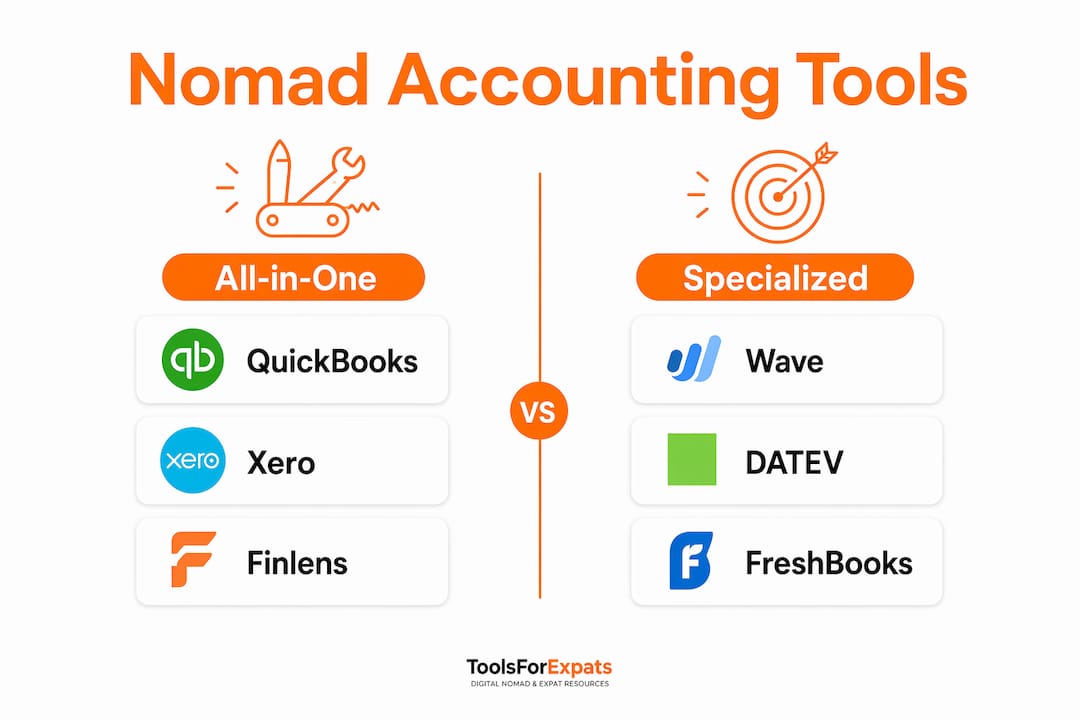
Wave is genuinely free for core features, which makes it a reasonable starting point. The catch: its multi-currency support is limited, and it lacks the depth needed once your business crosses borders regularly.
Revolut and Wise Business are not accounting software. Both are excellent for holding multiple currencies and making low-fee transfers, but neither provides double-entry bookkeeping or the detailed tax reporting a US LLC requires. Use them alongside an accounting platform, not instead of one.
YNAB, Mint, and Empower are personal finance tools. They help you budget and track spending, but they produce no audit trail and handle no tax compliance. They belong in your toolkit as a complement, not as your primary accounting solution.
DATEV is the professional standard for nomads registered with European tax authorities. If you operate through a German GmbH or similar EU entity, DATEV's compliance and audit features are hard to replace.
Pro Tip: If you are a US LLC nomad already using QuickBooks, add Finlens before tax season rather than after. The AI categorization keeps your books current automatically, so your CPA gets clean data instead of a cleanup project.
How to choose the right accounting software for your nomad setup
The right tool depends on three things: where your money comes from, how complex your tax situation is, and how much you want to automate. Here is how to think through each.
Start with your currency exposure
If you earn and spend in a single currency, almost any platform works. Once you have clients paying in euros, pounds, or pesos alongside USD expenses, you need native multi-currency support, not a workaround. Xero and QuickBooks Online handle this natively. Zoho Books does too, at a lower price point. Platforms like Wave and FreshBooks can manage basic foreign currency invoicing but require manual conversion for consolidated reporting.
Nomads who use multiple banks across countries need software that connects to international institutions automatically. Finlens connects to 12,000+ institutions via Plaid, which is the most comprehensive option currently available for US LLC founders.
Match automation to your transaction volume
Low volume, simple income? FreshBooks or Bonsai cover invoicing and basic expense tracking without overwhelming you. Growing volume with recurring clients and contractor payments? You need bank feeds, recurring invoice automation, and AI-driven receipt scanning. QuickBooks Online, Xero, and Finlens all deliver this. Keeper Tax is worth adding specifically for deduction identification if you are self-employed and want to minimize your US tax bill.

Assess your tax compliance requirements
US citizens owe federal taxes no matter where they live. If you run a US LLC, you also have state filing obligations and potentially 1099 requirements for contractors. Early adoption of cloud accounting avoids the expensive cleanup fees that come from handing a CPA a year's worth of disorganized records. Experts consistently recommend giving accountants direct access to cloud-based books rather than exporting spreadsheets.
Nomads operating through European entities should look at DATEV or Xolo, both of which include compliance tools aligned with EU tax authorities. For a digital nomad visa holder in Portugal or Spain, your tax residency situation may shift your obligations significantly.
Prioritize security and mobile access
Your financial data travels with you. Choose platforms with two-factor authentication, encrypted cloud backup, and a mobile app that works reliably on variable connections. QuickBooks Online, Xero, FreshBooks, and Finlens all offer strong mobile apps. Offline access is limited across most cloud platforms, so a reliable data connection matters.
Here is a quick checklist before you commit to any platform:
- Does it support all the currencies you actively use?
- Can your accountant access it remotely without you sending files?
- Does it automate bank reconciliation, or do you do it manually?
- Does it generate P&L, balance sheet, and cash flow reports automatically?
- Is the mobile app functional enough for on-the-road use?
- Does pricing scale with your transaction volume, or does it jump sharply?
Phased adoption works well for most nomads. Start with a simpler tool like FreshBooks or Bonsai, then migrate to QuickBooks or Xero as your business grows. Finlens is specifically designed for nomads who have already outgrown basic invoicing tools and need real-time multi-currency accounting without rebuilding their QuickBooks setup.
What experts say about tax compliance and bookkeeping for US nomads
The financial risk of poor bookkeeping is concrete. According to NASE's 2024 analysis, improper bookkeeping is a leading cause of fines and business failure among nomadic entrepreneurs. The IRS does not make exceptions for location. US citizens and LLC owners abroad face the same federal reporting obligations as those working stateside, including income reporting, self-employment tax, and 1099 filings for contractors.
Professional accountants require double-entry bookkeeping and cleanly categorized transactions. A banking app export or a spreadsheet does not meet that standard. When your CPA has to reconstruct a year of transactions from bank statements, you pay for that time, often at rates that dwarf what a year of accounting software would have cost. Direct accountant access to cloud-based books eliminates that problem entirely.
Automation is where the real time savings accumulate. By 2026, cloud platforms deliver instant P&L reports from any device, which means you always know whether your business is profitable before making decisions about where to live or which projects to take. That clarity is not just convenient. It is what separates nomads who sustain the lifestyle long-term from those who burn out managing financial chaos.
One distinction that trips up many nomads: banking apps like Revolut and Wise are transaction management tools. They track what moves through your account, categorize spending, and generate basic reports. What they cannot do is produce the audit-ready double-entry records that the IRS or a CPA requires for a US LLC. Treating Revolut as your accounting system is a compliance gap waiting to surface at the worst possible moment.
Separating business and personal accounts is the foundational step. Once that separation exists, clean expense tracking becomes straightforward, tax deductions are easier to claim, and your books reflect your actual financial position. Nomads who skip this step consistently report that tax season becomes a stressful reconstruction project rather than a routine filing.
For nomads who are just getting started as location-independent professionals, the accounting setup you choose in year one shapes how much cleanup you face in year two. Getting it right early is far cheaper than fixing it later.
ToolsForExpats gives you the financial picture before you pick your software
The accounting tools covered here handle your books once you are up and running. But before you commit to a country, a tax residency, or a monthly budget, you need to know what your finances actually look like in that location.
ToolsForExpats offers free calculators and planning tools built specifically for digital nomads and expats, no account required. Use the cost of living comparison to see how your budget holds up across cities, or run the nomad cost calculator to project your real monthly expenses before you book a flight. The visa checker covers 20+ countries so you know your residency options before your tax situation gets complicated. These tools do not replace accounting software. They give you the context to choose the right country, the right entity structure, and the right budget before your accounting software has anything to track.
Key Takeaways
Digital nomads who use purpose-built accounting software avoid IRS penalties, reduce bookkeeping time, and maintain audit-ready records accessible from anywhere in the world.
| Point | Details |
|---|---|
| Multi-currency is the core need | Platforms like QuickBooks Online support 145+ currencies; manual conversion creates errors and compliance gaps. |
| Banking apps are not accounting software | Revolut and Wise lack double-entry bookkeeping and cannot produce the tax records a US LLC requires. |
| Early cloud adoption saves money | Giving your CPA direct cloud access avoids expensive cleanup fees from disorganized records. |
| Match the tool to your complexity | Freelancers start with FreshBooks or Bonsai; US LLC nomads with multi-currency needs should look at Finlens on top of QuickBooks. |
| ToolsForExpats | Free calculators help you plan your budget and compare living costs before your accounting setup even begins. |