
Southeast Asia is the top choice for digital nomads because it delivers three things at once: genuinely low living costs, a ready-made community of remote workers, and reliable internet infrastructure across dozens of cities. You can live well on a modest monthly budget, find a coworking space within walking distance of most guesthouses, and hop between countries on low-cost flights. That combination is hard to match anywhere else on the planet.
The short version:
- Monthly budget ranges: $1,000–$1,500 (comfortable lifestyle in established hubs like Chiang Mai or Da Nang; Western salaries often buy 2–3x the lifestyle in Southeast Asia), $800–$1,200 (lean), $2,000+ (premium) in hubs like Chiang Mai, Da Nang, and Bali
- Top hub cities: Chiang Mai, Bangkok, Bali/Canggu, Ho Chi Minh City, Da Nang, Penang/George Town, Phnom Penh, Singapore
Before you commit to a city, run your numbers through the ToolsForExpats cost comparison tool to see exactly how your current expenses stack up against your target hub.
1. Why nomads choose Southeast Asia for the cost of living
The money argument is straightforward. A comfortable nomad lifestyle in established hubs like Chiang Mai or Da Nang generally costs significantly less per month, covering rent, food, coworking, and transport. Western salaries often buy substantially more lifestyle than they would at home.
Where the savings actually come from:
- Food: A proper local meal in Vietnam costs around $3–$4; restaurant meals for two rarely exceed $15
- Accommodation: A one-bedroom apartment in a non-tourist Chiang Mai neighborhood runs around $400 per month
- Transport: Grab rides across most cities cost $1–$4; monthly scooter rentals run $50–$80
- Coworking: Day passes average $5–$15; monthly memberships $80–$150
Sample monthly budget comparison (non-numeric approximate ranges)
| Category | Chiang Mai | Da Nang | Bali/Canggu | San Francisco (baseline) |
|---|---|---|---|---|
| Rent (1BR) | $350–$500 | $400–$600 | $500–$900 | — |
| Food | $150–$200 | $150–$200 | — | $600–$900 |
| Coworking | $80–$80 | $80–$100 | $100–$150 | $300–$400 |
| Transport | $40–$80 | $40–$70 | $50–$100 | $150–$200 |
| Total | $800–$1,200 | $900–$1,200 | $1,200–$1,800 | $4,500+ |
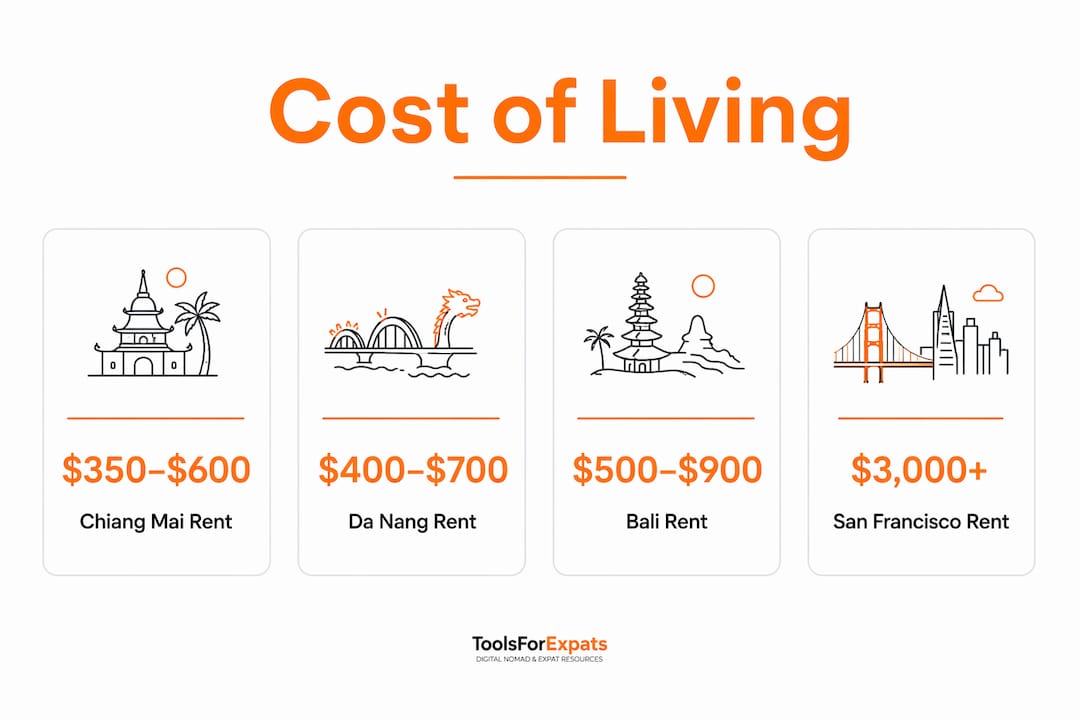
The gap between Southeast Asia and a major US city is not marginal. For a nomad earning a US-market salary, that difference funds travel, savings, or simply a higher quality of daily life.
2. Community and coworking spaces reduce friction fast
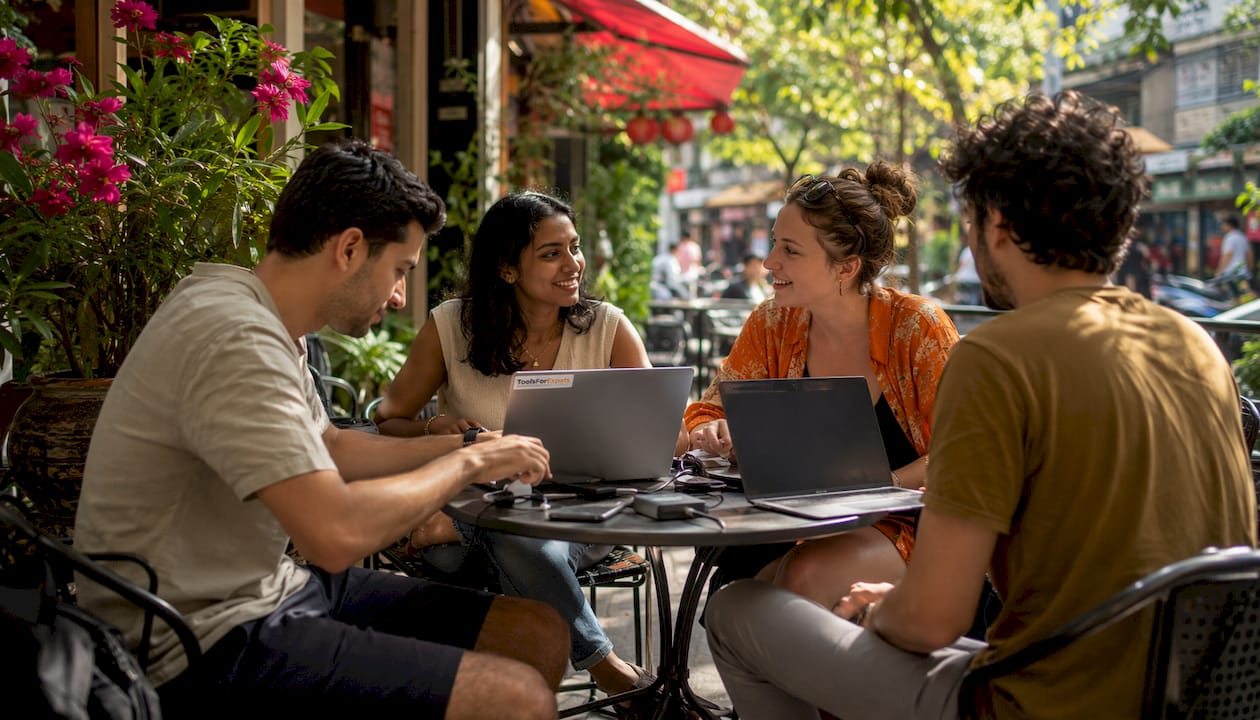
The decade-long nomad presence in cities like Chiang Mai and Bali has created a pre-built social ecosystem. Coworking spaces, coliving houses, weekly meetups, and active Telegram groups mean you can arrive in a new city and have a social life within 48 hours. That is genuinely unusual compared to most parts of the world.
Practical benefits of plugging into this infrastructure:
- Networking and hiring: Find contractors, collaborators, or clients at weekly nomad meetups
- Mental health: Regular social contact reduces the isolation that derails many solo nomads
- Local knowledge: Community members share visa tips, landlord recommendations, and neighborhood safety updates in real time
- Career growth: Nomad networking in Southeast Asia frequently leads to referrals, partnerships, and freelance contracts
Veteran nomads consistently point to community as the region's greatest non-monetary asset. Coworking and coliving combos, meetups, and active city groups make social integration faster here than in most Western cities.
Community types vary by city. Chiang Mai skews technical and entrepreneurial. Canggu in Bali leans creative and wellness-oriented. Bangkok attracts a broader mix of startup founders and corporate remote workers. Knowing which type fits you helps you pick the right base from day one.
Pro Tip: Before you arrive, join the local Telegram or Slack group for your target city. Most active hubs have one. You can ask about neighborhoods, coworking spaces, and upcoming events before you even book a flight.
3. Internet and remote-work infrastructure: what to expect
Major hubs in Southeast Asia increasingly offer fiber connections reaching 100 Mbps or faster, and coworking spaces in cities like Bangkok, Chiang Mai, and Kuala Lumpur often provide generator backup and multiple ISPs. Cafés across the region commonly offer reliable Wi-Fi, with connectivity in many Southeast Asian cities exceeding what you find in parts of Europe.
That said, infrastructure varies. A beachside villa in Bali may have inconsistent speeds; a coworking space two kilometers away will not. Plan accordingly.
Practical setup checklist:
- Test speeds at your accommodation before signing any lease (use Speedtest or Fast.com)
- Buy a local SIM on arrival; data plans are cheap and fast in Thailand, Vietnam, and Malaysia
- Get a pocket Wi-Fi or eSIM as a backup for travel days and café gaps
- Choose a coworking space with generator backup if your work involves video calls or large uploads
Time zones are a real operational factor. Bangkok sits roughly 11–12 hours ahead of the US East Coast, which means your morning in Southeast Asia overlaps with the previous evening in New York. Many nomads with US clients shift their schedule to afternoons and evenings locally. Use ToolsForExpats' time zone overlap calculator to confirm whether a hub's rhythm actually fits your client schedule before you commit.
Pro Tip: Schedule a standing weekly call with US or European clients during your local evening (their morning). It protects your daytime for deep work and keeps communication predictable across time zones.
4. Visa options and realistic timelines for staying legally
For years, nomads in Southeast Asia operated in a legal gray area, relying on tourist visas not designed for remote work. That has changed significantly. Eleven Asian countries now offer a digital nomad or remote-work visa, with requirements ranging from no income minimum to around $70,000 per year.
Common visa approaches by country:
- Thailand DTV (Destination Thailand Visa): Valid five years, 180-day consecutive stays, no income minimum (savings proof required). Accepts freelancers and self-employed workers. Among the most flexible options in the region.
- Malaysia DE Rantau Nomad Pass: Up to 12 months (extendable by 12 more). Requires annual income of $24,000–$60,000 depending on category. Accepts tech and non-tech professionals.
- Indonesia E33G Remote Worker Visa: Up to one year; must be employed outside Indonesia. Bali remains the most popular base.
- Tourist visa + border runs: Still common in Vietnam, Cambodia, and the Philippines. Practical for shorter stays but carries uncertainty at each entry.
- Long-stay/retirement visas: Thailand's Non-Immigrant O-A and similar options suit nomads with higher savings who want a stable multi-year base.
Typical planning sequence:
- Research visa requirements for your nationality 8–12 weeks before departure
- Check eligibility with the ToolsForExpats visa checker to narrow your options quickly
- Gather financial proof, health insurance, and passport photos before applying
- On arrival, register your address if required (Thailand and Indonesia both have registration steps for longer stays)
One important note: working for local clients without a proper work permit is illegal in most Southeast Asian countries, even on a digital nomad visa. These visas cover remote work for foreign clients or employers only. Confirm the current rules with the official immigration authority for your destination before you travel.
5. Short profiles of popular hubs and why nomads pick each one
Every city in Southeast Asia has a distinct personality. Here is a quick breakdown of the eight most popular nomad bases.
| City | Cost bracket | Best for | Vibe |
|---|---|---|---|
| Chiang Mai | $800–$1,200/mo | First-timers, tech nomads | Calm, community-dense, low-key |
| Bangkok | $1,200–$2,000/mo | Startup founders, city lovers | Fast-paced, excellent infrastructure |
| Bali/Canggu | $1,200–$1,800/mo | Creatives, wellness seekers | Beach-meets-coworking culture |
| Ho Chi Minh City | $900–$1,400/mo | Budget-focused, food lovers | Energetic, affordable, improving internet |
| Da Nang | $900–$1,200/mo | Beach + city balance | Relaxed, growing nomad scene |
| Penang/George Town | $900–$1,400/mo | Food culture, English speakers | Multicultural, underrated |
| Phnom Penh | — | Ultra-budget, adventurous | Raw, frontier feel, low cost |
| Singapore | — | High earners, visa stability | World-class infrastructure, premium cost |
A few standout notes:
- Chiang Mai is the classic first-timer hub. The nomad community is dense, English is widely spoken in expat areas, and the cost-to-quality ratio is hard to beat.
- Bali/Canggu has transformed into a coliving and networking hub, though rising rents mean the budget advantage has narrowed compared to five years ago.
- Da Nang offers a beach lifestyle with a lower price tag than Bali and a growing coworking scene that suits nomads who want calm over chaos.
- Singapore is the outlier: expensive by any measure, but its healthcare, legal stability, and flight connections make it a strong base for high earners or those needing a reliable regional hub.
- Phnom Penh suits experienced nomads comfortable with less infrastructure in exchange for very low costs and a genuinely local experience.
For a data-driven match between your lifestyle and a specific city, the best nomad city quiz on ToolsForExpats walks you through the key criteria in minutes.
6. Where to live: short-term stays, monthly rentals, and coliving
Your housing choice shapes your budget and your social life more than almost any other decision.
Short-term rentals (1–4 weeks): Guesthouses, serviced apartments, and Airbnb-style listings run $20–$60 per night in most hubs. Good for testing a city before committing. The per-night cost adds up fast, so treat this as a scouting phase, not a long-term strategy.
Monthly rentals (1–6 months): The sweet spot for most nomads. A furnished one-bedroom in a non-tourist neighborhood costs $350–$600 in Chiang Mai or Da Nang, $500–$900 in Bali, and $800–$1,400 in Bangkok. Negotiate directly with landlords when possible; you can often get 10–20% off the listed price for a three-month commitment.
Coliving spaces: All-inclusive monthly rates typically run $600–$1,500 and cover a private room, fast Wi-Fi, coworking access, and community events. The premium is real, but so is the social value for nomads who are new to a city or working through a lonely patch.
Checklist before signing any lease:
- Test the internet speed yourself (do not rely on the landlord's claim)
- Confirm air conditioning is functional and included in the price
- Check water pressure and hot water availability
- Clarify the deposit amount and refund conditions in writing
- Read the contract carefully; have a local or a community member review it if it is in Thai, Indonesian, or Vietnamese
Watch out for scams targeting new arrivals: fake listings, landlords who collect deposits and disappear, and short-term rentals that look nothing like the photos. Book your first week through a reputable platform, then find monthly accommodation in person after you have seen the neighborhood.
7. Regional travel and connectivity: flights, transport, and price expectations
Southeast Asia's geography is one of its biggest practical advantages. The region's low-cost carrier network means you can fly from Bangkok to Bali, or Kuala Lumpur to Da Nang, for $30–$80 on a good booking day. Major hubs like Bangkok (Suvarnabhumi and Don Mueang), Kuala Lumpur (KLIA), and Singapore (Changi) connect to virtually every city in the region and beyond.
Key transport facts for nomads:
- Short regional flights: AirAsia, Vietjet, and Lion Air regularly price routes under $50 when booked 3–6 weeks out
- Overland options: Sleeper buses and trains between Vietnam's major cities cost $10–$25 and double as overnight accommodation
- Local transport: Grab operates across Thailand, Vietnam, Malaysia, Indonesia, and the Philippines; a city ride rarely exceeds $3–$5
- Scooter rental: $50–$80 per month in most cities; the most practical option for daily errands outside Bangkok
For visa planning, budget airlines make border runs straightforward and affordable. A flight from Chiang Mai to Penang for a visa run typically costs $40–$70 round trip. Building flexible ticket dates into your booking strategy saves money and stress when visa timelines shift.
Pro Tip: Book one-way tickets when your stay length depends on visa approval. The flexibility is worth the marginal price difference, and it avoids the awkward situation of holding a return ticket you cannot use.
8. Safety and healthcare basics every nomad should plan for
Southeast Asia is generally safe for nomads, but the risks that do exist are specific and preventable.
Healthcare access:
- Bangkok's Bumrungrad International Hospital and Bangkok Hospital are internationally accredited and widely used by expats across the region
- Chiang Mai, Penang, and Ho Chi Minh City all have private hospitals with English-speaking staff
- Phnom Penh and smaller cities have more limited options; serious conditions often require medical evacuation to Bangkok or Singapore
Insurance checklist:
- Medical evacuation coverage (non-negotiable if you plan to spend time in Cambodia or rural areas)
- Local inpatient coverage with a direct-billing option at major hospitals
- Dental coverage if you plan to stay longer than three months
- Adventure sports rider if you plan to surf, dive, or ride a scooter regularly
Safety tips:
- Petty theft (bag snatching, phone grabs) is the most common risk in tourist-heavy areas; keep bags zipped and phones out of sight on busy streets
- Scooter accidents are the leading cause of injury among nomads; wear a helmet, avoid riding at night in unfamiliar areas, and check your insurance covers motorbike use
- Research neighborhoods before renting; expat community groups are the fastest source of current safety information
How to find English-speaking doctors:
- Ask your coliving or coworking space for their recommended clinic
- Check the US Embassy website for your destination country; most maintain a list of vetted medical providers
- Save the local emergency number before you need it (Thailand: 1669, Vietnam: 115, Indonesia: 119)
For a deeper look at health planning, the ToolsForExpats guide to nomad health challenges covers insurance gaps and common medical situations abroad.
9. Downsides, rising costs, and responsible-nomad practices
The honest picture includes real trade-offs. Nomads' higher disposable incomes can push up local rents and strain infrastructure in popular hubs, pricing out local residents in neighborhoods like Canggu and parts of Chiang Mai's old city. This is not a hypothetical concern.
"Short-term rentals, which both tourists and digital nomads heavily rely on, have been criticised for pricing locals out of their cities. As digital nomads generally possess greater purchasing power due to higher salaries, rental rates inevitably increase in popular areas." — Asialink, University of Melbourne
Other real downsides to plan for:
- Rising costs: Bali's Canggu has seen rents increase significantly over the past three years; the budget advantage that drew early nomads has narrowed
- App-bubble risk: Relying entirely on Grab and delivery apps can produce a surface-level experience that keeps you inside an expat bubble rather than engaging with local culture
- Overtourism pressure: Some hubs are showing signs of infrastructure strain; Bali has suspended new hotel construction to manage overdevelopment
Pro Tip: Eat at local markets and family-run restaurants rather than expat-facing spots. Shop at wet markets. Hire local freelancers for tasks you would otherwise outsource to international platforms. These habits keep money circulating in the local economy and give you a richer experience.
Pro Tip: If rents in your target neighborhood have risen sharply, look one or two kilometers outside the nomad cluster. You will often find the same quality accommodation for 20–30% less, and you will interact with more locals in the process.
When a hub no longer offers good value because of overtourism or inflation, the honest move is to rotate to a less-saturated city. Da Nang and Penang currently offer the community and infrastructure of more famous hubs at lower prices.
10. How to choose your base: an operational checklist and eight questions to ask
Picking the right city comes down to matching your work requirements, budget, and lifestyle preferences to what each hub actually delivers. Use this checklist before committing.
Operational checklist:
- Budget: Does the city fit your monthly target at your preferred lifestyle level?
- Time zone: Does the hub's working hours overlap with your clients' or employer's schedule?
- Internet: Does the city have coworking spaces with backup power and fiber speeds?
- Healthcare: Is there a reputable private hospital within 30 minutes?
- Visa: Can you stay legally for your intended duration without excessive border runs?
- Community: Does the city have an active nomad community in your professional niche?
- Travel access: Can you reach a major international airport within two hours?
- Climate: Can you tolerate the weather during the months you plan to be there?
Eight questions to eliminate unsuitable hubs quickly:
- What is my realistic monthly budget, including coworking and one leisure trip?
- What time zone do my clients or employer operate in, and how many overlap hours do I need?
- Do I need fast, stable internet for video calls and large file transfers, or is café Wi-Fi sufficient?
- Am I comfortable with limited English-language healthcare, or do I need a city with international hospitals?
- How long do I plan to stay, and does the available visa cover that duration legally?
- Do I want a large, established nomad community, or am I comfortable being more independent?
- How important is beach access, nightlife, or outdoor activities to my daily quality of life?
- Am I prepared for a tropical climate with a rainy season, or do I need a drier or cooler environment?
The ToolsForExpats best nomad city quiz runs through these criteria in about five minutes and matches your answers to specific cities. Pair it with the decision framework for choosing a nomad destination for a complete picture.
11. Planning tools and trusted resources for your move
Good planning tools cut the research time from weeks to hours. Here is what to use and when.
Recommended tools:
- ToolsForExpats cost comparison: Compare Chiang Mai vs. San Francisco (or any two cities) side by side in minutes. Useful for validating whether your current salary supports your target lifestyle.
- Nomad cost calculator: Enter your city and lifestyle preferences to get a monthly cost estimate broken down by category.
- Visa eligibility checker: Check which digital nomad visas you qualify for based on nationality, income, and planned stay length.
- Best nomad city quiz: Answer eight questions about your work style, budget, and lifestyle to get a ranked list of cities that fit.
Example workflow: You are based in Chicago earning $75,000 per year and considering Chiang Mai. Open the cost comparison tool, enter Chicago and Chiang Mai, and see that your current $4,500 monthly spend could drop to roughly $1,200 in Chiang Mai at the same lifestyle level. Then run the visa checker to confirm you qualify for Thailand's DTV. That is a complete go/no-go analysis in under ten minutes.
For authoritative visa information, always cross-reference with the official immigration authority of your destination country. The Asialink overview of Southeast Asian digital nomad visas and the ExpatDen guide to Asian digital nomad visas are two of the most thorough secondary sources available.
This article is general information, not legal, tax, or financial advice. Confirm current visa rules and tax obligations with the official immigration authority or a qualified professional before you travel.
Key Takeaways
Southeast Asia consistently delivers the best combination of low costs, established nomad communities, and reliable remote-work infrastructure of any region in the world.
| Point | Details |
|---|---|
| Cost advantage is substantial | A comfortable lifestyle in Chiang Mai or Da Nang commonly runs $1,000–$1,500 per month versus $4,500+ in a major US city. |
| Community is the non-monetary edge | Coworking, coliving, and active city groups make social integration faster here than in most Western cities. |
| Visa options have expanded | Eleven Asian countries now offer digital nomad or remote-work visas; Thailand's DTV is among the most flexible. |
| Responsible nomadism matters | Nomads' higher incomes can raise local rents; supporting local businesses and avoiding expat bubbles reduces that impact. |
| ToolsForExpats speeds up planning | The cost comparison tool, visa checker, and best-city quiz let you validate a destination decision in under ten minutes. |
A perspective on what Southeast Asia actually delivers
The cost numbers are real, and so is the community. But what surprises most nomads is how quickly the practical advantages compound into something that feels less like a budget hack and more like a genuinely better way to live. When your rent is $400, your lunch costs $3, and your coworking space runs $100 a month, you stop making financial decisions out of anxiety. That mental shift is underrated.
The cultural richness adds another layer that no calculator captures. Learning a few words of Thai or Vietnamese, navigating a wet market, or spending a weekend at a temple festival changes your relationship to a place in ways that staying inside an expat bubble never will. The nomads who get the most out of Southeast Asia are the ones who treat it as a place to live, not just a place to work cheaply.
The digital nomad lifestyle has real trade-offs, and Southeast Asia is not perfect. Rising costs in Bali, visa uncertainty in some countries, and the ethical weight of gentrification are all legitimate concerns. But for a remote worker who plans carefully, engages respectfully, and uses the right tools to validate their decisions, the region offers a quality of life that is genuinely hard to replicate elsewhere at any price.
Free ToolsForExpats calculators that make planning concrete
Knowing Southeast Asia is affordable is one thing. Seeing exactly how your salary maps to a specific city's costs is what actually moves you from research to booking.
ToolsForExpats offers a free suite of calculators and quizzes built specifically for this decision. The cost of living comparison tool lets you compare your current city against Chiang Mai, Da Nang, Bali, or any other hub in seconds, no account required. The nomad cost calculator breaks down monthly expenses by category so you can see where your money actually goes. The visa eligibility checker covers 20+ countries and tells you which long-stay options fit your nationality and income. And the best nomad city quiz matches your work style, budget, and lifestyle preferences to a ranked list of cities in about five minutes.
Start with the cost comparison tool. Enter your current city and one Southeast Asian hub you are considering. The result will either confirm your instinct or redirect you to a better fit. Either way, you will have a concrete number to plan around instead of a rough guess.
Useful sources and official links for deeper reading
- Asialink: The rise of digital nomads in Southeast Asia — Academic overview of nomad impacts, visa developments, and sustainability concerns across the region
- ExpatDen: All 11 digital nomad visas in Asia — Detailed breakdown of income requirements, eligibility, and practical ratings for every Asian digital nomad visa
- Fulcrum: The rise of digital nomads in Southeast Asia — Expert analysis of gentrification pressure and infrastructure strain in nomad hubs
- Nomad Outfit: Best digital nomad destinations in Asia — Cost examples, city profiles, and community assessments for major hubs
- Dragos Roua: Asia for digital nomads — Ground-level primer on café culture, connectivity, and daily costs
- ToolsForExpats: Free expat tools and calculators — Cost comparison, visa checker, city quiz, and budget calculators for nomads planning a move
- ToolsForExpats: Best countries for digital nomads in 2026 — Country-by-country guidance on top nomad destinations and what each offers