
A remote job is permanent employment with a company, performed outside a traditional office. Freelance work is self-employment where you offer services to multiple clients on a project basis. Both give you location flexibility, but they produce very different lives in terms of income, benefits, and daily structure.
Here is the core difference at a glance:
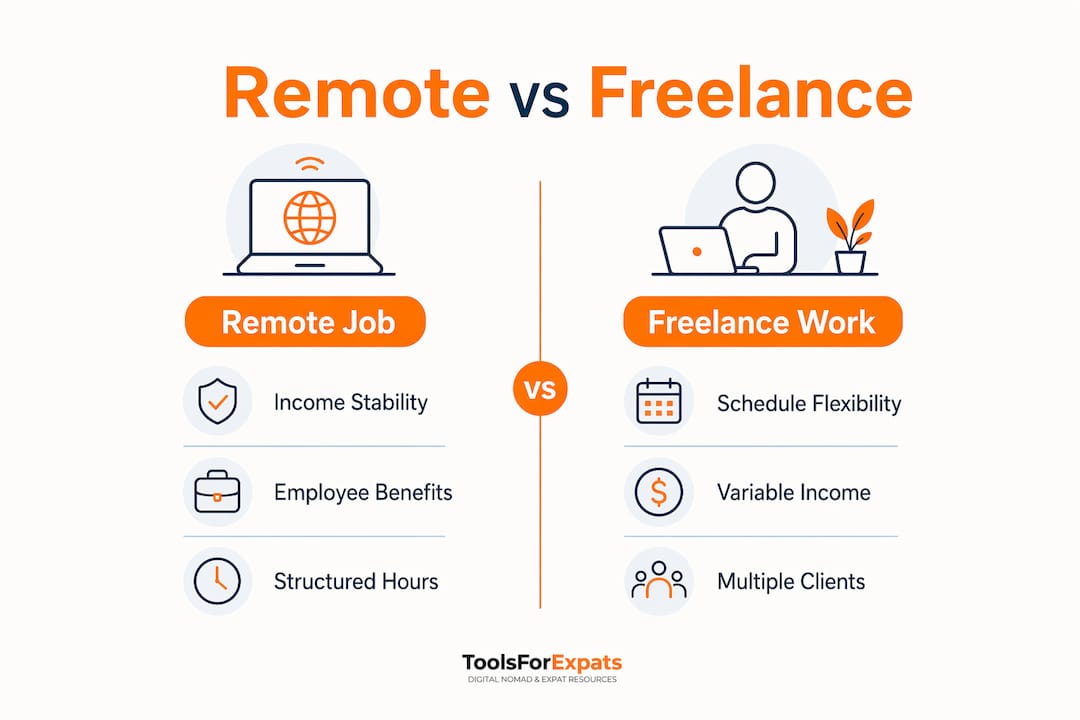
- Employment status: Remote workers are employees of a company; freelancers are self-employed.
- Income: Remote jobs pay a fixed salary on a predictable schedule; freelance income varies by project and client.
- Benefits: Remote employees typically receive health insurance, paid leave, and retirement contributions; freelancers fund all of that themselves.
- Schedule: Remote roles usually require set core hours or timezone overlap; freelancing offers true schedule autonomy.
- Stability vs. freedom: Remote jobs trade schedule control for security; freelancing trades security for independence.
Neither path is objectively better. The right choice depends on your career stage, risk tolerance, and what you want your daily life to look like.
What remote jobs and freelance work actually look like day to day
Understanding the difference between remote job and freelance work goes beyond a simple definition. The two models shape your entire working life differently.

Remote jobs: what to expect
A remote job is a traditional employment role performed outside a physical office. You report to a manager, follow company policies, and work within an organizational structure. Most remote job descriptions specify the remote type (fully remote, remote-first, or hybrid), eligible work locations, required timezone overlap, and whether the company provides equipment or a home-office stipend.
- You receive a W-2 and your employer withholds federal and state taxes.
- Your schedule is set by the company, often with core collaboration hours.
- You may be required to attend occasional in-person retreats or client visits.
- Career growth happens through promotions, internal training, and mentorship.
- Equipment is frequently company-provided or covered by a stipend.
Freelance work: what to expect
Freelance work means you run a business of one. You find clients, negotiate rates, deliver projects, send invoices, and then repeat the cycle. There is no single employer, no guaranteed next assignment, and no HR department handling your paperwork.
- You file taxes as self-employed, paying quarterly estimated taxes to the IRS.
- You set your own hours and choose which projects to accept.
- Income arrives project by project, not on a fixed payroll schedule.
- You handle your own marketing, contracts, and client relationships.
- Benefits like health insurance and retirement savings come entirely out of your pocket.
One detail many people overlook: freelancers juggle multiple roles beyond their core skill. A freelance copywriter is also their own account manager, billing department, and business development team.

Pros and cons of remote jobs versus freelancing
Both paths have genuine advantages and real drawbacks. Knowing them upfront saves you from a costly surprise six months in.
Remote jobs
Advantages:
- Predictable salary makes budgeting and financial planning straightforward.
- Employer-sponsored health insurance, paid time off, and retirement matching add substantial value beyond the base salary.
- Structured mentorship and a clear promotion ladder support career growth, especially early in your career.
- Your employer handles payroll taxes, so you never face a surprise quarterly tax bill.
- Job security is higher since you are not dependent on a constant stream of new clients.
Disadvantages:
- Your income is capped by your role and the company's pay bands.
- Schedule control is limited. Most remote roles require set core hours or timezone overlap, even if your location is flexible.
- You are tied to one employer, which creates a single point of failure if layoffs happen.
- Work variety is lower, and monotony can set in over time.
Freelancing
Advantages:
- Full schedule autonomy. You decide when and how long you work each day.
- Earning potential is uncapped. You can raise rates, specialize in a high-demand niche, or take on more clients.
- You choose your projects and clients, which keeps work varied and engaging.
- Location freedom is absolute. No core hours means you can work from any timezone.
Disadvantages:
- Income is highly variable. Strong months and dry months can look dramatically different.
- You pay self-employment tax on top of income tax, and you fund your own benefits.
- Finding clients, managing contracts, and handling invoices consume time that does not generate revenue.
- Without external structure, overworking and burnout are common traps.
Pro Tip: Calculate your "effective hourly rate" as a freelancer by subtracting unpaid admin hours and business expenses from your gross earnings. A $100/hour rate can shrink fast once you account for overhead and unbillable time.
| Factor | Remote job | Freelance work |
|---|---|---|
| Income stability | Fixed salary, predictable | Variable, project-dependent |
| Benefits | Employer-provided | Self-funded |
| Schedule control | Limited, core hours required | Full autonomy |
| Tax handling | Employer withholds | Self-managed, quarterly payments |
| Career growth | Structured ladder | Self-directed |
| Financial risk | Lower | Higher |
Which work model fits your lifestyle and career stage?
The decision between remote employment and freelancing pivots on one core question: do you want organizational support or full autonomy? Your answer usually depends on where you are in your career and how much financial uncertainty you can absorb.
| Dimension | Remote job | Freelance work |
|---|---|---|
| Employment status | Employee (W-2) | Self-employed (1099) |
| Income stability | High, fixed salary | Low to moderate, variable |
| Benefits and perks | Employer-provided package | Self-funded entirely |
| Flexibility in schedule | Moderate, core hours apply | High, full schedule control |
| Career growth | Structured, mentorship available | Self-directed, portfolio-driven |
| Risk and financial management | Lower risk, single employer | Higher risk, income volatility |
Who benefits most from a remote job
Remote employment tends to suit people who are early in their careers (roughly 0–5 years of experience), since structured mentorship and resume credibility are hard to replicate on your own. It also fits anyone who values a predictable paycheck, employer-sponsored health insurance, or a clear promotion path. If the idea of hunting for your next client every few months sounds exhausting rather than exciting, a remote role is the more comfortable fit.
Who benefits most from freelancing
Freelancing rewards people with in-demand skills, an existing professional network, and a genuine appetite for running their own business. Mid-to-senior professionals with seven or more years of experience tend to have the expertise and contacts to make it viable quickly. If you thrive on variety, want to set your own rates, and are comfortable managing income swings, freelancing can be both financially rewarding and personally satisfying.
The hybrid approach
You do not have to choose permanently. Many professionals keep a full-time remote job while building a freelance client base on the side. This lets you test whether you actually enjoy selling and managing clients before depending on that income. Some freelancers land one or two long-term retainers that cover baseline expenses, then fill remaining capacity with higher-rate project work, combining stability with upside. Transitions between remote and freelance careers are increasingly common and often complementary rather than mutually exclusive.
Pro Tip: If you are considering a move abroad while working remotely or freelancing, check your visa eligibility options early. The rules differ significantly depending on whether you are a W-2 employee or self-employed.
US-specific remote job standards and freelancing financial considerations
What US remote job descriptions must include
A well-written remote job description in the US goes well beyond "work from home." Employers are now expected to specify the remote type (fully remote, remote-first, hybrid, or work-from-anywhere), the eligible states or regions where they can legally hire, required timezone overlap for team collaboration, travel expectations, and equipment provisions. Some roles are remote only for candidates in specific states because of payroll tax and benefits compliance requirements.
- Remote type: Fully remote, remote-first, hybrid, or work-from-anywhere.
- Eligible locations: States, regions, or timezones where the company can legally employ.
- Timezone overlap: Core collaboration hours the candidate must be available for.
- Travel: Whether occasional retreats, client visits, or onsite meetings are required.
- Equipment: Company-provided laptop, home-office stipend, or bring-your-own-device policy.
Pro Tip: When reviewing a remote job posting, look for the eligible locations clause. "Remote" sometimes means remote within a single state, not nationwide. Missing this detail can disqualify your application before it is even reviewed.
Tax differences between remote employees and freelancers
Remote employees receive a W-2 at year end. Their employer withholds federal income tax, Social Security, and Medicare throughout the year, so there are no surprise tax bills. Freelancers receive 1099 forms from each client and are responsible for paying self-employment tax on top of income tax. That self-employment tax covers both the employee and employer share of Social Security and Medicare. Freelancers also make quarterly estimated tax payments to the IRS to avoid underpayment penalties.
For freelancers working internationally, the tax picture gets more complex. Legal considerations around remote work abroad, including tax treaties and local registration requirements, are worth researching carefully. A resource like remote work legal rules covers the key compliance factors that affect both remote employees and self-employed workers operating across borders.
Financial preparation for freelancers
Financial buffer: Financial advisors recommend saving at least 6 months of living expenses before committing to full-time freelancing. This buffer absorbs the income swings that hit hardest in the first year.
Beyond the emergency fund, freelancers need to budget for costs that remote employees never see. Health insurance through the ACA Marketplace, a SEP-IRA or Solo 401(k) for retirement, liability insurance, accounting software, and invoicing tools all come out of gross revenue before you pay yourself. Treating freelancing as running a small business from day one, rather than as a loose collection of gigs, is what separates freelancers who thrive from those who burn out within a year.
If you are planning to freelance or work remotely from abroad, your cost of living calculations need to account for local healthcare costs too. Freelancers in countries like Germany, for example, face specific health insurance requirements that differ from US-based coverage options.
Key Takeaways
Remote jobs offer stability and employer-managed benefits, while freelancing delivers schedule autonomy and uncapped earning potential at the cost of income predictability and self-funded benefits.
| Point | Details |
|---|---|
| Employment status drives everything | Remote workers are W-2 employees; freelancers are self-employed and file as 1099 contractors. |
| Stability vs. autonomy | Remote jobs provide fixed salaries and benefits; freelancing offers full schedule control but variable income. |
| Financial buffer for freelancers | Advisors recommend at least 6 months of savings before going full-time freelance to absorb income swings. |
| Remote does not mean flexible | Most remote roles require core hours or timezone overlap, unlike freelancing's true schedule freedom. |
| Hybrid paths are viable | Starting remote and building freelance clients on the side is a low-risk way to transition between models. |
Plan your remote or freelance career with free tools
Whether you are leaning toward a remote job or ready to go freelance, your financial plan needs to be solid before you make the leap. ToolsForExpats offers a free suite of calculators and tools built specifically for remote workers and digital nomads evaluating their next move.
Use the free expat tools to compare living costs across cities, estimate your moving budget, and check visa eligibility for over 20 countries. If you are weighing a remote job in a lower-cost city abroad or planning a freelance career from a new country, the cost of living comparison tool gives you the numbers you need to make a confident decision. Everything is free, no account required.