
The main types of expat long-term visas fall into eight categories: work and employment, student and exchange, family reunification, investor and entrepreneur, retirement and passive income, digital nomad and remote worker, humanitarian and asylum, and diplomatic and official. Each category has its own qualifying condition, and knowing which one fits your situation is the fastest way to cut through the confusion.
Here's a quick inventory of what each category covers, with U.S. examples where they apply:
- Work visas require employer sponsorship or proof of extraordinary ability. U.S. examples: H-1B (specialty occupation), L-1 (intracompany transfer), O-1 (extraordinary ability).
- Student and exchange visas are tied to enrollment at an approved institution. U.S. examples: F-1 (academic), J-1 (exchange visitor).
- Family reunification visas let citizens or permanent residents sponsor close relatives. U.S. examples: IR/CR immigrant categories (immediate relatives and conditional residents), K-1 (fiancé), K-3 (spouse).
- Investor and entrepreneur visas require capital investment or a viable business plan. U.S. example: EB-5 (immigrant investor).
- Retirement and passive-income visas require proof of steady pension or investment income, with no local employment. The U.S. has no dedicated retirement visa.
- Digital nomad visas allow remote workers to live in a country while earning income from foreign employers. The U.S. does not currently offer one.
- Humanitarian visas cover asylum seekers, refugees, and those under temporary protection. U.S. examples: asylum and Temporary Protected Status (TPS).
- Diplomatic and official visas are issued to government representatives and their dependents through formal diplomatic channels.
According to LegalClarity, long-stay visas share a common core bargain across all categories: proof of a legitimate reason to stay, proof of sufficient funds, and a clean criminal record.
What are the main work-based long-stay visas?
Work visas are the most widely used long-stay category worldwide, and they split into several distinct subtypes. Understanding which subtype fits your situation saves you from applying to the wrong program entirely.
Employer-sponsored skilled worker (H-1B type)
The U.S. H-1B is the benchmark employer-sponsored visa for specialty occupations requiring at least a bachelor's degree. Your employer files a petition with USCIS, and the visa is tied to that employer. Switching jobs requires a new petition. The H-1B is subject to an annual cap and a lottery, which means approval is not guaranteed even with a qualifying offer.
Intracompany transfer (L-1)
The L-1 visa moves employees within a multinational company from a foreign office to a U.S. location. L-1A covers managers and executives; L-1B covers workers with specialized knowledge. Because the employer relationship is already established, there's no lottery, but you must have worked for the company abroad for at least one continuous year within the past three years.
Extraordinary ability (O-1)
The O-1 is for individuals with demonstrated extraordinary ability in science, arts, education, business, or athletics. It requires extensive documentation of peer recognition, awards, publications, or high salary relative to peers. It is employer-tied but more flexible than the H-1B in terms of cap exemption.
Skilled-worker fast tracks and open permits
Outside the U.S., the EU Blue Card functions as a fast-track skilled-worker permit for non-EU nationals with a university degree and a qualifying job offer. Unlike the H-1B, it is not subject to a lottery. Some countries also offer open work permits that are not tied to a single employer, giving holders more flexibility to change jobs without reapplying.
Common approval delays to watch for:
- Missing or expired labor condition application (LCA) from the employer.
- Degree equivalency not properly documented for foreign credentials.
- Employer's financial records insufficient to demonstrate ability to pay the offered wage.
- Gaps in employment history that raise questions about the continuity of the employer relationship (especially for L-1).
- Specialty occupation classification disputed by the adjudicating officer.
When you switch employers on an H-1B, you can begin working for the new employer as soon as the new petition is filed (portability), but only if your current H-1B has been approved for at least 180 days. Losing that window is one of the most common and avoidable status complications.
What do student and exchange visas cover?
Student and exchange visas are tied directly to enrollment, so your visa duration follows your program length. Finish early or transfer schools, and you need to update your status.
The U.S. F-1 is the standard academic student visa, covering degree programs, language schools, and vocational training at SEVP-certified institutions. The J-1 covers exchange visitors, including students, researchers, professors, and au pairs, under programs designated by the U.S. Department of State. The key distinction: J-1 holders are often subject to a two-year home-country residency requirement before they can change to certain other visa categories.
Work limitations on student visas:
- F-1 holders may work on-campus up to 20 hours per week during the academic term.
- Off-campus employment requires authorization (Curricular Practical Training or Optional Practical Training).
- OPT allows up to 12 months of post-graduation work in a field related to your degree; STEM graduates can apply for a 24-month OPT extension.
- J-1 work authorization depends on the specific program category and sponsor approval.
Standard documents for a student visa application:
- Acceptance letter from an accredited institution (Form I-20 for F-1, DS-2019 for J-1).
- Proof of financial support covering tuition and living costs for at least the first year.
- Valid passport with at least six months of validity beyond the intended stay.
- Completed DS-160 visa application form and SEVIS fee payment receipt.
- Biometric photo meeting consular specifications.
- Health insurance documentation and, in some countries, a tuberculosis test result.
How do family reunification visas work?
Family visas let citizens and permanent residents sponsor close relatives for long-stay authorization. In the U.S., the category splits between immediate relatives (IR) and preference-based family categories (CR for conditional residents).
U.S. family-sponsored categories at a glance:
- IR-1/CR-1: Spouse of a U.S. citizen (IR-1 if married more than two years, CR-1 if less, with a two-year conditional period).
- IR-2: Unmarried child under 21 of a U.S. citizen.
- IR-5: Parent of a U.S. citizen who is at least 21 years old.
- K-1: Fiancé of a U.S. citizen, allowing entry to marry within 90 days and then adjust status.
- K-3: Spouse of a U.S. citizen, intended to shorten separation while an immigrant visa petition is pending.
Documents that prove the qualifying relationship:
- Marriage certificate with certified translation if not in English.
- Birth certificates for child or parent sponsorships.
- Proof of U.S. citizen or LPR status for the petitioner.
- Form I-864 Affidavit of Support showing the sponsor's income meets at least 125% of the federal poverty guideline.
- Evidence of a bona fide relationship (photos, communication records, joint financial documents) for spousal categories.
| Visa type | Immediate work rights? | Notes |
|---|---|---|
| IR-1 / CR-1 | Yes, upon entry as a lawful permanent resident | CR-1 holders must remove conditions after two years |
| K-1 | No — must adjust status first | Work authorization available after filing for adjustment |
| K-3 | No — must adjust status first | Rarely issued now that IR/CR processing has shortened |
| F-2A (LPR spouse/child) | No — must adjust status | Subject to annual visa caps; wait times vary |
| Dependent on work visa (H-4, L-2) | H-4: only with approved EAD; L-2: yes | L-2 spouses receive automatic work authorization |
What are investor and entrepreneur visas?
Investor and entrepreneur visas split into two distinct tracks. Residency-by-investment programs require you to commit capital, often into real estate, government bonds, or a qualifying business. Entrepreneur and startup visas require a viable business plan, evidence of funding, and often a commitment to create local jobs.
The U.S. EB-5 is the primary investor immigrant visa. It requires a minimum investment of $1,050,000 in a new commercial enterprise (or $800,000 in a Targeted Employment Area), creation of at least 10 full-time jobs for U.S. workers, and the investor's active involvement in management. EB-5 leads directly to a green card, making it one of the more direct investment-to-PR pathways globally.
Outside the U.S., many countries offer golden visa programs with lower capital thresholds, though these have become increasingly policy-sensitive. LSE research documents how the global market for residence and citizenship by investment has grown and shifted, with thresholds and qualifying asset classes changing substantially over time.
Key considerations for investor and startup visa applicants:
- Verify that the investment vehicle qualifies under current rules, not last year's rules. Portugal's golden visa program is a clear warning: Bloomberg reported that applicants were left in limbo after program changes created administrative backlogs and legal complications.
- Startup visas typically require a letter from an accredited accelerator, proof of seed funding, or a credible business plan with job-creation projections.
- Due diligence on real estate-linked investment schemes is critical; some programs have been suspended or restructured mid-application.
- Investment amounts vary widely by country: some programs start under $100,000 USD equivalent, while others require several hundred thousand or more.
Which countries offer retirement and passive-income visas?
Retirement and passive-income visas are designed for people who can support themselves without working locally. The qualifying condition is almost always a demonstrated, recurring income stream, whether from a pension, dividends, rental income, or investment returns.
Portugal's D7 visa is one of the most cited examples: it requires proof of passive income meeting a minimum monthly threshold and does not require the holder to be retired. Mexico's Temporary Resident Visa for retirees and financially independent applicants follows a similar model, requiring proof of monthly income or a minimum bank balance. Thailand's LTR program includes a Wealthy Pensioners category with specific income and asset requirements for retirees aged 50 and over.
What you typically need to qualify:
- Proof of pension, annuity, or investment income meeting the host country's monthly minimum (thresholds vary widely by country and are updated periodically).
- Bank statements covering three to six months showing consistent deposits.
- Private health insurance with coverage valid in the destination country.
- Clean criminal record certificate from every country you've lived in for the past five years.
- Proof of accommodation (lease or property ownership).
The U.S. does not offer a dedicated retirement visa. Americans who want to retire abroad apply under the destination country's passive-income or non-lucrative visa program. Conversely, foreign nationals cannot retire to the U.S. on a visa designed for that purpose; they would need to qualify under a family, investor, or other immigrant category.
These visas commonly lead to renewal and, after several years of continuous residence, to permanent residency applications. The path from passive-income visa to PR typically mirrors the standard residency timeline of the host country.
Do digital nomad visas lead to permanent residency?
Digital nomad visas let remote workers live in a country while earning income from foreign clients or employers. They generally prohibit local employment and require proof of foreign-source income above a monthly threshold. The threshold varies considerably by country.
Countries that have launched dedicated remote-worker programs include Portugal, Spain, Costa Rica, Indonesia (Bali), Georgia, and several others. Thailand's LTR program includes a Work-from-Thailand Professionals category for remote workers employed by foreign companies. Income thresholds and application requirements differ for each program, so checking the official immigration authority of your target country is the only reliable source.
Practical considerations before you apply:
- Private health insurance is almost always mandatory and must meet minimum coverage amounts set by the host country.
- Spending more than 183 days in a country typically triggers tax residency, even on a digital nomad visa. Some countries have negotiated favorable tax treatment for nomad visa holders; others have not.
- Local employment is prohibited on most nomad visas. Freelancing for local clients can violate the terms.
- The U.S. does not currently have a dedicated digital nomad visa. Americans working remotely abroad apply under the destination country's nomad or passive-income program.
One critical point that many applicants miss: digital nomad visas are inconsistent on whether time spent counts toward permanent residency. Some programs explicitly exclude nomad visa time from PR calculations. Check the country's rules before assuming your months on a nomad visa are building toward a green card equivalent.
For help matching your income and lifestyle to a destination, the Best City for Digital Nomads Quiz from ToolsForExpats is a practical starting point.
How do humanitarian and asylum visas work?
Humanitarian visas cover situations where someone cannot safely return to their home country. The qualifying grounds typically include persecution based on race, religion, nationality, political opinion, or membership in a particular social group, as well as conflict and, in some programs, natural disaster.
In the U.S., asylum can be applied for affirmatively (before removal proceedings begin) or defensively (as a defense in immigration court). Temporary Protected Status (TPS) is a separate category granted by the Secretary of Homeland Security to nationals of designated countries facing ongoing armed conflict, environmental disaster, or other extraordinary conditions. USCIS administers both programs.
Evidence typically required for humanitarian claims:
- Personal declaration detailing the basis for fear or harm.
- Country condition reports from credible sources (U.S. State Department, UNHCR, human rights organizations).
- Police reports, medical records, or witness statements corroborating the claim.
- Identity documents, where available.
Processing timelines for asylum cases can stretch to years in the U.S. due to case backlogs. Work authorization is available for asylum applicants 180 days after filing a complete application. TPS holders receive automatic work authorization for the designated period. These are not pathways to permanent residency in the same straightforward sense as work or family visas, though asylum, once granted, does lead to eligibility for a green card after one year.
Who gets diplomatic and official visas?
Diplomatic and official visas are issued to foreign government representatives, consular staff, and members of official delegations. They are not available to private citizens and are not part of the standard immigration system.
The application channel runs through foreign ministries and embassies, not standard immigration desks. A sending government formally notifies the receiving country's foreign ministry, and the visa is issued as part of that diplomatic exchange. Dependents of diplomatic personnel typically receive the same status and enjoy favorable entry and residence terms.
These visas carry privileges under the Vienna Convention on Diplomatic Relations, including immunity from local jurisdiction in most cases. They expire when the diplomatic posting ends, and holders must depart or change status within a short grace period after their posting concludes.
How do long-stay visas lead to permanent residency?
Most long-stay visas are designed as stepping stones, not endpoints. The standard pathway runs: temporary visa, renewal, permanent residence application, and eventually naturalization. How long each step takes depends heavily on the visa category and the country.
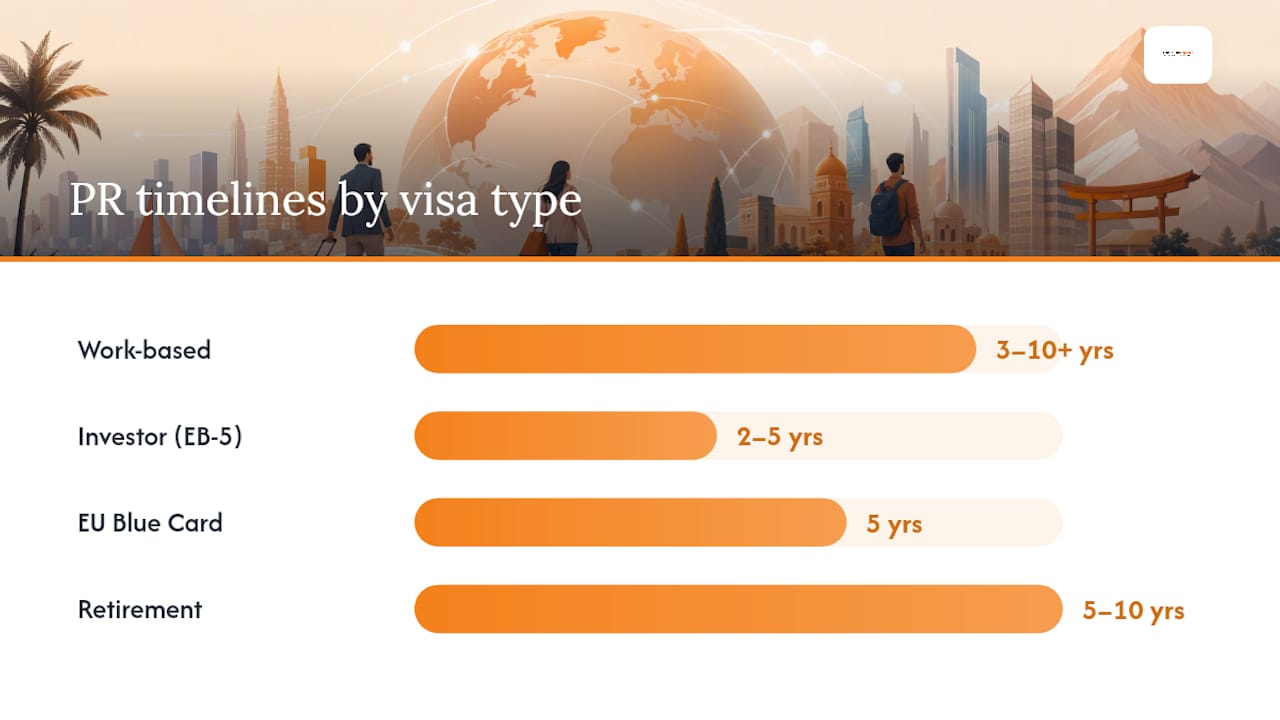
| Visa category | Typical PR timeline | Notes |
|---|---|---|
| Work-based (H-1B → EB green card) | 3–10+ years | Depends on country of birth and priority date backlog |
| Family-based (IR-1 spouse) | Immediate on entry | Immediate relatives of U.S. citizens enter as LPRs |
| Investor (EB-5) | 2–5 years | Conditional green card first; conditions removed after 2 years |
| EU Blue Card | 5 years (some countries faster) | EU long-term resident status requires 5 years of continuous legal residence |
| Retirement/passive income | 5–10 years (varies by country) | Depends on host country's standard residency timeline |
| Digital nomad | Often does not count | Many programs explicitly exclude nomad visa time from PR calculations |
Family-based routes are among the clearest paths to permanent residency in many countries. EscapeArtist's strategic guide notes that work, retirement, family, and investor visas can all lead to PR depending on the country, with family routes often carrying shorter timelines.
What to watch for when planning a PR pathway:
- Continuous residence requirements: most countries require uninterrupted legal residence, meaning extended absences can reset the clock.
- Category switches: if your nomad visa time doesn't count, you may need to switch to a work or family category before your PR clock starts.
- Language and civic integration tests are required in many EU countries before permanent status is granted.
- Some investor programs grant PR faster but require the investment to be maintained for a minimum holding period.
How do you choose the right visa and prepare your application?
The right visa category comes down to six factors: your purpose of stay, intended duration, whether you plan to work locally, your family situation, the funds you have available, and your long-term PR ambitions. Get those six clear before you research any specific program.
Step-by-step application checklist:
- Confirm your qualifying category with the official immigration authority of the destination country (USCIS for U.S. visas, the relevant ministry for other countries).
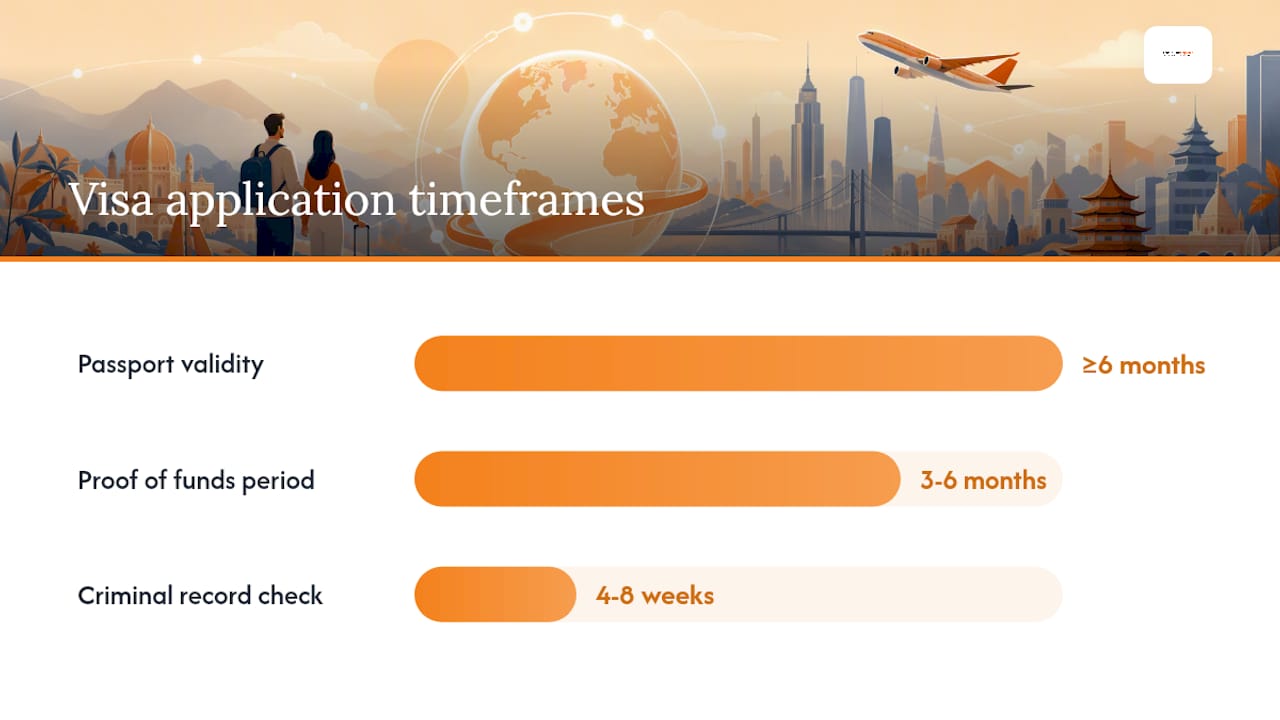
- Collect your passport and check that it has at least six months of validity beyond your intended stay.
- Obtain a criminal record check from every country you've lived in for the past five years. Allow four to eight weeks for this.
- Gather proof of funds: bank statements, pay stubs, pension letters, or investment account statements covering the most recent three to six months.
- Secure your sponsorship or enrollment document: employer petition, university acceptance letter, or family petition approval.
- Get certified translations of all documents not in the official language of the destination country.
- Arrange compliant health insurance before you apply. Many countries require proof of coverage as part of the visa application, not just upon arrival.
- Complete the visa application form on the official government portal and pay the required government fee.
- Schedule your consular interview or biometrics appointment as early as possible; slots fill quickly in high-demand periods.
- Keep copies of every document submitted and note the application reference number.
Common red flags that delay or deny applications:
- Translations not certified by an accredited translator.
- Proof of funds that shows a lump sum deposited shortly before the application, rather than consistent balances.
- Inconsistent travel history that raises questions about ties to the home country.
- Gaps in employer sponsorship documentation for work visa applications.
- Missing or expired criminal record certificates.
When the application is complex, particularly for investor visas, employer-sponsored categories with cap issues, or cases involving prior immigration violations, professional legal help is worth the cost. A single procedural error can trigger a denial that affects future applications.
Practical prep beyond the visa: what else do you need?
Getting the visa approved is the milestone most applicants focus on. What often catches people off guard is everything that comes after, and some of it needs to be in place before you even submit the application.
Securing compliant health insurance and understanding your tax obligations are two of the most frequently underestimated steps. Private health insurance is mandatory for most long-stay visa categories in the early stages because public healthcare access is typically restricted until you've contributed to local systems. Budgeting for annual premiums is not optional; it's a recurring visa condition. For practical guidance on choosing the right coverage, the ToolsForExpats guide to digital nomad health insurance covers the main options in plain language.
Practical checklist beyond the visa itself:
- Health insurance — confirm the policy meets the host country's minimum coverage requirements before purchasing.
- Tax residency check: if you'll spend more than 183 days in the country, consult a tax professional about your obligations in both your home country and the destination. The ToolsForExpats guide on filing taxes while working remotely abroad is a useful starting reference.
Pro Tip: Use the moving abroad budget calculator from ToolsForExpats to model 12 months of post-arrival costs, not just the one-time visa fee. Mandatory recurring costs like health insurance premiums and social security contributions often exceed the initial application fees.
ToolsForExpats also offers a free visa eligibility checker that screens which long-stay and digital nomad visas you may qualify for across more than 20 countries, and a cost of living comparison tool for side-by-side city comparisons when you're deciding between destinations.
Key Takeaways
Long-stay visas fall into eight categories, and choosing the right one before you apply determines whether your path leads to permanent residency or a dead end.
| Point | Details |
|---|---|
| Eight core categories | Work, student, family, investor, retirement, digital nomad, humanitarian, and diplomatic visas each have distinct qualifying conditions. |
| PR pathway matters | Family and work visas typically count toward permanent residency; digital nomad visas often do not. |
| Prepare beyond the visa | Health insurance, tax residency checks, and local bank accounts are required steps, not optional extras. |
| Verify with official sources | Always confirm current requirements with USCIS, the U.S. Department of State, or the destination country's immigration authority before applying. |
| Use ToolsForExpats tools | The free visa eligibility checker and moving abroad budget calculator help you screen options and model costs before you commit. |
One thing most visa guides get wrong
The standard advice is to pick your visa category, gather your documents, and submit. That's not wrong, but it skips the most consequential decision in the whole process: whether the visa you're applying for actually counts toward permanent residency in the country you want to stay in long-term.
Digital nomad visas are the clearest example of this gap. They're marketed as the flexible, modern way to live abroad, and for short-term stays, they are. But a surprising number of programs explicitly exclude nomad visa time from PR calculations. If you spend two years on a nomad visa assuming you're building toward permanent residency, then discover those months don't count, you've lost two years of your residency clock.
The same logic applies to investor visas. The EB-5 leads directly to a green card, which is why it commands a high investment threshold. Lower-threshold golden visa programs in other countries often come with conditions: minimum stay requirements, investment holding periods, and the very real risk of program changes mid-application, as Portugal's experience showed. Chasing the cheapest investment threshold without reading the PR conditions is a common and expensive mistake.
The practical takeaway: before you apply for any long-stay visa, map the full pathway from entry to permanent residency. If the visa you're considering doesn't count toward PR, decide whether that's acceptable for your situation, or whether you should apply for a category that does. That single decision shapes the next five to ten years.
Plan your long-stay visa with free ToolsForExpats tools
Sorting through eight visa categories, country-specific thresholds, and PR timelines is a lot to hold in your head at once. ToolsForExpats gives you free tools that make the planning concrete.
The visa eligibility checker screens your profile against long-stay and digital nomad programs across more than 20 countries in minutes, no account required. The moving abroad budget calculator lets you model 12 months of real post-arrival costs, including health insurance, housing, and local taxes, so you know what you're committing to before you submit a single form. And the cost of living comparison tool helps you weigh destinations side by side when the visa options are similar but the cost of living isn't.
All tools are free and accessible without creating an account. Start with the visa checker to see which programs you qualify for, then run the budget calculator to confirm the numbers work.
This article is general information, not legal or immigration advice. Confirm current requirements with USCIS, the U.S. Department of State, or the official immigration authority of your destination country before applying.
Useful official sources and further reading
Use these sources to verify requirements, check current thresholds, and research policy trends before you apply.
U.S. federal sources:
- Long-Stay Visa: Types, Requirements, and How to Apply - LegalClarity
- International Insurance — visas resources
- Golden visas and passports: the global market in residence and citizenship — LSE
- Portugal golden-visa applicants stuck in limbo, use legal options — Bloomberg
- What is a residence permit: definition, types & benefits — Savory & Partners
- EU Residence Permit 2026: 11 Pathways to Europe | YouResidency
- Visas That Lead to Permanent Residency: A Strategic Guide — EscapeArtist
- LTR Visa Thailand - Long Term Resident Program
Country immigration and program pages:
- Thailand LTR Visa Program — official page for Thailand's Long-Term Resident program covering four targeted categories.
- EU Residence Permit pathways — overview of 11 EU residency routes and the standard five-year path to EU long-term resident status.
Policy research and analysis:
- LSE — Golden visas and passports: the global market in residence and citizenship — academic analysis of how investment residency programs operate and why rules change.
- Bloomberg — Portugal golden-visa applicants stuck in limbo — real-world reporting on the risks of program changes for investor-visa applicants.
Practical reference guides:
- LegalClarity — Long-Stay Visa: Types, Requirements, and How to Apply — clear overview of long-stay visa categories and common requirements.
- Savory & Partners — What is a residence permit: definition, types & benefits — explains the distinction between visas and residence permits and categorizes permit types.
- EscapeArtist — Visas That Lead to Permanent Residency: A Strategic Guide — practical breakdown of which visa routes typically count toward PR.
- International Insurance — visas resources — guidance on health insurance requirements across long-stay visa programs.