
People become expats primarily to improve their quality of life, financial position, and career prospects by relocating to a country that better matches their values and goals. The term "expat," short for expatriate, describes anyone who lives outside their country of origin, whether temporarily or permanently. As of Q1 2026, about 5.5 million Americans live abroad, with departures rising 102% in early 2025 compared to the year before. That surge is not random. Understanding why people become expats reveals a clear pattern: the motivations are personal, financial, and structural all at once.
What are the primary reasons people become expats?
The decision to move abroad rarely comes from one single trigger. Most people who relocate internationally are responding to a combination of financial pressure, lifestyle dissatisfaction, and new professional possibilities.
Financial reasons sit at the top of the list. 49% of Americans considering a move abroad cite high living costs as their primary motivation. That number reflects a real squeeze: housing, healthcare, and childcare in the U.S. have outpaced wage growth for years, and many people are doing the math and finding that other countries offer a better deal.

Lifestyle improvements are nearly as powerful a driver. 69% of Americans abroad report moving for a better overall lifestyle, including safer neighborhoods, cleaner environments, and more reliable public services. That is not a vague feeling. Countries like Portugal, Spain, and Germany offer public transit, universal healthcare, and walkable cities that many Americans simply do not have access to at home.
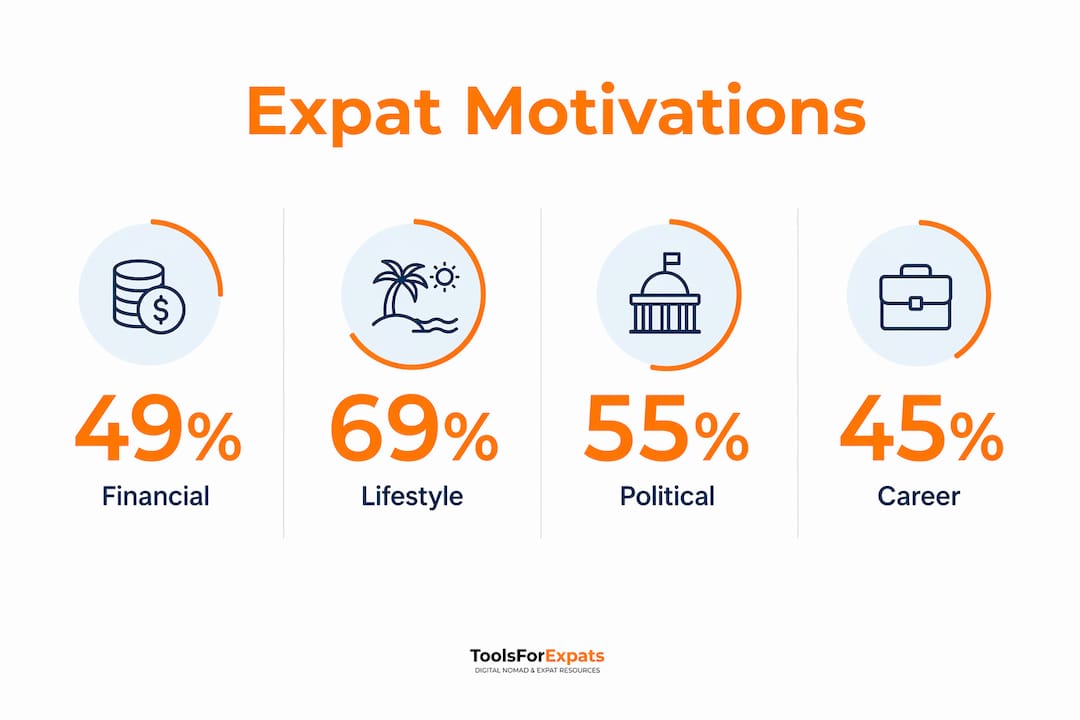
Political and social dissatisfaction also plays a significant role. 48% of Americans considering relocation cite political leadership and social tensions as key factors. Experts describe this as a private solution to structural problems, where younger adults use geographic mobility to find environments where life milestones feel achievable again.
Other common expat motivations include:
- Career opportunities: International assignments, global companies, and remote work contracts that pay in U.S. dollars or euros
- Love and family: Relationships with foreign nationals or a desire to raise children in a different cultural environment
- Adventure and personal growth: A deliberate choice to expand one's perspective and experience a different way of living
- Retirement: Lower costs and better healthcare access in countries like Mexico, Costa Rica, or Thailand
How do different expat lifestyle choices reflect their motivations?
Not all expats look the same, and that diversity tells you a lot about what drives people to move. Your motivation shapes your destination, your timeline, and how you structure your daily life abroad.
Here are the four most common expat profiles and what drives each one:
-
The retiree: Motivated primarily by cost and comfort. Countries like Mexico, Panama, and Portugal offer lower costs, warm climates, and strong expat communities. A retired couple from California can often cut their monthly expenses in half while gaining access to quality private healthcare at a fraction of U.S. prices.
-
The career-driven professional: Motivated by international experience and salary growth. Cities like Singapore, Dubai, and Amsterdam attract professionals in finance, tech, and consulting who want global credentials and tax-efficient compensation structures.
-
The digital nomad: Motivated by freedom and geo-arbitrage. Remote workers earning in strong currencies while living in lower-cost cities like Lisbon, Chiang Mai, or Medellín can dramatically increase their purchasing power. More than 50 countries now offer digital nomad visas specifically designed for this group.
-
The family relocating for education: Motivated by safety, schooling quality, and community. Germany and the Netherlands offer free or low-cost university education, and families from the U.S. increasingly factor that into long-term financial planning.
Pro Tip: Before committing to a destination, spend at least one month living there as a tourist or on a short-term rental. Your experience of a city as a visitor versus a resident can be completely different, and that test run can save you from a costly mistake.
What are the emotional and social trade-offs of expat life?
The benefits of expat life are real, but so are the costs. Moving abroad is not just a logistical shift. It is an emotional one, and the people who thrive long-term are the ones who go in with clear eyes.
Many expats experience emotional distance from home and the psychological weight of building new social networks from scratch. Missing family milestones, navigating bureaucracy in a second language, and losing your existing support system are real challenges. They do not disappear after the first exciting months.
The emotional benefits, though, are equally real:
- Personal growth: Adapting to a new culture builds resilience, flexibility, and self-awareness in ways that staying home rarely does
- Broader perspective: Living in a different country changes how you see your home country, your assumptions, and your priorities
- New communities: Expat networks in cities like Barcelona, Bali, and Cape Town are active and welcoming, and many people form their closest friendships abroad
The most important reframe is this one:
"Moving abroad is no longer just escape but a strategic realignment of values towards freedom, security, and personal fulfillment." The Expat Trade-Off
Successful long-term expats frame their move as a transformation of daily life, not a rejection of their past. That mindset shift makes a measurable difference in how well people adapt and how long they stay.
How does the financial equation of living abroad work in practice?
Money is the most concrete reason people move abroad, and the numbers are worth examining closely. The core concept is geo-arbitrage: earning income in a strong currency like the U.S. dollar while spending in a weaker local currency. The result is a significant boost in real purchasing power without needing a raise.
Living abroad often leaves more disposable income by reducing housing, transportation, and healthcare costs compared to U.S. equivalents. A one-bedroom apartment in Lisbon averages around $1,200 per month. The same apartment in San Francisco or New York costs three to four times more.
The childcare comparison is even more striking. Childcare expenses in some U.S. states exceed in-state public university tuition by over $15,000 annually. Countries like Portugal and Germany offer heavily subsidized public childcare, which changes the financial calculus for families entirely.
Here is a simplified cost comparison for a single professional:
| Expense category | U.S. average (monthly) | Portugal average (monthly) |
|---|---|---|
| Rent (1-bedroom, city center) | $2,200 | $1,200 |
| Health insurance | $500 | $80 |
| Groceries | $400 | $250 |
| Transportation | $300 | $60 |
| Total estimate | $3,400 | $1,590 |
The hidden costs are real too. U.S. citizens owe taxes to the IRS regardless of where they live, which means working with an international tax advisor is not optional. Visa fees, relocation costs, and the time spent on bureaucratic processes add up. Planning for these upfront prevents unpleasant surprises six months in.
Pro Tip: Use the cost of living comparison tool from ToolsForExpats to run a side-by-side breakdown of your current expenses versus your target country before you commit to anything.
What practical steps help you explore becoming an expat?
Knowing your motivation is the starting point. Turning that motivation into a real plan requires research, tools, and a willingness to test your assumptions before making permanent decisions.
Here is where to focus your preparation:
- Research visa options early: Visa eligibility is the first real constraint. Use the digital nomad visa checker from ToolsForExpats to see which countries you qualify for based on your income and profession.
- Build a realistic budget: Use a moving abroad budget calculator to estimate one-time relocation costs alongside ongoing monthly expenses in your target country.
- Understand the tax implications: U.S. citizens abroad still file with the IRS. Research the Foreign Earned Income Exclusion (FEIE) and consult a tax professional who specializes in expat filings.
- Test before you commit: Spend 30–90 days in your target country on a tourist visa before applying for residency. This is the single most effective way to validate your decision.
- Join expat communities: Facebook groups, Reddit communities like r/expats, and local meetups in your target city give you unfiltered, firsthand information that no guide can replicate.
The goal of this research phase is not to eliminate uncertainty. It is to reduce it enough that you can make a confident, informed decision.
Key takeaways
People become expats because the combination of financial, lifestyle, and personal motivations makes living abroad a more practical and fulfilling choice than staying home.
| Point | Details |
|---|---|
| Financial pressure drives most moves | 49% of Americans cite high living costs as their primary reason for considering relocation abroad. |
| Lifestyle gains are the most common outcome | 69% of Americans abroad report moving for better safety, services, and overall quality of life. |
| Geo-arbitrage multiplies income value | Earning in strong currencies while spending locally can cut monthly costs by 50% or more. |
| Emotional trade-offs are real but manageable | Homesickness and social rebuilding are common, but most long-term expats frame the move as personal growth. |
| Planning tools reduce uncertainty | Using visa checkers, cost calculators, and budget tools before moving leads to better, more confident decisions. |
The motivations are rarely what they appear to be on the surface
I have spent years reading expat stories, analyzing relocation data, and talking to people at every stage of the process. One thing stands out: the stated reason for moving abroad is almost never the whole story.
Someone says they moved to Portugal for the cost of living. But dig a little deeper and you find they were also exhausted by a political environment that felt hostile, a healthcare system that felt precarious, and a work culture that left no room for anything else. The cost of living was the trigger, not the cause.
Younger adults increasingly use geographic mobility to overcome fraying social contracts and hard economic realities. That framing resonates with me. The expat decision is often a vote of no confidence in a system, not just a spreadsheet calculation.
What I find encouraging about the 2026 data is that more people are making this move with their eyes open. The 102% surge in departures is not a panic response. It is a deliberate, researched choice by people who have done the math and decided the trade-offs are worth it. The ones who struggle are usually the ones who moved toward something vague, like "a better life," without defining what that actually means for them specifically.
My honest advice: get specific before you go. Know your number. Know your non-negotiables. Know what you are willing to give up. The expat life rewards preparation and punishes wishful thinking.
— Jay
Plan your move with free tools from ToolsForExpats
If you are seriously considering relocating abroad, the research phase is where most people get stuck. The questions pile up fast: Can I afford it? Do I qualify for a visa? What will my actual monthly budget look like?
ToolsForExpats offers a full suite of free expat planning tools built specifically for people in exactly this position. Run a city-by-city cost comparison, check your digital nomad visa eligibility across 20+ countries, and build a detailed moving budget before you commit to anything. No account required, no paywalls. Just clear, practical tools that help you move from "thinking about it" to "ready to go" with real numbers in hand.
FAQ
Why do people become expats in 2026?
The top reasons include high living costs, lifestyle improvements, and political dissatisfaction. As of 2026, 5.5 million Americans live abroad, with departures accelerating sharply in 2025.
What is the difference between an expat and an immigrant?
An expat is someone living outside their home country, often temporarily or for professional reasons, while an immigrant typically relocates with the intent to settle permanently and pursue citizenship.
Is living abroad actually cheaper than living in the U.S.?
For most destinations, yes. Countries like Portugal, Mexico, and Thailand offer significantly lower housing, healthcare, and transportation costs, often cutting total monthly expenses by 40%–60% compared to major U.S. cities.
What are the biggest challenges of being an expat?
The most common challenges include homesickness, building new social networks, navigating foreign bureaucracy, and managing U.S. tax obligations while living abroad.
How do I know which country is right for me?
Start by identifying your priorities: cost, climate, visa accessibility, language, and healthcare quality. Tools like the best nomad city quiz from ToolsForExpats can help you match your preferences to real destinations quickly.