
If you're a U.S. citizen or resident alien working remotely from another country, the IRS taxes your worldwide income regardless of where you earn it. That means your remote-work income earned abroad must be reported on Form 1040 if it meets the annual filing threshold. The good news: two powerful relief mechanisms, the Foreign Earned Income Exclusion (FEIE) and the Foreign Tax Credit (FTC), can dramatically reduce or eliminate your U.S. tax bill.
Here's what you need to know right now:
- FEIE 2026 cap: $132,900 of qualifying foreign earned income can be excluded from U.S. federal income tax.
- FTC: Offsets your U.S. tax dollar-for-dollar for income taxes you've already paid to a foreign government, claimed on Form 1116.
- FBAR: If your foreign financial accounts exceed $10,000 in aggregate at any point during the year, you must file FinCEN Form 114.
- Next steps: Confirm your tax home is abroad, document your days outside the U.S., gather foreign tax receipts, and decide which relief fits your situation before you file.
2026 FEIE cap: $132,900 — the maximum foreign earned income you can exclude from U.S. federal tax if you qualify.
Key Takeaways
U.S. citizens and resident aliens owe federal tax on worldwide remote-work income, but the FEIE ($132,900 in 2026) and FTC together can reduce most expats' U.S. tax liability to zero when applied correctly.
| Point | Details |
|---|---|
| Worldwide income is taxable | All remote-work income earned abroad must be reported on Form 1040 if it meets the IRS filing threshold. |
| 2026 FEIE cap is $132,900 | Qualifying expats can exclude up to $132,900 of foreign earned income; requires a foreign tax home plus bona fide residence or 330 full days. |
| FTC beats FEIE in high-tax countries | The Foreign Tax Credit offsets U.S. tax dollar-for-dollar and carries forward; best when foreign tax rates match or exceed U.S. rates. |
| FBAR threshold is $10,000 | Foreign accounts exceeding $10,000 in aggregate at any point trigger a FinCEN Form 114 filing requirement with serious penalties for non-compliance. |
| ToolsForExpats free tools | Use the nomad cost calculator and cost comparison tool at ToolsForExpats to model FEIE vs. FTC outcomes before filing. |
Who has to file U.S. taxes on remote work income?
U.S. citizens and resident aliens — including green card holders and those who meet the substantial presence test — owe U.S. federal income tax on their worldwide income. Living in Portugal or Thailand doesn't change that. You must file Form 1040 if your gross worldwide income meets the IRS filing threshold for your status, which Publication 54 updates annually.
Tax home is the general area of your main place of business or where you're permanently or indefinitely engaged to work. Your tax home must be in a foreign country to qualify for FEIE. If you have no fixed workplace, your tax home may follow your regular place of abode — which is why nomads who keep a U.S. address can lose FEIE eligibility entirely.
Two tests determine FEIE eligibility beyond the tax home requirement:
- Bona Fide Residence Test: You've established a genuine residence in a foreign country for an uninterrupted period that includes a full tax year.
- Physical Presence Test: You spend 330 full days in a foreign country (or countries) during any 12-consecutive-month period.
Pro Tip: Track your travel times to the hour. Partial days don't count as full days for the 330-day test — a 6 AM departure from Germany still counts as a day in Germany only if you were there for the full calendar day. One miscounted day can disqualify your entire FEIE claim.
What are the main U.S. tax breaks for expats?
Foreign Earned Income Exclusion (FEIE)
FEIE lets qualifying expats exclude up to $132,900 (2026) of income earned for services performed abroad from U.S. federal income tax. Wages, salaries, and self-employment income from work done outside the U.S. all qualify. Investment income, pensions, and U.S.-source income do not. You claim FEIE on Form 2555, attached to your Form 1040.
Foreign housing exclusion and deduction
If you qualify for FEIE, you may also exclude or deduct a portion of your foreign housing costs above a base amount. Qualifying expenses include rent, utilities, and certain other housing costs. The housing exclusion applies to employees; self-employed expats use the housing deduction instead, which reduces self-employment income.
Foreign Tax Credit (FTC)
The FTC reduces your U.S. tax liability dollar-for-dollar for income taxes paid to a foreign government on the same income. There's no dollar cap on the credit itself, though it's limited to your U.S. tax liability on that foreign income. You claim it on Form 1116. Critically, you cannot apply FTC to income you've already excluded via FEIE — the two reliefs don't stack on the same dollars.
Key form reference summary:
- Form 1040: Your annual U.S. return — required even when living abroad.
- Form 2555: FEIE election and housing exclusion.
- Form 1116: Foreign Tax Credit claim.
How do you decide between FEIE and FTC?
The simple rule: FEIE tends to win in low- or zero-tax countries; FTC tends to win in high-tax countries.
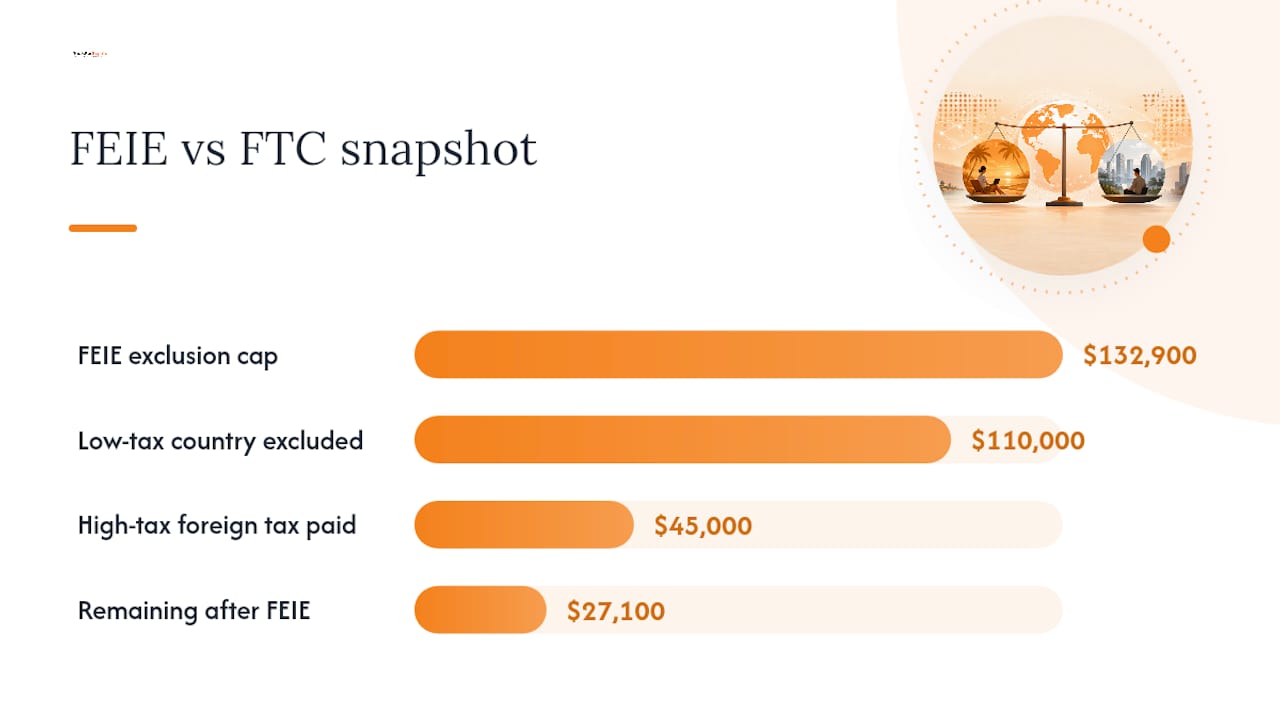
If you're living in a country with little or no income tax (think UAE or the Cayman Islands), FEIE shelters up to $132,900 of your earnings with no foreign tax offset needed. If you're in Germany or France, where income tax rates can exceed U.S. rates, FTC often eliminates your U.S. liability entirely — and you keep the excess credit for future years.
Three practical scenarios:
- Low-tax country (e.g., UAE): You earn $110,000. FEIE excludes the full amount. U.S. tax owed: $0.
- High-tax country (e.g., Germany): You earn $150,000 and pay $45,000 in German tax. FTC offsets your U.S. tax on that income dollar-for-dollar, likely eliminating the U.S. bill.
- Mixed approach: You earn $160,000 in a moderate-tax country. FEIE covers the first $132,900; FTC can potentially cover U.S. tax on the remaining $27,100.
One critical caveat for self-employed nomads: FEIE does not reduce self-employment tax. Totalization agreements with certain countries can prevent double Social Security taxation, but coverage varies by country and employment structure.
The FEIE election is sticky: once made, it stays in effect for future years unless you formally revoke it. Revocation typically bars re-election for five years without IRS permission. Choose with your multi-year plans in mind.
Pro Tip: If you're planning to return to the U.S. within two or three years, model the FTC route carefully. Unused FTC can carry forward one year back and ten years forward — FEIE credits disappear when you stop qualifying.
What other reporting requirements apply to expats?
Beyond income tax, several compliance obligations catch expats off guard.
FBAR is filed to FinCEN, not the IRS, and carries its own penalty structure. If your foreign accounts exceed $10,000 in aggregate at any point, you must file — even if the accounts earn no interest. Civil penalties for non-willful violations can reach $10,000 per violation; willful violations carry far steeper consequences.
FATCA (Form 8938) has higher thresholds than FBAR and covers a broader set of foreign financial assets, not just bank accounts. The threshold depends on your filing status and whether you live abroad.
Social Security and SE tax: Totalization agreements with 30+ countries can prevent double Social Security taxation for self-employed Americans, but you must confirm your specific country's agreement and whether your employment structure qualifies.
Estimated taxes: If you're self-employed or your employer doesn't withhold U.S. taxes, you owe quarterly estimated payments. Expats still get an automatic two-month extension to June 15 for filing, but estimated tax payments are still due on the standard quarterly schedule to avoid underpayment penalties.
How do you file U.S. taxes as an expat, step by step?
- Confirm your filing requirement. Check your gross worldwide income against the IRS threshold for your filing status using Publication 54.
- Gather income records. Collect pay stubs, employer statements, invoices (if self-employed), and any foreign tax notices or receipts.
- Verify your tax home and residency test. Compile your travel log with entry and exit dates and times.
- Choose FEIE or FTC. Run your numbers for both scenarios — or use a calculator to compare outcomes.
- Complete the relevant forms. Form 2555 for FEIE, Form 1116 for FTC, or both if income exceeds the FEIE cap.
- Check FBAR and FATCA thresholds. File FinCEN Form 114 electronically if required; attach Form 8938 to your 1040 if applicable.
- File Form 1040 by June 15 (expats get an automatic two-month extension). File Form 4868 by June 15 for a further extension to October 15.
Documents to have ready before you start:
- Travel log with full entry/exit dates and times
- Employment contract or client agreements
- Foreign payslips or invoices
- Foreign tax payment receipts or annual tax statements
- Bank statements for all foreign accounts (for FBAR)
- Prior-year Form 2555 or 1116 if you've filed before
What records should you keep to avoid audits?
The IRS pays close attention to FEIE claims, particularly the 330-day physical presence count. A missing travel log is the fastest way to lose your exclusion in an audit.
Keep these records for at least six years (longer if you have FBAR obligations):
- Travel logs with exact arrival and departure times, not just dates.
- Employment contracts and any remote-work authorization letters from your employer.
- Foreign tax receipts and annual tax assessments from the host country.
- Bank statements for every foreign account, covering the full calendar year.
- Form 2555 worksheets showing how you calculated your exclusion amount.
Common audit triggers include mismatched foreign income reported vs. foreign tax paid, late or missing FBARs, and FEIE claims with no supporting travel documentation. If you've missed filings non-willfully, the Streamlined Foreign Offshore Procedures (SFOP) offer a path to catch up with reduced penalties — but you must certify the delinquency was non-willful.
Pro Tip: Use a simple spreadsheet or a travel-tracking app to log every border crossing in real time. Reconstructing a year of travel from memory or credit card statements is error-prone and rarely convinces an IRS examiner.
When should you hire an expat tax specialist?
Hire a specialist if any of these apply to you:
- You own a foreign corporation or have interests in foreign trusts or PFICs (passive foreign investment companies).
- You have income from multiple countries in the same year.
- You've missed FBAR filings or have large unreported foreign accounts.
- You need treaty interpretation for a specific country's agreement with the U.S.
- You're self-employed with significant SE tax exposure and a totalization agreement may apply.
- You can't document 330 full days and need to assess your FEIE eligibility honestly.
A qualified expat tax professional handles treaty analysis, FEIE/FTC optimization, FBAR and FATCA cleanup, and IRS examination representation. The cost of a specialist is almost always less than the penalty exposure from a missed FBAR or a disallowed FEIE claim.
Do you still owe state taxes when living abroad?
Possibly. U.S. federal tax is only part of the picture. Several states — including California, New York, Virginia, and South Carolina — are known for aggressive residency rules and may continue to tax your worldwide income even after you move abroad.
State tax residency depends on your domicile (where you intend to return) and, in some states, on maintaining ties like a driver's license, voter registration, or a home you own or rent. Simply leaving the country doesn't automatically sever state tax residency. To establish a clean break, you typically need to change your domicile formally: update your driver's license, close local bank accounts, and file a part-year return for the year you left.
States with no income tax (Florida, Texas, Nevada, Washington, Wyoming, South Dakota, Alaska) create no state-level exposure for expats who were domiciled there before leaving. If you were domiciled in California or New York, consult a state tax specialist before assuming you've left their tax net. Digital nomad tax residency rules vary significantly by state and are worth reviewing carefully.
Can tax treaties reduce your U.S. tax beyond FEIE and FTC?
Yes, and this is an underused tool. The U.S. has income tax treaties with 70+ countries that can provide benefits beyond what FEIE and FTC offer. Treaty provisions vary widely, but common benefits include:
- Reduced withholding rates on dividends, interest, and royalties paid from the treaty country.
- Tie-breaker rules that determine which country has primary taxing rights when you're a resident of both.
- Pension and retirement income provisions that may exempt certain foreign pensions from U.S. tax or vice versa.
- Saving clauses that limit treaty benefits for U.S. citizens — most U.S. treaties include a saving clause that preserves the U.S.'s right to tax its citizens, so treaty benefits for Americans are narrower than for foreign nationals.
To claim treaty benefits, you generally file a return and attach a disclosure statement (Form 8833 in many cases). Treaty positions are not automatic — you must elect them. And because treaty language is technical and country-specific, this is one area where professional guidance pays for itself quickly.
A practical note for nomads and expats
The most common mistake I see among digital nomads isn't a complex tax strategy gone wrong. It's the basics: no travel log, no FBAR filed because "the balance was only over $10,000 for a week," and an FEIE election made in year one without thinking about what happens in year three when they return to the U.S. The tax rules for Americans abroad are genuinely manageable once you understand the structure — but they reward people who plan early and document consistently. Decide your FEIE vs. FTC approach before the tax year ends, not in April. Keep your travel log current. And if your situation involves a foreign company, a trust, or multiple income streams, get professional help before the filing deadline, not after.

Free tools from ToolsForExpats to help you plan
Navigating FEIE vs. FTC scenarios is much easier when you can model the numbers before committing to an election. ToolsForExpats offers a suite of free expat calculators built for exactly this kind of planning — no account required.
Use the nomad cost calculator to estimate your foreign housing costs city by city, which feeds directly into your housing exclusion calculation. The cost of living comparison tool lets you model net-after-tax income differences between two locations — useful when you're weighing a high-tax European country (FTC territory) against a zero-tax destination (FEIE territory). Before you commit to a location, run your visa options through the digital nomad visa checker to understand residency implications that affect your tax home. Head to ToolsForExpats now and run your first scenario free.
Sources
- U.S. citizens and resident aliens abroad | Internal Revenue Service
This article provides general information about U.S. tax obligations for expats and digital nomads. It is not tax, legal, or financial advice. Consult a qualified tax professional or review current IRS guidance before making filing decisions.
This article is general information, not a substitute for advice from a qualified financial advisor. Consult a qualified financial professional about your own circumstances before acting on anything here.