No single city is universally the safest for solo digital nomads. Safety is multi-dimensional, and the right city depends on your personal risk profile. That said, Kakapo's 2026 travel safety index scores cities against a global mean safety score, with a notable share rated as "Good" or safer. The cities that consistently land at the top for long-term solo remote workers are:
- Singapore — lowest violent crime globally; high cost, limited visa flexibility
- Tokyo — exceptional personal safety and transit; language barrier in emergencies
- Taipei — strong safety-to-cost ratio; typhoon season requires planning
- Lisbon — top-ranked for expat liveability; petty theft in tourist zones
- Helsinki — political stability and healthcare; high cost, dark winters
- Dublin — English-language emergency care; expensive housing market
- Auckland — low crime, English-speaking; earthquake exposure
- Tallinn — affordable, EU-stable, strong digital infrastructure; cold climate
- Seoul — excellent healthcare and transit; language gap in emergencies
- San José, Costa Rica — affordable with solid expat community; neighborhood selection critical
TL;DR:
- Kakapo's index puts the global mean safety score at 78.6/100 across 944 cities — your shortlist should target cities well above that baseline.
- Safety has five dimensions (personal crime, political stability, healthcare, digital security, natural disaster risk); no city scores perfectly on all five.
- Run the ToolsForExpats city-matching quiz to map your priorities to a personalized shortlist in minutes.
What does "safe for solo digital nomads" actually mean?
A low crime rate is a starting point, not a complete answer. Effective nomad safety evaluation requires assessing five distinct dimensions:
- Digital security — card skimming, public Wi-Fi vulnerabilities, and device theft. This risk scales with how much you rely on cafes and coworking spaces.
Cultural and language factors cut across all five. English usability in hospitals and police stations matters more than street-level language barriers. Local norms around public behavior also affect how visible and therefore how targeted you are.
Pro Tip: Neighborhood selection reduces your real-world risk more than city-level averages do. Mixed commercial-residential zones with steady foot traffic and visible mid-class commerce are consistently safer than tourist-saturated streets or isolated residential blocks.
How to assess any city's safety using a repeatable method
Composite safety scores are useful, but they need context. Here is a step-by-step method you can apply to any city in about 30 minutes:
- Check your government's travel advisory for the country (U.S. State Department for American nomads). Rule out any destination with a Level 3 or Level 4 advisory before going further.
- Pull the Kakapo composite score and drill into sub-scores for personal safety, night safety, and healthcare. Kakapo recommends cross-referencing composite scores with neighborhood-level editorial guides.
- Verify healthcare access via WHO hospital-density data and local expat forums. Confirm English-capable emergency care is available within a reasonable response window.
- Check local crime dashboards or national police statistics for the specific city, not just the country.
- Review real-time environmental data — active seismic alerts, flood-season calendars, and air quality indices.
Apply suggested weights based on your stay length and priorities:
| Safety dimension | Suggested weight (long-term stay) | Adjust if… |
|---|---|---|
| Personal crime | — | You work late or use transit at night |
| Political stability | — | You plan a stay of 6+ months |
| Healthcare access | — | You have existing health conditions |
| Digital security | — | You handle sensitive client data |
| Natural disaster risk | — | City is in a high-seismic or typhoon zone |
Cost-sensitive nomads can shift weight toward personal crime and digital security, where mitigation is behavioral rather than financial. Safety-averse nomads should weight healthcare and political stability higher.
Which cities score best for solo nomad safety in 2026?
Countries like Portugal, Taiwan, Japan, Singapore, Finland, Ireland, and New Zealand consistently appear across cross-source rankings for remote workers. Here are the top cities with honest caveats:
| City | Personal crime | Political stability | Healthcare (English) | Digital security | Natural disaster | Cost tier |
|---|---|---|---|---|---|---|
| Singapore | Very low | Very high | Excellent | Strong | Low | High |
| Tokyo | Very low | High | Good (limited English) | Strong | Moderate (seismic) | Medium-high |
| Taipei | Low | High | Good | Strong | High (typhoons) | Low-medium |
| Lisbon | Low-medium | High | Good | Moderate | Low | Medium |
| Helsinki | Very low | Very high | Excellent | Strong | Very low | High |
| Dublin | Low | Very high | Excellent | Strong | Very low | High |
| Auckland | Low | High | Excellent | Strong | Moderate (seismic) | Medium-high |
| Tallinn | Low | High | Good | Strong | Very low | Low-medium |
| Seoul | Low | High | Good (limited English) | Strong | Low | Medium |
| San José | Medium | Moderate | Moderate | Moderate | Low-moderate | Low |
City highlights:
- Singapore sets the global benchmark for personal safety and infrastructure. The trade-off is cost and visa rigidity — standard tourist entry limits stays to 30–90 days.
- Taipei offers the strongest safety-to-cost ratio on this list. Typhoon season (June–October) requires a disaster plan, but the city's response infrastructure is well-developed.
- Lisbon topped a 2026 global liveability study for expats. Petty theft in Alfama and Baixa is real; the Príncipe Real and Campo de Ourique neighborhoods are consistently safer for nomads.
- Tallinn is the most affordable EU-stable option. Its digital infrastructure is among the best in Europe, and the e-Residency program makes long-term administrative life straightforward.
- San José suits budget-conscious nomads with an established expat network, but neighborhood selection is non-negotiable. Escazú and Santa Ana are the go-to zones.
Kakapo's data shows night safety averages 76/100 globally versus 79/100 for daytime personal safety. Tokyo, Singapore, and Helsinki are the strongest performers on after-dark transit safety.
How do you choose the right city for your personal risk profile?
Start with three questions before you open any ranking:
- How important is after-dark transit safety to your daily routine?
- Do you need English-language emergency care, or do you have strong local-language skills?
- Is cost a hard constraint, or can you pay a safety premium?
Decision flow:
- Rule out any city with an active government advisory (Level 3+).
- Filter for healthcare access if you have existing health conditions or plan a stay longer than three months.
- Apply your cost ceiling — high-cost cities like Singapore and Helsinki carry a safety premium that is real but not always necessary.
- Move to neighborhood-level evaluation for your remaining candidates.
Red flags that should disqualify a city quickly:
- Active Level 3 or 4 travel advisory from the U.S. State Department
- No English-capable hospital within a 30-minute emergency window
- Consistent reports of unreliable emergency response times in expat forums
- Neighborhoods with documented night-safety gaps and no alternative transit
Length of stay changes the calculus. A three-month stay weights personal crime and digital security most heavily. A stay of a year or more shifts weight toward political stability, healthcare access, visa renewability, and community support — because those dimensions compound over time.
Practical safety habits every long-term solo nomad needs
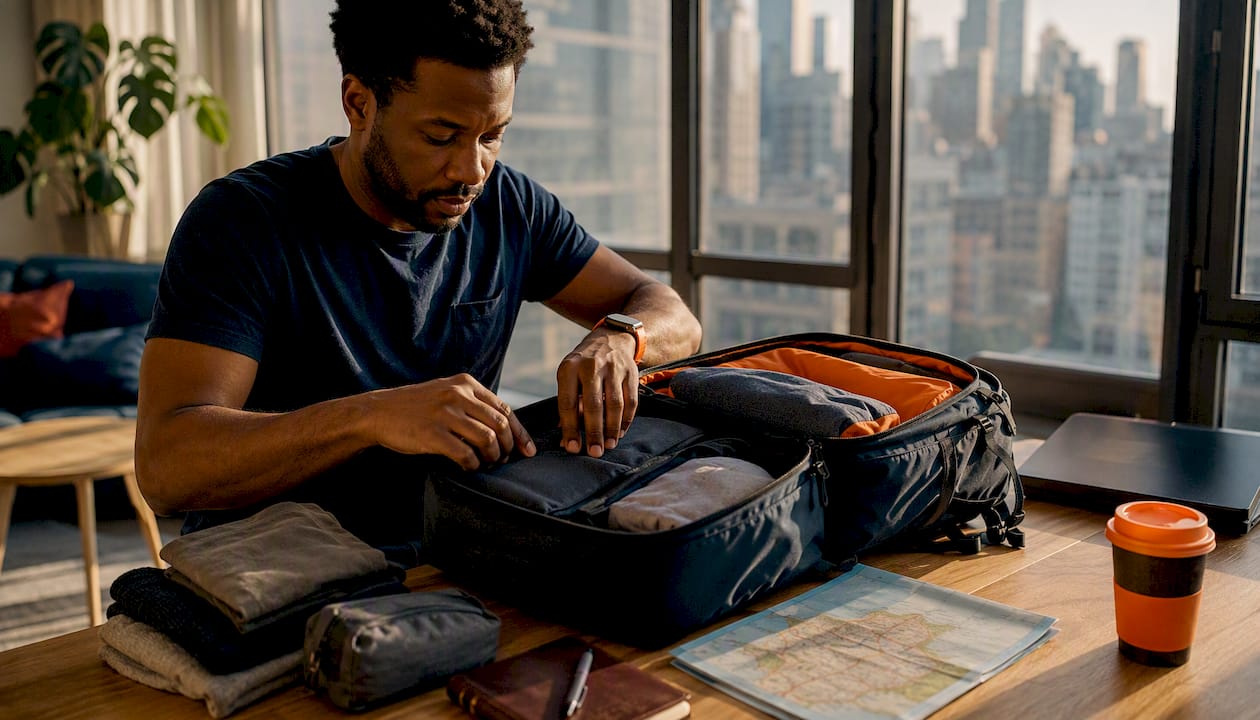
Most nomad incidents are opportunistic. Accommodation break-ins and transit-time laptop theft are the most common, and the majority are preventable.
Accommodation and daily habits:
- Choose mixed-use neighborhoods with visible daytime foot traffic.
- Verify keycard access and door locks before committing to a rental.
- Store passport copies and backup cards separately from your primary bag.
- Keep a low profile — avoid displaying expensive gear in transit.
Transport and arrival:
- Prebook airport transfers through verified apps or your accommodation.
- Walk your immediate neighborhood during daylight on arrival day.
- Use established ride apps (Grab, Uber, Bolt) rather than unmarked taxis.
Digital security:
- Use a VPN on all public Wi-Fi, without exception.
- Enable full-device encryption and automatic cloud backups.
- Never access banking on public networks; use a mobile hotspot instead.
Insurance and emergency planning:
- Buy expat-capable health insurance that covers emergency evacuation before you arrive.
- Register with the U.S. Embassy via the STEP program (Smart Traveler Enrollment Program) for each country.
- Keep one local emergency contact who knows your address and schedule.
Pro Tip: Your first 48 hours in a new city are your highest-vulnerability window. Fatigue, unfamiliar transit, and visible luggage all increase exposure. Plan arrivals for daylight, keep your first night's accommodation pre-confirmed, and do a short neighborhood walk before dark.
How ToolsForExpats' free tools help you find your safest-fit city
The shortlist above gives you candidates. These tools help you turn candidates into a personal decision:
| Decision step | ToolsForExpats tool | What it answers |
|---|---|---|
| Overall city fit | City-matching quiz | Which cities match your safety, cost, and lifestyle priorities? |
| Cost vs. safety trade-off | Cost of living calculator | What is the monthly cost of your shortlisted cities? |
| Visa and stay length | Visa eligibility checker | Which nomad visas can you qualify for, and for how long? |
Three steps you can complete in one session:
- Run the city-matching quiz to get a personalized shortlist ranked by your priorities.
- Compare your top two or three cities in the cost calculator to quantify the safety premium.
- Check visa eligibility for each finalist to confirm your intended stay length is viable.
After that, move to neighborhood-level research using Kakapo's editorial sub-scores and local expat forums for the specific districts that fit your budget and work schedule.
Key Takeaways
No single city is the safest for every solo digital nomad — the right choice depends on how you weight five safety dimensions against your budget, health needs, and stay length.
| Point | Details |
|---|---|
| Use a composite score | Target cities well above Kakapo's global mean of 78.6/100, then drill into sub-scores. |
| Prioritize healthcare and stability | For stays of 3+ months, English-capable emergency care and political stability matter most. |
| Select neighborhoods, not just cities | Mixed-use zones with steady foot traffic reduce real-world risk more than city averages. |
| Build your safety habits early | Insurance, embassy registration, and digital hygiene should be in place before arrival. |
| Use ToolsForExpats to personalize | The city-matching quiz, cost calculator, and visa checker turn this shortlist into your shortlist. |
Why personalization beats any single "safest city" ranking
The multi-dimensional approach in this article reflects something most safety rankings miss: the same city can be genuinely safe for one nomad and genuinely risky for another. A nomad with a chronic health condition needs English-capable emergency care above almost everything else. Someone working with sensitive client data weights digital security higher. A nomad planning an 18-month stay needs political stability in a way a three-month visitor simply does not.
The shortlist here is a starting point, not a verdict. Lisbon and Taipei consistently score well across most dimensions, and they are where most nomads should begin their research. But the real work is matching those city profiles to your specific situation — your health, your budget, your work hours, your risk tolerance. That is exactly what ToolsForExpats' tools are built for: making that match visible and fast, without requiring you to spend hours cross-referencing spreadsheets.
ToolsForExpats gives you a personalized safety shortlist for free
The cities in this article are strong starting points, but your ideal destination depends on factors only you know: your health situation, your budget ceiling, how long you plan to stay, and which safety dimensions matter most to your daily life.
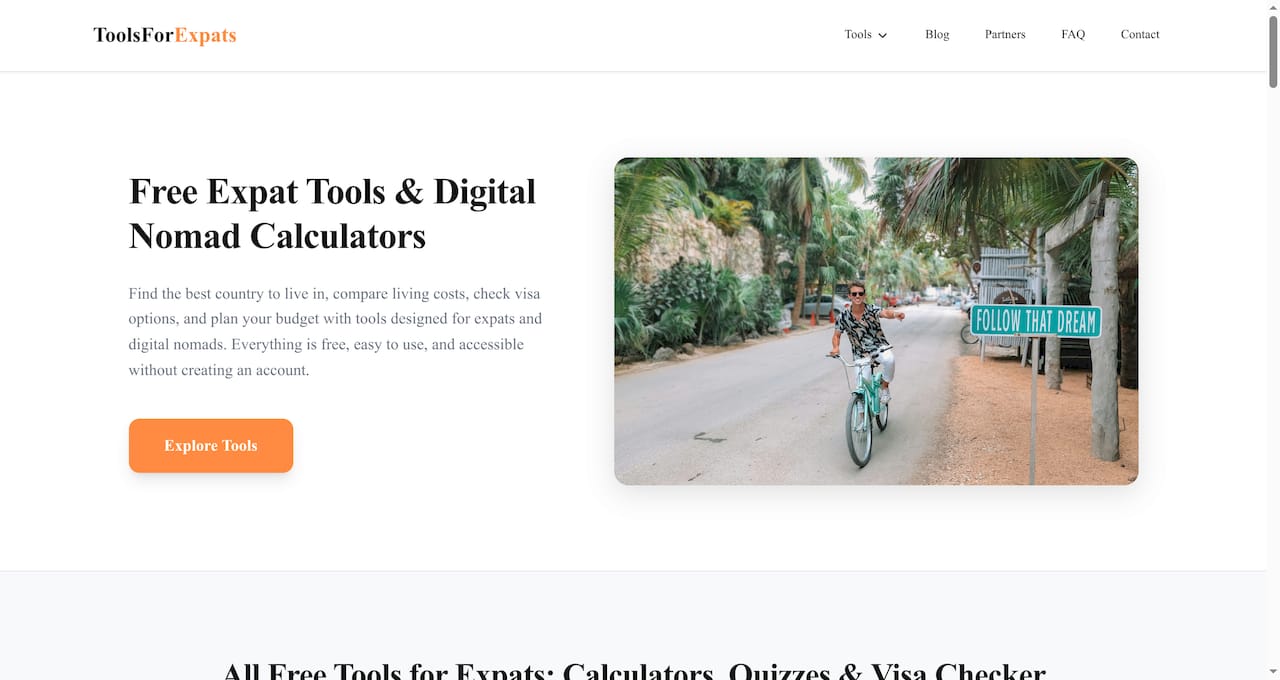
ToolsForExpats gives you three free tools to turn this shortlist into a personal decision. The city-matching quiz ranks destinations by your stated priorities in minutes. The cost of living calculator shows you the real monthly cost of your top candidates so you can weigh the safety premium against your budget. The visa eligibility checker confirms which destinations are actually viable for your intended stay length. No account needed, no cost, no guesswork. Start with the city quiz and have a personalized shortlist ready before your next planning session.
This article provides general information for planning purposes only. Confirm current travel advisories, visa rules, and healthcare access with official sources or a qualified professional before committing to a destination.