Transitioning kids to a nomadic lifestyle is fully achievable with deliberate planning across three areas: education, travel logistics, and emotional readiness. Families who treat this as a phased process rather than a single leap report far smoother outcomes. The core insight is simple. Stability for children does not come from a fixed address. It comes from consistent routines, involved decision-making, and a parent who has done the groundwork before departure. This guide covers every major step, from choosing a schooling model to managing your first 90 days on the road.
What education options work best for nomadic children?
The three main schooling pathways for mobile families are worldschooling, accredited online curriculum, and temporary local enrollment. Each suits a different family profile, and no teaching credentials are legally required for parents facilitating any of these approaches. That removes one of the biggest fears parents carry into this decision.
Worldschooling treats the world itself as the classroom. Children learn history by visiting historical sites, practice math through budgeting, and absorb languages through daily immersion. This approach offers maximum flexibility but requires a parent who can structure learning intentionally. Without that structure, gaps appear quickly.

Accredited online curriculum programs provide a formal, structured education that transfers across borders. Programs like Khan Academy, Time4Learning, and Connections Academy offer grade-level coursework that satisfies most home education requirements in the United States. The tradeoff is screen time and the need for reliable internet, which varies significantly by destination.
Temporary local enrollment places children in schools at each destination for weeks or months at a time. This builds language skills and social connections faster than any other method. The downside is curriculum inconsistency, especially across countries with different academic calendars and standards.
| Approach | Best for | Key challenge |
|---|---|---|
| Worldschooling | Flexible, experiential learners | Requires parental structure |
| Online accredited curriculum | Families needing formal transcripts | Needs reliable internet |
| Local temporary enrollment | Social development and language | Curriculum gaps between countries |
Most families blend two of these approaches. A common combination is an online curriculum for core subjects like math and English, paired with worldschooling activities for science, history, and culture. Review your home state's homeschooling laws before departure, since requirements vary by state.
How to plan the first 90 days of your nomadic family transition
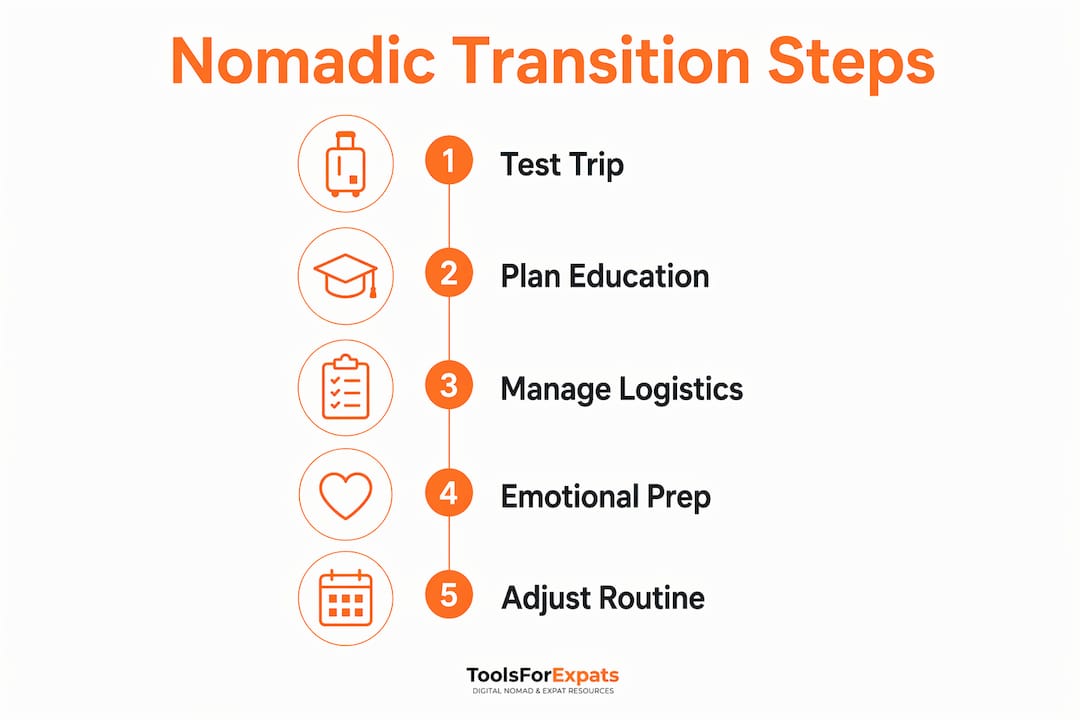
The first 90 days of nomadic family life require a phased approach to prevent burnout. Families who try to maintain full work and school output from day one tend to burn out and return home early. A structured ramp-up protects everyone.
-
Choose your first base location. Pick a destination with good infrastructure, affordable monthly rentals, and a family-friendly environment. Portugal, Mexico, and Thailand consistently rank well for nomadic families because of cost, safety, and English availability.
-
Sort insurance and schooling before you leave. International health insurance for families is non-negotiable. Research providers that cover children specifically, and confirm your chosen schooling approach is operational before your departure date.
-
Book a 30-day accommodation with essential amenities. A kitchen, stable Wi-Fi, and laundry access are not luxuries for families. They are the foundation of a functional daily routine. Monthly rentals reduce costs significantly compared to short-term bookings and give children a stable base to settle into.
-
Complete final logistics two weeks before departure. Finalize school materials, download offline resources, confirm insurance activation dates, and pack a medical kit. Do not leave these for the last 48 hours.
-
Treat week one as orientation only. Week 1 should focus on exploring the neighborhood, establishing sleep schedules, and locating grocery stores. Gradually increase school and work output over weeks two through four.
Pro Tip: A 2–4 week test trip before your full launch reveals how your kids handle living without a fixed home base. It is the single most useful data point you can gather before committing.
How do you prepare children emotionally for life on the road?
Emotional buy-in is the primary hurdle in moving kids to a nomadic life, not logistics. Children who feel the decision was imposed on them resist the lifestyle at every turn. Children who helped shape it become its biggest advocates.
Start involving your kids in planning at least three months before departure. Let them choose one destination on the itinerary. Ask them what they want to learn or see. Give them a packing list to manage themselves. These small acts of ownership shift their mindset from passenger to participant.
Once on the road, consistent routines provide the security that a fixed address used to. Predictable rhythms matter far more than familiar surroundings. The following practices anchor children's sense of normalcy regardless of location:
- Fixed school hours. Start lessons at the same time each morning, even if the view outside changes weekly.
- Weekly video calls. Schedule regular calls with grandparents, cousins, and close friends. Continuity of relationships reduces the sense of loss.
- A personal space ritual. Let each child set up their corner of any new accommodation the same way every time. Familiar objects in a familiar arrangement signal safety.
- Family check-ins. A short daily conversation where everyone shares one good thing and one hard thing normalizes open communication about the lifestyle.
Pro Tip: Create a "feelings map" with younger children. After each move, mark the new location on a physical map and write one word about how they felt arriving. Over time, this becomes a powerful record of resilience that kids are proud of.
What practical logistics do nomadic parents need to manage?
Raising children on the road requires managing four practical areas consistently: housing, healthcare, finances, and work-life balance.
Housing and slow travel
Slow travel, defined as booking stays of at least 30 days, reduces both expenses and burnout. Longer stays allow families to cook meals, build neighborhood routines, and avoid the premium pricing of short-term rentals. For families with school-age children, staying in one place for a full school term also provides social continuity.
Healthcare access
International health insurance is the most critical financial product a nomadic family carries. Confirm that your policy covers pediatric care, dental, and emergency evacuation. Research local clinic quality at each destination before arrival. For common nomad health challenges abroad, preparation beats reaction every time.
Financial foundations
Financial institutions require a legal domicile on file for services like banking and financing. Nomadic families must establish and maintain a legal address, typically with a trusted family member or a registered mail service, to keep financial accounts active. Tracking expenses by destination also helps families identify where their budget stretches furthest.
Work and parenting balance
The work-life balance challenge is one of nomadic family life's most demanding ongoing realities. Without external childcare, parents must build adaptable schedules that protect both work output and parenting presence. Many nomadic parents find that splitting the day works best: one parent works mornings while the other handles schooling, then they swap after lunch. If you are still building your remote income, exploring remote jobs for parents before departure gives you more options and financial breathing room.
| Logistics area | Key action | Common mistake |
|---|---|---|
| Housing | Book monthly stays | Relying on short-term rentals |
| Healthcare | Get international family insurance | Assuming travel insurance is enough |
| Finances | Maintain a legal domicile address | Closing all home-country accounts |
| Work schedule | Split the day between parents | Trying to work and parent simultaneously |
Key Takeaways
Successfully raising children on the road requires phased planning, consistent routines, and early emotional buy-in from kids, not perfect logistics.
| Point | Details |
|---|---|
| Education flexibility | Worldschooling, online curriculum, and local enrollment each work. Most families blend two approaches. |
| Phase the first 90 days | Treat week one as orientation only and ramp up school and work output gradually to prevent burnout. |
| Emotional buy-in first | Involve children in planning early. Kids who help shape the plan resist the lifestyle far less. |
| Routines over places | Fixed school hours, weekly calls, and personal space rituals create stability regardless of location. |
| Legal and financial prep | Maintain a legal domicile address and secure international family health insurance before departure. |
What I've learned from watching families make this leap
Most parents who contact me about raising children on the road are worried about the wrong things. They obsess over curriculum accreditation and packing lists. The families who struggle are almost always the ones who skipped the emotional groundwork with their kids.
I have seen families with meticulous spreadsheets fall apart by month two because their children felt blindsided. I have also seen families with a single carry-on each and a loose plan thrive for years, because the kids were genuinely excited and the parents were honest about the hard parts.
The other thing I would push back on is the idea that work-life balance gets easier once you are traveling. It does not. It gets different. You lose the office commute but gain the challenge of working while your kids want your attention in a fascinating new city. The families who adapt fastest are the ones who build a schedule and protect it, even when the beach is calling.
My honest advice: go slower than you think you need to. Pick a first destination that is easy, not exciting. Give your kids two months to settle before you push for the next adventure. The lifestyle rewards patience more than ambition.
— Jay
Planning your nomadic family move with ToolsForExpats
Choosing the right destination for your family involves more than gut instinct. Cost of living, visa access, and budget projections all shape whether a location is genuinely sustainable for a family with children.
ToolsForExpats offers a free suite of tools built for exactly this kind of planning. Use the cost of living comparison tool to compare monthly expenses across potential destinations side by side. Run your numbers through the moving abroad budget calculator to see what your transition will actually cost. And before you commit to a destination, check your visa eligibility across more than 20 countries in minutes. All tools are free and require no account to access.
FAQ
What is worldschooling?
Worldschooling is an educational approach where children learn through travel and real-world experiences rather than a fixed classroom. Parents structure learning around destinations, cultures, and daily life.
Do parents need teaching credentials to homeschool while traveling?
No teaching credentials are legally required for parents using worldschooling, online curriculum, or local enrollment approaches. Requirements vary by home country and state, so confirm your local laws before departure.
How long does it take kids to adjust to nomadic life?
Most children need four to eight weeks to settle into a new nomadic routine. A slow first month with low school and work demands significantly reduces adjustment time and prevents early burnout.
What is the biggest mistake nomadic families make in the first month?
Families who maintain full work and school output from day one burn out fastest. Week one should focus on orientation and neighborhood exploration, with gradual increases in structured activity over the following weeks.
How do you keep children socially connected while traveling?
Weekly video calls with family and friends, participation in local activities, and temporary school enrollment at each destination all maintain social bonds. Consistent digital connection with a home community reduces the sense of isolation children can feel on the road.