
The U.S. does not offer a dedicated digital nomad visa. If you want to live and work remotely in the United States, you will need to work within existing immigration categories, and the rules are strict about what counts as "work."
Here are the practical routes worth knowing:
- Visitor entries (ESTA/VWP or B-1/B-2): Short stays only, no productive employment permitted
- O-1 (extraordinary ability): The closest functional option for accomplished freelancers, filed through a U.S. agent
- H-1B (specialty occupation): Employer-sponsored, lottery-limited
- L-1 (intracompany transfer): Requires a qualifying multinational employer
- E-2 (treaty investor): Requires a qualifying nationality and real investment
Legal caveat: Visitor entries do not authorize billable or productive work from a U.S. address. Misusing them risks multi-year reentry bans. For case-specific advice, consult a licensed U.S. immigration attorney and review official USCIS guidance.
Pro Tip: Apply for ESTA at least 72 hours before travel, per CBP guidance, but applying several days earlier gives you time to resolve any issues before your departure.
Key Takeaways
The U.S. has no dedicated digital nomad visa; your legal options depend entirely on your credentials, employer situation, and how long you want to stay.
| Point | Details |
|---|---|
| No nomad visa exists | The U.S. offers no remote-work permit; visitor entries do not authorize productive employment. |
| O-1 is the closest option | Accomplished freelancers can file an O-1 through a U.S. agent, but the evidentiary bar is high. |
| Visitor routes carry real risk | Unauthorized work on ESTA or B-1/B-2 can trigger three- or ten-year reentry bars. |
| Tax residency starts at 183 days | The IRS Substantial Presence Test can create U.S. tax obligations; track every day and consult a cross-border tax advisor. |
| Alternatives exist | Countries like Portugal, Spain, Estonia, Japan, and Costa Rica offer purpose-built nomad visas; use ToolsForExpats' free visa checker to compare options. |
Why the U.S. doesn't have a digital nomad visa
A "digital nomad visa" is a remote-work residence permit that lets you live in a country legally while earning income from foreign clients or employers. Countries like Portugal, Spain, Estonia, Japan, and Costa Rica have created these permits specifically for location-independent workers, typically requiring proof of income above a set threshold and health insurance coverage.
The U.S. immigration system is built on a fundamentally different model. It centers on employer petitions, work authorization tied to specific job offers, and investment or family-based pathways. The idea of someone arriving to work for foreign clients, without a U.S. employer or investment, simply doesn't map onto any existing category. USCIS explains that most work-authorized nonimmigrant visas require a U.S. petitioner, and self-petition is limited to narrow categories like extraordinary ability.
There have been informal discussions in policy circles about a remote-work category, but as of 2026, no dedicated nomad permit exists and no legislation has passed to create one. The gap is real, and it affects hundreds of thousands of remote workers who want U.S. access. Understanding what a nomad visa actually offers globally helps clarify just how different the U.S. approach is.
Your real visa options as a digital nomad in the U.S.
No single visa perfectly fits the nomad model, but several categories can work depending on your situation. Here is a decision-ready breakdown.
Visitor routes: short stays, limited activity
ESTA / Visa Waiver Program (VWP): If you hold a passport from one of the 38 VWP-eligible countries, you can enter for up to 90 days without a visa. No extensions are possible, and you cannot change your status while inside the U.S. under VWP. Permitted activities include tourism, attending meetings, and networking, but not performing services for pay from a U.S. address.
B-1/B-2 Visitor Visa: The B-1/B-2 visa allows stays typically up to six months, with discretionary extensions possible via Form I-539. B-1 covers business activities like attending conferences or negotiating contracts; B-2 covers tourism and personal visits. Neither authorizes productive employment or billable remote work.
Work-authorized visas that can support remote workers
O-1 (Extraordinary Ability): This is the visa most frequently cited by immigration practitioners as the practical workaround for accomplished freelancers. Filed by a U.S. agent on your behalf, the O-1 authorizes work tied to the petitioned engagements. The evidentiary bar is high: you need documented extraordinary achievement in your field through awards, press coverage, high compensation, or critical roles. Ambra Talent Group's practitioner analysis identifies the O-1 with a U.S. agent as the closest functional pathway for high-achieving independent professionals.
H-1B (Specialty Occupation): Requires a U.S. employer sponsor and a degree in a specialty field. The annual lottery cap makes it unpredictable, and it is not a self-petition option. If you already have a U.S. employer willing to sponsor you, this is a well-established route.
L-1 (Intracompany Transfer): Works if you are employed by a multinational company and transferring to a U.S. affiliate, subsidiary, or parent. L-1A covers managers and executives; L-1B covers specialized knowledge workers. This is not a freelancer option, but it is a real path for remote workers at global companies.
E-2 (Treaty Investor): Requires nationality from a U.S. treaty country and a substantial, at-risk investment in a U.S. enterprise. It is renewable indefinitely as long as the business operates, making it one of the more flexible long-term options for entrepreneurs.
TN (USMCA): Available only to Canadian and Mexican nationals in specific professional categories. Canadians can apply at the port of entry; Mexicans apply at a U.S. consulate. It is employer-tied but straightforward for qualifying professions.
Visa comparison at a glance
| Visa | Lawful U.S. work? | Typical stay | Sponsorship required | Extendable? | Processing time | Typical cost range |
|---|---|---|---|---|---|---|
| ESTA/VWP | No | 90 days max | None | No | Minutes to 72 hours | ~$21 ESTA fee |
| B-1/B-2 | No | Up to 6 months | None | Yes (discretionary) | Weeks to months (consular) | $185 DS-160 fee + attorney |
| O-1 | Yes (petitioned work) | Up to 3 years | U.S. agent or employer | Yes (1-year increments) | 2–4 months standard; 15 days premium | $500+ filing + $3,000–$8,000 attorney |
| H-1B | Yes | 3 years (6 max) | U.S. employer | Yes | 3–6 months standard; 15 days premium | $500+ filing + attorney |
| L-1 | Yes | 1–3 years | U.S. employer (multinational) | Yes | 2–4 months standard; 15 days premium | $500+ filing + attorney |
| E-2 | Yes (own business) | 2 years | Self (investment) | Yes | 2–6 months consular | $185 application fee + attorney |
| TN | Yes | Up to 3 years | U.S. employer | Yes | Same-day (Canadians at port) | $160–$185 consular fee |
What actually counts as "work" at the U.S. border
This is where many nomads get into trouble, and the line is less obvious than it sounds.
Under U.S. immigration rules, "work" means performing services for compensation, regardless of where your employer or client is based. If you are physically in the U.S. and completing billable tasks for a foreign company, immigration authorities can treat that as unauthorized employment. The fact that your paycheck comes from abroad does not automatically make the activity legal on a visitor visa.
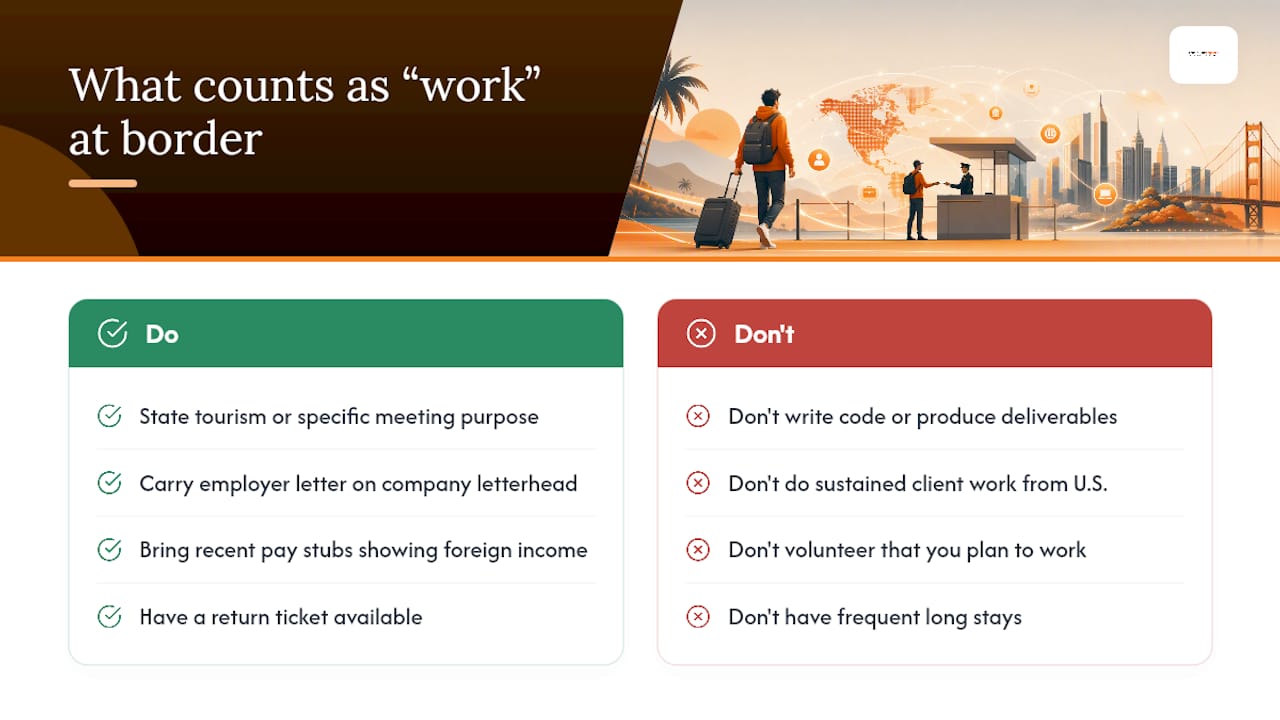
Permitted visitor activities include attending business meetings, conducting market research, negotiating contracts, and tourism. They do not include writing code, producing deliverables, or completing client work from a U.S. address on a sustained basis.
At the border: CBP officers have broad discretion. If you arrive with a laptop, mention you work remotely, or have a history of frequent long stays, you may face additional questioning. The best approach is honest and minimal: state that you are visiting for tourism or a specific meeting, carry a letter from your foreign employer confirming your employment and remote status, bring recent pay stubs showing foreign-source income, and have a return ticket. Do not volunteer that you plan to work from your Airbnb.
LegalClarity's legal commentary is direct on the consequences: unauthorized work or overstays can trigger three-year reentry bars (for unlawful presence of 180 days to one year) or ten-year bars (for more than one year). Visa revocation is also possible. These are not theoretical risks.
Pro Tip: Carry a short, signed letter from your foreign employer on company letterhead stating your employment status, your salary source, and that you are not performing services for any U.S. entity. This single document can defuse most CBP questions about your laptop.
Processing times, extensions, and what it all costs
Planning around U.S. visa timelines requires more buffer than most people expect.
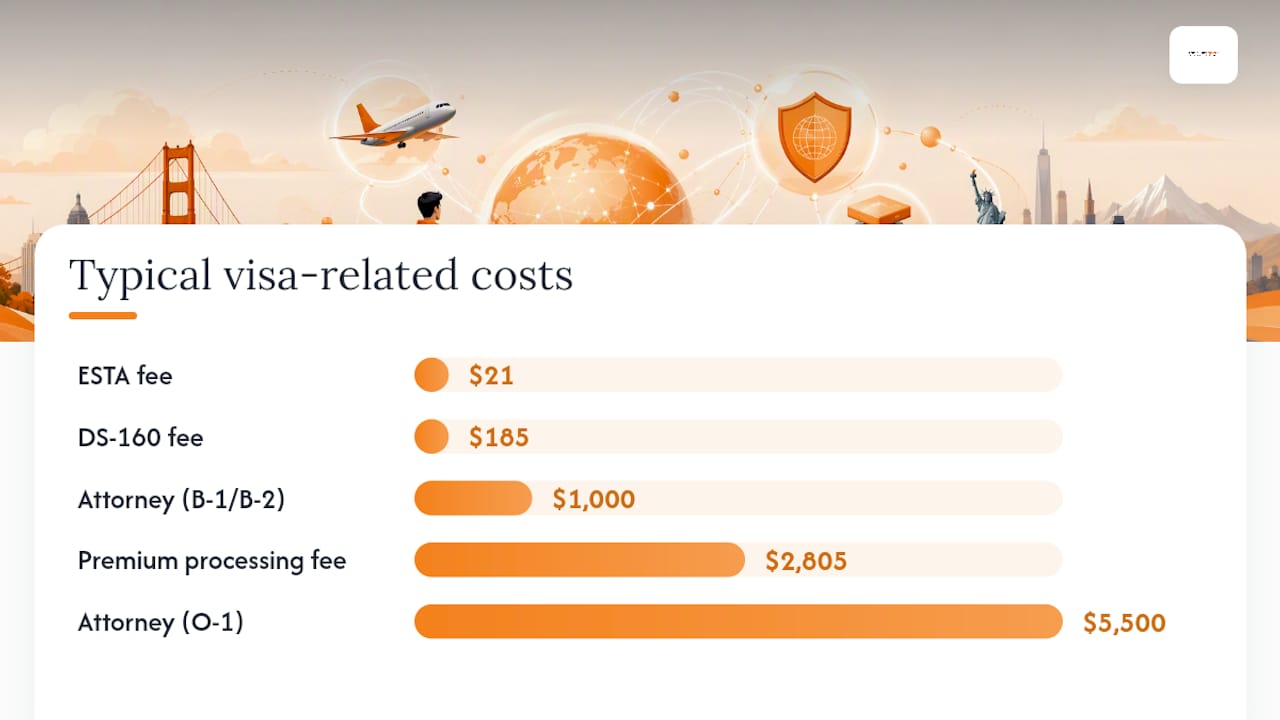
ESTA: Approval typically comes within minutes to 72 hours after submission. The fee is $21. Apply through the official CBP ESTA portal and never through third-party sites that charge inflated fees.
B-1/B-2 consular interview: Wait times vary dramatically by U.S. consular post. Some posts in Europe and Canada have waits of a few weeks; others in high-demand locations can stretch to several months. Check current wait times on the Department of State's appointment scheduling system. The DS-160 application fee is $185.
USCIS petitions (O-1, H-1B, L-1, E-2): Standard processing runs roughly 2–6 months depending on the category and current USCIS workloads. Premium processing, available for many petition types, reduces adjudication to 15 business days for an additional fee (currently $2,805 for most petition types, per USCIS fee schedules). Budget for this if your timeline is tight.
Extensions:
- B-2 extension: File Form I-539 with USCIS before your authorized stay expires. Adjudication can take several months, so file early.
- O-1 extensions: Filed in one-year increments by your U.S. agent; standard or premium processing applies.
- H-1B and L-1 extensions: Employer-filed, same USCIS process.
Attorney fees vary widely. For a B-1/B-2 application, many attorneys charge $500–$1,500 for consultation and preparation. O-1 petitions, which require assembling substantial evidence, typically run $3,000–$8,000 or more. E-2 petitions with business plan preparation can reach similar ranges.
For current official fee charts and processing time estimates, check USCIS's fee schedule and the Department of State's visa pages. Before any consular appointment, verify your passport is valid for at least six months beyond your intended stay. The Passportcenter is a useful resource if your passport needs updating before you apply.
U.S. tax implications you need to understand before a long stay
Tax residency in the U.S. is not just about having a visa. It is about how many days you spend on U.S. soil.
The IRS uses the Substantial Presence Test to determine whether a non-citizen is a U.S. tax resident. The test counts all days in the current year plus one-third of days in the prior year and one-sixth of days two years prior. If that weighted total reaches 183 days, you may be treated as a U.S. tax resident for that year, with obligations to report worldwide income on Form 1040.
Even if you do not meet the substantial presence threshold, being physically in the U.S. while earning income can still create filing obligations. If you are paid by a foreign employer for work performed on U.S. soil, that income may be considered U.S.-source income. Foreign persons receiving certain U.S.-source payments may need to complete IRS Form W-8BEN to certify their foreign status and applicable treaty benefits.
Practically, this means you should track every day you spend in the U.S. Keep clear records of invoices, payment receipts, and the location where work was performed. If you are planning stays longer than 60 days, consult a cross-border tax advisor before you travel, not after. Dual-status tax years, where you are a nonresident for part of the year and a resident for another part, add complexity that most general accountants are not equipped to handle.
State taxes add another layer. Several U.S. states assert tax jurisdiction based on physical presence alone, even for short periods. A tax professional familiar with cross-border situations is worth the cost.
If the U.S. doesn't fit: countries with real nomad visas
If you want a legal, purpose-built remote-work permit, the U.S. is not your best option right now. These countries have established programs that are genuinely designed for nomads:
- Portugal (D8 Visa): One year, renewable. Requires proof of remote income above a monthly threshold and health insurance. Popular with U.S.-based clients working for European companies.
- Spain (Digital Nomad Visa): Up to five years with renewals. Requires income above a set threshold and a qualifying remote work contract. Includes a favorable tax regime for the first years.
- Estonia (Digital Nomad Visa): Up to one year. Requires proof of remote employment or freelance income. One of the most straightforward applications in Europe. See the full Estonia nomad visa breakdown.
- Japan (Specified Skilled Worker / Freelance Visa): Japan launched a digital nomad visa in 2024 for stays up to six months, requiring income above ¥10 million annually and health insurance.
- Costa Rica (Rentista / Digital Nomad Visa): Up to two years. Requires proof of consistent foreign income above a monthly minimum.
When comparing these options, weigh: stay length, income threshold, tax exposure in that country, healthcare access, cost of living, and how friction-heavy the application process is. How remote work visas work globally is a useful primer if you are new to evaluating these programs.
The ToolsForExpats Digital Nomad Visa Eligibility Checker lets you filter 20+ countries by nationality, income, and stay length for free, no account needed. It is a fast way to see which programs you actually qualify for before spending time on applications.
Your practical next steps checklist
Step 1: Clarify your goal
- Decide whether you want a short visit (under 90 days), a medium stay (3–12 months), or a long-term arrangement.
- Check whether your nationality qualifies for the Visa Waiver Program.
- Identify which visa categories match your employment situation (freelancer, employee, entrepreneur).
Step 2: Gather your documents
- Valid passport (at least six months beyond intended stay; check passport photo requirements if renewing)
- Foreign employer letter confirming remote status and income source
- Bank statements showing financial stability (typically three to six months)
- Client contracts or portfolio evidence (critical for O-1 petitions)
- Business plan and proof of investment (for E-2)
- Awards, press coverage, and compensation evidence (for O-1)
- Return ticket and proof of home-country ties
Step 3: Decide when to hire an immigration attorney
You can handle ESTA and a straightforward B-1/B-2 application without legal help. For anything involving USCIS petitions (O-1, H-1B, L-1, E-2), an attorney is not optional in practice. O-1 petitions in particular require carefully assembled evidence packages, and a weak petition is likely to be denied. Consult an attorney early if your employment history is complex, if you have had prior visa issues, or if you are planning a stay longer than three months.
Red flags to avoid:
- Performing ongoing billable work on a visitor visa or ESTA
- Entering without a return ticket or clear proof of home-country ties
- Repeated near-overstays across multiple entries
- Relying on informal advice from online forums instead of licensed counsel
Planning your move or comparing destinations before committing to a U.S. visa path? ToolsForExpats offers a free suite of tools built for exactly this situation. Use the Digital Nomad Visa Eligibility Checker to screen 20+ countries by your nationality and income, run a cost of living comparison between U.S. cities and nomad-friendly alternatives, and estimate your full relocation budget with the moving abroad budget calculator. Everything is free, no account required.
The honest reality for nomads eyeing the U.S.
The U.S. is one of the most desirable destinations on the planet for remote workers, and the immigration system was simply not built with you in mind. That gap is frustrating, but it is also clarifying.
If your credentials are strong enough for an O-1, the U.S. is genuinely accessible. If you have a U.S. employer willing to sponsor an H-1B or L-1, the path exists. If you are an entrepreneur from a treaty country with real capital to invest, E-2 is a legitimate long-term option. But if you are a mid-career freelancer who wants to spend six months working from a U.S. city, the honest answer is that no clean legal pathway exists for you right now.
The countries that have built nomad visas did so because they wanted your spending, your taxes, and your presence. The U.S. has not made that calculation yet. Until it does, your best move is either to pursue a work-authorized visa with the credentials to back it, or to choose a country that has already built the door you are looking for.
Sources
U.S. government resources:
Professional consultation:
This article provides general information only and is not a substitute for legal or tax advice. Confirm current rules, fees, and processing times with USCIS, the U.S. Department of State, or a qualified immigration attorney before making any visa decisions.