
An online portfolio is a curated, professional showcase of your best work, accessible to clients anywhere in the world. For digital nomads and freelancers, it is the single most powerful tool for winning clients without a fixed address. You can build an online portfolio while traveling using cloud-based platforms that require nothing more than a browser and a Wi-Fi connection. This guide covers the right platforms, curation standards, and maintenance habits that keep your portfolio working for you, whether you are in Lisbon, Chiang Mai, or a hostel in Buenos Aires.
What tools and platforms let you build an online portfolio while traveling?
The best platforms for nomads run entirely in the cloud. You do not need a local development environment, a powerful laptop, or a stable fiber connection. Cloud-based AI builders let you create and deploy a portfolio from any location using only a web browser. That removes the single biggest technical barrier most freelancers face when they are on the road.
Several platform categories serve different creator types:
- AI-powered website builders generate layouts, suggest copy, and handle hosting automatically. Platforms in this category offer free starter tiers, making them ideal for nomads who want to test before committing.
- Content aggregation tools like Authory automatically collect published work, including articles, images, and videos, into a self-updating portfolio. Travel writers and bloggers benefit most from this approach because it prevents link rot and keeps the portfolio current without manual effort.
- Visual portfolio platforms suit photographers, UX designers, and videographers who need gallery-style layouts with fast image loading.
- Developer-focused platforms support code repositories, live project previews, and technical case studies.
One specific example worth noting: RationalGo provides 2,000 free initial credits for cloud-based portfolio and app building. That credit system lets you prototype and publish without upfront cost, which fits the nomad model of low overhead and high flexibility.
| Platform type | Best for | Key nomad advantage |
|---|---|---|
| AI website builder | Generalists, freelancers | No coding, browser-only |
| Content aggregator | Writers, bloggers | Auto-updates published work |
| Visual gallery platform | Photographers, designers | Fast image delivery |
| Developer platform | Coders, engineers | Code previews, GitHub integration |

Pro Tip: Test your portfolio on your phone's mobile data connection, not just the coworking space Wi-Fi. Clients often browse on mobile, and a slow-loading portfolio loses the job before you even get a chance to pitch.
How do you curate and write effective project presentations?
Curation is the skill that separates a portfolio that wins clients from one that just exists. The industry standard is 5–8 projects, each chosen to show range and depth rather than volume. Showing 20 average projects hurts you more than showing 6 exceptional ones. Every project you include should earn its place.
Each project entry needs three things: context, process, and outcome. Context tells the client what the problem was. Process shows how you approached it. Outcome proves you delivered results, ideally with a number attached. A UX designer might write: "Redesigned the checkout flow for an e-commerce client, reducing cart abandonment by 22%." That single sentence communicates more than three paragraphs of vague description.
Follow this sequence when building each project page:
- Write a one-sentence project summary. State the client type, the challenge, and the result. Keep it under 25 words.
- Add 2–3 short paragraphs. Cover the brief, your approach, and the measurable outcome. Avoid jargon.
- Include visuals. UGC travel creators, for example, need at least 3–5 high-quality photos or videos that show how a brand could use the content in real marketing.
- Adapt for your audience. A project description written for a tech startup reads differently than one written for a hospitality brand. Keep two versions if you pitch across industries.
- Write your About page in the first person. Specify your services clearly rather than using vague phrases like "passionate creative." Clients need to know exactly what you do and what they can hire you for.
- Treat the portfolio as a living document. Review and update it every six months or after every major project.
If you are new and lack paid work, spec projects are a legitimate path. Creating professional-quality content targeted for brand marketing use cases gives you real samples without waiting for a paying client to take a chance on you first.
Pro Tip: Read your project descriptions out loud. If a sentence sounds like a press release, rewrite it in plain language. Clients respond to clarity, not corporate tone.
How do you keep your portfolio accessible and professional on the road?
A portfolio that breaks while you are in transit costs you real money. Portfolios must be tested on multiple devices and browsers before you share them with any client. Mobile optimization is not optional. Many clients will open your link on a phone, and a layout that falls apart on a small screen signals carelessness.
Contact reliability is equally critical. Working contact forms and permanent email addresses prevent missed inquiries when you are moving between cities. Use a professional email tied to your domain, not a free webmail account you might abandon. Forward it to whichever inbox you actively monitor.
"Automation tools that aggregate diverse published and bylined travel content prevent content loss due to a scattered online presence or platform changes. For traveling professionals, preserving your professional footprint is not a nice-to-have. It is the foundation of your reputation."
Practical maintenance habits for nomads include:
- Schedule a portfolio review every six months. Block two hours in your calendar, check every link, update project outcomes, and remove anything outdated.
- Back up your portfolio files to cloud storage like Google Drive or Dropbox after every major update. Platform outages happen.
- Use a custom domain. A domain you own travels with you regardless of which platform you use. It also signals professionalism to clients.
- Check for broken links monthly. Free tools like Dead Link Checker scan your site in minutes and flag any URLs that no longer resolve.
The digital nomad lifestyle rewards preparation. A portfolio that works flawlessly from any location is one of the clearest signals to a client that you are a reliable professional, not just someone who travels.
What are the step-by-step actions to build your portfolio while traveling?
Building a portfolio on the road is straightforward when you follow a clear sequence. Skipping steps, especially early ones, creates problems that are harder to fix later.
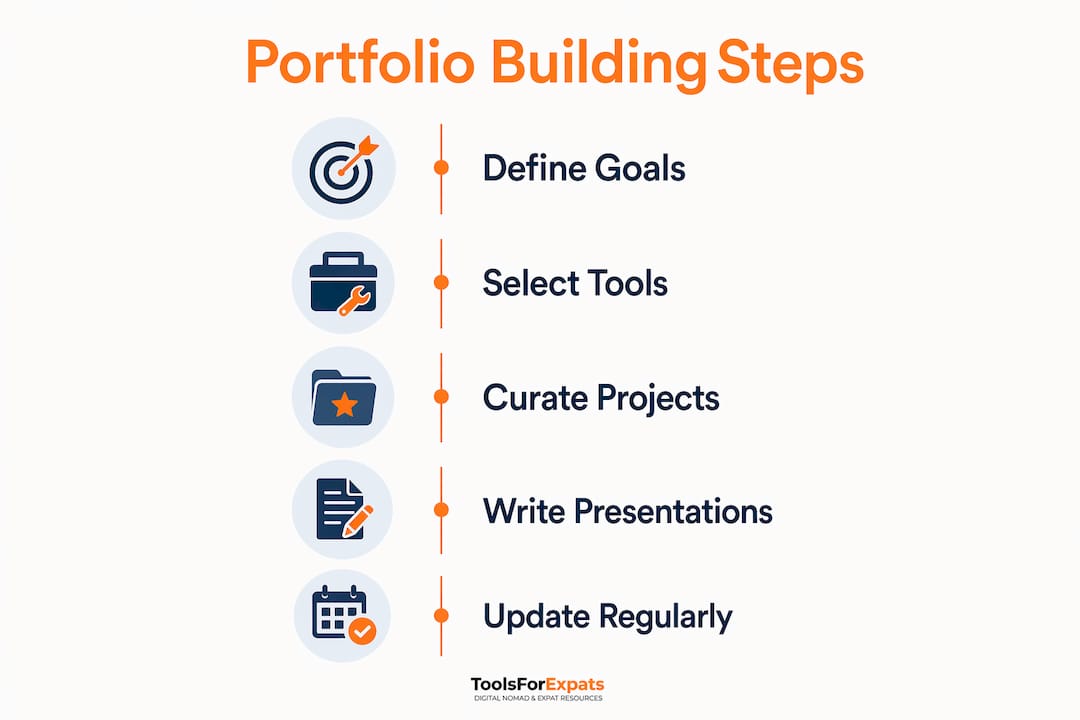
- Define your portfolio goals. Decide which type of client you want to attract and what work you want to be hired for. A portfolio built for travel brands looks different from one built for SaaS companies.
- Choose a cloud-based platform. Prioritize browser-only builders that do not require local software. Check that the platform works on your devices and loads quickly on slower connections.
- Curate your 5–8 strongest projects. Select work that shows measurable results and aligns with your target clients. Write clear, outcome-focused descriptions for each.
- Build the core pages. Every portfolio needs four pages: a home page with a clear headline, a projects page, an About page with explicit service offerings, and a contact page with a working form and direct email.
- Publish and connect your domain. Most cloud builders handle hosting automatically. Connect a custom domain to establish a permanent professional address.
- Share it strategically. Add the URL to your LinkedIn profile, email signature, and any nomad networking profiles you maintain. A portfolio no one sees does not generate leads.
- Maintain it on a schedule. Set a recurring reminder to review and update every six months or after completing a significant project.
| Step | Action | Priority |
|---|---|---|
| 1. Define goals | Identify target clients and work type | High |
| 2. Choose platform | Select cloud-based, mobile-friendly builder | High |
| 3. Curate projects | Pick 5–8 with measurable outcomes | High |
| 4. Build core pages | Home, projects, about, contact | High |
| 5. Publish and share | Connect domain, add to profiles | Medium |
| 6. Maintain regularly | Review every six months | Medium |
A portfolio is the evidence layer that proves your skills to clients who have never worked with you. Resumes tell clients what you claim to do. Portfolios show them what you actually deliver.
What I have learned from managing a portfolio across time zones
Building and maintaining a portfolio while traveling is less about the tools and more about the discipline. I have seen freelancers spend weeks choosing the perfect platform and then neglect the portfolio for months after launch. The platform matters far less than the habit of keeping it current.
The most common mistake I see is treating the portfolio as a one-time project. You build it, you share it, and then you forget it. Six months later, the contact form is broken, two project links are dead, and the most recent work listed is from a year ago. That is the fastest way to lose a client who was already interested.
My honest recommendation: pick the simplest cloud-based builder that lets you publish in a day, then focus your energy on writing strong project descriptions. A clean, well-written portfolio on a basic platform outperforms a visually impressive one with weak content every time. The digital craft portfolio research consistently shows that clear communication of skills and outcomes drives client decisions more than design alone.
One more thing that rarely gets mentioned: your portfolio is also a confidence tool. When you are pitching from a café in a new city, knowing that your work is well-presented and easy to find gives you a grounded, professional presence that clients can feel in your communication.
— Jay
Free tools to support your nomad work and finances
Building a strong portfolio is one part of the nomad equation. Knowing where you can afford to live and work is the other.
ToolsForExpats offers a full suite of free digital nomad calculators that help you plan your budget, compare living costs across cities, and check visa eligibility for over 20 countries. No account required. Whether you are deciding between Medellín and Tbilisi or figuring out how much runway you need before going full-time freelance, the cost of living comparison tool gives you real numbers to plan around. Pair a strong portfolio with solid financial planning, and you have the two pillars every successful nomad freelancer needs.
FAQ
How many projects should a nomad portfolio include?
The industry standard is 5–8 well-chosen projects, each with a clear problem, approach, and measurable outcome. Quality and relevance matter far more than quantity.
Can I build a portfolio with no paid client work yet?
Yes. Spec work, meaning professional-quality content created to demonstrate skills rather than for payment, is a recognized way to build portfolio samples. UGC travel creators, for example, regularly use spec content to show brands realistic marketing use cases.
What is the most important page in an online portfolio?
The About page and the contact page are equally critical. The About page must state your services clearly in the first person. The contact page must have a working form and a permanent email address so clients can reach you reliably.
How often should I update my portfolio while traveling?
Review and update your portfolio every six months at minimum, or immediately after completing a major project. Set a recurring calendar reminder so the review does not get skipped during busy travel periods.
Do I need a custom domain for my portfolio?
A custom domain is strongly recommended. It gives you a permanent professional address that stays consistent regardless of which platform you use, and it signals credibility to prospective clients.
Key takeaways
A strong online portfolio built on cloud-based platforms, curated to show 5–8 outcome-focused projects, and maintained on a regular schedule is the most reliable way for digital nomads to attract clients from anywhere.
| Point | Details |
|---|---|
| Use cloud-based platforms | Browser-only builders let you create and update your portfolio from any location without local software. |
| Curate 5–8 strong projects | Select work with measurable outcomes rather than showing everything you have ever done. |
| Write a specific About page | State your services clearly in the first person so clients know exactly what to hire you for. |
| Test on mobile regularly | Many clients browse on phones, so mobile performance directly affects whether you win the job. |
| Maintain on a schedule | Review every six months, check all links, and update outcomes to keep the portfolio credible. |