
Travel insurance for digital nomads is a mandatory financial safety net, not an optional add-on. Approximately 1 in 6 travelers faces a medical issue abroad requiring costly care, and private hospital bills can reach six figures without coverage. For nomads, the stakes are even higher: you have no fixed home base, no employer health plan, and often no fallback. Why nomads need travel insurance comes down to three unavoidable realities: catastrophic financial exposure, visa compliance requirements, and the complete failure of standard policies to cover mobile lifestyles. This guide covers all three, plus what to look for in a policy built for the way you actually live.
What financial risks do nomads face without travel insurance?
The financial case for coverage is the strongest argument you will encounter. Medical bills in private international hospitals can reach six figures without insurance. That is not a worst-case scenario. That is a realistic outcome from a motorbike accident in Thailand, a diving injury in Indonesia, or appendicitis in Portugal.
The costs stack up fast:
- Emergency hospitalization: Private hospital stays in Southeast Asia or Europe routinely cost $5,000–$20,000 per week.
- Emergency medical evacuation: Evacuation costs routinely exceed $100,000. Private aircraft and specialized medical staff are required, and no airline will accept a critically ill patient on a commercial flight.
- Upfront hospital deposits: Many hospitals in Thailand, Mexico, and the Philippines require a cash deposit before treatment. Without insurance, you pay out of pocket before anyone examines you.
- Gear theft and loss: Standard baggage coverage is often too low to replace a $2,500 laptop or a $3,000 camera setup. For nomads, that gear is income.
- Trip interruption: A family emergency or political crisis can force you to rebook flights at full price, often $1,500 or more on short notice.
Emergency medical evacuation is the single most overlooked risk in nomad financial planning. One evacuation without coverage can wipe out years of savings and create debt that follows you home.
The common health challenges nomads face abroad go well beyond dramatic emergencies. Food poisoning, respiratory infections, and dental issues are far more frequent, and even routine urgent care visits cost hundreds of dollars without coverage.
Pro Tip: Treat travel insurance as a fixed operational expense, the same way you treat your VPN subscription or coworking membership. Budget it as a non-negotiable line item, not a variable you cut when money gets tight.

Why standard policies don't work for digital nomads
Standard domestic health insurance and traditional single-trip travel insurance both fail nomads in predictable ways. Understanding where they break down helps you avoid a false sense of security.
| Feature | Standard travel insurance | Nomad-specific insurance |
|---|---|---|
| Trip duration | Fixed dates, usually 30–90 days | Rolling subscription, no fixed return date |
| Work coverage | Often excludes income-earning activities | Covers remote work and freelance activity |
| Home country visits | Usually not covered | Many plans allow limited home country visits |
| Purchase timing | Must buy before departure | Can be purchased while already abroad |
| Renewal flexibility | Single trip only | Monthly cancellation, no long-term commitment |
| Continuous coverage | Gaps between trips | Uninterrupted rolling coverage |
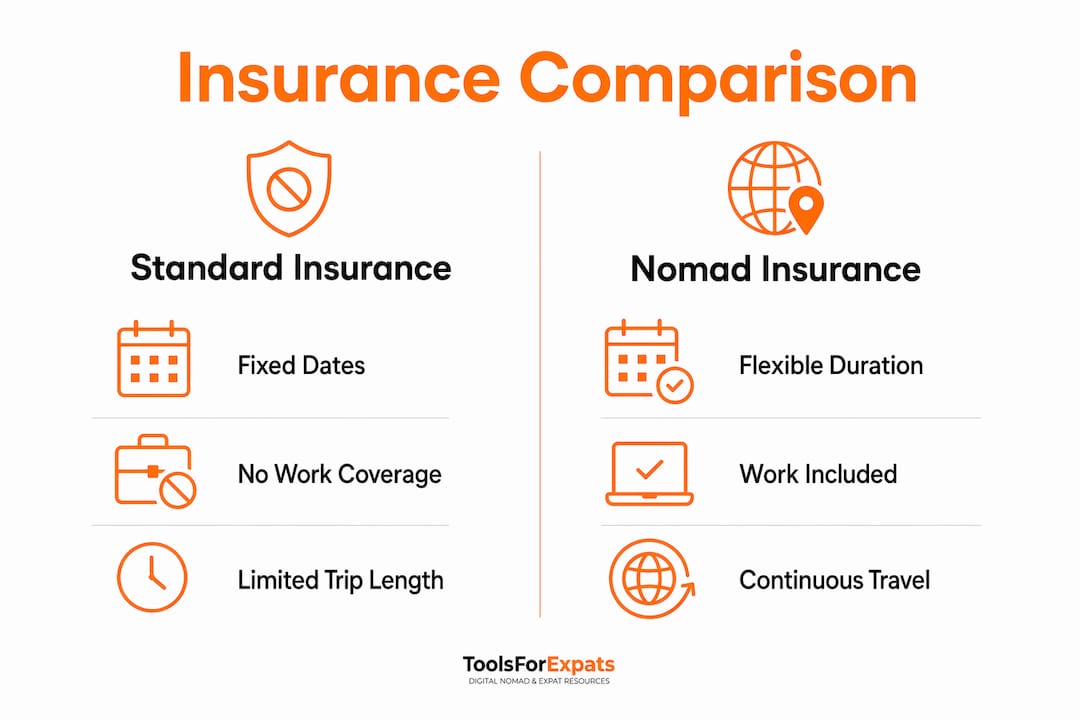
Standard travel insurance typically excludes work-related coverage and continuous travel needs. If you earn income while abroad, many traditional policies consider that a voiding condition. Your claim gets denied not because of what happened, but because of how you were living when it happened.
Domestic health insurance from your home country is equally problematic. Most plans provide zero coverage outside your home country, or cover only emergency stabilization before flying you home. That does nothing for a nomad who has no intention of returning home next week.
Subscription-based nomad insurance aligns with the flexible lifestyle and avoids the coverage gaps built into trip-based plans. You pay monthly, cancel when you want, and stay covered as long as you keep the subscription active. That structure matches how nomads actually travel.
Insurance must also explicitly cover income-earning activities and remote work to be valid for many digital nomads. Read the policy exclusions carefully. If the document does not mention remote work or freelance activity, assume it is excluded.
How does travel insurance affect visa applications?
Several of the most popular nomad destinations legally require proof of travel or health insurance before they will issue a visa. This is not a suggestion. It is a hard requirement, and missing it means visa denial.
Countries with documented insurance requirements for digital nomad or long-stay visas include:
- Portugal (D7 and Digital Nomad Visa): Proof of health insurance with minimum coverage thresholds
- Spain (Non-Lucrative Visa): Full health coverage for the duration of stay
- Thailand (Long-Term Resident Visa): Health insurance with minimum $40,000 coverage
- Croatia (Digital Nomad Residence Permit): Health insurance valid in Croatia
- Czech Republic (Long-Stay Visa): Comprehensive health insurance from an approved provider
Countries popular with digital nomads require insurance proof for visa approval, and the list grows each year as more governments formalize their nomad visa programs. The minimum coverage thresholds vary by country, but most require at least $30,000–$50,000 in emergency medical coverage.
The practical consequence of non-compliance is straightforward: no insurance documentation, no visa. You cannot enter legally, and any workaround puts your future visa applications at risk. Consulates do check, and they do reject applications that arrive without the correct paperwork.
Pro Tip: Before you apply for any nomad visa, use the ToolsForExpats visa checker to confirm the exact insurance requirements for your target country. Requirements change, and what applied last year may not apply today.
Use your digital nomad health insurance options research to match your policy to the specific country's requirements before you submit your application. Some consulates require policies from approved providers only.
What features should nomads look for in a travel insurance plan?
The right policy for a nomad covers more than emergency hospitalization. Here is what a complete plan looks like:
- Emergency medical coverage: The core of any plan. Look for a minimum of $100,000 in coverage, with no deductible or a low one.
- Emergency evacuation and repatriation: Separate from medical coverage in many policies. Confirm it is included and that the limit covers realistic costs.
- Trip interruption: Covers non-refundable bookings if you must leave a country unexpectedly due to illness, family emergency, or political instability.
- Gear and equipment theft: Standard baggage limits rarely cover professional equipment. Look for a rider or separate policy that covers your laptop, camera, and other work tools at replacement value.
- Adventure sports add-ons: If you surf, dive, ski, or climb, standard policies exclude those activities. Add the rider or choose a plan that includes them by default.
- Mental health coverage: Few travel insurance plans provide mental health treatment coverage. If this matters to you, confirm it explicitly before purchasing.
Nomad-specific travel insurance premiums range from $35 to $85 per month. That works out to roughly $1.50–$3.00 per day. Compared to the cost of a single uninsured emergency room visit, the math is not close.
Most nomad travel insurance plans exclude chronic prescriptions and routine outpatient care. Emergency coverage is the default. If you need ongoing medication or regular specialist visits, look for plans that offer outpatient add-ons, or consider pairing your travel insurance with a separate international health insurance policy for more complete coverage.
Combining coverage strategies is a proven approach. Many experienced nomads stack an emergency evacuation plan with credit card trip protections and a professional liability policy to fill the gaps that no single plan covers.
Pro Tip: Review your credit card benefits before buying add-ons. Some premium travel cards include trip interruption and baggage delay coverage that reduces what you need to purchase separately.
Key Takeaways
Travel insurance is a non-negotiable financial and legal requirement for digital nomads, protecting against medical costs, evacuation expenses, visa denial, and income loss from stolen gear.
| Point | Details |
|---|---|
| Medical costs are catastrophic without coverage | Private hospital bills can reach six figures; evacuation alone can exceed $100,000. |
| Standard policies fail nomads | Fixed-date and domestic plans exclude continuous travel, remote work, and long-term stays. |
| Visa compliance requires insurance proof | Portugal, Spain, Thailand, Croatia, and others mandate insurance documentation for nomad visas. |
| Nomad plans cost $35–$85 per month | Rolling subscriptions provide flexible, uninterrupted coverage with no fixed return date. |
| Stack coverage types for full protection | Combine emergency medical, evacuation, gear theft, and trip interruption for complete coverage. |
The uncomfortable truth about skipping travel insurance
I have spoken with nomads who went years without insurance and never had a problem. They treat that as proof the risk is overstated. It is not proof of anything except luck, and luck is not a financial strategy.
The survivorship bias in nomad communities around insurance is real. You hear from the people who got away with it. You rarely hear from the person who spent three months in a Thai hospital and came home $80,000 in debt, because that person is not posting in the Facebook group anymore.
I treat insurance the same way I treat backing up my hard drive. Nothing bad has happened yet, and I intend to keep it that way. The premium is the cost of staying in the game. Miss one payment and you are exposed. Have one bad week and you are finished financially.
The nomad lifestyle is built on mobility and flexibility. A single uninsured medical event removes both. You cannot work from a hospital bed in a country where you cannot pay the bill. You cannot move to your next destination if you are in debt to a foreign hospital. Insurance is what keeps the lifestyle intact when reality does not cooperate with your plans.
Budget your nomad monthly expenses with insurance as a fixed line item, not a variable you revisit each month. The moment it becomes optional in your mind, you are one bad day away from a financial crisis.
— Jay
Plan smarter with ToolsForExpats
Knowing you need travel insurance is step one. Knowing exactly how it fits into your monthly budget and visa requirements is where the real planning begins.
ToolsForExpats gives you free tools to map out every part of your nomad finances, from city-by-city cost of living comparisons to a full moving abroad budget calculator that lets you slot insurance in as a fixed monthly cost. The visa eligibility checker covers 20+ countries and flags insurance requirements so you know what documentation you need before you apply. No account required, no cost, and no guesswork about whether your budget actually works. For a broader look at how travel safety fits into your operational planning, the 2026 business travel safety guide is worth reading alongside your insurance research.
FAQ
Do nomads legally need travel insurance?
In many countries, yes. Portugal, Spain, Thailand, Croatia, and the Czech Republic all require proof of health or travel insurance for nomad and long-stay visa applications. Without it, your visa application is denied.
How much does nomad travel insurance cost?
Nomad-specific plans typically cost $35–$85 per month, which is roughly $1.50–$3.00 per day. The exact price depends on your age, coverage limits, and whether you add riders for adventure sports or gear theft.
Can I buy travel insurance after I have already left home?
Yes. Nomad-specific insurance plans allow you to purchase coverage while already abroad, with no penalty and no fixed return date required. Standard travel insurance typically does not offer this flexibility.
Does travel insurance cover my laptop and work equipment?
Standard baggage coverage is usually too low to replace professional equipment. You need a policy with a specific gear or electronics rider, or a separate policy, to cover laptops, cameras, and other income-generating tools at replacement value.
What does nomad travel insurance not cover?
Most nomad travel insurance plans exclude chronic prescriptions, routine outpatient care, pre-existing conditions, and mental health treatment. Emergency medical events are the primary coverage focus, so read exclusions carefully before purchasing.