
Maintaining relationships while nomadic is defined by one principle: intentional effort beats accidental contact every time. Distance and time zones do not destroy friendships or romantic bonds. Neglect does. Research consistently shows that quality communication predicts relationship satisfaction far better than raw frequency of contact. The nomadic lifestyle creates real structural barriers to deep connection, but those barriers are solvable with the right habits, tools, and mindset. This guide gives you a practical framework grounded in current research to keep your most important relationships strong, wherever you are.
What are the biggest relationship challenges nomads face?
The core problem is time. Building a close friendship requires more than 200 hours of shared experience. Most nomads spend four to eight weeks in a single location. That math makes deep bonds structurally difficult, not impossible, but genuinely hard.
Beyond time, there is a psychological barrier that rarely gets named directly. When both people know a connection is temporary, neither invests fully. Nomadic socializing often stays surface-level because protective logic kicks in on both sides. You avoid vulnerability to protect yourself from the pain of yet another goodbye. The result is a contact list with hundreds of names and no one to call at 2:00 AM.
The specific challenges that make conventional socializing fall short for nomads include:
- Time scarcity. Short stays prevent the repeated low-stakes interactions that build trust naturally.
- The "temporary person" dynamic. Both parties unconsciously limit emotional investment when they know the clock is ticking.
- Goodbye fatigue. Repeated farewells create a kind of emotional self-protection that hardens over time.
- Mismatched rhythms. Friends and family back home follow stable weekly routines. You do not. Scheduling calls across time zones and unpredictable work schedules creates friction that erodes even good intentions.
- Surface-level nomad culture. Many nomad hubs reward breadth of connection over depth, making it easy to collect acquaintances instead of friends.
Recognizing these patterns is the first step. Once you name the barrier, you can design around it.
What deliberate habits help you maintain connections despite distance?
The single most effective habit is dedicating 3 hours per week to direct, private communication with your closest friends. That is not three hours of group chats or social media scrolling. It is focused, one-on-one contact with the people who matter most. Three hours spread across a week is roughly 25 minutes per day. That is achievable even during busy travel periods.
The content of those conversations matters as much as the time spent. Self-disclosure predicts relationship satisfaction more reliably than contact frequency among long-distance couples. Sharing your fears, your real reactions to experiences, and your hopes creates emotional closeness. Reporting logistics does not. "I'm in Lisbon now, weather is great" maintains awareness. "I've been feeling disconnected and I'm not sure why" builds intimacy.
Here is a practical system for staying connected while traveling:
- Curate your inner circle. Identify 3–5 people you want to maintain deep relationships with globally. Trying to maintain 20 close friendships across time zones is a recipe for maintaining none of them well.
- Schedule recurring check-ins. Block time on your calendar for weekly or biweekly calls with each person. Treat these like work meetings. Reschedule when needed, but never just skip them.
- Use asynchronous communication strategically. Voice notes sent through WhatsApp or Telegram let you speak naturally without requiring both people to be awake at the same time. They feel warmer than text and more flexible than video calls.
- Celebrate milestones deliberately. Set reminders for birthdays, anniversaries, and important dates. A short voice note on someone's birthday lands harder than a belated text three days later.
- Share your world, not just your highlights. Send a photo of your messy desk or a voice note about a frustrating travel day. Authenticity keeps relationships real across distance.
Pro Tip: Use a unified messaging app like Beeper to manage conversations across multiple platforms in one inbox. This reduces the friction of switching between apps and makes it easier to stay consistent with your communication habits.
Maintaining work-life balance nomadically also protects your relationship time. When work bleeds into every hour, personal connections get squeezed out first.
How can nomads build deeper friendships in new places?
The most reliable tactic is slowing down. Slowmading, the practice of staying 2–3 months in one location, gives you the repeated low-stakes interactions that trust requires. You run into the same people at the same coffee shop. You show up to the same weekly event. Familiarity builds naturally, the same way it does in stable communities.
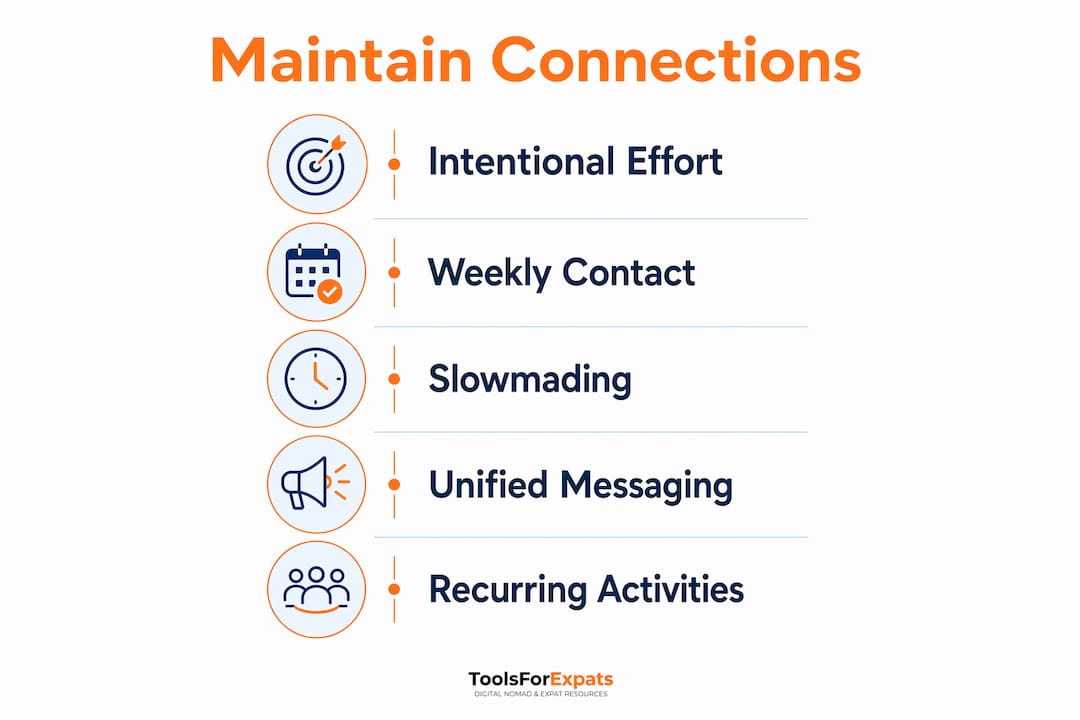
Becoming the organizer is the second most powerful move available to you. Nomads who create recurring events gain a structural advantage for relationship depth. When you host a weekly co-working session, a language exchange, or a Sunday hike, you become the person people associate with community. Repeated contact through organizing builds trust faster than any single social event can.
Practical tactics for deepening local connections:
- Be the initiator. Do not wait for someone else to suggest a second hangout. Send the message first. Most people appreciate it and few do it.
- Integrate with locals, not just other nomads. Local friendships tend to be more stable because locals stay. A friendship with a local in Medellín or Chiang Mai can last years if you return regularly.
- Be vulnerable early. Share something real in the first or second conversation. Not oversharing, but genuine. This signals that you are interested in depth, not just pleasant small talk.
- Attend the same events repeatedly. One visit to a meetup makes you a stranger. Three visits make you a regular. Regularity is the foundation of trust.
Pro Tip: If you are in a new city for more than a month, commit to one recurring weekly activity. A language class, a sports league, a community dinner. Consistency creates the repeated contact that friendship needs.
Understanding how nomad communities form can also help you find the right social structures to plug into quickly when you arrive somewhere new.
What strategies work for romantic relationships across distance?
60% of long-distance relationships succeed when couples use intentional communication strategies that prioritize self-disclosure and shared virtual activities. That statistic matters because it reframes the question. Long-distance is not a relationship death sentence. It is a different operating mode that requires different skills.
The most effective approach for navigating long-distance relationships as a nomad involves four concrete steps:
- Plan visits in advance. Having a confirmed reunion date on the calendar reduces anxiety and gives both partners something to look forward to. Uncertainty about when you will see each other next creates more stress than the distance itself.
- Move conflicts off text. Text strips tone and context from disagreements. When tension rises, switch to a voice call or video call immediately. Resolving conflict in writing almost always makes it worse.
- Create shared virtual rituals. Watch the same show simultaneously, cook the same recipe on a video call, or play an online game together. Shared experiences build connection even across thousands of miles.
- Have honest conversations about the timeline. Both partners need clarity on how long the distance phase will last and what the end goal looks like. Ambiguity about the future is one of the most corrosive forces in long-distance relationships.
The most fragile period for nomadic couples is not the distance itself. It is the first three months after reunification. One-third of couples break up during this adjustment phase, when two people who have been living independently must reintegrate their daily lives. Planning for this transition deliberately, and accepting that friction is normal, dramatically improves the odds of getting through it intact.
If the relationship involves immigration or legal complexity, resources like immigration and divorce guidance can help you understand your options before a crisis forces the conversation.
What tools best support staying connected while traveling?
Technology does not replace intentional effort, but the right tools reduce friction enough to make consistency realistic. The goal is to choose tools that fit your habits rather than tools that require new habits to maintain.
| Tool type | Best use case | Key advantage |
|---|---|---|
| Unified messaging (e.g., Beeper) | Managing contacts across platforms | One inbox, less app-switching |
| Voice notes (WhatsApp, Telegram) | Asynchronous emotional check-ins | Warm tone, no scheduling required |
| Video calls (FaceTime, Google Meet) | Deep conversations and conflict resolution | Real-time tone and facial expression |
| Calendar reminders | Birthdays, anniversaries, scheduled calls | Prevents important dates from slipping |
| Shared photo albums | Passive life updates with close contacts | Low effort, high intimacy signal |
A few principles for choosing your communication stack:
- Minimize the number of platforms. Every additional app is another place to miss a message. Consolidate where possible.
- Match the tool to the relationship. Voice notes work well for close friends. A shared photo album works well for family. Video calls work best for romantic partners and deep friendships.
- Protect your communication time. Frequent travelers who plan for multiple trips know that logistics can consume every spare hour. Guard your relationship time the same way you guard your work time.
Nomad networking strategies can also help you identify which digital tools your specific community uses most, so you are not fighting the current.
Key Takeaways
Maintaining meaningful relationships while nomadic requires deliberate habits, curated connections, and tools that reduce friction rather than add it.
| Point | Details |
|---|---|
| Quality beats quantity | Self-disclosure and depth of conversation predict relationship satisfaction more than contact frequency. |
| Curate your inner circle | Focus on 3–5 deeply invested relationships globally rather than maintaining a wide, shallow network. |
| Dedicate 3 hours weekly | Consistent, focused one-on-one contact is the baseline for sustaining long-distance friendships. |
| Slow down to go deep | Staying 2–3 months in one place creates the repeated interactions that trust and friendship require. |
| Plan for the reunion phase | One-third of nomadic couples struggle most in the first 3 months after reunification. Prepare for it. |
The paradox nobody talks about enough
The strangest thing about nomadic life is that you can be surrounded by people and still feel profoundly alone. I have been in co-working spaces packed with interesting, well-traveled people and felt more isolated than I ever did in a quiet apartment back home. That experience taught me something that took longer than it should have to learn: connection is not a byproduct of proximity. It is a result of choice.
The nomads I have seen thrive socially are not the ones with the biggest networks or the most Instagram followers. They are the ones who slow down, pick a handful of people they genuinely care about, and invest in those relationships with the same seriousness they bring to their work. They are also the ones willing to be a little vulnerable a little sooner than feels comfortable. That discomfort is the price of real friendship.
The practical advice in this article works. But the mindset shift underneath it matters more. Stop trying to maintain 50 relationships and start trying to deepen five. Stop waiting for connection to happen organically and start creating the conditions for it deliberately. The road does not have to be lonely. It just requires you to be intentional about who you bring along for it.
— Jay
Free tools to support your nomadic lifestyle
Planning your next move well is one of the best things you can do for your relationships. When logistics are under control, you have more mental energy for the people who matter.
ToolsForExpats offers a full suite of free expat tools built specifically for digital nomads and expats. Use the cost of living comparison tool to find cities that fit your budget without the hours of research. Check visa eligibility across 20+ countries with the digital nomad visa checker before you book flights. Every tool is free, requires no account, and is designed to reduce the logistical stress that eats into your time and attention. Less stress means more room for the relationships that make nomadic life genuinely worth living.
FAQ
How many hours per week should nomads spend on relationships?
Research recommends 3 hours per week of direct, private communication with close friends as a baseline for sustaining meaningful long-distance connections.
Do long-distance romantic relationships actually work?
60% of long-distance couples succeed when they use intentional communication strategies, including self-disclosure and shared virtual activities, rather than relying on contact frequency alone.
Why do nomad friendships often stay surface-level?
Both parties often avoid vulnerability when they know a connection is temporary, creating a protective dynamic that keeps relationships shallow even when both people would prefer depth.
What is the hardest phase for nomadic couples?
The first 3 months after reunification are the most fragile. One-third of couples break up during this adjustment phase as they reintegrate independent lives into a shared routine.
How long do you need to stay somewhere to build real friendships?
Staying 2–3 months in one location gives you the repeated low-stakes interactions that trust requires. Close friendships typically need more than 200 hours of shared time to develop fully.