
For digital nomads, "currency arbitrage" usually means capturing exchange and cost gaps between where you earn and where you live. It's not the same as high-frequency FX trading, and you don't need a Bloomberg terminal to benefit. The most practical version is straightforward: earn in a strong currency like USD, spend in a lower-cost economy, and plug the fee leaks that quietly drain 3–7% on card purchases (if you accept DCC) and 8–15% on airport kiosk exchanges.
The bottom line is this: open a no-FX-fee card and a multi-currency account, always pay in local currency at any terminal (never accept dynamic currency conversion), and run one small test transfer to measure your real savings. That single habit change can save a significant amount each year before you touch anything else.
Your main levers at a glance:
- Income currency: Invoice in USD or EUR whenever your client relationship allows it
- Payment routing: Use a low-cost transfer service instead of your home bank for international moves
- Card choice: Pick a card with no foreign transaction fee and no ATM surcharge
- Transfer timing: Avoid weekend conversions when some services add surcharges
How currency arbitrage actually works for nomads
The term "currency arbitrage" has two very different meanings depending on who's using it. Understanding the distinction saves you from chasing a strategy that doesn't fit your situation.
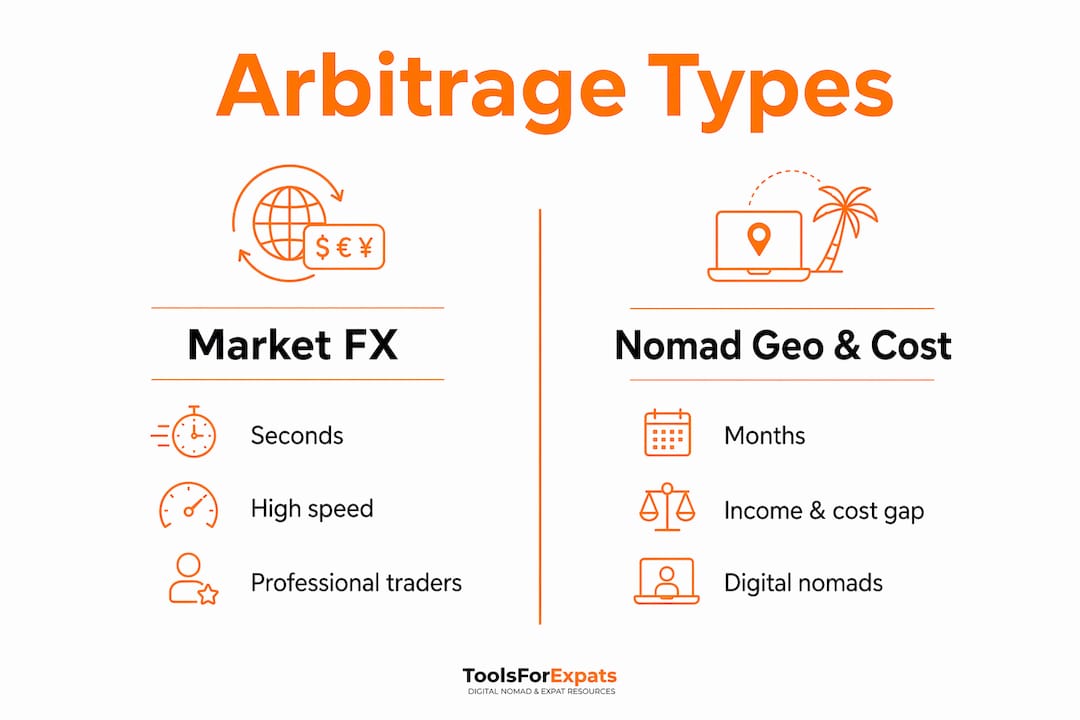
Market FX arbitrage is what professional traders do: buy a currency pair on one exchange where it's priced slightly lower, and simultaneously sell it on another where it's priced higher. The profit window is tiny, typically 0.1%–0.5% per trade, and it closes in milliseconds. It requires low-latency infrastructure, significant capital, and institutional-grade execution. For most nomads, this is not the play.
Geo-arbitrage and cost-arbitrage are the real nomad strategies. You earn income in a strong currency (USD, EUR, GBP) and spend it in a country where the cost of living is a fraction of what it is back home. The gap between your income and your local expenses is your arbitrage. Geographic arbitrage can push savings rates to a substantial portion of income for nomads moving from high-cost U.S. cities to places like Chiang Mai or Lisbon.
Core differences at a glance:
| Dimension | Market FX arbitrage | Nomad geo-arbitrage |
|---|---|---|
| Time horizon | Milliseconds to seconds | Months to years |
| Skills required | Quantitative, technical | Planning, research |
| Capital needed | Large (institutional) | Modest (living costs) |
| Complexity | Very high | Moderate |
| Relevant to nomads? | Rarely | Yes, primary strategy |
There's a middle ground worth knowing: payment-flow arbitrage, which is what you do when you choose Wise over your bank, decline DCC at a terminal, or book a flight through a foreign point-of-sale. This is legal, practical, and available to any nomad today.
Two worked examples that show the real math
FX-trading arbitrage (why it's harder than it looks)
Say EUR/USD trades at 1.0850 on one exchange and 1.0855 on another. You buy €10,000 at 1.0850 and sell at 1.0855, pocketing a $5 gross profit. Sounds easy. But by the time you account for two bid-ask spreads, transfer fees, and execution latency, that $5 is gone, and you may be slightly negative. Professional traders running this at scale with co-located servers can make it work. A nomad with a Wise account cannot.
Nomad geo-arbitrage (where the real money is)
You're a U.S.-based consultant billing $7,000/month in USD. You relocate to Lisbon, where a comfortable one-bedroom apartment, groceries, transport, and dining out costs significantly less than in San Francisco. Your effective savings rate increases substantially without raising your rates by a single dollar.
Now layer in payment-flow savings. Instead of wiring money through your U.S. bank (which might charge a notable FX spread plus fixed wire fees), you use a Wise-style transfer with lower percentage fees. On typical monthly transfers, this can translate into meaningful savings per year just from switching providers.
Pro Tip: The biggest friction in FX arbitrage isn't finding the spread — it's execution. Spreads widen, accounts get flagged, and timing is everything. For nomads, the geo-arbitrage gap between your income and your living costs is far larger and far more reliable than any FX spread you'll find.
Practical strategies nomads use to capture the gap
These are the tactics that move the needle. You can implement most of them this week.
Earning-side tactics
- Invoice in USD or EUR. If your client is in the U.S. or EU, bill in their currency. You capture the strong-currency income and convert on your own schedule.
- Negotiate billing currency explicitly. Some clients default to their local currency. Ask to invoice in USD — most will agree without pushback.
- Stagger billing around favorable rate windows. If you track rates with XE or OANDA, you can time large invoices to convert when your target currency is stronger.
Payment-routing tactics
- Open a multi-currency account (Wise is the most widely used for U.S. nomads) to hold USD, EUR, and local currency simultaneously.
- Use a low-cost transfer service for any move over $500. The savings over bank wires compound quickly.
- Split payouts: keep operating expenses in local currency, keep savings in USD, and convert only what you need each month.
- Check how international money transfers work before choosing a provider — fee structures vary more than most people realize.
Spending-side tactics
- Use a no-FX-fee credit card (Charles Schwab's debit card and cards from Capital One or Fidelity are popular among U.S. nomads) for all local purchases.
- Always pay in local currency at any terminal. Decline any offer to pay in USD — that's DCC, and it costs you 3–7% extra.
- Withdraw cash from ATMs strategically: larger, less frequent withdrawals reduce the impact of fixed ATM fees.
- Where local payment apps or QR-code rails are cheaper (common in Southeast Asia), use them for daily spending.
Which tools and accounts nomads actually use
The right combination of accounts and cards does most of the heavy lifting. Here's what the nomad community has settled on for U.S.-origin travelers.

Wise is the go-to for international transfers and multi-currency accounts. It converts at near mid-market rates and charges roughly 0.3–0.7% depending on the currency pair and day of the week. You can hold USD, EUR, GBP, and dozens of other currencies in one account, receive payments like a local in multiple countries, and send money abroad without the $25–$45 wire fees most U.S. banks charge.
PayPal works for receiving client payments, especially from U.S.-based clients who prefer it. The catch: PayPal's conversion rates carry a markup of around 3–4% when you convert between currencies inside the platform. Use it to receive, then withdraw to a Wise account or your bank before converting.
XE and OANDA are rate-monitoring tools, not transfer services. Use XE to check the mid-market rate before any conversion so you know exactly what markup you're paying. OANDA's historical rate data is useful for tax reporting when you need to document the exchange rate on a specific date.
No-FX-fee credit cards handle daily spending. The Charles Schwab Investor Checking account is a standby for U.S. nomads because it reimburses all ATM fees worldwide and charges no foreign transaction fee.
Pro Tip: Some app-based services (including certain Wise plans and Revolut tiers) add a weekend surcharge of 0.5–1% on FX conversions because interbank markets are closed. Schedule large transfers for weekday business hours to avoid this.
| Method | Typical FX cost | ATM access | Best for |
|---|---|---|---|
| Wise transfer | 0.3–0.7% | Via linked card | Large transfers, multi-currency holding |
| No-FX-fee debit card | 0% (card rate) | Fee reimbursed | Daily spending, ATM withdrawals |
| PayPal (internal FX) | ~3–4% markup | N/A | Receiving client payments only |
| U.S. bank wire | 2–3% spread + $25–$45 fee | N/A | Avoid for routine transfers |
| Airport kiosk | 8–15% markup | N/A | Emergency cash only |
Fee traps, risks, and U.S. tax basics
Common fee drains
- DCC (dynamic currency conversion): 3–7% markup when you let a terminal convert to your home currency. Always decline.
- Airport kiosks: 8–15% above mid-market. Use only for small emergency amounts.
- Bank FX spreads: 2–3% on top of the mid-market rate, plus fixed wire fees.
- ATM fixed fees: $3–$5 per withdrawal from foreign ATMs, which makes small withdrawals disproportionately expensive.
- PayPal FX conversion: ~3–4% markup when converting inside the platform.
Operational risks
- Account holds: Large or unusual transfers can trigger fraud flags. Notify your bank before traveling and keep a backup card on a separate network.
- Geo-blocking: Some U.S. financial services restrict access from certain countries. Test your accounts before you leave.
- FX volatility: If you're holding significant amounts in a foreign currency, a 5–10% swing in a week is realistic. Convert only what you need short-term.
- Regulatory changes: Visa rules and tax treaties shift. What works in one country today may change next year.
U.S. tax implications
Currency arbitrage is legal for U.S. citizens. The IRS treats currency gains as ordinary income if you're actively trading FX. For nomads doing geo-arbitrage (not trading), the main reporting obligations are:
- Worldwide income: The U.S. taxes citizens on all income regardless of where it's earned.
- FEIE (Foreign Earned Income Exclusion): U.S. citizens abroad may qualify to exclude a portion of foreign-earned income, but FEIE doesn't eliminate all reporting obligations and doesn't cover passive or investment income.
- State tax residency: Leaving a high-tax state like California or New York requires a formal "clean break" — closing accounts, selling property, filing a final state return, and documenting the change. Physical absence alone is rarely enough.
Pro Tip: Keep a simple spreadsheet logging every transfer date, the amount sent, the exchange rate used, and the fee paid. Screenshots from Wise or your bank app work fine. This takes five minutes per transaction and makes tax season and any audit defense much easier.
This article is general information, not tax or legal advice. Confirm your specific reporting obligations with a qualified tax professional or the IRS directly.
What realistic savings actually look like
Payment-flow arbitrage is not going to make you rich, but it's not trivial either. Here's how the numbers stack up.
Per-transaction savings by method:
- Switching from a bank wire to Wise: save roughly 1.5–2.5% per transfer
- Declining DCC at every terminal: save 3–7% on every card purchase abroad
- Avoiding airport kiosks: save 8–15% on cash exchanges
- Using a no-FX-fee card vs. a standard card with a 3% foreign transaction fee: save 3% on every purchase
Annualized example:
A nomad spending $2,500/month locally and transferring $2,000/month via Wise instead of a bank wire saves roughly $40–$50/month on transfers alone. Add $75/month from avoiding DCC on a $2,500 spending budget (at a conservative 3% DCC rate). Total: roughly $115/month, or $1,380/year, from two habit changes.
Decision rule: If your routine monthly outflows exceed $1,000 in foreign-currency spending, the setup cost of a Wise account and a no-FX-fee card pays for itself within the first month. If you're moving less than $500/month, the savings are real but smaller — still worth doing, just lower priority.
The geo-arbitrage multiplier is where the real leverage lives. Saving 50–80% of income by relocating from a high-cost U.S. city to a lower-cost country dwarfs any payment-flow optimization. Payment tactics are the finishing layer, not the foundation.
Your step-by-step checklist to test this safely
- Set your baseline. For 30 days, track every FX-related cost: bank wire fees, card foreign transaction fees, ATM fees, and any DCC charges. Screenshot your statements.
- Open a Wise account. Verify your identity, connect your U.S. bank, and fund it with a small amount ($100–$200 to start).
- Get a no-FX-fee card. Apply for a Charles Schwab debit card or a Capital One card with no foreign transaction fee if you don't already have one.
- Run a small test transfer. Send $100–$200 via Wise to a local account or your own foreign account. Note the rate, the fee, and the time to arrive.
- Make one local purchase with your no-FX-fee card. When the terminal asks which currency, choose local currency. Record the effective rate.
- Compare your effective rate to the mid-market rate on XE. The gap is your real cost. Repeat with your old method to see the difference.
- Log everything. Date, amount, rate, fee, method. A simple Google Sheet works fine.
- Model your annualized savings using the nomad cost calculator at ToolsForExpats to see what the monthly difference compounds to over a year.
- Keep emergency backup funds in your U.S. account. Never move 100% of your liquidity abroad. A backup card on a different network (Visa vs. Mastercard) is also worth having.
- Review and scale. After 60 days, decide whether to increase transfer volume, add a second currency account, or explore seasonal geo-arbitrage in a lower-cost city.
Research-backed warnings every nomad should know
The DCC trap is the most expensive mistake you'll make repeatedly
Always declining DCC and choosing to pay in local currency is the single highest-ROI habit in this entire article. The 3–7% markup applies to every transaction where you accept it, and terminals are designed to make the "pay in your home currency" option look like the safe, convenient choice. It isn't. Your card issuer's rate is almost always better than the merchant's conversion rate.
Treat income geography and living geography as separate decisions
The most strategic insight in geo-arbitrage is this: optimize income for currency strength and client quality; optimize living geography for total cost, visa stability, and tax regime. These are independent variables. You don't have to live where your clients are, and you don't have to earn in the currency of the country you live in. A U.S. consultant billing in USD from Medellín is running a different optimization than one billing in Colombian pesos.
Airline point-of-sale arbitrage can yield real savings on premium fares
Airlines file fares by market. Switching the country dropdown on a carrier's website to a different point-of-sale can reveal 15–30% lower pricing on some premium cabin fares. This works most reliably on routes where the carrier prices aggressively in a specific market. The catch: you need to verify that your payment card is accepted, that the fare rules match what you need, and that customer support is reachable in a language you speak.
Pro Tip: Before booking through a foreign airline POS, convert the fare to USD at the interbank rate (use XE), confirm the fare rules are identical, and check that your card will process without a foreign transaction fee. If all three check out, the savings are real. If any one fails, the friction usually isn't worth it.
You can use the cost comparison tool at ToolsForExpats to model how much a destination change affects your monthly budget, which helps you decide whether a lower-cost city justifies the move before you book anything.
Seasonal geo-arbitrage is also worth considering: splitting time between your home base and a lower-cost location captures many of the cost benefits without requiring full relocation, and it reduces some visa and tax complications. For nomads not ready to commit to a single base, this is a practical middle path.
Key Takeaways
For digital nomads, the highest-leverage currency arbitrage move is geo-arbitrage: earning in USD while living in a lower-cost country, combined with no-FX-fee cards and low-cost transfers to eliminate the 3–15% fee drag on every transaction.
| Point | Details |
|---|---|
| DCC is the costliest habit | Declining DCC saves 3–7% on every foreign card transaction — always pay in local currency to avoid this markup. |
| Wise beats bank wires | Wise-style transfers cost 0.3–0.7% vs. 2–3% plus fixed fees at most U.S. banks. |
| Geo-arbitrage is the big lever | Earning in USD while living in a low-cost country can push savings rates to 50–80% of income. |
| Tax compliance is non-negotiable | U.S. citizens owe tax on worldwide income; FEIE helps but doesn't remove all obligations — document everything. |
| ToolsForExpats models the math | Use the nomad cost calculator to estimate annualized savings before committing to any move or account change. |
Why the conventional wisdom on currency arbitrage undersells the real opportunity
Most articles about currency arbitrage for nomads focus on the payment-flow tactics: get a Wise account, avoid DCC, skip the airport kiosk. That's all correct, and it's worth doing. But it misses the bigger picture.
The real opportunity isn't in shaving 0.5% off a transfer fee. It's in recognizing that your income geography and your living geography are genuinely independent decisions, and that most people never question the assumption that they have to be the same place. A U.S. freelancer earning $80,000/year in San Francisco and spending $65,000 to live there has almost no margin. The same person earning $80,000 while living in a city where $24,000 covers a comfortable life has a completely different financial trajectory — not because they got a raise, but because they changed the denominator.
Payment-flow optimization is the finishing layer. It's worth doing, and the $1,000–$1,500/year in savings from better cards and transfer services is real money. But the geo-arbitrage gap, when you actually run the numbers, is often 10–20 times larger. The nomads who treat currency arbitrage as a payment hack are leaving the main prize on the table.
The checklist in this article is designed to get you started with low-risk, reversible steps. Test the payment tactics first because they cost nothing to implement. Then use the cost calculators to model what a destination change would actually mean for your annual savings. The math usually makes the decision obvious.
ToolsForExpats gives you free calculators to model your savings before you move
Knowing the tactics is one thing. Seeing your actual numbers is what makes the decision concrete. ToolsForExpats offers a free suite of calculators built specifically for nomads and expats — no account required, no paywalls.
The nomad cost calculator lets you enter your income, your current city, and a target destination, then shows you the monthly and annualized cost difference. The cost comparison tool puts two cities side by side so you can see exactly where the savings come from — rent, food, transport, and more. If you're planning a move, the moving abroad budget calculator helps you estimate one-time setup costs against projected annual savings, so you know how quickly the arbitrage pays off. Run your numbers at ToolsForExpats and see what your geo-arbitrage gap actually looks like.
Useful sources and further reading
These are the primary sources used in this article, each worth bookmarking for deeper research:
- How to Get the Best Exchange Rates When Traveling Abroad — Utilia: Covers DCC mechanics, airport kiosk markups, ATM fee structures, and Wise fee ranges. The most practical single reference for payment-flow tactics.
- Geographic Arbitrage 2026: Earning in USD While Living — EarnifyHub: Detailed breakdown of geo-arbitrage strategy, FEIE basics, state tax residency requirements, and savings-rate examples for nomads.
- Foreign Airline Website Booking: Currency Arbitrage — Aviafares: Explains airline POS pricing mechanics and how to check whether a foreign fare is genuinely cheaper after conversion.
- Geographic Arbitrage and FIRE — The Good Life Journey: Covers seasonal geo-arbitrage as a lower-commitment alternative to full relocation, with FIRE planning context.
- Understanding Arbitrage: How Traders Profit — Bookmap: Explains pure FX arbitrage mechanics and why the profit window (0.1–0.5% per trade) is inaccessible to retail participants.
- How International Money Transfer Works — Ping Money: Clear explanation of transfer mechanics, fee structures, and what to look for when comparing providers.
- ToolsForExpats — Free Expat Calculators and Nomad Tools: Free cost-of-living calculators, city comparison tools, visa checker, and nomad budget planner — the practical next step after reading this article.