
Yes, U.S. citizens can move to Spain, and the path is clearer than most people expect. Spain does not offer automatic residency to non-EU nationals, so you will need a visa, but four realistic routes exist for most Americans: the Non-Lucrative Visa (NLV) for retirees and those with passive income, the Digital Nomad Visa (DNV) for remote workers, a sponsored Work Permit for those with a Spanish employer, and the Student Visa for those enrolled in a recognized program. Your first week of planning should focus on three things:
- Choose your visa route based on income source and work intentions. The NLV is the most common starting point for retirees and those with investment income; the DNV suits remote workers earning from non-Spanish clients. Consulate processing typically runs 1–3 months, so apply before you book flights.
- Confirm private health insurance that meets Spanish consular standards. Every long-stay visa requires it, and policies must be from a provider authorized to operate in Spain with no copayments and no coverage gaps.
- Start gathering apostilled documents immediately. U.S. background checks, birth certificates, and financial statements all need state-level apostilles, and the process can take 4–8 weeks depending on your state.
The two official bodies you will deal with most are the Ministerio de Asuntos Exteriores (Spain's Foreign Ministry, which handles visa applications through Spanish consulates in the U.S.) and the Agencia Tributaria (AEAT), Spain's tax authority, which governs your tax obligations once you arrive. Use ToolsForExpats calculators to run your budget and check visa eligibility before you commit to anything.
Pro Tip: Hire a gestor (a licensed Spanish administrative professional) for your first filings. The fee is modest, and a good gestor can cut weeks off your NIE and residency permit timeline by catching document errors before your appointment.
Which visa route is right for you?
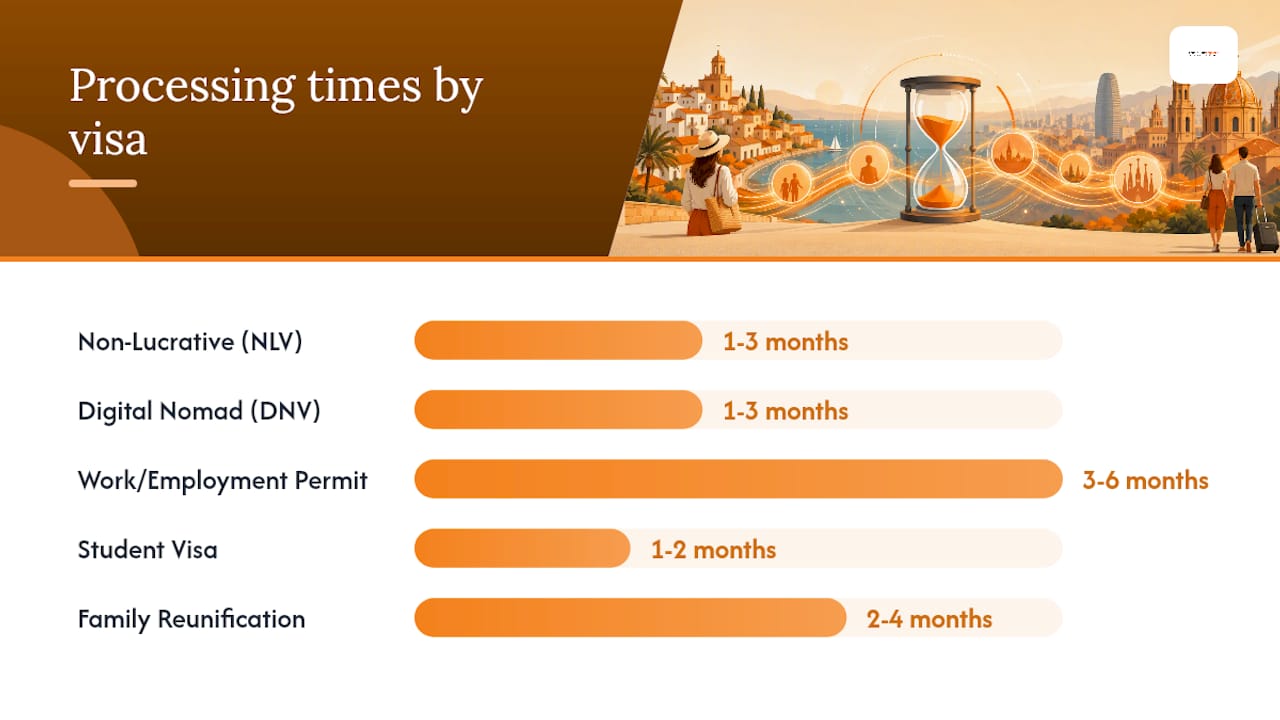
Choosing the wrong visa is the most expensive mistake U.S. expats make, because it can mean reapplying from scratch. The table below summarizes the five main routes, including a note on the Golden Visa, which changed significantly in 2024.
| Visa Type | Best For | Key Financial Threshold | Right to Work | Typical Processing |
|---|---|---|---|---|
| Non-Lucrative Visa (NLV) | Retirees, passive-income earners | approximately €2,400/month for a single applicant (verify current threshold with consulate) | No (passive income only) | 1–3 months |
| Digital Nomad Visa (DNV) | Remote workers, freelancers | ~€2,646/month for remote workers (verify current threshold) | Yes, for non-Spanish clients | 1–3 months |
| Work/Employment Permit | Employer-sponsored workers | Employer must demonstrate need | Yes, with sponsoring employer | 3–6 months |
| Student Visa | Enrolled students | Proof of enrollment + sufficient funds | Limited (part-time only) | 1–2 months |
| Family Reunification | Spouses/dependents of Spanish residents | Sponsor must meet income threshold | Varies by permit | 2–4 months |
Golden Visa note: Spain's government announced the end of the real-estate-based Golden Visa (€500,000 property investment route) in 2024. Other investment categories may still apply, but check the Ministerio de Asuntos Exteriores for current status before planning around this route.
The Beckham Regime (formally the impatriate tax regime) is not a visa, but it is worth knowing about at the planning stage. If you arrive in Spain under a work or DNV arrangement and have not been a Spanish tax resident in the previous five years, you may qualify to pay a flat 24% income tax rate on Spanish-source income for up to six years, rather than the progressive rates that reach 47%. A gestor or tax advisor can assess eligibility before you file your first Spanish return.
Documents required for the most common visa routes
Non-Lucrative Visa:
- Valid U.S. passport (minimum 1 year validity beyond intended stay)
- Completed national visa application form
- Recent passport photos
- Proof of sufficient financial means (bank statements, pension letters, investment account statements, apostilled)
- Private health insurance policy from a Spain-authorized provider, with no copayments and no coverage limits
- U.S. federal background check with apostille
- Medical certificate from a licensed physician
Digital Nomad Visa:
- All of the above, plus proof of remote employment or freelance contracts
- Evidence that at least 80% of income comes from non-Spanish clients or employers
- Company registration documents if self-employed
Work Permit:
- Employer-initiated application in Spain (the employer files first)
- Job offer letter and contract
- Proof of qualifications (diplomas, apostilled)
- Background check with apostille
You apply for all long-stay visas at the Spanish consulate with jurisdiction over your U.S. state of residence. Consulates vary in their specific document requirements and appointment availability, so check your consulate's page directly. The visa eligibility checker at ToolsForExpats lets you test which route matches your income and work profile before you contact a consulate.
What to do after you arrive: NIE, TIE, and empadronamiento
The short answer: get your empadronamiento first (it is the fastest and unlocks almost everything else), then your NIE, then your TIE if you are staying longer than 90 days as a resident.
- NIE (Número de Identificación de Extranjero): Your foreign ID number, required for almost every official transaction in Spain, from opening a bank account to signing a lease. You can apply at a Spanish consulate in the U.S. before you leave, or at a Policía Nacional office in Spain. Official NIE guidance from the Ministerio de Asuntos Exteriores outlines the required documents.
- TIE (Tarjeta de Identidad de Extranjero): Your physical residency card, issued after your visa is approved and you are in Spain. Apply within 30 days of arrival at the Oficina de Extranjería or Policía Nacional. This is what proves your legal residency status.
- Empadronamiento: Registration at your local town hall (ayuntamiento). You register at the address where you live, and the certificate you receive is required for school enrollment, healthcare registration, and many other services. It is usually the fastest step, often completed the same day.
- NIF (Número de Identificación Fiscal): Your tax ID number. For non-Spaniards, the NIE and NIF are typically the same number. AEAT uses it for all tax filings.
What paperwork do you need before you apply?
The documents that trip up U.S. applicants most often are the ones that require extra steps: apostilles, sworn translations, and background checks. Start these at least 8–10 weeks before your intended consulate appointment.
Documents that typically require an apostille:
- U.S. federal or state criminal background check
- Birth certificate (if required for family reunification or student visa)
- Marriage certificate (if applicable)
- Academic diplomas or transcripts (for work permits requiring qualifications)
- Financial statements (some consulates require notarized and apostilled bank letters)
How to get a U.S. apostille:
- Obtain the original document (or certified copy) from the issuing authority. For a federal background check, request it from the FBI.
- Submit the document to the Secretary of State's office in the state where it was issued (for state documents) or to the U.S. Department of State Office of Authentications (for federal documents like the FBI background check).
- Allow 4–8 weeks for state apostilles; federal apostilles through the State Department can take 6–10 weeks unless you use an expediting service.
Sworn translations: Any document not in Spanish must be translated by a sworn translator recognized by the Spanish Ministry of Foreign Affairs. This is not the same as a notarized translation. Sworn translators are certified by the Spanish government, and their translations carry an official stamp. Budget 1–2 weeks for translation after you receive the apostilled originals.
Medical certificate: Required for the NLV and some other visas. It must be issued by a licensed physician and confirm you have no contagious diseases listed in the 2005 International Health Regulations. Some consulates require this on a specific form; check your consulate's page.
Notarization vs. apostille vs. sworn translation: Notarization confirms a signature is genuine. An apostille certifies the notary's or official's authority, making the document valid in Hague Convention countries (Spain is a member). A sworn translation converts the content into Spanish with legal standing. You often need all three steps in sequence for a single document.
Pro Tip: Order two certified copies of every document that needs an apostille. Consulates occasionally lose originals, and having a backup set saves weeks of reordering.
How much does it really cost to live in Spain?
Spain is significantly cheaper than most major U.S. cities, but costs vary sharply by location. A single person can live comfortably in cities like Valencia or Málaga on a modest budget; living in central Madrid or Barcelona is generally more expensive. These figures assume renting a one-bedroom apartment, cooking most meals at home, and using public transit.

City-level rent and monthly cost comparison
| City | Avg. 1BR Rent (City Center) | Avg. 1BR Rent (Outside Center) | Est. Monthly Total (Single) |
|---|---|---|---|
| Madrid has higher rental and living costs compared to other cities | |||
| Barcelona has higher rental and living costs compared to other cities | |||
| Valencia offers lower rental and living costs relative to larger cities | |||
| Málaga offers affordable rental and living costs | |||
| Tenerife (Santa Cruz) with generally lower rental and living costs |
Rent figures are approximate market ranges based on INE population and housing data and general market reporting. Exchange rate assumed at €1 = $1.08 (verify current rate before budgeting).
Sample monthly budgets
Single digital nomad (Valencia):
- Rent (1BR, outside center): €700
- Utilities + internet: €120
- Groceries: €250
- Eating out (2–3x/week): €150
- Transport (bus/metro pass): €40
- Private health insurance: €80–€150
- Miscellaneous: €150
- Total: approx. €1,490–€1,560/month
Family of four (Madrid):
- Rent (2BR, outside center): €1,400
- Utilities + internet: €180
- Groceries: €600
- School fees (semi-private): €300–€600
- Transport: €120
- Health insurance (family): €250–€400
- Miscellaneous: €300
- Total: approx. €3,150–€3,600/month
Retiree couple (Málaga):
- Rent (1BR, outside center): €800
- Utilities + internet: €130
- Groceries: €400
- Dining out: €200
- Transport: €60
- Health insurance (couple): €200–€350
- Miscellaneous: €200
- Total: approx. €1,990–€2,140/month
Where you can reduce costs most: choosing a smaller city or a neighborhood outside the historic center, cooking at home, and using Spain's excellent public transit instead of owning a car. Use the cost of living comparison tool at ToolsForExpats to test your own assumptions across cities, and the moving abroad budget calculator to build a full relocation budget including one-time setup costs.
Taxes, banking, and moving money as a U.S. expat
When you become a Spanish tax resident: Spain's Agencia Tributaria applies the 183-day rule as the primary test. Spend more than 183 days in Spain in a calendar year, and you are a Spanish tax resident for that year, regardless of where you are registered. A secondary test applies if your main economic interests or family are based in Spain, even if you spend fewer days there.
Once you are a Spanish tax resident, you pay Spanish income tax on your worldwide income, file an annual declaración de la renta (typically April–June for the prior year), and may need to file the Modelo 720, which declares foreign assets above €50,000 held outside Spain.
Key filing obligations and deadlines:
- Declaración de la renta: Filed April 1–June 30 for the prior tax year. First-time filers should use a gestor.
- Modelo 720 (foreign asset declaration): Filed March 31 for assets held the prior December 31. Applies if foreign accounts, property, or securities exceed €50,000 per category.
- Quarterly IVA (VAT) returns: Required if you are registered as autónomo and subject to VAT. The AEAT VAT regimes page outlines which activities are exempt and which fall under standard or reduced rates.
- U.S. filing obligations: Moving to Spain does not end your U.S. tax obligations. The IRS requires U.S. citizens to file a federal return every year regardless of where they live. You must also file an FBAR (FinCEN Form 114) if your foreign financial accounts exceed $10,000 at any point during the year, and Form 8938 if foreign assets exceed the applicable threshold. The U.S.-Spain tax treaty helps prevent double taxation on most income types, but it does not eliminate filing requirements.
Pro Tip: File your U.S. return and your Spanish return in the right order. Most expats file the Spanish return first (it is due earlier), then apply the Foreign Tax Credit on the U.S. return to offset taxes already paid. A tax advisor familiar with both systems is worth the fee in year one.
For more detail on cross-border filing, see the ToolsForExpats guide to filing taxes while working remotely abroad.
Opening a Spanish bank account
You can open a non-resident account at most Spanish banks with just your passport and NIE. Once you have your TIE, switching to a resident account gives you access to mortgages, direct debits for utilities, and better terms. Major banks with English-language services include Banco Sabadell and CaixaBank, both of which have dedicated expat or international customer services. Online banks like Wise and Revolut are not Spanish banks, but many expats use them for day-to-day spending and international transfers while waiting for a local account.
For moving money from the U.S. to Spain, specialist transfer services typically offer better exchange rates and lower fees than traditional wire transfers through U.S. banks. Always confirm the mid-market rate before initiating a large transfer, and avoid converting large sums all at once if the rate is unfavorable.
How healthcare works for expats in Spain
Private health insurance is mandatory for most long-stay visas, including the NLV and DNV. The policy must be from a provider authorized to operate in Spain, cover the full duration of your visa, have no copayments, and carry no coverage limits. This is a hard consular requirement, not a suggestion.
Three tiers of healthcare access for expats:
- Mandatory visa insurance: Required before your visa is approved. Covers the initial period in Spain and satisfies consular requirements. Providers like Sanitas, Adeslas, and Asisa are commonly accepted; verify acceptance with your consulate before purchasing.
- Private supplemental insurance: Many expats keep private insurance even after gaining access to the public system, because private providers offer shorter wait times, English-speaking doctors, and broader specialist access. Research comparing public and private healthcare systems internationally, including NCBI analysis of health system structures, consistently shows that private supplemental coverage improves access to specialists and reduces wait times in mixed public-private systems.
- Public healthcare (SNS, Sistema Nacional de Salud): Access to Spain's public system follows registration and, typically, social security contributions. If you are employed or registered as autónomo and paying into social security, you and your dependents are entitled to SNS coverage. Retirees from EU countries can access it via the S1 form; U.S. retirees on the NLV generally cannot access the public system and must maintain private insurance throughout.
Practical tips:
- Families with children should confirm pediatric coverage in their private policy before purchasing.
- Those with chronic conditions should check that their specific medications are covered and available in Spain; some U.S. brand-name drugs are sold under different names or require a Spanish prescription.
- Retirees on the NLV should budget for private insurance for the full duration of their stay, as public system access is not guaranteed without social security contributions.
Renting vs. buying: how to find housing in Spain
For new arrivals, renting is the right starting point. Buying a property as a non-resident is legally possible, but it requires a Spanish bank account, an NIE, and ideally some local credit history. Most expats rent for at least the first year, which also gives you time to learn which neighborhoods actually suit your lifestyle.
Renter checklist:
- Documents you will need: NIE, passport, proof of income (pay stubs, bank statements, or pension letters), and sometimes a Spanish guarantor or a deposit equivalent to 2–3 months' rent.
- Standard contract terms: Spanish rental law (Ley de Arrendamientos Urbanos) sets a minimum lease term of 5 years for residential rentals (7 years if the landlord is a company). Short-term contracts exist but are regulated differently.
- Deposit norms: One month's deposit is the legal standard for unfurnished rentals; two months is common for furnished. Some landlords request additional guarantees.
- Acta de inventario: Always request a written inventory of the apartment's contents and condition at move-in. This protects your deposit when you leave.
- Utilities: Electricity, water, and gas are typically registered in the tenant's name. Bring your NIE and bank account details to the utility company or use an online transfer service.
Red flags to watch for:
- Landlords who refuse to provide a formal written contract
- Rent prices significantly below the neighborhood average (often signals an unregistered or illegal rental)
- Cash-only payment requests with no receipts
- Pressure to sign immediately without time to read the contract
Pro Tip: Visit the apartment in person before signing anything, and walk the neighborhood at different times of day. Spanish rental listings often use wide-angle photos that make small spaces look larger, and noise levels vary dramatically by street.
For buyers: Purchasing property in Spain involves a 10% ITP (transfer tax) on resale properties in most regions, plus notary fees, registry fees, and legal costs that typically add another 2–3% to the purchase price. Always hire an independent abogado (lawyer) to review the purchase contract and verify there are no outstanding debts on the property.
Everyday life: language, schools, driving licenses, and cultural expectations
Where you need Spanish: Banking, healthcare appointments, most government offices, and any interaction with local bureaucracy will require at least basic Spanish. English is widely spoken in tourist areas, international schools, and some private businesses, but relying on it for official matters will slow you down considerably.
Practical everyday checklist:
- Schools: Spain offers public schools (free, instruction in Spanish or regional language), semi-private concertados (subsidized, often with religious affiliation), private Spanish schools, and international schools (British, American, German curricula, taught in English or another language). International schools are the most expensive option but offer continuity for children who may move again. Enrollment for public and concertado schools typically opens in March–April for the September school year; contact your local ayuntamiento for the specific process.
- Driving license: The U.S. and Spain have a reciprocal agreement for some states, but it is not universal. Check whether your state's license qualifies for direct exchange. If it does not, you have one year from becoming a resident to drive on your U.S. license, after which you must take the Spanish driving test. The Dirección General de Tráfico (DGT) manages license exchanges and tests.
- Pets: Dogs and cats entering Spain from the U.S. need a microchip, up-to-date rabies vaccination (at least 21 days before travel), and an EU-format health certificate issued by a USDA-accredited veterinarian and endorsed by the USDA APHIS. Spain does not impose quarantine for pets meeting these requirements. Certain breeds classified as potentially dangerous require additional permits.
- Registering children for school: You will need your child's birth certificate (apostilled and translated), vaccination records, empadronamiento certificate, and your own residency documents.
Cultural adaptation: Spain operates on a relationship-oriented model in business and personal life. Decisions take longer, and pushing for faster outcomes often backfires. Expats who invest in learning Spanish and building local relationships consistently report faster integration and fewer bureaucratic headaches. Language apps like Duolingo and Babbel are useful for basics; structured classes through a local language school or platforms like iTalki accelerate conversational fluency faster.
For community-building strategies, the ToolsForExpats guide on expat communities abroad covers how to find your people in a new country.
Your 60-day, 6-month, and 12-month relocation checklist
Moving to Spain is manageable when you break it into phases. Here is a concrete timeline with priorities and rough cost estimates.
60 days before arrival (pre-departure):
- Choose your visa route and book a consulate appointment (allow 4–8 weeks for the appointment itself).
- Order your FBI background check and begin the apostille process (6–10 weeks for federal apostille).
- Purchase compliant private health insurance.
- Gather financial documentation (3–6 months of bank statements, pension letters, or investment account records).
- Arrange sworn translations of all required documents.
- Secure temporary housing for the first 30–60 days (a short-term rental or serviced apartment gives you time to find a long-term place).
Estimated pre-departure costs:
- Visa application fee: approximately €80–€120 (varies by consulate)
- FBI background check: $18 (FBI fee) plus apostille and expediting fees, typically $50–$200 total
- Sworn translations: $50–$150 per document
- Private health insurance (annual): €800–€2,000 depending on age and coverage level
- Flights: varies widely; budget $600–$1,500 per person for a one-way ticket
First 30 days after arrival:
- Register your address (empadronamiento) at your local ayuntamiento.
- Apply for your NIE at the Policía Nacional.
- Apply for your TIE within 30 days.
- Open a Spanish bank account (non-resident account initially).
- Register with a local GP (médico de cabecera) through your private insurer.
Months 2–6:
- Secure long-term housing and sign a formal rental contract.
- Register utilities in your name.
- Enroll children in school (if applicable).
- Register as autónomo if self-employed (AEAT + Social Security).
- Begin tracking days in Spain for tax residency purposes.
- Consult a gestor or tax advisor about your first Spanish tax year.
Months 6–12 (stabilization):
- File your first Spanish tax return if you became tax resident in the prior year.
- File U.S. tax return and FBAR by the extended deadline (June 15 for Americans abroad, with FBAR due April 15 but extendable).
- Begin the driving license exchange or test process if needed.
- Assess whether to renew your visa or apply for long-term residency (after 5 years of legal residency, you can apply for permanent residency or EU long-term resident status).
Statistic callout: According to INE data, Spain's foreign resident population has grown steadily, with hundreds of thousands of non-EU nationals registered across the country, reflecting Spain's sustained appeal as a relocation destination.
What expats consistently underestimate
The single biggest time-saver in your first year is hiring a gestor for administrative filings. A gestor is a licensed professional who handles paperwork with Spanish government agencies on your behalf, and the Cigna expat guide to Spain specifically recommends using one to navigate the complexity of Spanish bureaucracy. The fee for a gestor typically ranges from €50–€300 per task depending on complexity, and that cost almost always pays for itself in avoided errors and resubmissions.
The most common expat missteps:
- Underestimating the TIE timeline: — Many expats assume the TIE arrives quickly. In practice, 4–8 weeks is standard, and some offices in high-demand cities run longer. Plan around this when setting up banking and signing leases.
Pro Tip: When hiring a gestor, ask specifically whether they have experience with non-EU clients and U.S. expats. The U.S.-Spain tax situation has specific complexities (FBAR, FEIE, treaty elections) that not every gestor handles regularly.
Choosing a gestor: Look for gestores affiliated with professional associations like the Consejo General de Gestores Administrativos de España. Many expat Facebook groups and forums for specific cities (Madrid Expats, Barcelona Expats) maintain recommended lists based on community experience.
How ToolsForExpats free tools help you plan your Spain move
Planning a move to Spain involves dozens of variables, and the most useful thing you can do before committing to a city or visa route is run the numbers. ToolsForExpats offers a suite of free calculators and checkers built specifically for this kind of planning, with no account required.
The most relevant tools for a Spain move:
- Moving Abroad Budget Calculator: Build a full relocation budget including one-time setup costs (flights, deposits, visa fees, shipping) and ongoing monthly expenses. Useful for testing whether your savings cover the first 6 months before income starts.
- Cost of Living Comparison Tool: Compare monthly costs across Spanish cities side by side. Plug in your lifestyle assumptions and see how Madrid, Barcelona, Valencia, and Málaga stack up against each other and against your current U.S. city.
- Digital Nomad Cost of Living Calculator: Tailored for remote workers, this tool estimates monthly expenses by city and lets you factor in coworking costs, travel, and variable income.
- Visa Eligibility Checker: Answer a few questions about your income source, employment status, and savings, and the checker identifies which Spanish visa routes you likely qualify for.
How to use them in practice:
Scenario 1 (single digital nomad): Open the Nomad Cost Calculator, select Valencia as your target city, input your monthly income, and compare the result against the DNV income threshold (~€2,646/month). If you clear the threshold with room to spare, you have a realistic budget. If not, the tool shows you which cost categories to adjust.
Scenario 2 (family of four): Use the Moving Abroad Budget Calculator to model the first-year total: visa fees, flights for four, first and last month's rent plus deposit, school enrollment fees, and private health insurance for the family. The output gives you a concrete savings target before you give notice at your current job.
These tools do not replace a gestor or a tax advisor, but they give you a grounded starting point before you spend money on professional consultations.
Key Takeaways
Moving to Spain as a U.S. citizen is achievable in 2026, but success depends on choosing the right visa early, preparing apostilled documents well in advance, and using a gestor for your first administrative filings.
| Point | Details |
|---|---|
| Choose your visa first | NLV suits passive-income earners (typically requiring ~€2,400+/month); DNV suits remote workers earning ~€2,646/month or more from non-Spanish clients. |
| Start documents 8–10 weeks early | FBI background checks, apostilles, and sworn translations each take weeks; missing one delays your consulate appointment. |
| Hire a gestor for first filings | A gestor typically costs €50–€300 per task and prevents the document errors that cause multi-week delays on NIE and TIE applications. |
| Know your tax triggers | Spending more than 183 days in Spain makes you a Spanish tax resident; U.S. filing obligations continue regardless of where you live. |
| Use ToolsForExpats to budget | The free cost comparison tool and moving budget calculator let you test city affordability and set a realistic savings target before you commit. |
The part most guides skip
The paperwork for moving to Spain is genuinely manageable. What catches people off guard is not the complexity of any single step, but the pace at which the system moves and the tolerance for ambiguity it requires.
Most U.S. expats are accustomed to systems that respond quickly, give clear timelines, and escalate when something goes wrong. Spanish bureaucracy works on a different rhythm. Appointments take weeks to book. Documents get rejected for reasons that feel arbitrary. Offices close for lunch. None of this is malicious; it is simply a different operating tempo, and the expats who adapt fastest are the ones who plan for it rather than fight it.
The practical implication is this: build more time into every step than you think you need, hire a gestor for anything that involves a government office in the first six months, and resist the urge to escalate when things move slowly. Relationship-building with your local gestor, your bank contact, and even your landlord pays dividends that no amount of insistence at a government counter will.
The other thing most guides understate is how good life in Spain actually is once the administrative phase is behind you. The cost of living, the food, the climate, the pace of daily life, and the social culture are genuinely different from what most Americans are used to, and for the vast majority of expats, that difference is the whole point.
Plan your Spain move with ToolsForExpats free tools
Knowing which visa to apply for and how much to budget are the two decisions that determine whether your Spain move goes smoothly or stalls at the planning stage. ToolsForExpats gives you free, no-account-required tools to answer both questions before you spend a dollar on professional consultations.
The cost of living comparison tool lets you test Madrid vs. Valencia vs. Málaga side by side with your actual lifestyle assumptions. The moving abroad budget calculator builds a full first-year cost estimate, from visa fees and flights to deposits and health insurance. The visa eligibility checker takes five minutes and tells you which routes match your income profile. None of these tools require you to create an account or share personal information.
Run your numbers at ToolsForExpats and arrive at your consulate appointment knowing exactly what you can afford and which visa you are applying for.
This article provides general information for planning purposes only. Tax rules, visa thresholds, and legal requirements change. Confirm current requirements with the relevant Spanish consulate, the Agencia Tributaria, and a qualified professional before making decisions.
Useful official sources
These are the primary sources used in this article. Bookmark them, because thresholds and procedures change, and the consulate or government page is always more current than any guide.
- exteriores.gob.es
- sede.agenciatributaria.gob.es
- sede.agenciatributaria.gob.es
- ine.es
- irs.gov
- ncbi.nlm.nih.gov
- Expat Guide to Spain: Everything You Need to Know
- statista.com
Check your specific Spanish consulate's website for the most current document checklists, as requirements are updated periodically and vary by consulate jurisdiction. Visa income thresholds are typically adjusted annually; verify current figures directly with the consulate or a licensed immigration attorney before applying.