
Yes, you can form a U.S. LLC or corporation as a nonresident. The first decision is simple but critical: will you actively work inside the U.S., or run the company remotely? That single choice determines your visa requirements, tax obligations, and banking timeline before anything else.
Three things to confirm before you file any form:
- IRS requirements: You will need an EIN (Employer Identification Number) and possibly an ITIN (Individual Taxpayer Identification Number) if you lack a Social Security Number.
- Business-phase framing: Baker McKenzie recommends categorizing your operation as passive, testing, or boots-on-the-ground before setting compliance priorities.
- Budget runway: Run the ToolsForExpats Moving Abroad Budget Calculator now to confirm you have enough runway before paying any formation fees.
Pro Tip: Build three budget models: lean, realistic, and stress-case. Keep a 15–25% contingency for translation, notarization, and unexpected compliance costs that routinely exceed estimates.
How do you set up a local business as an expat in the U.S.?
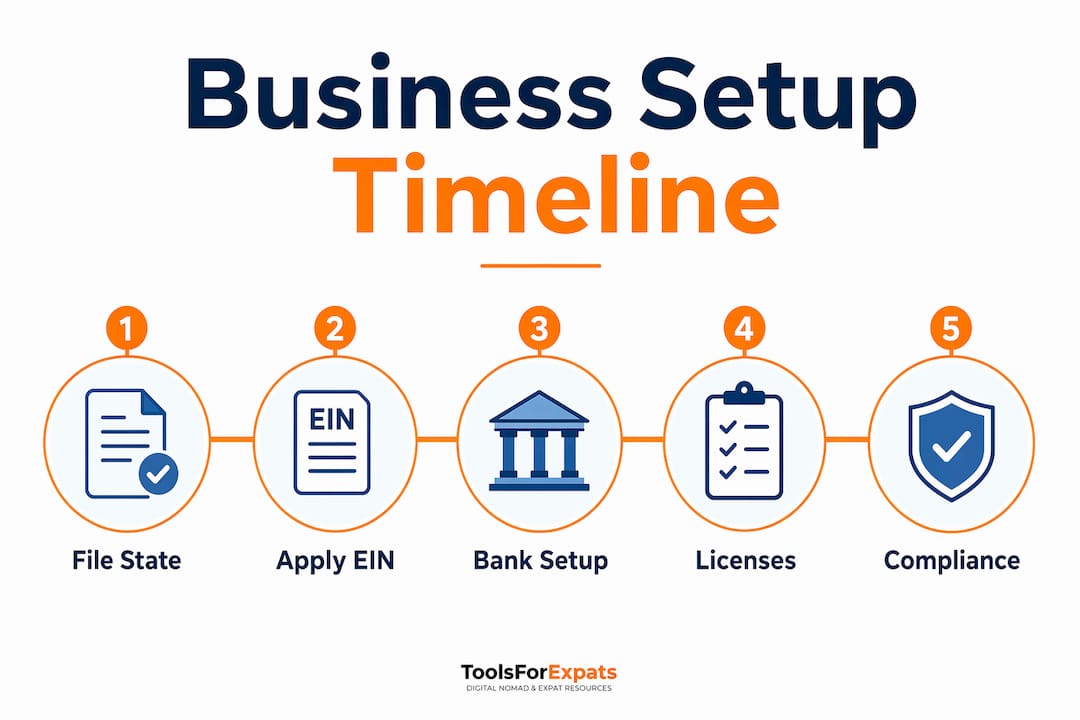
Formation checklist
- Decide your entity type (LLC, C-corp, or sole proprietorship).
- Choose your formation state and appoint a registered agent.
- File formation documents with the state (Articles of Organization or Incorporation).
- Apply for your EIN from the IRS (and ITIN if needed).
- Register for state taxes where you have nexus.
- Obtain required business licenses and local permits.
- Open a U.S. business bank account.
Realistic timeline and cost estimates
| Step | Typical timeline | Estimated cost |
|---|---|---|
| State formation filing | 1–5 business days (expedited) | $50–$500 state fee |
| EIN (online, foreign applicant) | Same day to 4 weeks by fax/mail | Free (IRS) |
| ITIN application | 7–11 weeks | $0–$200 (preparer) |
| State tax registration | 1–2 weeks | Varies by state |
| Business bank account | 3–6 weeks | Varies |
| Business licenses | 1–4 weeks | $50–$500+ |
Remote LLC formation typically runs several hundred to a few thousand dollars all-in for the first year; see details on the incorporation cost of an International Business Company for cost comparisons. A C-corp with registered agent and legal review usually costs more than an LLC. Add a contingency for translation, notarization, and unexpected compliance costs.
Pro Tip: Apply for your EIN and begin bank outreach simultaneously. Banking is almost always the slowest step, so starting it early saves weeks.
Which legal entity should you choose as an expat?
The LLC is the default choice for most nonresident founders. It offers pass-through taxation, flexible ownership, and minimal ongoing formalities. A C-corporation makes sense when you need to raise venture capital or issue stock options, since investors expect it. A sole proprietorship is the simplest structure but offers no liability protection and can complicate banking.
S-Corp is effectively off the table for non-U.S. persons. The IRS restricts S-Corp shareholders to U.S. citizens and permanent residents. Electing S-Corp status as a nonresident triggers immediate disqualification and potential back taxes.
| Entity | Liability protection | Tax treatment | Best for expats when |
|---|---|---|---|
| LLC | Yes | Pass-through (default) | Simplicity, flexibility |
| C-Corp | Yes | Corporate (21% federal) | Investor-ready, stock issuance |
| Sole proprietorship | No | Pass-through | Lowest-cost testing only |
| S-Corp | Yes | Pass-through | Not available to nonresidents |
Before filing, discuss these with a U.S. CPA: your home country's tax treaty with the U.S., FBAR and Form 5471 reporting obligations, and whether LLC pass-through income triggers self-employment tax for nonresidents.
Pro Tip: The DLA Piper Global Expansion Guide covers entity mechanics and notes that a bank account is not required for incorporation itself, but you will need one almost immediately after.
Does owning a U.S. company give you the right to work there?
No. Owning a U.S. entity and having U.S. work authorization are entirely separate. You can legally form and own an LLC from abroad without any U.S. visa. The moment you perform work physically inside the U.S., immigration rules apply.
Key distinction: Signing documents, receiving dividends, and directing strategy from outside the U.S. generally does not trigger work-authorization requirements. Showing up in the U.S. to manage operations, meet clients, or supervise employees does. Get this wrong and you risk visa violations that can affect future entry.
Common visa routes for expat founders who want to work in the U.S.:
- E-2 Treaty Investor visa: Requires a substantial investment and a treaty country passport. Processing varies by consulate.
- O-1A visa: For individuals with extraordinary ability. High bar, but viable for established founders.
- L-1 visa: Intracompany transfer for founders moving from a foreign affiliate to a U.S. entity.
- EB-5 immigrant investor: Permanent residency route requiring a significant capital investment.
Consult a U.S. immigration attorney before making any plan that involves physically working inside the U.S. The rules turn on intent, duration, and activity type.
How do you register your business in a U.S. state?
Picking a state matters more than most guides admit. Delaware and Wyoming are popular for their low fees and flexible LLC laws, but if your customers, employees, or physical office are in California or New York, you will likely need to foreign-qualify there anyway, paying fees in two states.

| State | Formation fee | Annual fee | Why expats choose it |
|---|---|---|---|
| Delaware | $90 | $300 franchise tax | Investor-friendly, established case law |
| Wyoming | $100 | $60 minimum | Low cost, strong privacy |
| New Mexico | $50 | $0 | Cheapest option, no annual report |
| Your operating state | Varies | Varies | Avoids dual-state fees |
Key mechanics to understand:
- Registered agent: Every U.S. LLC needs one. As a nonresident, use a commercial registered agent service ($50–$300/year) rather than listing a personal address.
- Foreign qualification: If you form in Delaware but operate in Texas, you must register as a foreign LLC in Texas and pay that state's fees.
- DBA (Doing Business As): Lets you operate under a trade name without forming a new entity. Useful for branding, but does not change your legal structure.
Pro Tip: Decide where your bank, customers, and any physical presence will be before choosing a formation state. Forming in Delaware when your operations are in Florida often creates more paperwork, not less.
What are the U.S. tax basics for expat-owned businesses?
Apply for your EIN early. Without it, you cannot open a bank account, hire employees, or file most tax forms. If you lack a Social Security Number, you will also need an ITIN for personal tax filings.
Core obligations to plan for:
- Federal income tax: LLC income passes through to your personal return (Form 1040-NR for nonresidents). C-corps pay a flat 21% federal corporate tax rate.
- Self-employment tax: Nonresident LLC members may owe self-employment tax on U.S.-source income. Confirm with a CPA.
- Sales tax and economic nexus: Most states now require sales tax registration once you exceed a revenue or transaction threshold in that state, even without a physical presence.
- Payroll tax: If you hire U.S.-based employees, you must withhold federal income tax, Social Security, and Medicare, and file quarterly payroll returns.
Digital nomad tax residency rules add another layer. Your home country's tax treaty with the U.S. determines whether you owe taxes in both places. Baker McKenzie's business-phase framing is a practical tool here: your compliance burden scales directly with how physically present your operation is.
Consult a U.S. CPA for cross-border filings. Common mistakes include missing FBAR deadlines and misclassifying LLC income on nonresident returns. Review common digital nomad tax mistakes before your first filing season.
How do you open a U.S. bank account as a nonresident?
Banking is almost always the slowest bottleneck. Non-resident founders often face high rejection rates from mainstream banks due to AML/KYC requirements. Apply to multiple banks in parallel and budget sufficient time for onboarding.
Documents banks typically require:
- Certified copy of formation documents (Articles of Organization/Incorporation)
- EIN confirmation letter (IRS Form CP 575)
- Passport and secondary government-issued ID
- Proof of U.S. business address (registered agent letter works)
- Business plan or description of operations
If traditional banks reject you, U.S.-friendly fintechs and business payment platforms can serve as interim solutions while you continue bank outreach. Multi-currency payment providers let you accept U.S. payments and pay contractors before your bank account is active.
Pro Tip: Choose your target bank before finalizing your registered agent address. Some banks have preferred relationships with specific registered agent providers, which can speed up the KYC review.
What do you need to do after formation to stay compliant?
Formation is the start, not the finish. These operational steps keep your company in good standing:
- Obtain all required business licenses (federal, state, and local) before you start trading.
- Get a general liability insurance policy. Professional liability (errors and omissions) coverage is standard for service businesses.
- Decide contractor vs. employee status early. Misclassifying employees as contractors triggers IRS penalties and back payroll taxes.
For payroll, platforms like Gusto, Rippling, or ADP handle federal and state withholding, filings, and W-2 issuance. A professional employer organization (PEO) is worth considering for your first one or two U.S. hires.
Annual compliance tasks:
- File your annual report with the state (deadlines vary; Delaware is March 1 for LLCs).
- Pay franchise taxes or annual fees on time.
- Renew business licenses before expiration.
- Update your registered agent if you change providers.
- Keep a separate business bank account and maintain clean bookkeeping records.
Should you test the market before incorporating?
If you lack confirmed local demand or your plan requires physical U.S. operations to scale, test first. Administrative burden and maintenance costs often outweigh the benefits of early incorporation. Tasa's expat entrepreneur guidance makes the same point: many founders replicate their domestic model without validating local demand first.
Low-burden testing routes:
- Sell as a foreign sole proprietor for a defined pilot period.
- Use an established U.S. marketplace (Amazon, Etsy, Upwork) to test demand without forming an entity.
- Run pilot projects with U.S. contractors under a representative agreement.
Pressure-test your readiness before incorporating:
- Do you have at least one confirmed paying U.S. customer or a signed letter of intent?
- Does your business model require a U.S. entity for contracts, banking, or regulatory reasons?
- Have you validated that local demand, language, and cultural expectations fit your offer?
- Can you sustain the ongoing compliance costs (at least $500–$2,000 per year) without revenue?
If you answered no to most of these, test first. Incorporate when the answers flip.
Free tools to plan your move and your numbers
ToolsForExpats offers a suite of free planning tools that map directly to your formation tasks:
- Moving Abroad Budget Calculator: Model your lean, realistic, and stress-case budgets before paying any formation fees.
- Cost of Living Comparison: Compare city-level costs to validate where your operating budget goes furthest.
- Nomad Cost Calculator: Refine your monthly runway by city.
- Digital Nomad Visa Eligibility Checker: Screen visa routes across 20+ countries before committing to a location.
- Best City for Digital Nomads Quiz: Match your lifestyle and business needs to the right U.S. city.
Three actions to run in the next 48 hours:
(1) build your budget model using the Moving Abroad Budget Calculator, (2) run the Visa Eligibility Checker to confirm your work-authorization path, and (3) take the City Quiz to shortlist your operating base.
Pro Tip: Complete the budget and visa checks before you speak to a registered agent or attorney. Walking into those conversations with your numbers and visa status already mapped saves time and money.
What licenses and permits does your industry require?
Federal, state, and local licenses stack on top of each other. A food business in California needs a state food handler permit, a county health permit, and possibly an FDA registration. A financial services firm needs state-level licensing through FINRA or state regulators. A construction contractor needs state contractor licensing plus local permits for each job site.
The SBA's Business License and Permits tool lets you search by state and industry. State secretary of state websites list profession-specific licensing boards. For regulated industries (healthcare, finance, real estate, alcohol), budget extra time: licensing can take 3–6 months and require background checks, surety bonds, or proof of insurance before approval.
How do you handle U.S. business insurance as an expat owner?
General liability insurance is the baseline for almost every U.S. business. It covers third-party bodily injury and property damage claims. Professional liability (errors and omissions) covers service businesses against negligence claims. If you hire employees, workers' compensation is mandatory in most states.
As a nonresident owner, you can purchase U.S. business insurance through domestic carriers. Providers like Hiscox, Next Insurance, and The Hartford offer online applications that do not require a U.S. address for the owner. Your registered agent address works for policy correspondence. Expect to provide your EIN, formation documents, and a description of business activities during the application.
How do you protect your intellectual property in the U.S.?
The U.S. Patent and Trademark Office (USPTO) allows foreign nationals to file trademark and patent applications without a U.S. address. Trademark registration protects your brand name and logo; a federal registration gives you nationwide rights and the ability to sue infringers in federal court. File through the USPTO's TEAS (Trademark Electronic Application System) online portal.
Copyright protection in the U.S. is automatic upon creation of original work, but registering with the U.S. Copyright Office strengthens your legal position significantly. For patents, work with a registered U.S. patent attorney. The process is lengthy (18–36 months for utility patents) and expensive, but the protection is enforceable against U.S. competitors.
What does ongoing compliance look like year after year?
Good standing means your state considers your company active and legally authorized to do business. Losing it can void contracts, freeze your bank account, and trigger personal liability.
Annual compliance calendar:
- January–March: File annual reports and pay franchise taxes (state deadlines vary).
- April 15: Federal tax return deadline for most entities (extensions available).
- Quarterly: File and pay estimated federal and state taxes; submit payroll tax returns (Form 941).
- Ongoing: Renew business licenses before expiration; update registered agent and address changes within 30 days.
Keep your formation documents, EIN letter, operating agreement, and annual filings in a single organized folder. If you use a registered agent service, they will send compliance reminders automatically.
Where do you go for official filings and registrations?
Primary sources for every formation and compliance task:
- IRS EIN application: Apply online (U.S. applicants) or by fax/mail (international applicants using Form SS-4).
- State secretary of state portals: Search "[your state] secretary of state business filing" for formation documents, annual reports, and foreign qualification forms.
- SBA.gov: Federal licensing guidance, business plan resources, and small business loan programs.
- USPTO.gov: Trademark and patent filings for IP protection.
- Baker McKenzie Field Guide: Business-phase compliance framing for cross-border expansion.
A practical note on professional advice: Government portals tell you what to file. A U.S. CPA tells you how to structure it so you do not overpay taxes. A U.S. immigration attorney tells you whether your plan is visa-compliant. Both are worth the cost before you commit to a structure.
Key Takeaways
Sequencing is the single most important factor when you set up a local business as an expat: map visa eligibility, banking, and formation in the right order before booking travel or signing leases.
| Point | Details |
|---|---|
| Owning vs. working | Owning a U.S. entity does not grant work authorization; consult an immigration attorney before operating physically in the U.S. |
| Banking timeline | Budget 3–6 weeks for bank onboarding and apply to at least two institutions in parallel. |
| Entity choice | LLCs suit most nonresident founders; S-Corps are unavailable to non-U.S. persons. |
| Tax and compliance | Get your EIN early; consult a U.S. CPA for cross-border filings and FBAR obligations. |
| ToolsForExpats | Run the Moving Abroad Budget Calculator and Visa Eligibility Checker before paying any formation fees. |
The mistake most expat founders make (and how to avoid it)
Poor sequencing is the root cause of most failed U.S. business setups. The pattern looks like this: a founder picks a state, pays formation fees, then discovers their preferred bank will not open an account without a physical U.S. address, or that their visa status prevents them from attending the client meetings their business model requires. By then, they have already spent money and time on a structure that does not fit their actual situation.
The corrective sequence is straightforward: confirm your visa path first, then choose your state based on where your bank and customers will be, then file formation documents, then pursue banking in parallel with your EIN application. Sequencing these dependencies before any travel or lease signing prevents the most common and most expensive mistakes.
Three actions that prevent this entirely: (1) run the ToolsForExpats Visa Eligibility Checker before choosing a state, (2) call your target bank before filing formation documents, and (3) build your realistic budget model with a 15–25% contingency before committing to any structure.
ToolsForExpats helps you plan before you pay a single filing fee
Before you spend money on formation, registered agents, or attorney consultations, you need two things confirmed: your budget runway and your visa eligibility. ToolsForExpats gives you both for free, with no account required.
The Moving Abroad Budget Calculator models your lean, realistic, and stress-case formation budgets so you know exactly what you can afford. The Digital Nomad Visa Eligibility Checker screens your options across 20+ countries in minutes. The Cost of Living Comparison, Nomad Cost Calculator, and Best City for Digital Nomads Quiz round out the picture by matching your lifestyle and operating costs to the right city. Run your budget and visa check at ToolsForExpats now, before you pay anything.
Authoritative sources for filings and deeper reading
- IRS EIN/ITIN guidance: Official forms, application instructions, and tax treaty information.
- SBA.gov: Federal licensing, business plan tools, and small business programs.
- Baker McKenzie 2026 Field Guide to Going Global: Business-phase framing for compliance priorities across jurisdictions.
- DLA Piper Global Expansion Guide: Entity mechanics and practical formation notes for the U.S. market.
- USPTO.gov: Trademark and patent registration for IP protection.
- State secretary of state portals: Formation documents, annual reports, and foreign qualification filings (search your target state directly).
Disclaimer: This article is general information, not legal, tax, or immigration advice. Confirm current rules with the IRS, your state's secretary of state, a qualified U.S. CPA, and a U.S. immigration attorney for your specific situation.