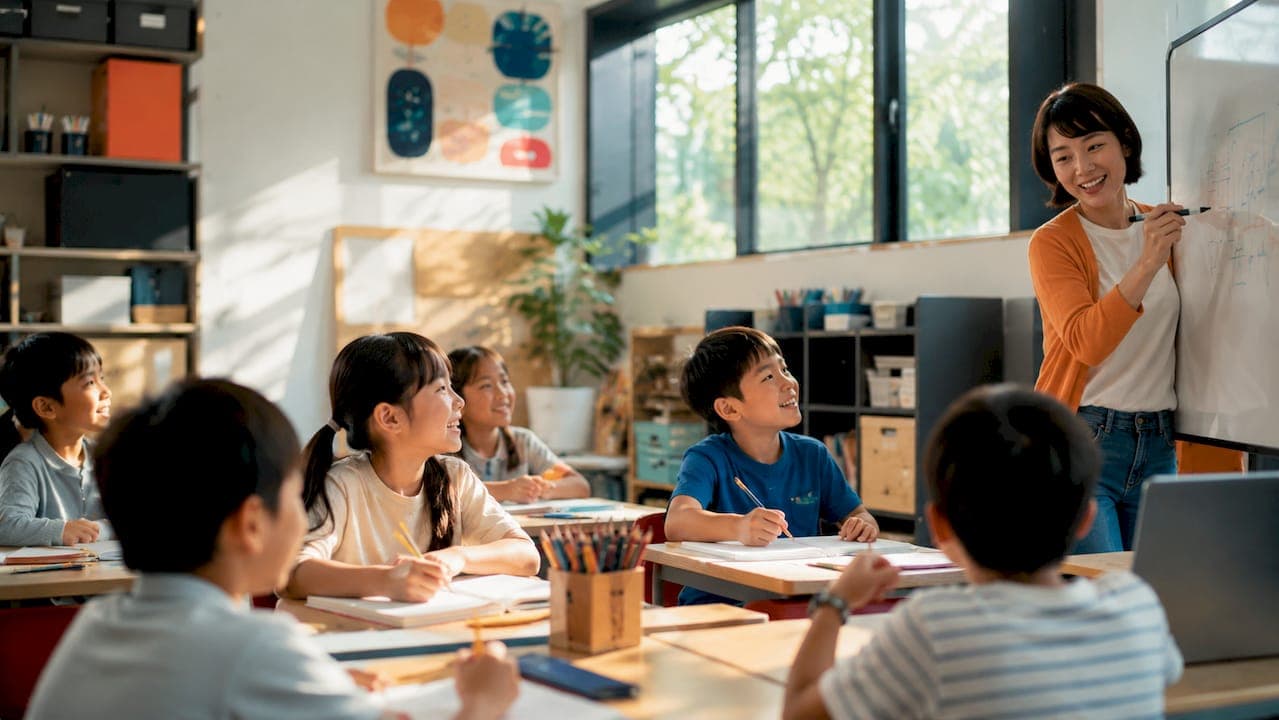
Education in Japan runs on a nationally coordinated 6–3–3 system, with nine years of compulsory schooling covering elementary and lower secondary school, governed by the Ministry of Education, Culture, Sports, Science and Technology (MEXT) and delivered through a single national curriculum called the Course of Study. If you're trying to understand how Japanese schooling works, whether for academic research, a family relocation, or studying abroad, here are the headline facts:
- Academic calendar: The school year runs April through March, divided into three semesters with summer, winter, and spring breaks.
- Entrance exams: Competitive exams for upper secondary and university admission are concentrated in the January–March window and shape the entire trajectory of a student's academic life.
- International performance: Japan consistently ranks among the top OECD nations in science and mathematics on the PISA assessment.
What makes the system genuinely distinctive is the combination of a centralized national curriculum with cultural school-life practices, like student-led classroom cleaning, communal lunches, and after-school club activities (bukatsu), that are treated as core character education rather than optional extras.
Key numbers and facts about Japan's schools
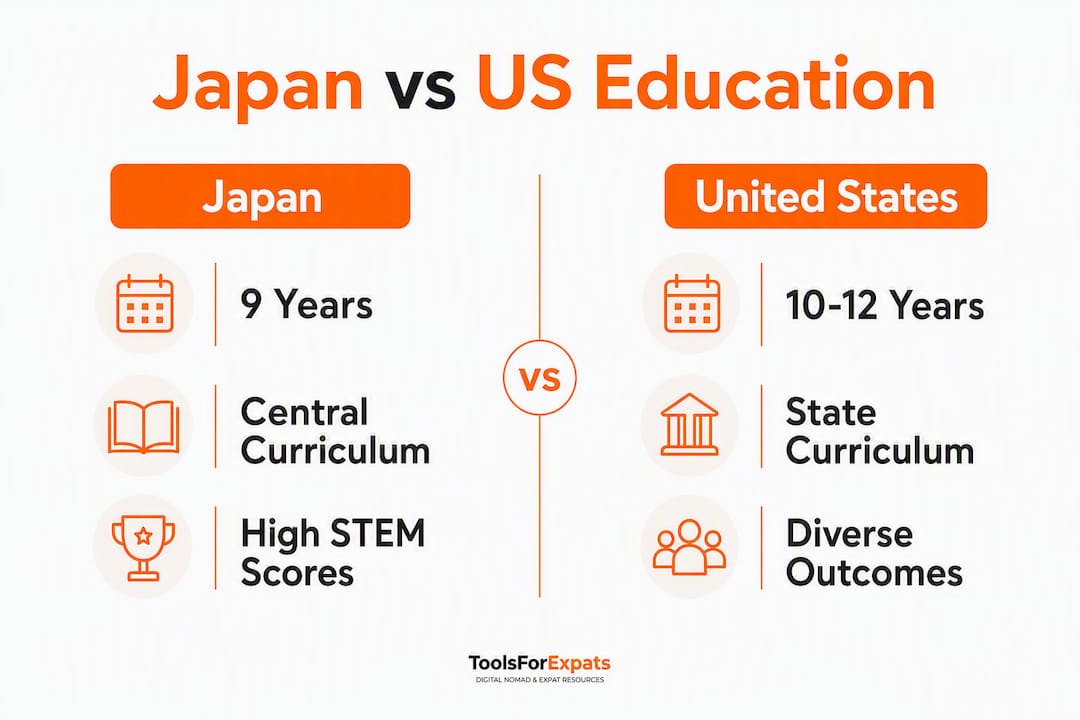
The table below captures the core structural indicators you'll want to reference when comparing Japan's system to the U.S. or any other country.
| Indicator | Japan |
|---|---|
| Compulsory years | 9 (6 elementary + 3 lower secondary) |
| Compulsory age range | 6–15 |
| School year start | April |
| Pre-primary enrollment (age cohort) | very high (above OECD average) |
| Upper secondary enrollment | Very high (near-universal) |
| Education spending (% of GDP) | modest share (primary to tertiary) |
| Entrance exam window | January–March |
Japan's pre-primary enrollment rate sits at approximately 98% for the relevant age cohort, well above the OECD average. That figure reflects both cultural expectations around early education and a policy push to expand childcare access. At the other end of the pipeline, tertiary enrollment is also high, though field-of-study patterns are uneven.
On PISA, Japan's science and mathematics results consistently outperform most OECD peers. Spending tells a different story: Japan devotes approximately 4.0% of GDP to education institutions from primary through tertiary, which sits below the OECD average. That gap matters when you're evaluating how Japan achieves strong outcomes with comparatively modest public investment.
Entrance exams for both upper secondary and university are typically scheduled between January and March. That timing compresses preparation cycles into the autumn and winter months and shapes the rhythm of the entire upper-secondary school year.
Who runs education in Japan, and how?
Japan's education system is centrally coordinated but locally administered, and understanding that split is key to making sense of how schools actually operate.
MEXT sets the national framework. The ministry publishes the Course of Study, the binding national curriculum standard that defines what students learn at every level. MEXT revises the Course of Study on a roughly 10-year cycle, with each revision reflecting policy priorities like English proficiency, digital literacy, and moral education. The goal, as MEXT frames it, is to maintain equal educational quality across all schools regardless of geography or local resources.
Prefectural and municipal boards of education handle implementation. Prefectural boards oversee upper secondary schools and special needs schools. Municipal boards manage elementary and lower secondary schools, including hiring decisions, school facilities, and local curriculum adaptations within the national framework. This means a school in rural Hokkaido and one in central Tokyo follow the same Course of Study but may differ in how they allocate elective time or organize extracurricular programs.
At the school level, principals carry administrative authority, and teachers take on significant administrative roles beyond classroom instruction. Japanese teachers are expected to participate in school management, student guidance, and club supervision, which contributes to the well-documented workload pressures the profession faces.
- MEXT: national curriculum standards, policy priorities, textbook authorization
- Prefectural boards: upper secondary schools, special needs schools, teacher licensing
- Municipal boards: elementary and lower secondary schools, local staffing, facilities
- School principals: day-to-day administration, curriculum implementation, community liaison
Pro Tip: For the most current curriculum guidelines and policy updates, go directly to the MEXT overview page rather than relying on secondary summaries. MEXT publishes English-language policy documents, and local prefectural boards of education often post school-year calendars and enrollment procedures in Japanese on their own sites.
How are Japanese schools structured by level?
Japan's educational system moves from pre-school through a 6–3–3 structure before branching into several higher-education pathways. Here's how each level maps to U.S. grade equivalents.
| Japanese Level | Duration | Typical Ages | U.S. Equivalent |
|---|---|---|---|
| Kindergarten (yochien) | 1–3 years | 3–5 | Pre-K / Kindergarten |
| Elementary school | 6 years | 6–12 | Grades 1–6 |
| Lower secondary (junior high) | 3 years | 12–15 | Grades 7–9 |
| Upper secondary (high school) | 3 years | 13–15 | Grades 10–12 |
| University (bachelor's) | 4 years | — | College freshman–senior |
| Junior college | 2–3 years | — | Associate degree |
| College of technology | 5 years | 13–15 | Vocational/technical |
| Professional/vocational university | 4 years | — | Applied bachelor's |
Elementary school (grades 1–6)
Compulsory education begins at age 6 with six years of elementary school. The curriculum covers Japanese language, mathematics, science, social studies, music, arts and crafts, physical education, and home economics. Moral education (dotoku) and special activities, which include class meetings, school events, and student council participation, are built into the timetable from the start. English was formally introduced as a subject in upper elementary grades in recent curriculum revisions, reflecting MEXT's push toward global communication skills.
Lower secondary school (grades 7–9)
The final three years of compulsory education. Students study a broader subject range, including Japanese, mathematics, science, social studies, English, music, fine arts, health and physical education, technology, and home economics. Class structures become more subject-specific, with different teachers for different subjects. Near-universal progression to upper secondary follows, though it requires passing an entrance exam.
Upper secondary school (grades 10–12)
Upper secondary is not compulsory, but enrollment rates are very high. Students choose between academic and vocational tracks. Academic-track schools prepare students for university entrance exams; vocational schools focus on fields like agriculture, industry, commerce, and welfare. The entrance exam to get into a preferred upper secondary school is a significant milestone, and the school a student attends often signals their likely university trajectory.
Higher education
Higher education in Japan includes four main types:
- Universities: Four-year bachelor's programs; the University of Tokyo (Todai) is the most selective and internationally recognized example, consistently ranking among Asia's top institutions.
- Junior colleges: Two- to three-year programs, historically popular among women, though enrollment has declined.
- Colleges of technology: Five-year programs beginning after lower secondary, combining secondary and tertiary education in technical fields.
- Professional/vocational universities: Four-year applied programs introduced in 2019, blending academic and practical training.
What do students actually learn in Japanese schools?
The Course of Study is the document that answers this question. MEXT publishes it as the binding national curriculum standard, and it covers every subject at every level. The roughly 10-year revision cycle means the curriculum responds to societal shifts, but slowly and deliberately.
At the primary level, the subject mix is broad: language arts, mathematics, science, social studies, music, art, physical education, and moral education all appear from early grades. The moral education subject (dotoku) was formalized as a graded subject in 2018, a notable shift from its previous status as a non-graded activity.
At secondary level, the curriculum expands to include English as a core subject, informatics (a computing and digital literacy course now required at upper secondary), and a wider range of electives. The informatics requirement reflects MEXT's response to Japan's need for a digitally capable workforce, and it was strengthened in the most recent Course of Study revision.
- Primary subjects: Japanese, math, science, social studies, music, art, PE, moral education, special activities, English (upper grades)
- Lower secondary subjects: All of the above plus technology and home economics, with English as a graded core subject
- Upper secondary subjects: Core plus electives, informatics (required), and subject-specific depth for university preparation
Teaching approaches have traditionally leaned toward structured lecture and whole-class instruction. Recent MEXT reforms push toward more interactive, inquiry-based, and collaborative learning, sometimes called "active learning" in Japanese policy documents. The shift is real but uneven across schools and regions.
The national curriculum's consistency is one of Japan's most studied features. Because every school follows the same Course of Study, a student who transfers from Osaka to Sapporo in the middle of the school year will find the same content being taught at the same pace. That kind of nationwide coherence is rare among developed nations and is a direct product of MEXT's centralized authority.
How does the entrance exam system work?
Assessment in Japanese schools operates on two tracks: ongoing school-based evaluation and the high-stakes entrance examinations that gate access to upper secondary and university.
At the elementary and lower secondary levels, teachers assess students through regular tests, class participation, homework, and end-of-term exams. There is no single national standardized test at these levels comparable to U.S. state assessments. Grades are reported on a descriptive or numerical scale depending on the school level.
The entrance exam system becomes central from upper secondary onward. For university admission, the most significant national assessment is the Common Test for University Admissions (Daigaku Nyushi Kyotsu Test), which replaced the older Center Test in 2021. Most national and public universities require it; many private universities set their own exams.
Here's the typical sequence a Japanese student follows when navigating university admissions:
- Autumn of upper secondary year 3: Research target universities, review admission requirements, and register for the Common Test.
- January: Sit the Common Test for University Admissions over two days.
- February: Take individual university entrance exams (secondary exams) at national and public universities.
- February–March: Sit private university entrance exams, which run on their own schedules.
- March: Receive results and placement decisions; accept an offer before the deadline.
Pro Tip: If you're an international student or a family considering studying abroad in Japan, many national universities now offer English-taught undergraduate and graduate programs. MEXT's "Top Global University Project" has expanded these pathways significantly. Check individual university admissions pages and the JASSO (Japan Student Services Organization) website for scholarship options and English-language program listings.
What is school life actually like in Japan?
The school day in Japan is structured, communal, and deliberately designed to build social responsibility alongside academic skills. A typical school day runs roughly six periods of 45–50 minutes each, with a lunch break and a short homeroom session at the start and end of the day.
The academic year runs April through March, with three semesters. Major breaks fall in summer (late July to late August), winter (late December to early January), and spring (late March to early April). The spring break is also the transition period between school years.
Bukatsu: club activities
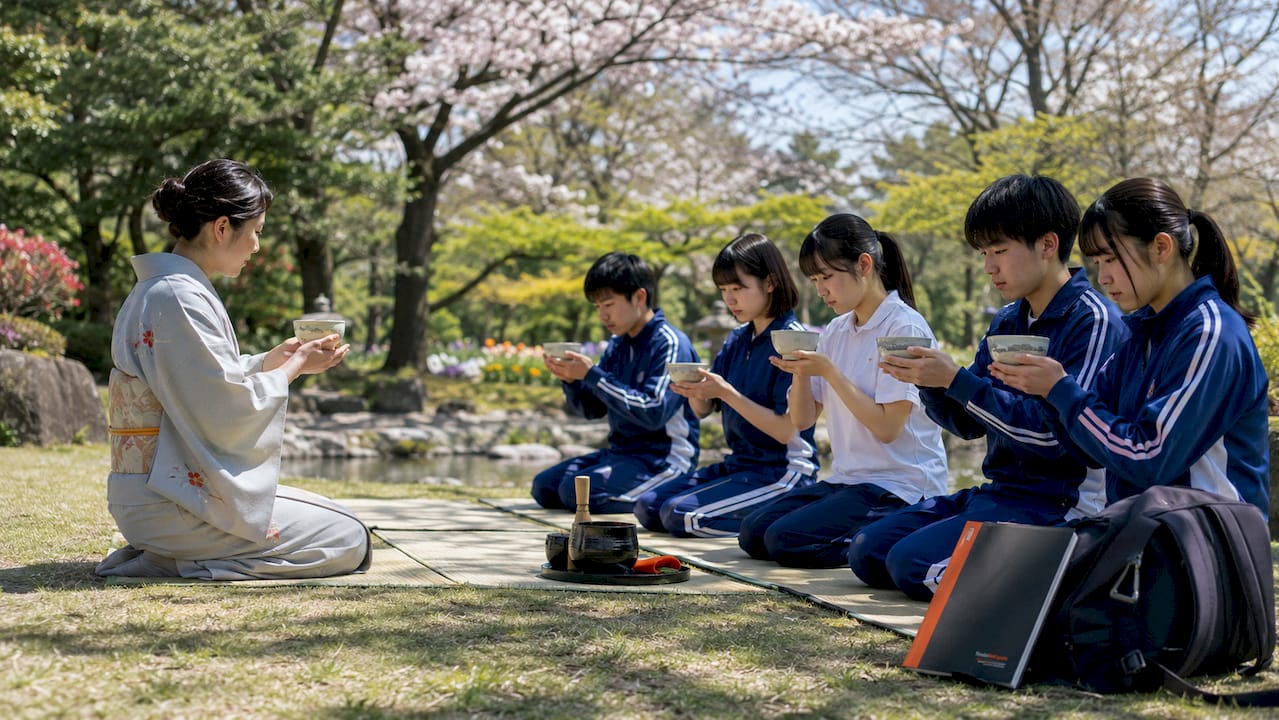
Club activities, known as bukatsu, are one of the most defining features of Japanese school life. They run after school on weekdays and often on weekends, covering sports (baseball, soccer, tennis, swimming, kendo), cultural activities (music, drama, calligraphy), and traditional arts. Participation is not legally mandatory, but social expectations make it effectively near-universal at the lower and upper secondary levels. Bukatsu teaches teamwork, discipline, and commitment in ways that classroom instruction alone cannot replicate. They are not extracurricular in the American sense of "optional enrichment." They are institutional.
Cleaning duties and communal responsibilities
Students clean their own classrooms, hallways, and school grounds as part of the daily schedule, typically after lunch. There are no custodial staff responsible for these tasks during the school day. The practice, called soji, is framed as character education: students learn to take ownership of shared spaces and develop a sense of collective responsibility. School lunches (kyushoku) follow a similar logic. Students serve food to their classmates, eat together in the classroom, and clean up afterward. School festivals (bunkasai) and sports days (undokai) round out a calendar of communal events that reinforce school identity and social bonds.
- Uniforms: Most lower and upper secondary schools require uniforms; elementary schools vary.
- School lunches: Nutritionally planned, served in the classroom, and eaten together.
- Cleaning (soji): Daily, student-led, and treated as part of the educational program.
- Bukatsu: After-school clubs that are central to social development and school culture.
- Festivals: Bunkasai (cultural festival) and undokai (sports day) are major annual events.
Pro Tip: For international families relocating to Japan, the communal expectations of Japanese school life can feel unfamiliar at first. If your child joins a local public school, expect club participation to be strongly encouraged and cleaning duties to be non-negotiable. Reading up on managing school transitions for kids before you arrive can help the whole family prepare mentally, not just logistically.
How is education funded, and what reforms are underway?
Japan's education funding follows a pattern common to many OECD nations: public money dominates at the primary level, while private funding plays a larger role in pre-primary and tertiary education.
| Level | Primary Funding Source | Notes |
|---|---|---|
| Pre-primary | Mixed public/private | Recent policy push to expand public subsidies |
| Elementary | Predominantly public | High public share; MEXT and municipal funding |
| Lower secondary | Predominantly public | Same public-dominant model as elementary |
| Upper secondary | Public and private | Private high schools significant in urban areas |
| Tertiary | Mixed; higher private share | National universities publicly funded; private universities dominant by enrollment |
Japan spends a modest share of GDP on education institutions from primary to tertiary, below the OECD average. Per-student spending is higher at the tertiary level than at primary or secondary, a pattern that has drawn policy attention given Japan's demographic pressures. Early-childhood spending has historically been comparatively low against OECD peers, and recent policy moves aim to correct that by expanding pre-primary subsidies and childcare access.
Three policy pressures are reshaping the system right now. First, Japan's declining birthrate is shrinking the school-age population, which creates school consolidations in rural areas and raises questions about teacher deployment. Second, teacher workload is a documented crisis: Japanese teachers report among the longest working hours of any OECD country, driven partly by bukatsu supervision and administrative duties. MEXT has introduced workload-reduction guidelines, but implementation varies. Third, internationalization of higher education remains a priority. Programs like the Top Global University Project have pushed national universities to expand English-taught courses, international partnerships, and foreign student recruitment.
The OECD notes teacher shortages in mathematics and foreign languages as a specific pressure point, which is notable given Japan's strong PISA performance in math. Strong average outcomes can coexist with supply-side staffing gaps, and Japan illustrates that tension clearly.
How does Japan perform on international measures?
Japan's measured outcomes are strong, particularly in science and mathematics, though the picture is more nuanced when you look at gender patterns and field-of-study distribution.
| Measure | Japan | OECD Context |
|---|---|---|
| PISA science | High performer | Consistently above OECD average |
| PISA mathematics | High performer | Consistently above OECD average |
| PISA reading | Above average | Slightly less dominant than science/math |
| Pre-primary enrollment | very high | Above OECD average |
| Women in STEM (tertiary entry) | low share | Significantly below OECD average |
| Education spending (% GDP) | ~4.0% | Below OECD average |
The science and math results are the headline story. Japan's PISA performance has been consistently strong across multiple assessment cycles, placing it among the top-performing OECD nations. That performance is widely attributed to the coherence of the national curriculum, the cultural emphasis on academic effort, and the motivating pressure of the entrance exam system.
The gender gap in STEM is a significant counterpoint. Only 7% of women entering tertiary education in Japan were studying STEM fields according to recent OECD data, a figure that sits well below the OECD average and reflects persistent structural and cultural barriers. High average PISA scores do not translate automatically into equitable tertiary participation.
Graduation rates from upper secondary are very high, reflecting the near-universal enrollment at that level and the strong social expectation to complete secondary education. Tertiary attainment rates are also high overall, though the distribution across fields and by gender shows the imbalances noted above.
For U.S. readers, the OECD's Education at a Glance country note for Japan is the most reliable single source for current comparative data. It contextualizes Japan's figures against OECD averages and flags where trends are moving.
How does Japan's system compare to the U.S.?
The structural and cultural differences between Japan and the U.S. are significant enough that U.S. families and educators often find the comparison clarifying rather than just academic.
| Category | Japan | United States |
|---|---|---|
| Compulsory years | 9 (ages 6–15) | 10–12 (varies by state; ages ~5–17) |
| Grade equivalents | Elementary (1–6), JHS (7–9), HS (10–12) | Elementary (K–5/6), Middle (6–8), HS (9–12) |
| Academic calendar | April–March | September–June |
| Assessment style | Entrance exams gate progression; school-based ongoing assessment | Standardized state tests; GPA and SAT/ACT for college |
| Curriculum centralization | National (MEXT Course of Study) | Decentralized; state and district standards |
| School-life elements | Uniforms, student cleaning, communal lunches, bukatsu | Varies widely; cafeteria staff, optional clubs |
| PISA outcomes | Top-tier in science/math | Below OECD average in math; mid-range in reading |
| Spending (% GDP) | ~4.0% | Higher (OECD data) |
A few practical implications stand out for U.S. families. Credit transfer between U.S. and Japanese institutions is not automatic and requires evaluation by the receiving institution. The NIC-Japan (National Information Center for Academic Recognition) handles credential evaluation for Japanese qualifications. Classroom norms differ considerably: Japanese students are expected to participate in cleaning and communal routines that have no U.S. equivalent, and the social pressure to join a club is much stronger than anything most American students experience.
For U.S. educators, the most instructive contrast is the curriculum centralization point. Japan's national Course of Study means every teacher in the country is working from the same framework at the same time. The U.S. model, built on state and district standards, produces enormous variation in content, pacing, and expectations. Neither model is strictly superior, but the consistency Japan achieves is measurable in its PISA results.
Quick takeaways for U.S. families or educators:
- The April school-year start means a mid-year U.S. transfer will land a child partway through a Japanese school year, which requires coordination with the receiving school.
- Japanese grading scales and transcript formats differ from U.S. conventions; get credentials evaluated before applying to U.S. colleges.
- The entrance exam culture is intense by U.S. standards. Many Japanese families use juku (private cram schools) to supplement regular schooling.
- Classroom cleaning and communal lunch duties adapt quickly for most children; club participation takes more cultural adjustment.
Practical resources for expat families and international students
If you're planning a move to Japan with children, or considering studying abroad there, the school-choice decision is one of the most consequential you'll make. Here's how the main options break down.
Schooling choices for expat families:
- Local public school: Free, follows the Japanese national curriculum, taught in Japanese. Best for families planning a long-term stay and wanting full cultural immersion. Requires Japanese language support, especially in the early months.
- Private international school (kakushu gakko or miscellaneous schools): Taught in English or another language, follows an international curriculum (IB, British, American). Fees can be substantial, often running into the millions of yen per year. Found mainly in Tokyo, Osaka, Yokohama, Kobe, and Nagoya.
- Japanese private school: Follows the national curriculum but may offer additional programs, smaller class sizes, or religious affiliation. Tuition applies.
- Special needs schools (tokubetsu shien gakko): Publicly funded schools for students with physical, intellectual, or developmental disabilities, governed at the prefectural level.
Visa and residency notes: Your visa status directly affects your child's school enrollment options. Families on long-term resident visas generally have access to local public schools. Short-term or specific-purpose visas may limit options. For current visa requirements and residency rules, consult the Japan Immigration Services Agency or your nearest Japanese embassy directly. This article provides general orientation, not legal or immigration advice.
Pro Tip: Private international school fees in Tokyo can exceed ¥3,000,000 per year per child. Before you commit to a city or neighborhood, use the ToolsForExpats cost-of-living comparison tool to model how tuition stacks against housing, transport, and daily expenses across different Japanese cities. The difference between living in central Tokyo and a suburban area can be significant, and that gap affects what school options are financially realistic.
Useful planning links:
- Living Costs in Japan: 2026 Guide for Expats & Nomads: Detailed breakdown of monthly costs by city, including housing and education.
- How to Transition Kids to a Nomadic Lifestyle: Practical guidance on managing school transitions and continuity of learning.
- MEXT Overview: Official English-language policy documents and curriculum standards.
- JNTO Education in Japan: Clear overview of the school system structure for international visitors and students.
- Embassy of Japan in the U.S.: Education System: Concise official summary for American families.
Key Takeaways
Japan's education system delivers consistently strong international outcomes through a centralized national curriculum, nine years of compulsory schooling, and a school culture that treats communal responsibility as inseparable from academic achievement.
| Point | Details |
|---|---|
| Compulsory structure | Nine years total: six elementary plus three lower secondary, covering ages 6–15. |
| National governance | MEXT sets the Course of Study, revised roughly every 10 years, ensuring consistent quality nationwide. |
| Entrance exam culture | High-stakes exams in January–March gate access to upper secondary and university, shaping the entire upper-school experience. |
| PISA performance | Japan ranks among top OECD nations in science and math; only 7% of women entering tertiary education study STEM fields. |
| Expat planning | Use the ToolsForExpats cost-comparison tool to model school fees and living costs before choosing a city or school type. |
Japan's system deserves both admiration and honest scrutiny
What outside observers most often miss about Japan's education system is that its strengths and its tensions come from the same source. The national curriculum produces remarkable consistency. Every student, regardless of whether they attend school in a dense urban ward or a rural mountain town, works from the same Course of Study, with the same subject sequence, at roughly the same pace. That coherence is what drives the PISA results. It is not magic; it is coordination.
But that same coordination creates a system where advancement is gated by high-stakes exams that compress years of preparation into a narrow January–March window. The juku industry, Japan's sprawling network of private cram schools, exists precisely because the official system's consistency does not eliminate competitive pressure. It intensifies it. Families who can afford juku gain a real advantage, which means the equity picture is more complicated than the strong average PISA scores suggest.
The cultural practices, bukatsu, soji, communal lunches, are genuinely impressive as institutional design. They build social cohesion and a sense of collective responsibility in ways that most Western school systems simply do not attempt. But they also contribute to the workload crisis that MEXT is now trying to address. Teachers supervising weekend club activities are not doing so as a choice; it is an expectation baked into the role. Reforming that without dismantling the cultural value of bukatsu is one of the harder policy problems Japan's education planners face.
For U.S. readers, the most useful takeaway is probably this: Japan's system shows that a centralized curriculum and strong cultural expectations around school participation can produce excellent average outcomes. What it does not automatically produce is equity across gender and field of study, or sustainable working conditions for teachers. Those are the trade-offs worth watching.
Plan your move to Japan with the right tools from the start
Relocating to Japan with a family means budgeting for more than just rent and groceries. Private international school fees, enrollment timing tied to the April school year, and city-level cost differences all affect what your move actually costs and which school options are realistic for your situation.
ToolsForExpats gives you free planning tools that make those numbers concrete before you commit. The cost-of-living comparison tool lets you stack Tokyo against Osaka, Yokohama, or Kobe side by side, so you can see how housing, transport, and daily expenses shift across cities. The moving abroad budget calculator helps you estimate one-time relocation costs, including deposits and shipping, so nothing catches you off guard on arrival. And if you're still sorting out visa options, the visa eligibility checker gives you a fast read on which pathways apply to your situation.
No account needed, no paywalls. Head to ToolsForExpats and run the numbers before you book the flights. Always verify current visa and enrollment requirements with official Japanese government sources before making final decisions.
Useful sources for further reading
- MEXT: Overview of Education Policy in Japan: The official English-language hub for national curriculum standards, Course of Study documents, and policy priorities.
- OECD: Education at a Glance 2024, Japan Country Note: Comparative data on spending, enrollment, attainment, and PISA performance with OECD benchmarks.
- OECD PISA Program: The primary source for international student assessment data and country rankings.
- JNTO: Japanese Educational System: Clear structural overview of the school system for international visitors and prospective students.
- Embassy of Japan in the United States: Education System: Concise official summary of school structure, cultural practices, and key features for American families.
- NIC-Japan: Overview of the Japanese Education System: The national credential recognition center; essential for anyone transferring Japanese qualifications to a U.S. institution.
- ToolsForExpats: Living Costs in Japan: Practical cost-of-living data for expat families planning a move, including city-level breakdowns.
- ToolsForExpats: Cost-of-Living Comparison Tool: Free interactive tool for comparing city costs across Japan and other destinations.