
A realistic single-person budget in Japan depends heavily on location and lifestyle, ranging from modest to more comfortable levels. Numbeo provides estimates for monthly costs excluding rent for singles and families, showing a significant difference by household size. Add rent, and the picture shifts fast.
Rent is the single biggest variable in your budget, with prices in central Tokyo generally much higher than in cities like Fukuoka or Sapporo. That gap alone can mean the difference between a tight budget and a comfortable one. For a family, total monthly costs including rent vary significantly depending on lifestyle and location.
Before you get too deep into monthly figures, know that Japan's upfront move-in costs can be genuinely shocking. Between security deposits, possible key money, agent fees, and guarantor company fees, your first month in a new apartment can cost the equivalent of 4–6 months' rent in one lump sum. Planning a substantial liquidity buffer for initial move-in costs upon arrival in Tokyo is prudent.
Pro Tip: Share houses and UR Housing (Japan's public housing corporation) often waive key money and reduce deposit requirements significantly, making them smart first stops for new arrivals who want to land without draining their savings.

1. How much does housing actually cost in Japan?
Rent and utilities form the foundation of any Japan budget, and the range is wide enough to matter a great deal.
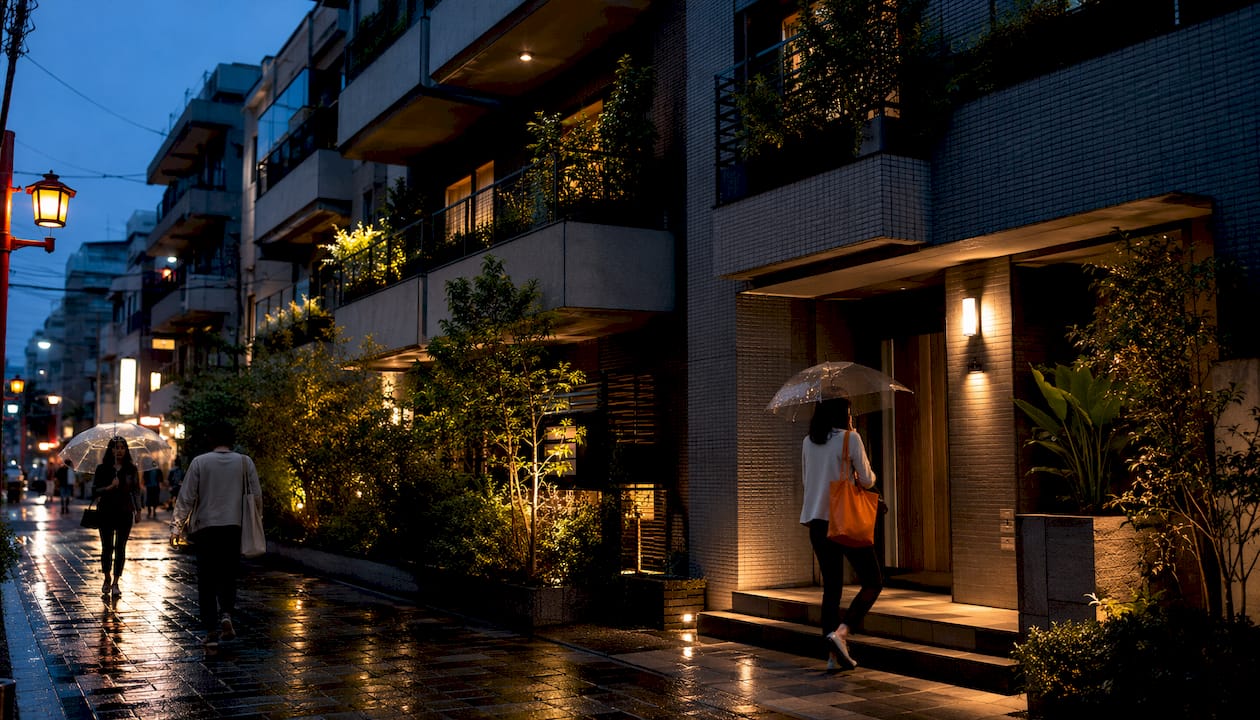
Rent by city and apartment size
| City / Area | 1R or 1K (studio) | 1DK or 1LDK (1-bed) | 2LDK (2-bed) |
|---|---|---|---|
| Tokyo central (Shibuya, Shinjuku) | ¥90,000–¥120,000 | ¥120,000–¥200,000 | ¥200,000–¥300,000 |
| Tokyo suburbs (30–40 min out) | ¥60,000–¥85,000 | ¥75,000–¥120,000 | ¥120,000–¥200,000 |
| Osaka | ¥50,000–¥75,000 | ¥70,000–¥100,000 | ¥110,000–¥160,000 |
| Fukuoka | ¥35,000–¥60,000 | ¥55,000–¥85,000 | ¥85,000–¥130,000 |
| Sapporo | ¥30,000–¥50,000 | ¥50,000–¥75,000 | ¥75,000–¥120,000 |
Japan Guide provides typical ranges for nationwide average rents and notes that central Tokyo rents are comparatively higher. Those figures align well with what you'll see on real estate portals like Suumo or Homes.jp.
Move-in costs: the number most guides bury
Initial move-in costs in Japan follow a formula that surprises almost every newcomer. For a mid-range Tokyo studio, initial move-in costs typically include security deposit, possible key money, agency fees, and guarantor company fees, which can collectively amount to several months' rent upfront.
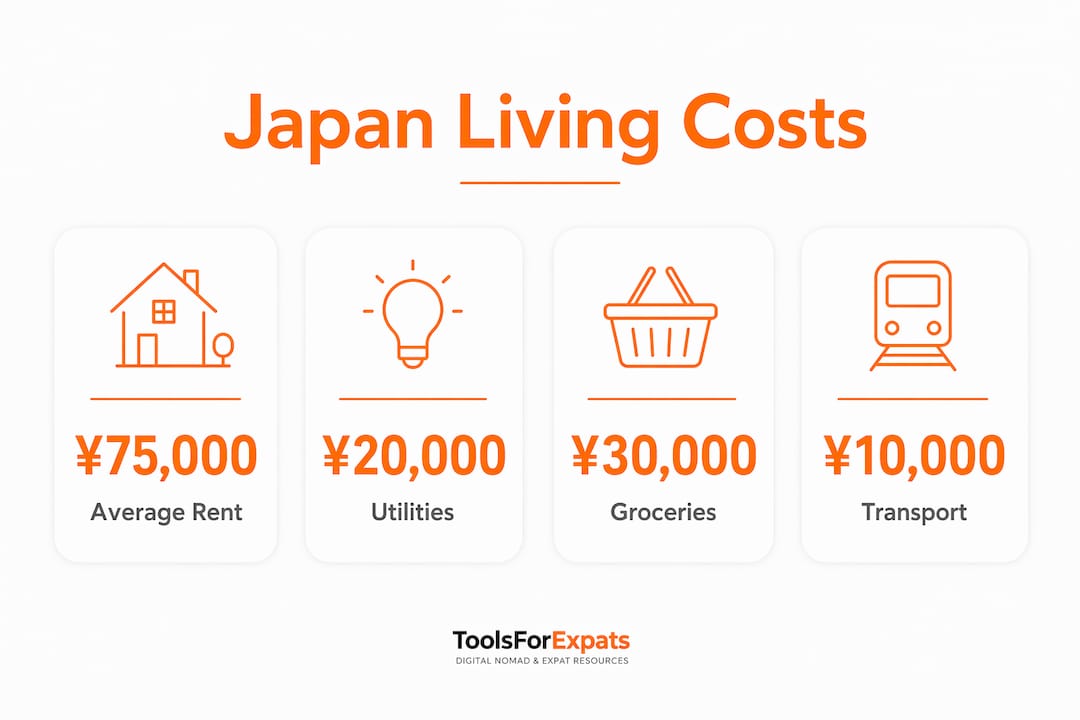
Monthly utilities
Japan Guide estimates average monthly utilities costs for a single person, noting typical expenses for electricity, gas, and water, with increases during peak seasons. Those figures are baseline. Summer air conditioning (June through September) and winter heating (December through February) can push electricity and gas bills 50–80% higher during peak months. Budget ¥18,000–¥25,000/month for utilities if you're in a region with harsh seasons.
Pro Tip: Apartments with newer insulation and inverter AC units run noticeably cheaper on electricity. When apartment hunting, ask about the building's construction year and whether the unit has a modern AC system.
2. What you'll spend on groceries and eating out
Food costs in Japan are genuinely manageable if you shop like a local. The challenge for newcomers is the first few months, when unfamiliarity with stores and habits leads to overspending.
A realistic monthly grocery basket (single person)
| Item | Approximate monthly cost |
|---|---|
| Rice (5 kg bag, lasts ~3–4 weeks) | ¥2,000–¥3,000 |
| Eggs (2–3 packs of 10) | ¥600–¥800 |
| Vegetables (seasonal mix) | ¥3,000–¥5,000 |
| Tofu, miso, soy sauce (staples) | ¥1,500–¥2,000 |
| Meat and fish | ¥5,000–¥10,000 |
| Dairy and beverages | ¥2,000–¥4,000 |
| Snacks and miscellaneous | ¥2,000–¥4,000 |
| Monthly total | ¥18,000–¥25,000 |
A thrifty cook shopping at discount supermarkets can keep groceries under ¥20,000/month. A balanced lifestyle with occasional convenience-store meals lands around ¥25,000–¥35,000. Frequent dining out pushes the food budget to ¥50,000 or more.
Eating out in Japan covers a huge range. A bowl of ramen or a teishoku (set meal) at a neighborhood restaurant runs ¥700–¥1,200. A mid-range sit-down dinner for one is typically ¥1,500–¥3,000. High-end dining or izakaya evenings with drinks can easily hit ¥5,000–¥10,000 per outing. If you eat out twice a week at mid-range spots, that adds roughly ¥12,000–¥24,000/month on top of groceries.
Saving strategies worth knowing:
- Shop at discount supermarkets (Gyomu Super, OK Store) rather than convenience stores for staples
- Hit the supermarket after 7 PM for marked-down bento boxes and prepared foods (typically 20–50% off)
- Buy seasonal produce at local markets; imported fruit is expensive, domestic fruit is reasonable
- 100-yen shops (Daiso, Seria) cover many household and pantry staples at a fraction of supermarket prices
- Convenience stores (konbini) are fine for occasional meals but expensive as a daily habit
3. How much does getting around Japan cost each month?
Public transit in Japan is frequent, reliable, and genuinely affordable for daily commuting. Cars are a different story.
IC cards and commuter passes
IC cards (Suica, Pasmo, ICOCA) are the standard way to pay for trains and buses. A single local ride in a city typically costs ¥200–¥500, depending on distance. For regular commuters, monthly passes (teikiken) reduce the per-trip cost substantially and cover unlimited rides on a fixed route. A 40-minute commute in Tokyo (say, Kawasaki to Shinjuku) runs roughly ¥15,000–¥20,000 for a monthly pass. Many Japanese employers reimburse commuting costs up to a set monthly cap, which can effectively make your transit budget zero.
Urban public transit users typically spend ¥5,000–¥20,000/month on transport, depending on commute distance and how often they travel beyond their regular route.
Car ownership: the real cost
Owning a car in Japan is expensive, especially in cities. Parking alone in central Tokyo runs ¥30,000–¥60,000/month. Add mandatory shaken (biennial vehicle inspection and road tax, which averages ¥60,000–¥120,000 every two years), insurance (roughly ¥5,000–¥10,000/month), and fuel, and a city car easily costs ¥60,000–¥100,000/month all-in. Outside major cities, parking is cheap or free, which makes car ownership far more practical in rural areas or smaller cities.
Public transit vs. car: quick comparison
- Public transit: lower monthly cost, no parking stress, employer reimbursement possible, limited flexibility for rural areas
- Car ownership: high monthly cost in cities, essential in rural Japan, shaken adds a biennial lump-sum expense, fuel costs vary by region
Pro Tip: If you're in Tokyo or Osaka, skip the car entirely for at least your first year. Rent one through services like Times Car Share or Careco when you need it for day trips.
4. What healthcare and insurance will cost you in Japan
Japan's healthcare system is genuinely good, and the cost structure is more predictable than most Americans expect.
National Health Insurance vs. Employee Health Insurance
All residents in Japan are required to enroll in one of two systems. If you're employed by a Japanese company, you'll join Employee Health Insurance (shakai hoken), with premiums split between you and your employer. If you're self-employed, a student, or a freelancer, you'll enroll in National Health Insurance (NHI, kokumin kenko hoken), administered by your local municipality.
NHI premiums are income-based, so they vary widely. A single person earning ¥3,000,000/year might pay roughly ¥20,000–¥30,000/month in NHI premiums. Someone with lower income pays less; higher earners pay more. Employee Health Insurance premiums are typically lower for the same income level because the employer covers half.
Co-pays and out-of-pocket costs
Under both systems, the standard patient co-pay is 30% of the official treatment cost. A typical GP or outpatient visit costs ¥1,000–¥3,000 out of pocket after the co-pay. Japan also has a monthly out-of-pocket cap (kōgaku iryōhi seido) for high medical expenses, which limits catastrophic costs for most income brackets.
What's covered and what isn't:
- Covered: most doctor visits, hospital stays, surgeries, prescriptions, maternity care
- Partially covered: some dental procedures (basic extractions and fillings yes; cosmetic or implant work, no)
- Not covered: routine vision care, most dental cosmetics, elective procedures
Expect to pay ¥5,000–¥15,000/month for glasses or contact lenses out of pocket. Dental cleanings run ¥2,000–¥5,000 per visit with partial coverage.
Pro Tip: New arrivals on short-stay visas should carry travel health insurance until they're enrolled in NHI. The enrollment window after arrival is short, and gaps in coverage can be costly.
5. Connectivity and recurring household costs
Japan has excellent mobile and broadband infrastructure. The cost depends on whether you're staying short-term or committing to a long-term contract.
Mobile plans:
- MVNO (budget carriers): ¥1,500–¥3,000/month for a data-only or voice+data SIM (IIJmio, Mineo, Rakuten Mobile are common options)
- Major carriers (Docomo, SoftBank, au): ¥5,000–¥8,000/month for unlimited data plans
- eSIM or pocket Wi-Fi (short stays): ¥3,000–¥6,000/month, no contract required
Home broadband:
Fiber internet (NTT Flets, NURO, Softbank Hikari) typically runs ¥4,000–¥6,000/month after the first few months. Setup and router fees can add ¥10,000–¥20,000 upfront. Many apartments now include internet in the rent, so check your lease before signing up for a separate contract.
Recurring household items:
- Streaming subscriptions (Netflix, Disney+, Amazon Prime Japan): ¥600–¥1,500/month each
- Laundry (coin laundry if no in-unit machine): ¥1,000–¥3,000/month
- Household consumables (cleaning products, toiletries): ¥3,000–¥6,000/month
Pro Tip: For stays under three months, an eSIM or pocket Wi-Fi is almost always cheaper than a full carrier contract, which typically requires a 12–24 month commitment and a Japanese bank account.
6. Entertainment, personal care, and other monthly costs
These categories are highly variable, but they add up faster than most budgets account for.
Entertainment:
- Movie ticket: ¥1,800–¥2,000 (discount days drop this to ¥1,100–¥1,300)
- Karaoke (1–2 hours): ¥500–¥2,000 depending on time of day and location
- Café visit: ¥500–¥1,200 for coffee and a light snack
- Monthly entertainment budget (moderate): ¥10,000–¥25,000
Personal care:
- Men's haircut at a basic barber (QB House style): ¥1,200–¥1,500
- Women's cut and style at a mid-range salon: ¥4,000–¥8,000
- Monthly personal care total: ¥3,000–¥10,000
Childcare and education:
This is where family budgets can diverge sharply. Public daycare (hoikuen) costs ¥0–¥30,000/month depending on income and municipality. Private daycare or international preschool runs ¥50,000–¥150,000/month. International schools for school-age children typically charge ¥1,500,000–¥3,000,000/year in tuition. Families relying on international schooling should treat education as a major budget line, not a miscellaneous item.
Miscellaneous buffer:
Clothing, household repairs, gifts, and unexpected costs add ¥10,000–¥20,000/month for most people. Building a 10–15% contingency into your monthly budget is a reasonable habit, especially in your first year.
7. How costs change by city and lifestyle: four sample budgets
Regional variation in Japan is significant. Moving from central Tokyo to a regional city like Fukuoka or Sendai can reduce your total monthly costs by 30–50%, often with minimal quality-of-life tradeoffs. Osaka sits in the middle: cheaper than Tokyo, more urban amenities than smaller cities.
Sample monthly budgets
| Profile | Rent | Food | Transport | Utilities + Internet | Other | Monthly Total |
|---|---|---|---|---|---|---|
| Student (share house, Tokyo) | ¥50,000 | ¥25,000 | ¥8,000 | ¥8,000 | ¥10,000 | ~¥100,000 |
| Single worker (Tokyo suburbs) | ¥75,000 | ¥40,000 | ¥15,000 | ¥18,000 | ¥20,000 | ~¥160,000 |
| Family 2 adults + 1 child (Osaka) | ¥120,000 | ¥75,000 | ¥20,000 | ¥25,000 | ¥50,000 | ~¥280,000 |
| Digital nomad (short-stay Tokyo) | ¥120,000 | ¥50,000 | ¥12,000 | ¥10,000 | ¥25,000 | ~¥200,000 |
Assumptions: Student share house includes shared utilities; single worker uses public transit with partial employer reimbursement; family includes basic childcare and no international schooling; digital nomad uses a furnished monthly rental and pocket Wi-Fi.
Can you live on ¥100,000/month? Technically yes, in a share house outside central Tokyo or in a regional city, if you cook at home and use public transit. Resident.com's 2026 guide puts a frugal single-person budget at around ¥150,000/month, which is a more realistic floor for most people once you include all categories.
Is $40,000/year enough? At roughly ¥5,000,000/year (depending on exchange rates), that's about ¥416,000/month, which is comfortable for a single person almost anywhere in Japan and workable for a couple in a regional city.
8. Japan vs. the USA: how do costs actually compare?
Many Americans overestimate Japan's costliness because they compare Tokyo luxury neighborhoods to U.S. average costs. The reality is more nuanced, and often more favorable than the reputation suggests.
Category-by-category comparison:
- Housing: Tokyo central is expensive by Japanese standards but often cheaper than New York, San Francisco, or Boston. A comparable apartment in Osaka or Fukuoka typically costs 40–60% less than a similar unit in a mid-tier U.S. city.
- Food: Groceries in Japan run cheaper for staples like rice, tofu, fish, and vegetables. Imported goods and Western-style products cost more. Eating out at casual restaurants is generally cheaper in Japan than in the U.S.
- Transport: Public transit in Japan is significantly cheaper and more reliable than in most U.S. cities. Car ownership costs are comparable or higher in urban Japan due to parking.
- Healthcare: Out-of-pocket costs for routine care are lower in Japan under NHI or Employee Health Insurance than under typical U.S. insurance plans, though premiums vary by income.
- Utilities: Broadly comparable to U.S. costs, with seasonal spikes similar to northern U.S. states.
- Purchasing power: Wise reports an average monthly net salary of around $1,953 equivalent in Japan. U.S. salaries in comparable roles are generally higher, which means Americans earning U.S. income while living in Japan often find their purchasing power stretches further.
Where Japan is usually cheaper than the U.S.:
- Casual dining and convenience food
- Public transportation
- Routine healthcare visits
- Fresh produce and local staples
Where Japan can cost more:
- Imported Western groceries and alcohol
- Car ownership in cities
- International schooling
- Large apartments in central Tokyo
Pro Tip: Cross-country cost comparisons shift with the yen-dollar exchange rate. When the yen is weak (as it has been recently), American income goes further in Japan. Use the cost comparison tool on ToolsForExpats to run a live Japan vs. U.S. scenario with your actual income.
9. Practical ways to lower your monthly spending in Japan
The good news: Japan's living costs are highly controllable. Small decisions about location, housing type, and daily habits compound into meaningful monthly savings.
- Choose location over apartment size. A 1K in Tokyo's suburbs costs 30–40% less than the same size in central wards. The train ride adds 20–30 minutes but saves ¥30,000–¥50,000/month in rent.
- Start in a share house. Share houses eliminate key money, reduce deposits, and include utilities and internet in one monthly fee. They're ideal for your first 3–6 months while you learn the market.
- Use an MVNO mobile plan. Switching from a major carrier to an MVNO like IIJmio or Rakuten Mobile cuts your phone bill from ¥6,000–¥8,000/month to ¥1,500–¥3,000/month.
- Shop at Gyomu Super or OK Store. These discount supermarkets stock bulk staples at prices 20–40% below convenience stores and standard supermarkets.
- Hit the supermarket after 7 PM. Marked-down prepared foods and bento boxes are a legitimate daily strategy, not a last resort.
- Optimize your commuter pass. If your employer reimburses commuting costs, make sure your registered route is accurate and covers your actual daily travel.
- Look for listings without key money (reikin-nashi). These exist in every city and are increasingly common in newer buildings. Filtering for them on Suumo or Homes.jp saves you 1–2 months' rent upfront.
- Use UR Housing for long-term rentals. UR (Urban Renaissance Agency) apartments have no key money, no agent fee, and no guarantor requirement. The trade-off is limited availability and a minimum income requirement.
- Rent furnished short-term while you search. A monthly rental or share house for your first 1–2 months lets you explore neighborhoods before committing to a long lease, avoiding a costly mismatch.
- Track seasonal utility spikes. Set aside an extra ¥5,000–¥10,000/month in July–September and December–February for higher electricity and gas bills. Budgeting for the average and getting hit by the peak is a common first-year mistake.
10. How to build your personal Japan budget with ToolsForExpats
Generic ranges are a starting point. Your actual budget depends on your city, household size, lifestyle, and income, and the fastest way to get a number that fits your situation is to run it through a calculator built for exactly this purpose.
ToolsForExpats offers three free tools that are directly relevant to Japan budget planning, all accessible without creating an account:
- Cost of Living Comparison Tool: Compare Japan to your current U.S. city across housing, food, transport, and healthcare. Useful for the Japan vs. U.S. framing and for deciding between Japanese cities.
- Nomad Cost of Living Calculator: City-level budget tool for digital nomads. Plug in Tokyo, Osaka, or Fukuoka to get a tailored monthly estimate based on your lifestyle inputs.
- Moving Abroad Budget Calculator: Covers both one-time move-in costs and recurring monthly expenses, so you can plan your liquidity buffer alongside your monthly budget.
Worked example: A single earner planning to move to Tokyo, renting a 1K in the suburbs (¥75,000/month), eating a mix of home cooking and occasional dining out, and using public transit would input those parameters into the Nomad Cost Calculator. The tool returns a personalized monthly total across all categories, which you can then adjust by swapping Tokyo for Osaka or changing your rent target.
Pro Tip: Run two scenarios back to back: one frugal (share house, MVNO plan, mostly home cooking) and one comfortable (private 1K, mid-range dining twice a week, occasional travel). The gap between those two numbers is your lifestyle budget range, and knowing it before you arrive is genuinely useful.
Key Takeaways
Japan's living costs are manageable and often lower than Americans expect, but rent and upfront move-in fees are the two variables that most frequently derail first-year budgets.
| Point | Details |
|---|---|
| Rent drives everything | A single person's monthly total ranges from ~¥100,000 (share house) to ¥280,000+ depending on city and apartment type. |
| Move-in costs are large | Initial fees of 4–6 months' rent are common in Tokyo; plan a ¥700,000–¥1,000,000 buffer before arrival. |
| Utilities spike seasonally | Average utilities run ~¥13,000/month but can climb 50–80% higher in summer and winter peak months. |
| Regional cities cut costs sharply | Moving to Fukuoka or Sendai instead of central Tokyo can reduce total monthly costs by 30–50%. |
| ToolsForExpats calculators | The free Cost of Living Comparison and Nomad Cost Calculator let you build a personalized Japan budget without creating an account. |
What newcomers consistently underestimate about Japan's costs
The numbers in this article are accurate, but there's a gap between knowing the figures and being ready for what actually happens when you land.
Move-in costs are the most common shock. Most people read "1–2 months' security deposit" and stop there. They don't account for the guarantor company fee, the agency commission, and the fact that key money, while less universal than it once was, still appears on a meaningful share of Tokyo listings. You can walk into a perfectly reasonable apartment search and find yourself writing checks totaling ¥700,000–¥1,000,000 before you've spent a single night there.
The second underestimated item is furniture. Japan's apartments come empty. No appliances, no curtains, sometimes no light fixtures. A basic setup (bed, desk, small fridge, washing machine, curtains, kitchen gear) runs ¥100,000–¥200,000 for budget options from Nitori or second-hand shops, and more if you want anything comfortable. Factor that into your arrival budget alongside the deposit.
Seasonal energy bills catch people off guard too. The first August electricity bill after running AC daily is a genuine surprise for newcomers from mild climates. The same goes for January heating in northern cities like Sapporo.
One pattern worth noting: people who moved from central Tokyo to Osaka or Fukuoka after their first year consistently report that the quality-of-life tradeoff was minimal while the financial relief was substantial. A ¥40,000–¥60,000/month rent reduction compounds into real savings quickly. If you're not tied to Tokyo for work, it's worth running the numbers on a regional city before you commit.
A practical minimum: keep three months of your expected total monthly budget in liquid savings before you arrive. That covers move-in costs, furniture, and the first few weeks of figuring out your actual spending patterns.
Plan your Japan budget before you book the flight
Knowing the ranges is one thing. Knowing your number, for your city, your household size, and your lifestyle, is what actually lets you plan with confidence.
ToolsForExpats gives you three free calculators that do exactly that, no account required. The Cost of Living Comparison Tool lets you put Japan side by side with your current U.S. city so you can see the real gap across housing, food, and transport. The Nomad Cost of Living Calculator breaks down city-level monthly estimates for Tokyo, Osaka, Fukuoka, and more. And the Moving Abroad Budget Calculator covers both your one-time arrival costs and your ongoing monthly budget in one place.
Run your frugal scenario and your comfortable scenario. Compare two cities. See what changes when you adjust your rent target. All of it takes about five minutes and costs nothing. Head to ToolsForExpats and build your Japan budget today.
Useful sources and further reading
These are the primary sources behind the figures in this article. Each one serves a different purpose, so knowing which to use for what saves time.
- Numbeo: Cost of Living in Japan — Crowdsourced price data updated monthly. Best for current per-item prices (groceries, restaurants, transport) and rent ranges by city. Updated July 2026.
- Japan Guide: Prices and Living Costs — Practical category-by-category breakdowns with utility estimates and saving tips. One of the most reliable general references for newcomers.
- Wise: Cost of Living in Japan 2026 — Per-item averages for food, transport, and broadband, plus salary context. Useful for Americans comparing purchasing power.
- Gaijin Blog: Cost of Living in Japan for Foreigners (2026) — Detailed city-by-city breakdowns and practical expat perspective on rent vs. Western cities. Strong on move-in cost realities and regional savings.
- Resident.com: Living Costs in Japan 2026 — Budget tiers (frugal, moderate, upscale) with government statistics context. Good for macro trend awareness.
- ToolsForExpats: Free Expat Calculators — Free tools for personalized Japan budgets, city comparisons, and move-in cost planning. No account required.