
A single person moving to Canada can expect to spend a wide monthly range depending on city, while a family of four typically lands in a higher range including rent. Those are wide bands, and that width is the point: your choice of province and city is the single most consequential financial decision you will make before you land. Canada.ca confirms that most Canadian households spend 35%–50% of income on housing and utilities alone, which means getting city selection wrong can cost you hundreds of dollars every month before you buy a single grocery item.
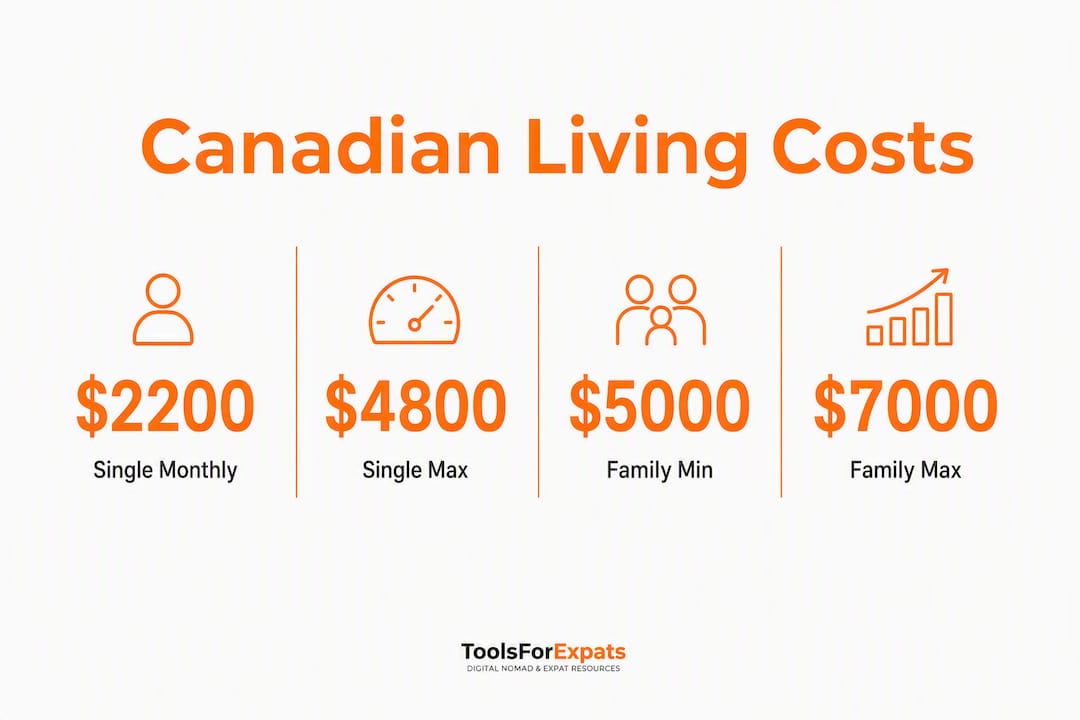
The fastest way to cut through those national averages is to run your specific city scenario through the ToolsForExpats cost comparison tool, which generates city-level budgets you can actually use for planning. The sections below give you the framework to understand what drives those numbers.
What does the cost of living in Canada actually look like nationally?
National averages are a starting point, not a budget. The table below shows what most sources, including Numbeo's July 2026 data and aggregated 2026 reporting, converge on for typical monthly ranges.
| Household type | Monthly cost (excl. rent) | Monthly cost (incl. rent) | Suggested income band |
|---|---|---|---|
| Single person | $2,200–$4,800 | $2,200–$4,800 | moderate income range |
| Couple (no children) | — | — | moderate income range |
| Family of four | $5,000–$7,000 | $5,000–$7,000 | higher income range |
The "excluding rent" column exists because Numbeo and Expatistan both publish figures that strip out shelter costs, which lets you isolate how much city choice changes your non-housing expenses. The gap between the low and high ends of the "including rent" column is almost entirely explained by where you live, not how you live.
Provincial spread adds another layer. Rent data shows a notable difference between the cheapest and most expensive provinces. That 30%+ regional variance means a national average is genuinely misleading if you are budgeting for a specific city.
Pro Tip: Never use a national average to build a city-specific budget. Run your target city through the ToolsForExpats nomad cost calculator to get figures that actually reflect local rent, transit, and tax rates.
Breaking down your monthly expenses in Canada
Housing dominates every Canadian budget, but the other categories matter more than most newcomers expect. Here is how the major expense lines typically break down.

| Category | Typical monthly range | Notes |
|---|---|---|
| Rent (1BR, city center) | varied widely | Highest in Vancouver and Toronto |
| Groceries | varies by household size | varies by household size |
| Transportation | typical transit pass ranges | Car ownership adds significant costs |
| Utilities + heating | ranges vary by season and province | Spikes in winter in colder provinces |
| Internet + phone | monthly costs vary | Bundle deals available |
| Childcare | varies widely by province | Quebec's subsidized system is notably cheaper |
| Health insurance (private) | ranges vary | Required during provincial waiting periods |
| Entertainment + dining | varies by lifestyle | Highly discretionary |
A few categories deserve extra attention. Heating is the most commonly underestimated line item: in Manitoba, Saskatchewan, or northern Ontario, winter gas and electricity bills can run $300–$500/month, well above the year-round average; budget for peak winter months separately rather than smoothing them into an annual average.
Childcare is the other major variable. Licensed daycare runs $500–$2,000 per child per month depending on province, but Quebec's subsidized CPE system brings that cost down dramatically compared to market rates in Ontario or British Columbia. For families, provincial childcare policy alone can swing the monthly budget by more than $1,500.
Sales tax also shifts your purchasing power. Alberta charges only 5% GST with no provincial sales tax, while provinces with HST or combined PST/GST can reach 13%–15%. On large purchases like furniture, appliances, or a car, that gap is real money.
Categories you can realistically optimize: groceries (store brands, ethnic grocery stores), entertainment, dining out, and phone plans. Categories that are largely fixed once you sign a lease: rent, utilities, transit passes, and insurance premiums.
How costs differ across Canada's major cities
City choice changes your budget more than any lifestyle adjustment you can make. The table below shows approximate one-bedroom rent ranges and a brief note on what makes each city expensive or affordable.

| City | 1BR rent (city center) | 1BR rent (suburbs) | Key cost driver |
|---|---|---|---|
| Toronto | — | — | Housing demand, 13% HST |
| Vancouver | — | — | Housing scarcity, high transit costs |
| Ottawa | — | — | Government-sector demand |
| Calgary | — | — | No provincial income tax, 5% GST |
| Montreal | — | — | Rent control legacy, subsidized childcare |
| Halifax | — | $1,000–$1,500 | Growing demand, lower baseline wages |
| Winnipeg | $1,000–$1,500 | — | Lowest rents, cold climate heating costs |
Toronto and Vancouver are among the most expensive cities for shelter, and that cost influences other expenses: parking, dining, and services often price at a premium in dense urban cores. Montreal is the standout affordable major city, combining relatively low rents with Quebec's subsidized childcare and a rich cultural scene. Calgary benefits from Alberta's tax structure: no provincial income tax and 5% GST only, which meaningfully increases take-home pay compared to Ontario or BC at similar gross salaries.
Halifax and Winnipeg are often overlooked by newcomers focused on the big three. Both offer significantly lower rents, though Halifax has seen demand rise sharply in recent years, and Winnipeg's heating bills in January and February can offset some of the rent savings.
Pro Tip: If you are comparing a high-salary offer in Toronto against a lower offer in Calgary or Montreal, calculate net disposable income after rent and tax, not just gross salary. The city with the lower headline number often wins on actual purchasing power. Use the ToolsForExpats city comparison tool to run that math before you decide.
Your pre-move financial checklist
Getting to Canada financially prepared means more than having first and last month's rent. Most newcomers underestimate the cash they need in the first 30–90 days.
Canada.ca recommends arriving with 6–12 months of living expenses saved. That is a wide range, but the logic is sound: provincial health coverage has a waiting period of up to three months in most provinces, employment can take weeks to secure, and upfront costs stack fast.
Here is a practical numbered checklist to work through before you book your flight:
- Calculate your proof-of-funds requirement. Immigration, Refugees and Citizenship Canada sets minimum thresholds by family size. Check the current figures on Canada.ca for your specific program.
- Save first and last month's rent plus a damage deposit. In most provinces that is 2–3 months of rent before you have keys.
- Budget for utility connection deposits. Hydro, gas, and internet providers often require deposits from newcomers with no Canadian credit history.
- Purchase private health insurance for the waiting period. Most provinces impose a 3-month wait before provincial coverage activates. Short-term international health plans fill that gap.
- Set aside a furniture and setup fund. A basic furnished apartment setup (bed, desk, kitchen basics) runs $1,500–$4,000 depending on whether you buy new or secondhand.
- Buy a transit pass or budget for a vehicle. A monthly transit pass costs $100–$200 in most cities; factor this in from day one.
- Plan for phone setup costs. A SIM card and first month of a Canadian plan typically runs $50–$120.
- Build a 3-month emergency buffer on top of all of the above. Job searches, lease surprises, and unexpected medical costs are common in the first year.
Pro Tip: Use the ToolsForExpats moving abroad budget calculator to map every upfront cost before you leave. It is easier to adjust a spreadsheet than to scramble for cash after landing.
Sample monthly budgets for different households and cities
The budgets below are worked examples, not guarantees. They reflect realistic 2026 cost ranges for three household types across low-cost and high-cost scenarios.
Low-cost city scenario (e.g., Winnipeg or Montreal)
| Line item | Single | Couple | Family of four |
|---|---|---|---|
| Groceries | — | — | $1,000 |
| Transportation | — | — | $300 |
| Utilities + heating | — | $200 | — |
| Internet + phone | — | — | $200 |
| Insurance | $90 | — | — |
| Entertainment + other | $200 | — | — |
| Total | $2,200 | $3,200 | $5,000 |
High-cost city scenario (e.g., Toronto or Vancouver)
| Line item | Single | Couple | Family of four |
|---|---|---|---|
| Rent | $2,600 | $3,200 | $3,800 |
| Groceries | $500 | $850 | — |
| Transportation | — | $320 | $400 |
| Utilities + heating | $200 | — | $300 |
| Internet + phone | $150 | $180 | — |
| Childcare | — | — | $1,800 |
| Insurance | $120 | $200 | $280 |
| Entertainment + other | $300 | $500 | — |
| Total | $4,800 | $5,900 | $8,200 |
The median after-tax household income in Canada means a single person in a high-cost city can spend a large portion of take-home pay on rent alone, leaving little room for savings. That affordability pressure is why city selection deserves more weight than most newcomers give it.
To adapt these budgets: subtract or add roughly $400–$800/month per step up or down in city cost tier, and adjust childcare by province using the Quebec vs. Ontario gap as your reference range.
Why a higher salary in Toronto doesn't always mean more money
The salary-versus-cost trade-off is one of the most misunderstood dynamics in Canadian relocation planning. A job offer in Toronto at $90,000 gross looks better than one in Calgary at $75,000, but the after-tax, after-rent picture often reverses that.
Ontario's combined federal and provincial income tax on $90,000 is meaningfully higher than Alberta's on $75,000 (Alberta has no provincial income tax). Add $2,600/month in Toronto rent versus $1,600 in Calgary, and the Toronto earner can end up with less discretionary income despite the higher headline number. Higher median salaries in Toronto and Vancouver are frequently neutralized by higher shelter and transit costs, and a job's headline salary must be compared to city-level net disposable income, not national averages.
The practical calculation: take gross salary, subtract federal and provincial income tax for that province, subtract average rent for a comparable unit, and compare what remains. That remainder is your real quality-of-life number.
Pro Tip: When evaluating competing job offers in different cities, ask whether the employer offers remote-work flexibility. Even two or three days per week working remotely from a lower-cost suburb can reduce commuting costs by $150–$300/month and open up cheaper rental markets.
Where the numbers come from and how to get your own estimates
The figures in this guide draw from several sources, each with different methodologies worth understanding before you rely on them.
- Statistics Canada — publishes official Consumer Price Index data and household expenditure surveys, which are the most methodologically rigorous figures but lag real-time market conditions by 6–18 months.
One distinction that trips up many readers: figures that "exclude rent" are useful for comparing lifestyle costs between cities, but they will understate your actual monthly spend significantly. Always confirm whether a quoted number includes or excludes shelter before using it in a budget.
The fastest way to produce a personalized, city-specific estimate is to use the ToolsForExpats cost comparison tool. It aggregates public data and crowd-sourced indexes to generate side-by-side city budgets you can adjust by household size and lifestyle.
Practical ways to reduce your monthly costs in Canada
Cutting costs in Canada is possible, but the high-impact moves are mostly structural, not behavioral. Here is where the real savings live.
- Choose your neighborhood deliberately. Rents in inner suburbs are often 20%–35% lower than city-center equivalents with comparable transit access. Research transit maps before signing a lease.
- Time your move to avoid peak rental season. May through August is peak moving season in most Canadian cities. Landlords have more leverage then. Moving in October through February often means more negotiating room on rent or included utilities.
- Use Quebec's childcare system if you have young children. Quebec's subsidized CPE daily rate is one of the most significant financial advantages in Canadian provincial policy. For families with two children, the savings versus Ontario market rates can exceed $2,000/month.
- Stack cashback on fixed costs. Rent and utilities are hard to cut, but fintech platforms that earn cashback on bill payments let you recover 1%–2% on otherwise non-negotiable expenses. Over 12 months, that adds up on a $2,000+ monthly rent payment.
- Bundle internet and phone services. Canadian telecoms offer meaningful discounts when you bundle home internet with a mobile plan. The savings are modest ($20–$40/month) but require no behavior change.
- Apply for provincial newcomer programs. Several provinces offer transit subsidies, settlement grants, or subsidized language training that reduces indirect costs. Check your destination province's settlement services page.
- Buy secondhand furniture and appliances. Facebook Marketplace and Kijiji are active in every Canadian city. Furnishing a one-bedroom apartment secondhand versus new can save $2,000–$4,000 upfront.
- Negotiate rent on longer lease terms. Landlords in slower rental markets (Calgary, Winnipeg, Halifax off-peak) will often accept a rent reduction in exchange for a 24-month lease commitment.
Pro Tip: For fixed costs like rent and utilities, use low-fee international payment rails and cashback platforms that specifically support those payment types. Recovering 1%–2% on $2,500/month in fixed costs is $25–$50 back every month with zero lifestyle change. For more on managing money across borders, the ToolsForExpats guide to offshore accounts covers the mechanics.
Key Takeaways
Canada's cost of living is manageable with the right city choice and a realistic budget: housing is the dominant variable, and choosing a lower-cost city can save a family of four more than $3,800 per month compared to Toronto or Vancouver.
| Point | Details |
|---|---|
| National monthly ranges | Single: $2,200–$4,800; family of four: $5,000–$7,000, depending on city. |
| Housing dominates the budget | Rent consumes 30%–50% of take-home pay in expensive cities; it is the highest-leverage decision you make. |
| City choice matters most | Provincial costs vary by more than 30%; Quebec's childcare and Alberta's tax structure are major budget factors. |
| Prepare for upfront costs | Arrive with 6–12 months of expenses saved; budget for deposits, private health insurance, and a 3-month emergency buffer. |
| ToolsForExpats calculators | Use the free cost comparison tool to generate city-specific budgets before you commit to a location. |
Why city selection is the one decision you cannot undo easily
Most newcomers spend more time researching Canadian visa categories than they do comparing city costs, and that is the wrong order. A visa gets you into the country. Your city choice determines whether you can afford to stay.
The numbers in this guide make that concrete. A family of four in Winnipeg or Montreal can live comfortably on $5,000–$7,000/month. The same family in Toronto or Vancouver needs $8,000–$9,000 to maintain a comparable lifestyle, and that gap is almost entirely structural: rent, childcare, and tax. No amount of grocery optimization closes a $3,000/month structural gap.
What I find most underappreciated in the standard cost-of-living conversation is the childcare variable. Most guides mention it briefly. But for a family with two young children moving from Ontario to Quebec, the savings from the subsidized CPE system alone can exceed $3,000/month. That is not a rounding error. It is a life-changing financial difference that should drive provincial selection for families just as much as job market or language preference.
The salary-versus-cost trade-off deserves the same scrutiny. A $15,000 salary premium in Toronto sounds compelling until you subtract Ontario's higher provincial tax rate and $1,000+ in additional monthly rent. The math often does not favor the bigger city, and the people who figure that out before they sign a lease are the ones who build savings in year one instead of breaking even.
Plan deliberately. Run the numbers by city, not by national average. And give yourself the financial runway to make a considered decision rather than a pressured one.
Free tools to plan your Canadian budget before you land
ToolsForExpats gives you the city-specific numbers you need before you commit to a location, and every tool is free with no account required.

The cost of living comparison tool lets you run side-by-side budgets for any two Canadian cities, adjusting for household size and lifestyle. The moving abroad budget calculator maps your upfront relocation costs, from flights and deposits to furniture and health insurance, so you know exactly how much cash to have ready before you land. For remote workers and digital nomads weighing multiple Canadian cities, the nomad cost calculator at ToolsForExpats generates city-level cost scenarios you can compare against your current income.
These tools draw on the same aggregated data sources described in this guide, Numbeo, Expatistan, and public datasets, and present them in a format built for relocation planning rather than academic research. Start with the cost comparison tool, enter your target city and household size, and you will have a working budget in under five minutes.
Useful sources
The figures in this guide are drawn from the following primary and aggregated sources. Where crowd-sourced indexes are used, treat them as directional benchmarks and verify current figures before finalizing a budget.
- Prepare financially, Canada.ca: Government of Canada guidance on proof-of-funds requirements, housing cost benchmarks, and settlement financial planning. Authoritative for immigration-related financial thresholds.
- Numbeo: Cost of Living in Canada, updated July 2026: Crowd-sourced price index covering hundreds of Canadian cities, with separate figures excluding and including rent. Updated continuously by user submissions.
- Expatistan: City-level cost comparison index using a similar crowd-sourced model. Particularly useful for comparing your current city against a Canadian destination to get a relative cost index. (No single URL provided; search "Expatistan Canada" for current city pages.)
- Cost of Living in Canada 2026: Real Monthly Budgets by City, MoneyAbroadGuide: Aggregated 2026-priced estimates for single-person and family budgets by city, including childcare and tax notes.
- Average cost of living in Canada by province 2026, Neobanc: Provincial breakdown including April 2026 national average rent data and cashback strategy notes.
- Average cost of living in Canada, Spergel: Provincial sales tax comparison and spending-power analysis by province.
- Canadian income tax rates, Canada Revenue Agency: Federal and provincial income tax rate tables for calculating net take-home pay by province.
- Canada Health Care System, Health Canada: Overview of provincial health coverage structure and eligibility, relevant to understanding waiting periods for newcomers.
A note on crowd-sourced indexes: Numbeo and Expatistan reflect self-reported prices from users in each city. They are accurate as directional benchmarks but can lag rapid rent changes by a few months. For the most current rent data, cross-reference with local listing platforms in your target city. For personalized, city-specific budget estimates, run your scenario through the ToolsForExpats cost comparison tool.
This article provides general financial information for planning purposes. It is not professional financial or immigration advice. Verify current proof-of-funds requirements, tax rates, and provincial health coverage rules directly with Canada.ca or a qualified professional before making relocation decisions.