
A single adult living in New York City should plan for a broad range of total monthly expenses including rent, reflecting different lifestyle choices. That wide range reflects real choices: a frugal setup in the Bronx looks nothing like a modest one-bedroom in Brooklyn, and both are miles from Manhattan. Families with one child typically need a significantly higher monthly budget to cover the basics without running a deficit.
Here are the gross salary benchmarks that map to each lifestyle tier:
- Bare-bones (outer borough, roommates): a gross salary range consistent with lower monthly take-home pay
- Modest (outer borough, solo or shared 1BR): a gross salary range supporting moderate monthly net income
- Comfortable (Brooklyn/Queens, solo 1BR or Manhattan share): a higher gross salary tier enabling comfortable net income
Can you live on $3,000/month? Technically yes, but only with roommates, a long commute, and zero savings buffer. About $5,000 per month can cover a modest outer-borough lifestyle with some breathing room. Around $8,000 per month can provide a comfortable Brooklyn or lower-Manhattan setup with savings and discretionary spending.
One critical note: 62% of New York City residents do not have the resources to meet the full cost of living even after accounting for government support. That figure comes from the NYC True Cost of Living measure, which counts housing, food, healthcare, childcare, transportation, taxes, and savings together. It's a sobering baseline for anyone planning a move.
How your monthly costs break down by category
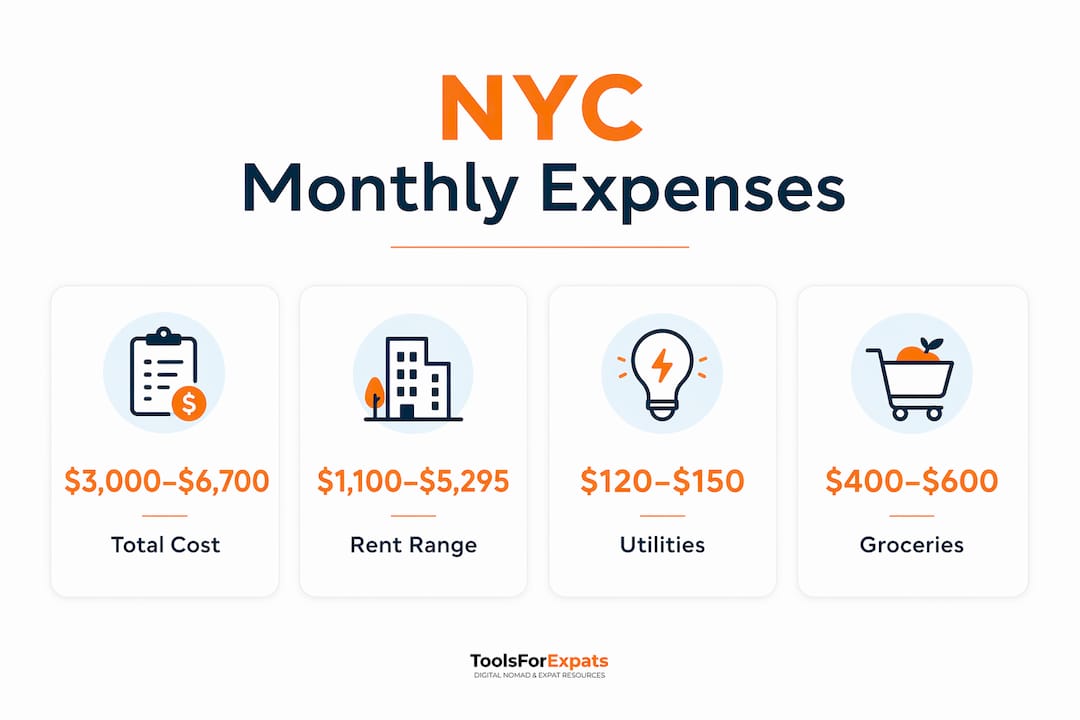
The table below shows typical monthly costs for a single adult. Ranges reflect outer-borough frugal to Manhattan comfortable.

| Category | Low | Median | High | Notes |
|---|---|---|---|---|
| Rent (1BR) | — | $4,350 | $5,295+ | Brooklyn median $4,350; Manhattan median $5,295 (both as of June 2026) |
| Utilities (electric, gas) | $80 | $130 | $200 | Heat sometimes included in rent |
| Internet | $50 | — | $100 | Standalone; often bundled |
| Groceries | $300 | — | $600 | One person; store choice matters |
| Dining out / delivery | $100 | $250 | $500 | Highly variable by habit |
| Transportation | $50 | $132 | $300 | Unlimited MetroCard vs. rideshare mix |
| Health insurance | $150 | $300 | $600 | Employee contribution; ACA varies |
| Personal / misc. | $100 | $200 | $400 | Laundry, subscriptions, personal care |
A few sample item prices worth knowing before you shop:
- Dozen eggs: $4–$6
- Gallon of milk: $4–$5.50
- Loaf of bread: $3.50–$5
- Drip coffee at a café: $3–$5
- Basic lunch at a sit-down restaurant: $18–$28
- Netflix or similar streaming: $15–$23/month
- Monthly gym membership: $30–$150 depending on chain vs. boutique
What's sometimes included in rent: Heat and hot water are commonly bundled in older buildings and rent-stabilized units, especially in the Bronx and parts of Queens. Electricity and internet are almost always separate. Always ask before signing.
What you'll actually pay for rent by borough and apartment type
Manhattan median rent hit $5,295 in June 2026, a new record, while Brooklyn median rent reached $4,350 in the same period. Active listings in Manhattan fell 16% year-over-year, which means less negotiating leverage for renters and faster leasing timelines. If you see something you like, you often have 24–48 hours to decide.
Here's how rents break down across boroughs and unit types:
| Borough | Studio | 1BR | 2BR | Notes |
|---|---|---|---|---|
| Manhattan | $4,200+ | $5,295 | $5,500–$8,000+ | Median 1BR $5,295 (June 2026); doorman buildings add $500–$1,000/mo |
| Brooklyn | $2,200–$3,200 | $4,350 | — | Median 1BR $4,350 (June 2026); North Brooklyn (Williamsburg) near Manhattan prices |
| Queens | — | $2,000–$3,200 | $4,200 | Astoria and LIC command premiums |
| Bronx | $1,400–$2,000 | $2,000–$2,500 | $2,200–$3,200 | Most affordable borough overall |
| Staten Island | $1,500–$2,200 | $1,800–$2,400 | $2,400–$3,500 | Longer commute; car often needed |
HUD Fair Market Rents for NYC are notably lower than these market medians. HUD's 1BR FMR runs around $2,700, compared to market medians above $4,000 in many boroughs. HUD figures are benchmarks for assistance programs, not a realistic guide to what you'll find on the open market.
Doorman vs. non-doorman: Doorman buildings typically cost $500–$1,000 more per month but include package handling, maintenance coordination, and a security layer. For most budget-conscious movers, a well-located non-doorman building in a safe neighborhood is the smarter trade-off.
The FARE Act context: The FARE Act, which shifted many broker fees from tenants to landlords, has been in effect for over a year. Some landlords have adjusted asking rents to offset those costs, particularly in non-doorman segments. You may not pay a broker fee directly anymore, but the economics often show up in the monthly rent.
Pro Tip: Search in neighborhoods one subway stop beyond your target area. Astoria instead of Long Island City, Crown Heights instead of Prospect Heights, and Kingsbridge instead of Inwood can save $300–$600/month on nearly identical apartments. February and March are historically the slowest rental months, giving you slightly more negotiating room on price or move-in date.
What utilities and internet actually cost each month
Utilities and internet together typically run $150–$300/month for a single adult, depending heavily on whether heat is included in your rent and how aggressively you run air conditioning in summer.
Monthly cost ranges to budget:
- Electricity: $60–$120 in moderate months; $120–$200 in July and August with A/C running
- Gas (when not included): $30–$80 in summer; $80–$150 in winter for heating
- Internet: $50–$100/month for standard broadband (Optimum, Verizon Fios, Spectrum are the main providers)
- Cell service: $30–$80/month depending on plan and carrier
Seasonal reality: New York summers are genuinely hot and humid. Window A/C units are standard in most apartments, and running one in a small bedroom adds $40–$80 to your electric bill in peak months. Winters push gas bills up sharply if you're responsible for your own heat. Budget $200–$250/month for utilities in January and February if heat is not included.
A few billing quirks worth knowing: ConEdison (the primary utility provider) uses estimated billing cycles, which can create surprise true-up charges. When you move in, request an actual meter read on day one. Some landlords split a building's master utility bill among tenants, which can make your monthly charge unpredictable. Ask how billing works before you sign.
Groceries and eating out: building a realistic food budget
Food costs in NYC run above the national average, but the gap is smaller than most people expect if you shop strategically.
| Item | Typical Price |
|---|---|
| Dozen eggs | $4–$6 |
| Gallon of whole milk | $4–$5.50 |
| Loaf of bread (sliced) | $3.50–$5 |
| Bag of salad greens | $4–$6 |
| Drip coffee (café) | $3–$5 |
| Lunch at a casual restaurant | $18–$28 |
| Dinner at a mid-range restaurant | $40.00–$—.00 per person |
Monthly grocery budgets by eating style:
- Frugal (cooking most meals, discount stores): $300–$380/month. Aldi, Trader Joe's, and ethnic grocery stores in Jackson Heights, Flushing, or Sunset Park are your best allies here.
- Average (mix of cooking and occasional takeout): $400–$500/month for groceries plus $150–$250 in dining and delivery.
- Food-forward (quality ingredients, regular dining out): $600–$900+/month combined.
Delivery apps inflate costs fast. A $15 lunch becomes $22–$26 after delivery fees, service fees, and a tip. If you order delivery three times a week, that habit alone adds $200–$350/month to your food budget. Meal planning two weeks at a time and batch cooking on Sundays cuts grocery waste and keeps the weekly spend predictable.
Transportation: MTA, rideshares, and whether a car makes sense
For most New Yorkers, the unlimited monthly MetroCard costs $132 and covers unlimited subway and local bus rides. That's the single most cost-efficient transportation decision you can make in the city.
Your main transit options:
- Unlimited MetroCard: $132/month, best if you commute five days a week
- Pay-per-ride: $2.90 per trip; better if you work from home most days and commute fewer than 23 times a month
- Express buses: Additional fare on top of MetroCard
- Rideshare (Uber/Lyft): $12–$20 for a short trip within a borough; $25–$45 for cross-borough rides; surge pricing can double those figures during peak hours or bad weather
The real cost of owning a car in NYC:
- Insurance: $2,400–$4,800/year (NYC rates are among the highest in the country)
- Parking: $300–$600/month for a garage spot in Manhattan; $150–$300 in outer boroughs
- Tolls: $100–$300/month depending on your routes and the MTA's congestion pricing zone
- Maintenance and registration: $1,200–$2,400/year
- Total annual cost: $12,000–$18,000/year, or $1,000–$1,500/month
That annualized car ownership cost makes the $132 MetroCard look like one of the best financial decisions you'll make in New York. Unless you have a specific professional need for a vehicle or live in a part of Staten Island with limited transit, skip the car entirely.
Practical verdict: Budget $132–$200/month for transit if you're subway-primary with occasional rideshares. Add $50–$100/month if you use rideshares regularly for late nights or weekend trips.

Healthcare and insurance: what to budget each month
Health insurance in New York is not optional, and the costs are real. What you pay depends heavily on whether your employer offers coverage.
- Employer-sponsored insurance (employee contribution): Typically $150–$400/month for an individual, depending on the plan tier and how much your employer covers
- ACA marketplace (individual, no employer coverage): $300–$700/month for a mid-tier silver plan, before subsidies; subsidies can reduce this significantly based on income
- Dental and vision add-ons: $20–$60/month each, often purchased separately
- Family coverage: Employer-sponsored family plans typically run $500–$1,200/month in employee contributions
Beyond premiums, plan for out-of-pocket costs. A typical urgent care visit runs $150–$300 after insurance. A specialist copay is usually $40–$80. Prescription costs vary widely. A reasonable monthly buffer for out-of-pocket medical expenses is $50–$150 for a healthy adult, and $200–$400 for a family.
The NYC True Cost of Living measure puts annual healthcare costs at over $19,000 for adults without children and over $27,000 for families with children. That figure includes employer premium contributions that don't show up in your paycheck but represent real compensation you're spending on coverage. It's a useful reminder that healthcare is one of the two largest cost categories in NYC, alongside housing.
Taxes and take-home pay: what your paycheck actually looks like
NYC residents pay three layers of income tax: federal (10%–37%), New York State (4%–10.9%), and NYC local (3.078%–3.876%). That stack meaningfully reduces what you actually bring home. For tax planning beyond the basics, higher earners in particular should review their withholding and deduction strategy early.
Here are three worked examples of gross-to-net conversion (approximate, single filer, standard deduction):
- $75,000 gross/year: Federal ~$12,000, NY State ~$5,200, NYC local ~$2,600, FICA ~$5,700. Take-home: roughly $49,500/year, or $4,125/month.
- $100,000 gross/year: Federal ~$18,000, NY State ~$7,800, NYC local ~$3,500, FICA ~$7,650. Take-home: roughly $63,000/year, or $5,250/month.
- $150,000 gross/year: Federal ~$32,000, NY State ~$14,000, NYC local ~$5,500, FICA ~$9,100. Take-home: roughly $89,400/year, or $7,450/month.
These are estimates. Your actual take-home depends on filing status, pre-tax deductions (401k, health insurance), and any tax credits. The key habit to build: always budget from your net monthly pay, not your gross salary. The difference between $100,000 gross and $5,250/month net surprises almost every first-time NYC resident.
Three sample monthly budgets with the math shown
These three scenarios show how rent, taxes, and living costs combine at different income levels. All figures are monthly and assume a single adult.
Bare-bones budget (Bronx or shared Queens apartment)
| Line Item | Monthly Cost |
|---|---|
| Rent (shared 2BR, your share) | $1,100 |
| Utilities (included in rent) | $0 |
| Internet | $55 |
| Dining out / delivery | $100 |
| Transportation (MetroCard) | $132 |
| Health insurance (employer) | $180 |
| Personal / misc. | $120 |
| Total | $2,007 |
Gross salary needed: ~$55,000–$60,000/year (take-home ~$3,400–$3,700/month). This leaves $1,400–$1,700 for savings, emergencies, and anything else. It works, but United Way NYC's analysis calls this a survival budget: there's no real cushion for childcare, unexpected medical costs, or saving for the future.
Modest budget (solo 1BR in Astoria or Crown Heights)
| Line Item | Monthly Cost |
|---|---|
| Rent (solo 1BR) | $2,200–$3,200 |
| Utilities | $120 |
| Groceries | $420 |
| Dining out / delivery | $200 |
| Transportation (MetroCard + occasional rideshare) | $175 |
| Health insurance | $250 |
| Personal / misc. | $200 |
| Total | $3,635 |
Gross salary needed: ~$85,000–$95,000/year (take-home ~$4,800–$5,400/month). This leaves $1,100–$1,700/month for savings, travel, and building an emergency fund. Comfortable enough to live well without constant financial stress.
Comfortable budget (solo 1BR in Brooklyn or lower Manhattan)
| Line Item | Monthly Cost |
|---|---|
| Rent (1BR, Brooklyn/Manhattan) | $4,350–$5,295 |
| Utilities | $150 |
| Internet | $80 |
| Groceries | $550 |
| Dining out / delivery | $400 |
| Transportation (MetroCard + rideshares) | $220 |
| Health insurance | $300 |
| Personal / misc. | $350 |
| Total | $5,850 |
Gross salary needed: ~$130,000–$150,000/year (take-home ~$7,200–$8,400/month). This leaves $1,350–$2,550/month for savings, travel, and discretionary spending. For young professionals building financial security, this tier is where saving for retirement and an emergency fund becomes genuinely achievable.
Can you live on $3,000/month? Only with roommates and a tight grip on every category. $5,000/month covers the modest scenario above with a small savings buffer. $8,000/month gets you the comfortable setup with room to spare.
One-time and upfront moving costs to plan for
The month you move into a New York City apartment is the most expensive month of your NYC life. Plan your cash reserves accordingly.
Typical upfront costs at lease signing:
- First month's rent: Required at signing, always
- Security deposit: Usually one month's rent; legally capped at one month in New York State
- Broker fee: Under the FARE Act, landlords are now responsible for broker fees in most cases. However, some landlords have embedded those costs into higher asking rents. Verify before assuming you owe nothing.
- Total move-in cash needed: For a $2,200/month apartment, expect to bring $4,400–$5,000 to signing
Furniture and setup:
- Unfurnished apartments are the norm. Budget $2,000–$5,000 for basic furniture (bed, desk, couch, kitchen essentials) if you're starting from scratch.
- IKEA in Red Hook (Brooklyn) and Facebook Marketplace are the most common cost-cutting moves.
- Furnished apartments exist, especially in short-term or sublet markets, but typically cost $300–$700/month more. The trade-offs of furnished vs. unfurnished depend heavily on how long you plan to stay.
Other startup costs to budget:
- Moving truck or movers: $300–$1,500 depending on distance and volume
- Utility deposits or setup fees: $0–$200 (ConEdison rarely requires deposits for new accounts with good credit)
- First grocery run and household supplies: $150–$300
- ID and bank setup: minimal, but factor in a few hours and any notary fees
Pro Tip: Use the moving budget calculator at ToolsForExpats to build a full move-in month cash estimate before you sign anything. Enter your target rent, furniture needs, and moving distance to get a realistic total. Most people underestimate this number by $1,500–$3,000.
Practical ways to lower your monthly costs in NYC
Cutting costs in New York doesn't mean suffering. It means making smarter choices about where the money goes.
Housing:
- Get a roommate. Splitting a 2BR in Astoria ($3,200/month) saves $600–$800/month compared to a solo 1BR in the same area.
- Target neighborhoods one or two subway stops beyond the trendy ones: Ridgewood instead of Bushwick, Woodside instead of Astoria, Mott Haven instead of Harlem.
- Sign a lease in January or February when landlord incentives (free month, reduced deposit) are more common.
- Look at accommodation types beyond standard 12-month leases: sublets and short-term furnished rentals can bridge the gap while you learn the market.
Food and shopping:
- Shop at Aldi, Trader Joe's, H Mart, or the ethnic grocery markets in Jackson Heights and Flushing. Prices run 20–40% below Whole Foods or D'Agostino.
- Meal prep Sunday through Thursday. Treat dining out as a social activity, not a daily default.
- Bring lunch to work. A $15 daily lunch habit costs $3,750/year.
Transportation:
- Commit to the unlimited MetroCard if you commute more than 23 times a month. It pays for itself quickly.
- A Citi Bike annual membership ($185/year) combined with the subway covers most of Manhattan and Brooklyn without a single rideshare.
- Avoid rideshares during surge hours (7–9 AM, 5–7 PM, Friday and Saturday nights). Walking two blocks or waiting 10 minutes often drops the price significantly.
Utilities and subscriptions:
- Compare Verizon Fios, Optimum, and Spectrum rates when you move in. Introductory rates can save $20–$40/month for the first year.
- Audit your subscriptions every six months. The average American pays for 4–6 streaming services simultaneously; two is usually enough.
Pro Tip: Track your first three months of spending in a simple spreadsheet or budgeting app like YNAB or Copilot. New arrivals almost always discover one or two categories where spending is 40–60% higher than they expected. Catching that early saves real money.
How we calculated the numbers and the primary sources used
The figures in this article draw from a combination of market-rate rental data, consumer price indexes, and official cost-of-living frameworks. Here's what each source covers and why it was chosen:
| Source | What it covers | Why it's useful |
|---|---|---|
| Corcoran/Inhabit Market Report (June 2026) | Manhattan and Brooklyn median rents, inventory trends | Most current market-rate rental data available |
| HUD Fair Market Rents | Bedroom-level rent benchmarks for assistance programs | Useful for understanding the floor; not a market predictor |
| NYC True Cost of Living (TCOL) Measure | Eight-category annual cost thresholds by family type | Best framework for understanding full economic security costs |
| BLS Consumer Price Index | Grocery, utility, and transportation price trends | National benchmark adjusted for NYC premium |
| NYC Paycheck Calculator (aggregated market data) | Borough-level monthly budget totals, tax estimates | Practical aggregation of multiple data streams |
| United Way NYC | Survival vs. true cost analysis | Differentiates bare-bones from economically secure budgets |
A note on median vs. HUD vs. market rents: These three figures track different things. Market medians reflect the actual mix of apartments listed and leased, including luxury units that pull the median up. HUD FMRs are set lower as assistance benchmarks. When you're budgeting for a real apartment search, use market medians as your planning figure and treat HUD FMRs as a floor, not an expectation.
Primary sources used:
- NYC True Cost of Living Measure — NYC Mayor's Office of Equity and Racial Justice / Urban Institute
- Corcoran NYC Rental Market Report, June 2026
- HUD Fair Market Rents / RentDataNow analysis
- United Way NYC True Cost of Living
- Brick Underground NYC Rental Market, June 2026
All figures were last checked in June–July 2026. Rents and utility rates change; re-verify any specific figure against the source before making a financial decision.
How to personalize these numbers with ToolsForExpats' free calculators
The ranges in this article are a starting point. Your actual monthly cost depends on your borough, family size, commute, and lifestyle. ToolsForExpats offers free cost-of-living calculators that let you convert these citywide ranges into a number that reflects your specific situation.
Which tools to use:
- Cost of Living Comparison Tool: Compare NYC against your current city or another destination. Enter your current housing, food, and transport costs to see how NYC stacks up and get a personalized monthly estimate.
- Nomad Cost Calculator: Built for solo movers and digital nomads. Input your target neighborhood, family size, and work setup to get a tailored monthly budget.
- Moving Budget Calculator: Estimates your move-in month cash requirement, including deposit, first month, furniture, and setup costs.
Step-by-step: modeling your NYC budget
- Go to the Cost of Living Comparison Tool and select New York City as your destination.
- Enter your current monthly rent, grocery spend, and transport costs as your baseline.
- Select your target borough (Bronx for frugal, Queens/Brooklyn for moderate, Manhattan for full market).
- Input your family size and whether you'll have employer health coverage.
- Review the output: the tool produces a personalized monthly estimate and flags categories where NYC costs exceed your current baseline.
- Export or screenshot the result as your planning budget for the move.
Pro Tip: Run the moving budget calculator before you start apartment hunting, not after. Knowing your total move-in cash requirement upfront prevents the common mistake of signing a lease you can afford monthly but can't actually get into.
Key Takeaways
A single adult in NYC needs $3,400–$6,700/month (rent included), and gross salary benchmarks of $55,000–$150,000+ map to bare-bones, modest, and comfortable lifestyles respectively.
| Point | Details |
|---|---|
| Rent is the biggest variable | Monthly rent ranges from under $2,000 (Bronx studio) to $5,295 (Manhattan median as of June 2026), so borough choice drives your entire budget. |
| Budget from net pay, not gross | NYC's three tax layers reduce a $100,000 salary to roughly $5,250/month take-home — always plan from that number. |
| Plan $4,400–$5,000 in move-in cash | First month plus security deposit alone requires this at a $2,200/month apartment, before furniture or setup costs. |
| Survival vs. true cost | A bare-bones budget may cover rent and food but leaves no room for savings or emergencies, per the NYC True Cost of Living measure. |
| Use ToolsForExpats calculators | The free cost comparison tool converts these ranges into a personalized monthly budget for your specific borough and family size. |
What most people moving to NYC actually get wrong
The numbers in this article are accurate, but numbers don't capture the timing problem. Most people who move to New York City underestimate how long it takes for their financial life to stabilize after arrival.
The first 60–90 days are the most expensive. You're paying move-in costs, buying things you forgot to pack, eating out more than planned because your kitchen isn't set up, and possibly paying for a short-term furnished rental while you search for a permanent place. That furnished apartment premium is real: expect to pay $300–$700/month more than an equivalent unfurnished unit, which is fine for a month or two but quietly devastating if it stretches to four.
Taxes are the other consistent surprise. Most people moving from lower-tax states have never paid a local income tax on top of state and federal. That NYC local tax (3.078%–3.876%) doesn't sound large until you realize it's a fourth line item on your paycheck that didn't exist before. Combined with New York State's rates, a $100,000 earner loses roughly $11,000–$12,000 more in state and local taxes than they would in a state with no income tax. That's nearly $1,000/month in spendable income that simply disappears.
The practical fix is straightforward: build a three-month cash reserve before you move, not a one-month buffer. One month covers the deposit and first rent. The second and third months cover the setup chaos, the unexpected costs, and the gap between your first paycheck and when your budget actually stabilizes. People who arrive with that cushion treat the first few months as an adventure. People who don't often spend their first year in New York feeling like they're always one bad week away from a crisis.
ToolsForExpats has free tools to build your personal NYC budget
Planning a move to New York City is much easier when you can convert these ranges into your own numbers. ToolsForExpats gives you a suite of free calculators that do exactly that, with no account required and no paywall.

The cost comparison tool lets you enter your target borough, family size, and current spending to produce a personalized monthly budget for NYC. The moving budget calculator estimates your full move-in month cash requirement, including deposit, furniture, and setup. The nomad cost calculator is built for solo movers who want a quick, clean monthly estimate by city. Every tool is free, takes under five minutes to run, and gives you a printable output you can use as your planning document.
If you're comparing NYC against other cities or trying to decide whether a salary offer actually works for the lifestyle you want, start with the free cost comparison tool at ToolsForExpats. Run your numbers before you sign anything.
Useful sources and further reading
The figures in this article reflect June–July 2026 market data. Rents and utility rates change seasonally and year-over-year. Always re-verify specific numbers against the primary sources below before making a financial commitment.
- NYC True Cost of Living Measure — NYC Mayor's Office of Equity and Racial Justice and the Urban Institute. The most rigorous framework for understanding what full economic security actually costs in NYC across eight categories. Last checked: July 2026.
- Corcoran NYC Rental Market Report, June 2026 — Current Manhattan and Brooklyn median rents, inventory trends, and year-over-year comparisons. Best source for market-rate rent benchmarks.
- RentDataNow: NYC Rent by Apartment Size — Explains HUD Fair Market Rents vs. market medians and provides bedroom-level breakdowns. Useful for understanding the gap between assistance benchmarks and real market prices.
- United Way NYC True Cost of Living — Analysis of survival budgets vs. true cost, with data on the resource gap affecting working New Yorkers. Essential context for salary benchmarking.
- Brick Underground NYC Rental Market, June 2026 — Covers FARE Act impacts on broker fees, landlord pricing behavior, and inventory dynamics in the current market.
- NYC Paycheck Calculator — Cost of Living Guide 2026 — Aggregated borough-level budget totals, MetroCard costs, tax layer breakdowns, and car ownership estimates.
- ToolsForExpats Cost Comparison Tool — Free interactive calculator to convert citywide ranges into a personalized monthly budget. No account needed.
This article provides general budgeting information for planning purposes. Tax estimates are approximations for a single filer using standard deductions. Confirm current tax rates, rent figures, and insurance costs with official sources or a qualified professional before making financial decisions.