
Homesickness in expats is defined as the emotional distress caused by losing familiar routines, social roles, and the predictable environment that once anchored daily life. It goes well beyond simply missing people. Psychologists call it "attachment distress," a state where your brain actively seeks the safety and predictability it no longer finds in your surroundings. Understanding why expats feel homesick at this level is not just reassuring. It is the first step toward doing something constructive about it.
Why expats feel homesick: the psychological and neurological roots
The brain treats familiar environments as a safety cocoon. Automatic routines, like knowing which grocery store aisle has your cereal or which bus to catch without thinking, reduce cognitive load and create a baseline sense of calm. When you relocate, those subconscious cues disappear overnight. Your brain registers their absence as a threat, triggering stress responses that show up as anxiety, low mood, disrupted sleep, and even physical symptoms like headaches or fatigue.
This response involves something close to grief. Attachment research shows that losing access to familiar places and people activates the same neural pathways as other forms of loss. You are not being dramatic. You are experiencing a mild but real grief reaction to a life you left behind.

Structural loneliness compounds this further. Psychotherapist Christina Babich describes it as the absence of shared history with the people around you. You can have a full social calendar in your new city and still feel profoundly alone, because your new acquaintances do not know the version of you that existed before. That context takes years to build, and its absence creates a persistent, low-grade loneliness that busy social lives cannot fix quickly.
Cultural background also shapes how intensely you feel this. Students from collectivist cultures experience sharper emotional adjustments than those from individualist cultures, because their sense of identity is more tightly woven into community and family networks. Moving abroad severs those threads more abruptly.
- Loss of automatic routines: Daily habits that required no thought now demand conscious effort, draining mental energy.
- Attachment distress: Your brain interprets the loss of familiar people and places as a safety threat.
- Structural loneliness: New friendships lack the shared history that makes relationships feel deep and sustaining.
- Cultural identity disruption: Expats from collectivist backgrounds often feel the rupture more acutely.
- Physical symptoms: Poor sleep, appetite changes, and low energy are common neurological side effects.
Pro Tip: Keep one or two small rituals from home intact in your new environment. A specific morning coffee routine or a weekly call with a close friend gives your brain a predictable anchor while everything else is new.
How does homesickness differ from culture shock?
These two experiences overlap but have distinct causes and remedies. Knowing which one you are dealing with helps you respond more effectively.
Culture shock is the disorientation that comes from encountering a different set of social rules, values, and behaviors. It peaks when you realize that what felt normal at home is not universal. Culture shock tends to fade as you learn the local system and build competence in navigating it.
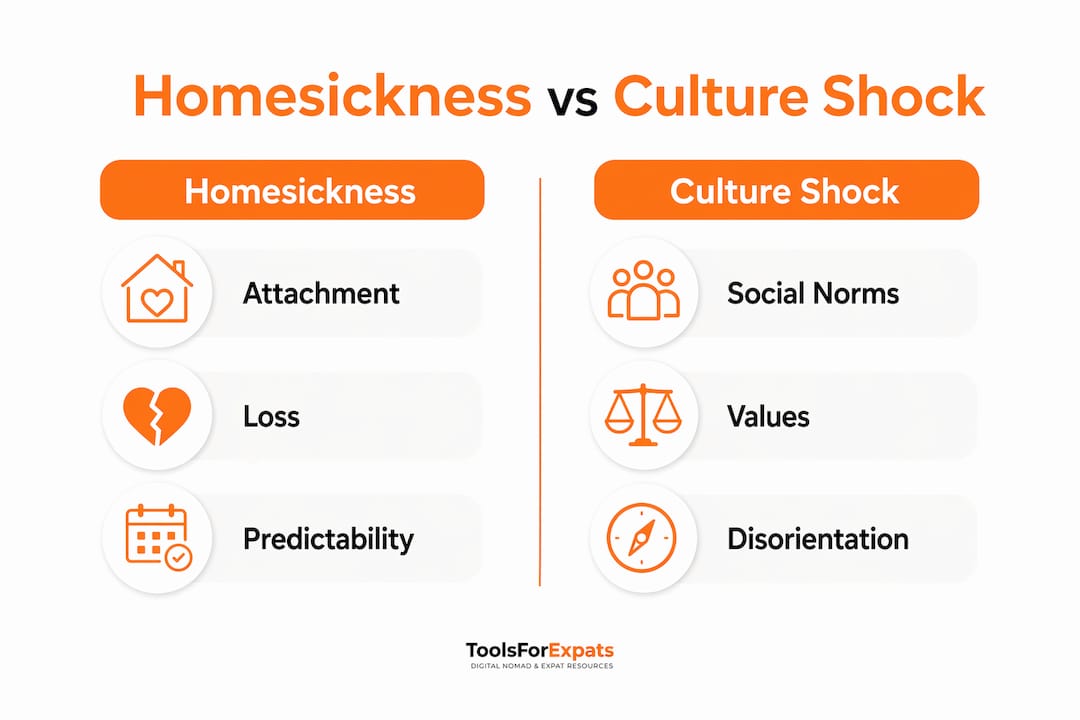
Homesickness is rooted in attachment and loss. It does not require cultural difference to occur. You can feel deeply homesick moving from Boston to Seattle, where the culture is broadly similar, simply because your social network and familiar environment are gone.
| Feature | Culture shock | Homesickness |
|---|---|---|
| Primary trigger | Unfamiliar social norms and values | Loss of familiar people, places, and routines |
| Requires cultural difference | Yes | No |
| Main emotion | Confusion, frustration, disorientation | Longing, sadness, grief-like distress |
| Typical remedy | Learning local norms, building competence | Rebuilding routines and social bonds |
| Timeline | Eases with cultural fluency | Eases with time and new attachments |
A third phenomenon worth noting is reverse culture shock, which hits when you return home after a long stint abroad and find that home no longer feels like home either. Your reference points have shifted in both directions. Recognizing all three experiences as distinct helps you avoid misdiagnosing what you feel and applying the wrong solution.
What triggers homesickness spikes abroad?
Homesickness rarely stays at a constant level. It surges in predictable patterns, and knowing those patterns helps you prepare rather than be blindsided.
Sensory cues are among the most powerful triggers. A song that played at a family gathering, the smell of a specific food, or hearing your native language spoken by a stranger can send a wave of longing through you in seconds. These cues bypass rational thought entirely and go straight to emotional memory.
Holidays and anniversaries are the most reliable spikes. Thanksgiving, Christmas, Eid, Diwali, or a parent's birthday all carry emotional weight that distance amplifies. The contrast between what you imagine happening at home and what you are experiencing abroad can feel stark and painful.
Approximately 70% of international students experience significant homesickness during their first semester abroad, with intensity peaking between weeks 2 and 6 before typically reducing by month 3. That timeline applies broadly to expats as well. The first two months are usually the hardest.
Empty evenings hit harder than busy days. When work fills your schedule, you have less mental space for longing. But quiet Sunday afternoons or evenings with no plans can feel isolating in ways that surprise even experienced travelers.
- Sensory triggers: Smells, music, and language cues activate emotional memory instantly.
- Holidays and anniversaries: Absence from shared family events amplifies the sense of loss.
- Winter and shorter days: Reduced daylight worsens mood and compounds feelings of disconnection.
- Empty social time: Unstructured evenings without plans create space for longing to intensify.
- Constant home contact: Unrestricted contact with home can anchor you emotionally to the past and prevent you from settling into your new life.
That last point surprises most expats. Calling home every day feels like comfort, but it can keep you mentally living in a place you no longer inhabit physically.
Practical strategies for overcoming homesickness abroad
Coping with homesickness is not about suppressing it. It is about building a life abroad that gives your brain new anchors while maintaining healthy connections to home.
-
Build new routines deliberately. Choose a regular gym class, a weekly market visit, or a standing coffee spot. Predictable rituals restore the subconscious safety your brain lost when you moved. They do not need to be elaborate. Consistency matters more than novelty.
-
Schedule bounded contact with home. Rather than calling home whenever longing strikes, set regular, time-limited calls. Scheduled calls home let you stay connected without anchoring your emotional attention to a place you are not in. Two or three calls per week works well for most expats.
-
Invest in your local social network. Joining a local sports team, language exchange group, or expat community gives you a context for building shared history with new people. The expat community abroad offers a ready-made starting point, since others around you understand the adjustment experience firsthand.
-
Use transitional objects wisely. A photo, a familiar scent, or a piece of home décor can provide comfort without pulling you into nostalgia. The key is using these objects to feel grounded, not to mentally escape your new environment.
-
Prioritize sleep, exercise, and sunlight. The neurological symptoms of homesickness worsen significantly when you are sleep-deprived or sedentary. Regular exercise and morning light exposure stabilize mood and reduce the physical toll of adjustment stress.
-
Seek professional support tuned to expat needs. Expats face higher acculturative stress than domestic peers, and many underuse mental health support due to stigma. A therapist familiar with expat or cross-cultural issues can provide targeted help. International health coverage that includes mental health services, such as expat health insurance, makes accessing that support far more practical.
Pro Tip: Use the ToolsForExpats loneliness risk calculator to get a personalized read on your emotional adjustment. Knowing where you stand helps you decide whether self-care strategies are enough or whether professional support makes sense.
Key Takeaways
Homesickness in expats is attachment distress rooted in the loss of familiar routines, social bonds, and environmental predictability, not simply a longing for people.
| Point | Details |
|---|---|
| Homesickness is attachment distress | Your brain seeks safety from predictability; losing familiar cues triggers a stress response. |
| Structural loneliness is distinct | New social lives do not cure loneliness caused by the absence of shared history with others. |
| Culture shock and homesickness differ | Culture shock fades with cultural fluency; homesickness requires rebuilding attachments. |
| Spikes are predictable | Holidays, sensory cues, and empty evenings reliably intensify homesickness. |
| Bounded contact helps | Scheduled, time-limited calls home reduce emotional anchoring to the past. |
What I've learned after years of watching expats adjust
The most common mistake I see expats make is treating homesickness as evidence that they made the wrong decision. They did not. Homesickness is a sign of attachment and love, not personal failure. You can miss home deeply and genuinely love your new life at the same time. Those two feelings are not in conflict.
What I find consistently true is that the expats who adjust best are not the ones who cut ties with home. They are the ones who integrate both worlds. They keep meaningful rituals from their home culture while building real roots in the new one. They do not try to replace what they had. They add to it.
The emotional turmoil Americans face after moving abroad often lasts 1–2 years before settling. That timeline is uncomfortable but normal. Expecting to feel fully at home within a few weeks sets you up for unnecessary self-criticism. Give yourself the same patience you would give a close friend going through a major life change.
Loneliness abroad is a feature of global mobility, not a flaw in your character or your choice. Self-compassion is not a soft suggestion here. It is the practical foundation for getting through the hardest months.
— Jay
Tools to make your life abroad less stressful
Emotional wellbeing and practical stability are connected. When logistics feel manageable, the mental load of adjusting abroad gets lighter.

ToolsForExpats offers a full suite of free tools built specifically for expats and digital nomads. Use the cost of living comparison tool to understand what your budget actually buys in your new city. Check visa eligibility, plan your moving budget, and measure your wellbeing with the expat happiness test. No account needed, no fees, no friction. Everything at ToolsForExpats is designed to reduce the logistical stress that makes emotional adjustment harder than it needs to be.
FAQ
What is the main reason expats feel homesick?
Homesickness is attachment distress caused by losing familiar routines, social roles, and environmental predictability. The brain interprets this loss as a threat to safety, triggering emotional and physical stress responses.
How long does homesickness last for expats?
Homesickness typically peaks in the first 2–6 weeks abroad and begins to ease by month 3, though the broader emotional adjustment period can last 1–2 years for many expats.
Is expat loneliness the same as homesickness?
No. Loneliness in expats often stems from the absence of shared history with new acquaintances, not just a lack of social contact. You can have an active social life and still feel structurally lonely.
Does calling home too often make homesickness worse?
Yes. Unrestricted daily contact with home can anchor you emotionally to the past and prevent you from building presence in your new environment. Scheduled, bounded calls work better for long-term adjustment.
How can I tell if I have culture shock or homesickness?
Culture shock involves confusion and frustration with unfamiliar social norms and fades as you learn the local system. Homesickness is rooted in loss and longing, and it can occur even when cultures are similar.