
You've been living the dream. New cities, flexible hours, freedom on your own terms. But somewhere between the third visa run and the fifth coworking space, something shifted. You're exhausted in a way that sleep doesn't fix, and the thought of booking another flight feels more like a chore than an adventure. That's nomad burnout. It's not just travel fatigue or a rough week. It's a distinct, layered exhaustion that happens when constant movement collides with the pressure of remote work, and it affects more digital nomads than most people admit.
Table of Contents
- Key takeaways
- What is nomad burnout, really
- Root causes of nomad burnout
- Signs of nomad burnout by severity
- Practical recovery strategies that actually work
- How to avoid nomad burnout before it starts
- The loneliness factor in nomad burnout
- My honest take on nomad burnout
- Tools to help you manage and recover
- FAQ
Key takeaways
| Point | Details |
|---|---|
| Nomad burnout is distinct | It combines travel stress, remote work pressure, and social isolation into a unique form of exhaustion. |
| Causes go beyond tiredness | Decision fatigue, blurred work-life boundaries, and destination apathy are core drivers. |
| Signs vary in severity | Burnout ranges from light motivation dips to severe emotional detachment requiring professional support. |
| Recovery has a timeline | Light cases resolve in 1–3 weeks; severe cases need 2–3 months with structured support. |
| Prevention beats recovery | Slowmad stays, tech boundaries, and community anchors protect your mental health long term. |
What is nomad burnout, really
Nomad burnout is the chronic exhaustion that builds when the demands of remote work and constant relocation outpace your capacity to recover. 52% of employees report burnout symptoms in traditional work settings, and for digital nomads, the number is compounded by the fact that 45% feel more drained since the pandemic blurred the line between work time and rest time.
What makes nomad burnout different from regular workplace burnout is the environment itself. There's no commute that separates work from home because home keeps changing. There's no neighborhood you know well enough to decompress in. Every few weeks, you're adapting to a new city, a new time zone, a new SIM card, a new rhythm. The recovery time you'd normally get from familiar surroundings never arrives.

This is nomadic lifestyle fatigue at its most specific. It's not that travel is bad. It's that travel without recovery is unsustainable, and most nomads don't realize they're depleted until the exhaustion has been building for months.
Root causes of nomad burnout
Understanding the causes of nomad burnout is the first step toward doing something about it. The triggers are predictable once you know what to look for.
- Context switching overload. Every move means learning a new system. New housing rules, new internet setup, new banking workarounds, new visa requirements. None of it becomes routine because you never stay long enough for it to.
- Decision fatigue. Daily logistics never become automatic for nomads the way they do for people in settled life. Where to eat, where to work, how to get a local SIM, whether the apartment WiFi will hold for a client call. These decisions drain mental resources that should go toward meaningful work.
- Social relationship withdrawal. You might be surrounded by people at hostels and coworking spaces, yet feel profoundly alone. Casual social contact is not the same as emotional support, and nomadic lifestyle stress often comes from this invisible gap.
- Blurred work-life boundaries. When your bedroom is also your office and your "commute" is walking to a café, there's no natural off switch. The "always-on" culture of remote work intensifies on the road because there's no physical separation to enforce limits.
- Destination apathy. Loss of excitement in new locations is one of the clearest signals of chronic low-grade stress. When a city you'd have been thrilled to visit a year ago now just feels like another logistics puzzle, burnout has already taken hold.
Pro Tip: If you notice yourself researching the next destination before you've settled into the current one, that restlessness is often anxiety in disguise, not genuine excitement. Pause and check in with how you actually feel.
Signs of nomad burnout by severity
Recognizing nomad burnout early gives you more options. The symptoms show up across emotional, physical, and psychological dimensions, and they tend to escalate if ignored.
Emotional and motivational signs:
- Persistent low motivation even for work you normally enjoy
- Feeling detached from people and places around you
- Irritability that seems disproportionate to the situation
- Procrastination that wasn't there six months ago
Physical signs:
- Sleep disturbances despite being tired
- Chronic low energy that coffee doesn't touch
- Frequent minor illnesses as immune function dips
Psychological signs:
- Feeling like you're watching your life from a distance
- Cynicism about travel, work, or the nomad lifestyle itself
- Difficulty making even small decisions
The table below maps these signs to severity levels and gives you a realistic recovery timeline based on evidence-based research:
| Severity | Key symptoms | Suggested recovery timeline |
|---|---|---|
| Light | Motivation dips, mild fatigue, slight irritability | 1–3 weeks of rest and reduced workload |
| Moderate | Sleep issues, work quality decline, social withdrawal | 4–8 weeks with a base-camp month |
| Severe | Emotional detachment, inability to work, health decline | 2–3 months with professional support |
If you're reading this and recognizing yourself in the moderate or severe column, that's not a sign of weakness. It's a sign that your system has been running without adequate recovery for too long.
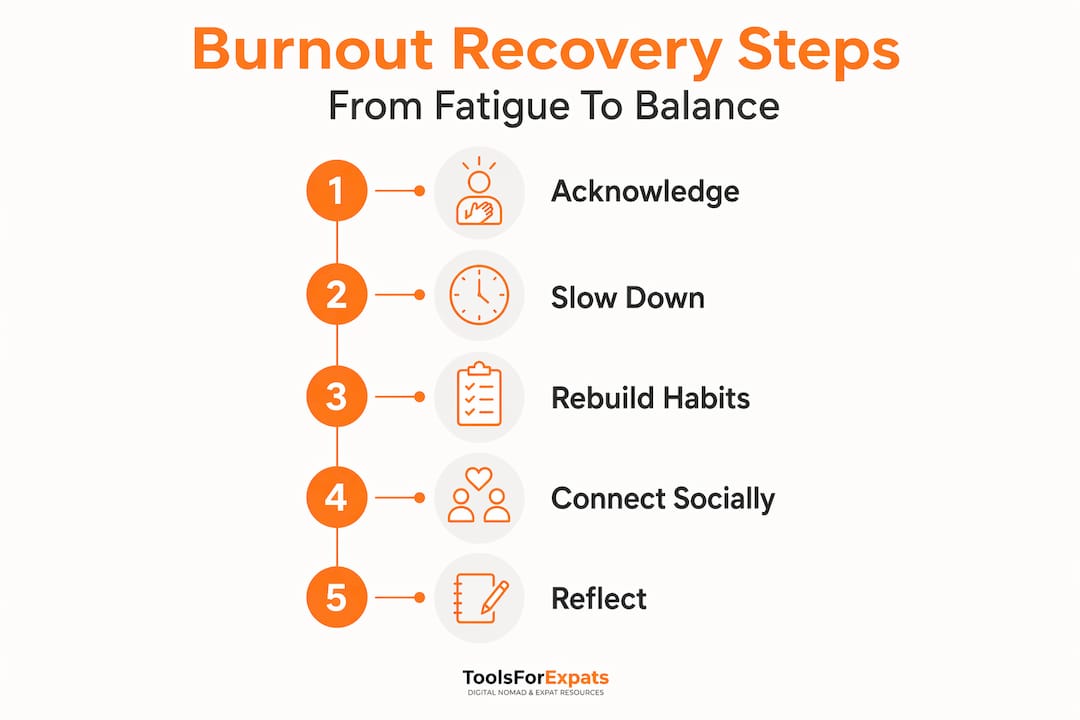
Practical recovery strategies that actually work
Recovery from nomad burnout is not about taking a weekend off and pushing through. It requires deliberate, structured changes to how you work and move. Here's a step-by-step approach:
-
Cut your workload immediately. Reduce deliverables by 30–50% for at least two to four weeks. This isn't optional. Your nervous system cannot heal while still operating at full capacity.
-
Reset your sleep. Target 8–9 hours per night and taper caffeine to one dose before noon. Sleep is the foundation of nervous system recovery, and most burned-out nomads are running a significant sleep debt.
-
Take a base-camp month. Booking another trip only provides a short dopamine lift. True recovery requires staying in one place long enough for it to feel familiar. Pick a city you already know and stay for at least four weeks without planning the next move.
-
Seek mental health support. Therapy, mindfulness practice, and community connection are not luxuries. Sleep, workload reduction, and social connection are all critical components of effective burnout recovery. A counselor who understands expat life can make a significant difference.
-
Rebuild slowly. After the triage phase, reintroduce travel and work gradually. One new destination per month is more sustainable than three. Protect your recovery by not returning to old patterns too quickly.
Pro Tip: Use the ToolsForExpats cost calculator to find an affordable city where you can stay for a full month without financial stress adding to your recovery load.
How to avoid nomad burnout before it starts
Prevention is far less painful than recovery. The good news is that most of the causes of burnout in nomads are addressable with intentional lifestyle design.
- Adopt the slowmad approach. Longer stays in fewer locations give you novelty without the constant adaptation tax. Staying three months in one city instead of three weeks in three cities changes everything.
- Build non-negotiable routines. Consistent work hours, a morning ritual, a regular gym or walk. These anchors reduce cognitive load and create the psychological stability that travel constantly disrupts.
- Set hard tech boundaries. No work messages after a set hour. No laptop in bed. Notifications off during meals. These rules feel small but they protect the mental space you need to actually rest.
- Invest in community. Join a recurring online group, a local sports league, or a coworking space with regulars. Consistent faces matter more than the number of people you know.
- Make mobility intentional. Strategic moves based on objectives rather than reactive or impulsive travel reduce the cognitive overload that feeds nomadic lifestyle fatigue. Ask yourself why you're moving before you book.
"Burnout is not failure. It's a signal to recalibrate your routines and boundaries for a sustainable work-life balance on the road." — rentremote.com
You can also use the ToolsForExpats visa checker to plan longer stays strategically, so you're not scrambling to figure out visa logistics at the last minute and adding unnecessary stress to your planning process.
The loneliness factor in nomad burnout
Social isolation is one of the most underestimated causes of nomad burnout, and it's worth its own honest conversation. You can have 500 contacts in your phone and still feel like there's no one to call when things get hard.
The challenge is structural. Building a close friendship requires 200+ hours of shared time. When you move every few weeks, you never accumulate that time with anyone. You get lots of casual connections and very few deep ones. That imbalance creates what researchers call emotional malnutrition: the feeling of being socially active but emotionally starved.
Here's what actually helps:
- Prioritize depth over breadth. One honest conversation with a friend you've known for years does more for your mental health than ten new acquaintances at a hostel happy hour.
- Maintain long-distance friendships actively. Schedule regular video calls with people who know your full story. Don't let those relationships drift just because you're not in the same city.
- Be vulnerable with people you trust. True friendship requires consistent presence and vulnerability, not just proximity. You can build real connection across distance if you're willing to go below the surface.
- Find community anchors. A recurring online community, a mastermind group, or even a group chat where people check in regularly can serve as a stable social foundation while you move around.
Slowing down to invest in a few deep relationships is not a compromise on your nomad lifestyle. It's one of the most effective tools for protecting your mental health for digital nomads long term.
My honest take on nomad burnout
I've watched a lot of people try to outrun burnout by booking the next flight. New city, new energy, new chapter. It makes sense on paper. Movement is what the nomad identity is built on, and stopping feels like giving up.
But burnout is predictable from sustained novelty exposure, and the resistance to rest is often identity-linked. If your self-worth is tied to being the person who's always somewhere new, then staying put feels like losing. That's the trap.
In my experience, the nomads who recover fastest are the ones who stop treating stability as a failure. Boredom is not the enemy. A familiar coffee shop, a predictable Tuesday morning, a neighborhood you know well enough to walk without Google Maps. These things are not boring. They're restorative.
The most unconventional advice I can offer is this: redefine what success looks like for you. If success means sustainable, joyful work from anywhere, then protecting your mental health is part of the job. Saying no to a tempting trip because you need to stay grounded is not weakness. It's wisdom. The ToolsForExpats blog has resources that support exactly this kind of intentional thinking about expat and nomad life.
— Ceyhun
Tools to help you manage and recover

If you're working through nomad burnout or trying to prevent it, having the right tools in your corner reduces the logistical stress that compounds exhaustion. ToolsForExpats offers a free suite of expat and nomad tools built specifically for people living and working abroad. You can check your wellbeing with the Expat Happiness Score Test to get a clearer picture of where you stand emotionally and whether your current setup is actually working for you. You can also use the burnout recovery workflow from Heske Therapy to structure your recovery with professional guidance. No account needed, no cost, just practical support when you need it most.
FAQ
What is nomad burnout?
Nomad burnout is chronic exhaustion caused by the combination of constant relocation, remote work pressure, decision fatigue, and social isolation. It goes beyond regular tiredness and requires deliberate recovery strategies to address.
What are the most common signs of nomad burnout?
Common signs include persistent low motivation, sleep disturbances, destination apathy, emotional detachment, and declining work quality. These symptoms tend to build gradually over weeks or months.
How long does it take to recover from nomad burnout?
Recovery timelines depend on severity. Light burnout typically resolves in 1–3 weeks, moderate cases take 4–8 weeks with a base-camp month, and severe cases may require 2–3 months with professional support.
How can I avoid nomad burnout?
The most effective prevention strategies include adopting a slowmad approach with longer stays, building consistent daily routines, setting firm tech boundaries, and investing in deep social connections rather than accumulating casual contacts.
Is nomad burnout the same as regular burnout?
Not exactly. While it shares core symptoms with workplace burnout, nomad burnout is compounded by constant environmental change, logistical decision fatigue, and the absence of stable social support structures that settled life provides.