
U.S. citizens can absolutely live in Malaysia, provided they secure the right pass before arrival. The most common routes are the Employment Pass (EP) for employer-sponsored workers, the Residence Pass-Talent (RP-T) for high-skilled professionals, the Professional Visit Pass for shorter assignments, and the Malaysia My Second Home (MM2H) program for long-stay residents and retirees. A single professional in Kuala Lumpur can live comfortably on a moderate budget typical of expats, while a family of four should budget accordingly to cover their needs. The Expatriate Services Division (ESD) and the Immigration Department of Malaysia are the two agencies you will interact with most.
Quick verdict:
- Pros: Low cost of living relative to U.S. cities, excellent private healthcare, strong English proficiency, vibrant expat community, tropical climate, and a well-connected regional hub.
- Cons: Employment Pass salary thresholds rose significantly in 2026 according to recent policy changes., new duration caps limit how long you can stay on an EP, employer sponsorship is required for most work passes, and Malaysia does not recognize dual citizenship.
- First step: Run your numbers and check your visa eligibility with ToolsForExpats before you accept any job offer or sign a lease.
Key Takeaways
Malaysia is a strong destination for U.S. expats who secure the right pass, verify the 2026 salary thresholds, and plan their budget before committing to an offer.
What visa route fits you as an expat in Malaysia?
Your pathway into Malaysia depends almost entirely on why you are going and who is paying for it. The table below maps the five main routes to the reader type most likely to use each one.
A few things to know before you pick a lane:
- Employed by a Malaysian company or transferred by a multinational? The Employment Pass is your route. Your employer files through the ESD portal and the MYXpats Centre handles pass endorsement at entry.
- Highly skilled or senior executive? Ask your employer about the Residence Pass-Talent, which offers a longer validity and more flexibility.
- Retiree or financially independent? MM2H is a residence program, not a work permit. Verify work rights separately before assuming you can take on local income.
- Remote worker employed by a U.S. company? Malaysia does not yet have a dedicated digital nomad visa, but a Professional Visit Pass can work for some arrangements. Check the Gov and the Immigration Department for current options, and note that Malaysia does not recognize dual citizenship.
- Spouse of a Malaysian citizen? A Dependent Pass or Long-Term Social Visit Pass may apply; confirm with the Immigration Department directly.
Pro Tip: Before you accept a job offer, verify that your prospective employer is already registered with the ESD. An unregistered employer cannot sponsor your EP, and registration takes time. Ask HR for their ESD registration number early in negotiations.
What does it actually cost to live in Malaysia?
Malaysia's cost of living is one of its biggest draws for U.S. expats. Kuala Lumpur is significantly cheaper than most major American cities, and secondary cities like Penang and Johor Bahru are cheaper still. That said, international school fees and private health insurance can push family budgets higher than the headline numbers suggest.
Monthly budget ranges by city
| City | Single (mid-range) | Couple | Family (2 adults + 2 kids) |
|---|---|---|---|
| Kuala Lumpur | RM5,000–RM8,000 | RM8,000–RM12,000 | RM15,000–RM22,000 |
| Penang (George Town) | RM4,000–RM6,500 | RM7,000–RM10,000 | RM13,000–RM18,000 |
| Johor Bahru | RM3,500–RM6,000 | RM6,500–RM9,500 | RM12,000–RM17,000 |
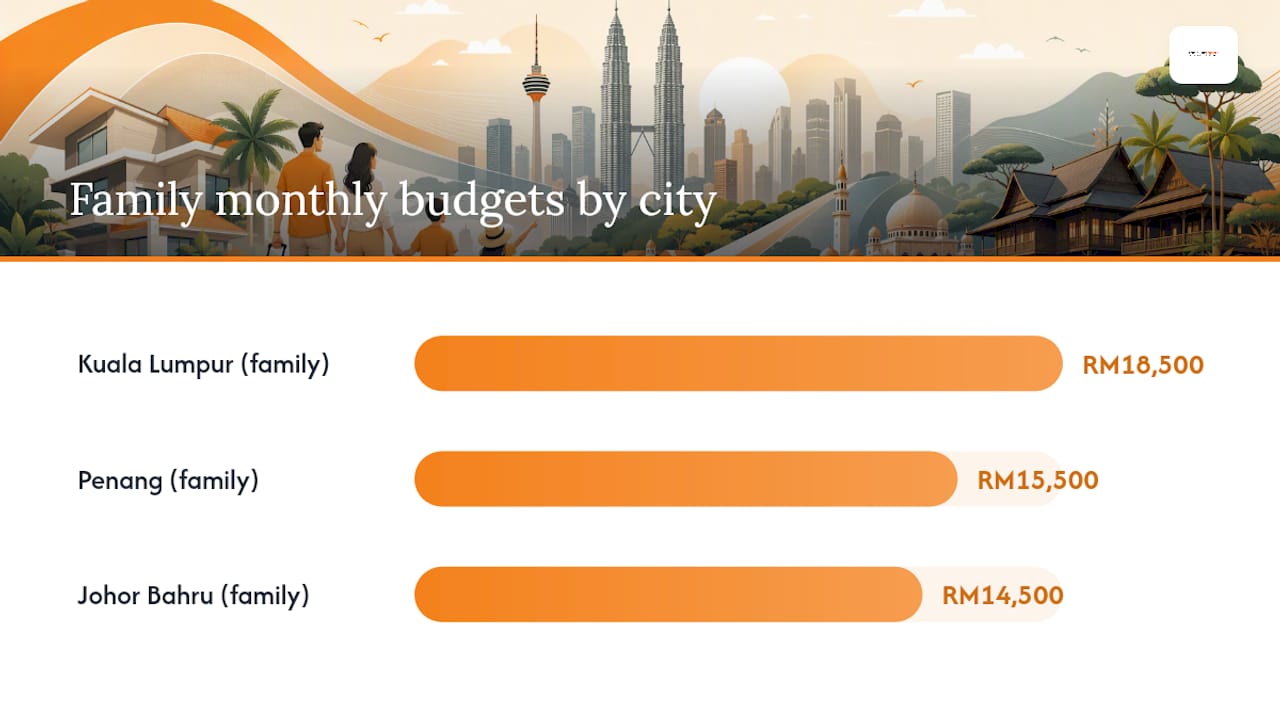
USD conversions are approximate at RM4.70/USD and will fluctuate. Always verify the current exchange rate.
These ranges include rent, groceries, utilities, local transport, and basic health insurance. They exclude international school fees, which add RM2,000–RM5,000+/month per child depending on the school. The HSBC Expat guide to Malaysia confirms that private healthcare and schooling are the two biggest variables in expat budgets.
Can you live on $1,000/month in Malaysia?
A single person living modestly outside KL's city center, cooking at home, and using public transit can get close to RM4,700/month ($1,000 USD). It is tight but possible in Penang or Johor Bahru. In KL's expat neighborhoods, $1,000 leaves very little margin. For most U.S. expats on an Employment Pass, salary thresholds make this a moot point since the EP itself requires a minimum monthly salary well above that level.
One-time moving costs to plan for
- International flights: $800–$2,500 per person depending on routing and timing
- Visa and pass fees: Variable; EP fees are employer-paid in most cases, but budget for document authentication and medical exam costs
- First-month rent + deposit: Typically 2–3 months' rent upfront (first month + 2-month security deposit)
- Furniture and household setup: RM3,000–RM10,000 depending on whether the unit is furnished
- International school registration and security deposit: RM5,000–RM30,000 depending on school
- Shipping or air freight: $1,500–$8,000 for a partial household shipment from the U.S.
Pro Tip: Arrive with a short-term furnished rental for the first 4–6 weeks. This gives you time to visit neighborhoods in person before signing a 12-month lease, and it often saves money compared to rushing into the wrong apartment. Use the Moving Abroad Budget Calculator to model your full first-year costs before you commit.
How does the visa application process actually work?
For most U.S. expats, the Employment Pass is the answer. The RP-T suits senior or highly specialized hires, and MM2H is the route for those who want long-term residence without a local employer.
Employment Pass: step-by-step
- Employer registers with the ESD. Your Malaysian employer must be registered with the Expatriate Services Division before filing any application. If they are not registered, this step alone can take several weeks.
- Employer submits application via Xpats Gateway / MES. The MIDA Expatriate System (MES) provides process flow documents and user manuals for employers navigating the 2026 system updates.
- Approval in Principle (AIP) is issued. Processing typically takes 4–10 weeks for standard applications; fast-track options exist for certain sectors.
- Applicant obtains a single-entry visa at a Malaysian consulate or embassy in the U.S. (if required based on nationality).
- Pass endorsement at entry. The MYXpats Centre at the point of entry endorses the pass in your passport. You are then legally authorized to work.
- Dependent passes filed separately. Spouses and children under 18 can be added as dependents; file these alongside or immediately after the main EP application.
Key documents to prepare
- Valid passport (minimum 18 months' validity recommended)
- Signed employment contract
- Academic credentials (degree certificates, transcripts)
- Professional certifications relevant to your role
- Medical examination report from an approved clinic
- Passport-sized photographs
- For MM2H: proof of offshore income, fixed deposit evidence, and health insurance policy
2026 policy changes you must know
A new expatriate employment policy effective June 1, 2026 raises minimum salary thresholds and introduces maximum employment durations for EP categories. Category I now requires a minimum of RM20,000/month, and duration limits of 5–10 years have been set depending on the EP category. Many expats are still working from older salary figures that no longer qualify. Verify the current thresholds directly on the ESD and Immigration Department portals before signing any contract.
How do you find work and handle taxes as an expat?
Finding work in Malaysia
Most expats need employer sponsorship, which means the job search and the visa process are inseparable. Malaysia's World Bank economic data reflects a growing, diversified economy, and the sectors most actively hiring foreign professionals include:
- Information technology and software development
- Engineering (oil and gas, renewables, manufacturing)
- Banking, finance, and fintech
- Education (international schools and universities)
- Healthcare (specialist physicians and allied health)
Multinational companies with Malaysian offices typically handle EP sponsorship in-house. Smaller local employers may be less familiar with the process, so it is worth asking HR about their ESD registration status before you get deep into negotiations.
Employment Pass mechanics
Your employer is responsible for filing the EP application and bears most of the administrative burden. In return, your contract must meet the salary threshold for your EP category (RM20,000+/month for Category I from June 2026), and your employer is generally required to provide health insurance as part of the package. The contract should specify the role, salary, duration, and any relocation allowance. If your employer is going through the MIDA Expatriate System for investment-linked schemes, the process flow differs slightly from the standard ESD route.
Malaysian tax residency
Malaysia uses a 182-day rule for tax residency. Spend 182 or more days in Malaysia in a calendar year and you are a tax resident, subject to progressive income tax rates. Spend fewer than 182 days and you are taxed at a flat nonresident rate on Malaysian-sourced income. The Inland Revenue Board of Malaysia (IRB / LHDN) is the tax authority; their portal is the authoritative source for current rates and filing deadlines.
U.S. citizens have an additional layer: you remain obligated to file U.S. federal tax returns regardless of where you live, and you may owe U.S. tax on foreign income above the Foreign Earned Income Exclusion threshold. The Foreign Tax Credit can offset some double taxation, but the interaction between Malaysian and U.S. tax rules is complex enough to warrant professional advice from both sides. Read up on filing taxes while working remotely abroad before your first Malaysian tax year begins.
Pro Tip: Engage a Malaysian tax advisor and a U.S. expat tax specialist before you relocate, not after your first year ends. Common digital nomad tax mistakes like missing the 182-day count or failing to file FBARs carry real penalties.
What healthcare do you need as an expat in Malaysia?
Private healthcare is the standard choice for expats in Malaysia, and for good reason. Private hospitals in KL, Penang, and Johor Bahru offer high-quality care, English-speaking staff, and short wait times at costs that are a fraction of U.S. prices. Public hospitals are available to all residents but typically have longer waits and less English-language support, making them less practical for most expats day-to-day.
Public vs. private care at a glance
- Public hospitals: Low cost (heavily subsidized for residents), longer wait times, variable English proficiency, adequate for routine care
- Private hospitals: Higher cost but still affordable by U.S. standards, English-speaking staff, modern facilities, short wait times, preferred by expats
- Specialist care: Available in major cities; some procedures may still require medical evacuation for complex cases
What insurance to buy
Your Employment Pass often requires your employer to provide health insurance, but the coverage level varies. Before arrival, confirm:
- Whether your employer's plan covers inpatient and outpatient care
- Whether dependents are included or require a separate policy
- Whether the plan includes medical evacuation and repatriation (critical for remote areas)
- The annual coverage limit (look for at least $100,000 USD equivalent for a single adult)
If your employer's plan is thin, supplement it with an international health insurance policy. For detailed guidance on what to look for, the digital nomad health insurance guide covers the key policy features worth comparing.
Emergency contacts: The general emergency number in Malaysia is 999. The U.S. Embassy in Kuala Lumpur provides consular assistance and emergency contact information for U.S. citizens; register with the Smart Traveler Enrollment Program (STEP) before you arrive.
Where should you live? Housing and neighborhoods for expats
Most expats rent for at least the first year, and that is the right call. Buying property in Malaysia as a foreigner is possible but comes with state-level minimum purchase prices (typically RM1,000,000 or higher depending on the state and property type), stamp duties, and a more complex legal process. Renting gives you flexibility while you learn which neighborhood actually fits your lifestyle.
Neighborhood snapshots
Kuala Lumpur
- KLCC / Bukit Bintang: Central, walkable, close to the Petronas Towers; higher rents but excellent amenities and public transit access
- Mont Kiara: The most established expat enclave in KL; international schools, Western restaurants, and a large expat community; slightly higher rents than average
- Bangsar: Trendy, walkable, popular with younger professionals; good mix of local and international dining
Penang (George Town / Tanjung Tokong)
- George Town offers a UNESCO World Heritage setting with strong café culture and a growing creative scene; Tanjung Tokong and Gurney Drive are popular with families for their proximity to international schools
Johor Bahru (Iskandar Malaysia)
- Close to Singapore, which makes it attractive for expats working across the causeway; lower rents than KL with improving infrastructure; Medini and Danga Bay are the main expat-friendly zones
Typical rent ranges
Utilities (electricity, water) typically run RM150–RM350/month for an apartment. Broadband internet is widely available and affordable, with fiber plans starting around RM100–RM150/month for 100–500 Mbps. The RAI Malaysia portal provides additional guidance on administrative processes for newcomers.
Rental checklist
- Confirm the tenancy agreement is in writing and covers notice periods (typically 2 months)
- Verify the security deposit amount (standard is 2 months' rent) and conditions for return
- Request a full inventory of furniture and appliances before signing
- Ask whether utilities are included or billed separately
- Check whether the building has a management fee (strata title properties often do)
- Use local property portals (PropertyGuru, iProperty) to compare listings before committing
What are your schooling options for kids in Malaysia?
International schools are the default choice for expat families, and the waiting lists at the most popular ones are long. Apply 6–12 months ahead of your intended start date if at all possible.
Curriculum options
- British curriculum (IGCSE / A-Level): The most widely available; maps reasonably well to U.S. college admissions with some planning
- American curriculum (AP / U.S. diploma): Fewer schools offer this, but they exist in KL and Penang; the most direct pathway back into the U.S. education system
- International Baccalaureate (IB): Globally recognized, strong in critical thinking; accepted by U.S. universities
- Australian curriculum: Available at several schools; less common than British or IB
Tuition and fees
International school tuition in Malaysia ranges from roughly RM25,000/year at smaller or newer schools to RM80,000–RM120,000/year at established flagship schools in KL. On top of tuition, budget for:
- Registration fee: RM500–RM3,000 (one-time)
- Security deposit / capital levy: RM5,000–RM30,000 (refundable at some schools, not at others)
- Uniforms and books: RM1,000–RM3,000/year
- School transport: RM300–RM600/month
Pro Tip: Join local parent Facebook groups and expat forums before choosing a school. Reputation and teaching quality can shift significantly between campuses of the same brand, and parents on the ground will tell you things the school's brochure won't. The RAI Malaysia portal also lists accredited international schools.
Is Malaysia safe, and how do you fit in culturally?
Malaysia is generally safe for expats. Violent crime against foreigners is uncommon, and the country consistently ranks as one of the more stable destinations in Southeast Asia. That said, petty crime, phone snatching, and scams targeting newcomers do occur, particularly in busy urban areas.
Safety basics
- Use Grab (the dominant ride-hailing app) rather than flagging down unmarked taxis, especially at night
- Keep bags on your lap or in front of you in crowded areas; phone snatching from motorcycles is the most reported crime against expats
- Avoid displaying expensive jewelry or electronics in street markets
- Emergency number: 999 (police, fire, ambulance)
- Register with the U.S. Embassy's STEP program for safety alerts and consular support
- The U.S. Embassy in Kuala Lumpur is located in the Ampang area; their website lists consular services and emergency contacts
Cultural do's and don'ts
Malaysia is a Muslim-majority country with significant Chinese and Indian communities, and the cultural norms reflect that diversity.
- Remove shoes before entering homes and many traditional businesses
- Dress modestly in mosques, temples, and conservative areas outside major cities; cover shoulders and knees
- During Ramadan, avoid eating, drinking, or smoking in public during daylight hours in conservative areas; many restaurants close or operate with curtains drawn during fasting hours
- Use your right hand for giving and receiving items; the left hand is considered unclean in Malay culture
- Greet with "Selamat pagi" (good morning) or "Selamat datang" (welcome); a simple smile and nod goes a long way
- English is widely spoken in KL, Penang, and Johor Bahru, especially in business and hospitality settings; you will rarely be stuck without an English speaker in urban areas
Download the Grab app for transport and food delivery, Touch 'n Go eWallet for cashless payments (used everywhere from toll booths to hawker stalls), and the MyRapid or Moovit apps for public transit in KL. Basic Malay phrases earn genuine goodwill even when English would have worked fine.
How do you open a bank account and move money to Malaysia?
You can open a local Malaysian bank account as an expat, though the process and required documents vary by bank and your visa status. The major local banks include Maybank, CIMB, Public Bank, and RHB; international banks like HSBC also operate in Malaysia.
Account opening checklist
- Valid passport
- Employment Pass or other valid visa/pass endorsement
- Proof of Malaysian address (utility bill or tenancy agreement)
- Employment contract or letter from employer
- Some banks require a minimum initial deposit (typically RM250–RM1,000)
Most banks require you to visit a branch in person for the initial account opening. Online-only account opening for foreigners is not yet standard at major Malaysian banks.
Moving money between the U.S. and Malaysia
Wire transfers through traditional banks carry fees of $25–$50 per transfer plus unfavorable exchange rates. Dedicated international transfer services typically offer better rates and lower fees for regular transfers. If you are receiving a Malaysian salary, your employer will pay directly into your local account. For sending money back to the U.S. or covering initial setup costs, compare transfer options before you go.
Pro Tip: Keep your U.S. bank account open throughout your time in Malaysia. You will need it for U.S. tax payments, retirement account contributions, and any financial ties you maintain at home. Set up two-factor authentication on all accounts before you leave, and notify your U.S. bank of your international address to avoid fraud flags on legitimate transactions.
For context on working remotely and managing cross-border finances, the guide on whether you can work remotely from another country covers the employer permission and tax implications worth reviewing before you go.
Your pre-departure and first-90-days checklist
Getting the sequence right makes the difference between a smooth arrival and weeks of scrambling. The three highest-priority pre-departure tasks are: securing your visa and documents, establishing bank access, and locking in housing.
Pre-departure checklist
- Confirm your Employment Pass (or other pass) application is filed and the Approval in Principle has been issued
- Obtain a single-entry visa from the Malaysian consulate if required
- Get vaccinations recommended for Malaysia (Hepatitis A and B, typhoid, and routine updates; check CDC guidance)
- Gather certified translations of key documents (birth certificates, marriage certificate, academic credentials)
- Research and apply to international schools if you have children (do this as early as possible)
- Notify your U.S. bank and credit card companies of your move
- Set up a U.S. mail forwarding service or update your address with the IRS and financial institutions
- Arrange international health insurance to cover the gap before your employer plan activates
- Make shipping decisions: what to bring, what to store, what to sell
Arrival week priorities
- Submit your MDAC (Multiple Entry Visa / pass endorsement paperwork) and collect your pass endorsement at the MYXpats Centre
- Open a local bank account as soon as your pass is endorsed
- Get a local SIM card (Maxis, Celcom, Digi, and U Mobile all offer prepaid and postpaid plans; a local number is needed for most apps and services)
- Register your children with their school
- Register with the U.S. Embassy's STEP program
30/60/90-day follow-up items
- By day 30: Confirm your tax residency start date with your employer's HR; understand when you cross the 182-day threshold
- By day 60: Enroll in your employer's health insurance plan and verify dependent coverage; set up recurring money transfers if needed
- By day 90: Look into driver's license conversion if you plan to drive (an international driving permit from the U.S. is valid temporarily; a Malaysian license requires a conversion process); confirm your IRB/LHDN registration if you are self-filing taxes
Where do you find the expat community in Malaysia?
Malaysia has one of the most established expat communities in Southeast Asia, and finding your people is genuinely easy once you know where to look.
Community resources
- InterNations Malaysia: One of the largest organized expat networks globally, with active KL and Penang chapters hosting regular events
- Facebook groups: "Expats in Kuala Lumpur," "American Expats in Malaysia," and city-specific parent groups are active and practical for day-to-day questions
- Reddit: r/malaysia and r/digitalnomad have active threads on visa updates, neighborhood recommendations, and practical living questions
- Local meetups: Coworking spaces in KL (such as those in the KLCC and Bangsar South areas) often host networking events for international professionals
Official resources to bookmark
- U.S. Embassy Kuala Lumpur: Consular services, STEP registration, emergency contacts, and safety alerts
- Immigration Department of Malaysia / ESD / MYXpats Centre: Visa applications, pass endorsements, and policy updates
- MIDA: Investment-linked work pass guidance and the MES system for employer filings
- IRB / LHDN: Malaysian tax filing, residency rules, and payment portals
Pro Tip: Expat forums and Facebook groups are great for day-to-day tips, but never act on visa or immigration advice from community posts without verifying it on the official ESD or Immigration Department portals. Policy changes in 2026 have made some widely shared advice outdated, and the consequences of a failed EP application can delay your start date by months.
How ToolsForExpats helps you plan your Malaysia move
Planning a move to Malaysia involves a lot of moving parts, and the fastest way to get clarity is to run your actual numbers before you commit to anything.
ToolsForExpats offers two tools that are directly useful for this:
Both tools are free, require no account, and take under five minutes to use. For city-level cost comparisons across Southeast Asia, the cost of living comparison tool lets you stack Malaysia against your current U.S. city or other regional options.
What U.S. expats should realistically expect from a move to Malaysia
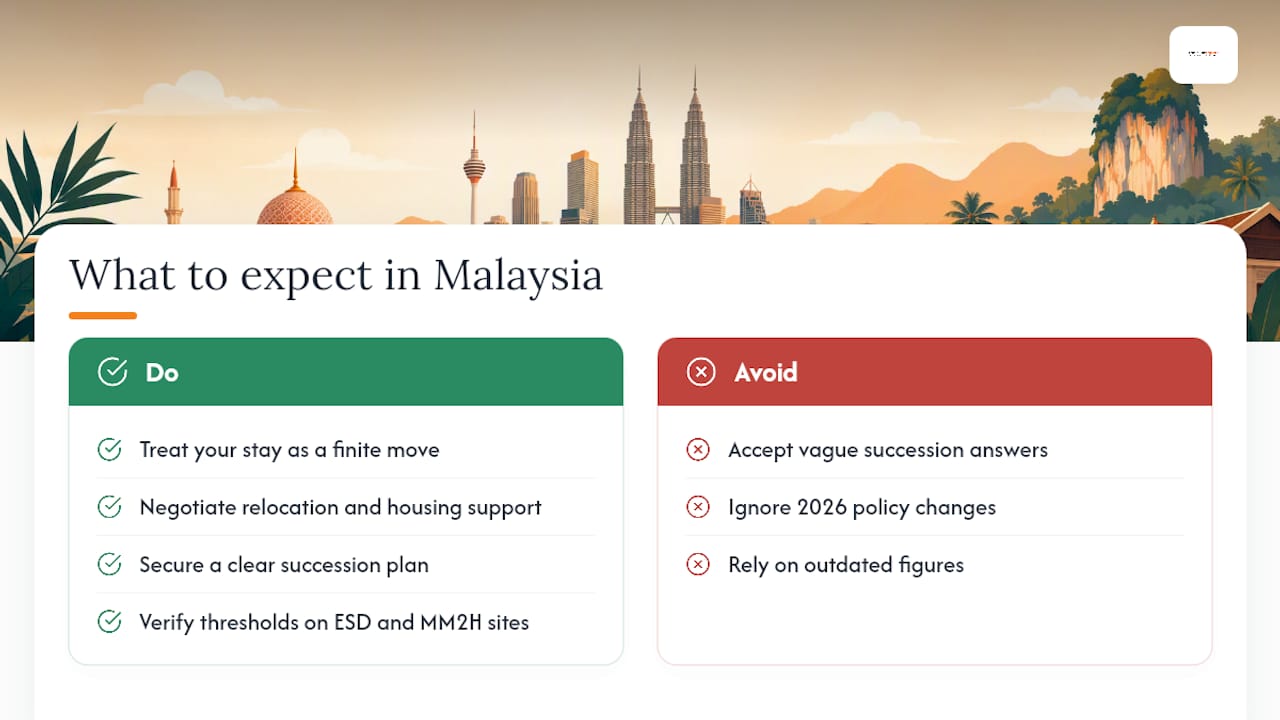
Malaysia is a genuinely good destination for U.S. expats, but the 2026 policy shift changes the calculus in one important way: treat your stay as a finite career move unless you are actively pursuing MM2H or RP-T. The new duration caps mean that even a successful EP holder should plan for an eventual transition, whether that means a local promotion into a permanent residency pathway, a move to another market, or a return to the U.S.
That framing is actually useful in negotiations. When you know your stay has a likely endpoint, you can push harder for a relocation package, a housing allowance, and a clear succession plan in your contract. Employers who are serious about hiring foreign talent understand the new rules and should be willing to discuss what happens at the end of your EP duration. If an employer is vague about succession planning or dismissive of the 2026 changes, that tells you something about how they will handle your career development.
The practical advice is straightforward: verify every salary threshold and duration limit on the ESD portal and the Immigration Department's MM2H page before you sign anything. The numbers in this guide reflect the best available information as of mid-2026, but thresholds can be updated, and the cost of relying on outdated figures is a failed application and a delayed start.
Your Malaysia move starts with the right numbers
The single biggest mistake U.S. expats make when planning a Malaysia move is skipping the budget math until after they have already accepted an offer. ToolsForExpats fixes that with two free tools built specifically for this moment. The Moving Abroad Budget Calculator lets you model your exact household scenario, from a single professional in KL to a family of four in Penang, with real line-item costs for rent, schooling, insurance, and one-time moving expenses. The Visa Eligibility Checker takes your employment situation and income level and maps them to the passes you are most likely to qualify for under the 2026 rules.
Both tools are completely free, no account required, and you can run as many scenarios as you need. Start with the budget calculator to see whether Malaysia fits your financial plan, then use the visa checker to confirm your most likely pathway before you talk to any employer or agent.
Sources
Bookmark these official and authoritative resources before you start any application or sign any contract.
- Malaysia overhauls expat policy for 2026: Higher salaries, time limits, and local talent focus | Malay Mail
- Gov
- Employment Pass (EP) — Expatriate Services Division (ESD) / Immigration Department of Malaysia
- MIDA Expatriate System (MES) — MIDA
- Malaysia My Second Home (MM2H) — Immigration Department of Malaysia
- Live in Malaysia — RAI Malaysia
- Moving to Malaysia | Expat Explorer Guide - HSBC Expat
- World Bank — Malaysia GDP indicator
This article is general information, not a substitute for advice from a qualified lawyer. Consult a qualified legal professional about your own circumstances before acting on anything here.