
An expatriate is a person who lives outside their native country, typically by choice, for reasons like work, retirement, or lifestyle. The term comes from the Latin ex patria, meaning "out of one's homeland." Most major English dictionaries, including Dictionary.com, define an expat as a voluntary relocator, not someone forced to leave. If you have ever wondered what separates an expat from an immigrant, or why the term carries social weight, you are in the right place. This article breaks down the definition of expatriate, its history, who qualifies, and what living as one actually means in practice.
What does expatriate mean, and how is it used?
An expatriate, often shortened to "expat," is someone who has left their home country to live abroad on a long-term or permanent basis. The key word in most definitions is voluntary. According to Dictionary.com, expats relocate by choice, not due to exile, forced displacement, or academic study. That voluntary element is what separates the term from related concepts like refugee or asylum seeker.
The word is used in two distinct ways. In everyday conversation, "expat" describes anyone living outside their birth country by personal choice, whether that is a retired American in Portugal or a British engineer working in Singapore. In legal and governmental contexts, "expatriation" carries a much heavier meaning: the formal act of renouncing citizenship. Those two uses create real confusion, and understanding the difference matters if you are planning a move abroad.

The term also appears frequently in corporate settings. Human resources departments at multinational companies like Deloitte, KPMG, and IBM use "expatriate" to describe employees sent on international assignments. That corporate usage has shaped much of how the word is understood today.
Expatriate vs immigrant: what is the real difference?
The distinction between "expat" and "immigrant" is one of the most debated questions in global migration discussions. Technically, both terms describe someone living outside their country of origin. The difference is largely social and perceptual, not legal.
Linguist Charlotte Taylor traced the association of "expat" with wealthier, skilled professionals to British civil servants working abroad in the mid-20th century. That historical link created a class-based split in language. A French software engineer in New York is often called an expat. A Mexican construction worker in the same city is called an immigrant. The work is different, but so is the social framing.
Experts caution that the term carries exclusionary implications tied to race, socioeconomic status, and geography. The label "expat" tends to be applied to Western, educated, and relatively affluent movers. "Immigrant" is more often applied to people from developing nations, regardless of their skill level or income.
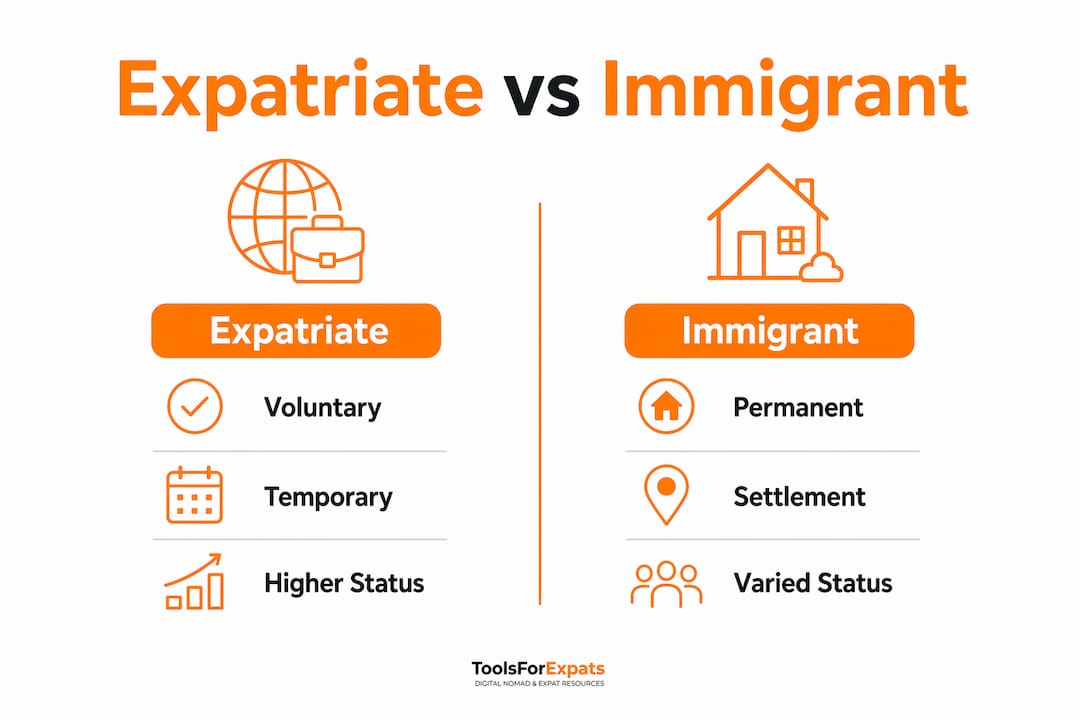
Here is a quick breakdown of how the two terms are typically applied:
- Expat: Voluntary relocation, often temporary, frequently tied to professional or lifestyle motivations, associated with higher income brackets
- Immigrant: Relocation that may be voluntary or necessity-driven, often implies intent to settle permanently, applied more broadly across income levels
- Migrant worker: Typically describes someone moving for economic labor, often with less legal protection or social status
- Refugee or asylum seeker: Describes forced displacement due to conflict, persecution, or disaster, entirely distinct from expat status
Pro Tip: If you are moving abroad and unsure which label applies to your situation, focus on your visa category and residency status rather than the social label. Your legal classification matters far more than the informal term.
The distinction between expat and immigrant ultimately hinges on perceived status and migration motives. That perception shapes social dynamics in host countries, sometimes creating parallel communities that rarely interact.
Historical and legal origins of the term
The word "expatriate" has roots in the Latin ex (out of) and patria (fatherland or homeland). In its earliest uses, the term described someone banished or exiled from their country, often as a punishment. Dante Alighieri, exiled from Florence in 1302, would have been called an expatriate in the original sense.
The term evolved from meaning exile to describing voluntary relocation over several centuries. By the 20th century, especially after World War II, "expat" had largely shed its punitive connotations. British colonial administrators, diplomats, and aid workers living abroad adopted the term as a professional identity marker.
The legal meaning, however, stayed serious. The U.S. Expatriation Act of 1868 formally established the right to renounce citizenship. That act was a direct response to disputes over whether naturalized American citizens could be reclaimed by their countries of origin. Today, formally renouncing U.S. citizenship is a complex legal process involving the State Department, exit taxes, and permanent loss of the right to live in the United States.
| Meaning | Context | Key distinction |
|---|---|---|
| Exile or banishment | Historical, pre-20th century | Involuntary, punitive |
| Voluntary relocation | Modern colloquial use | Personal choice, lifestyle or work |
| Formal renunciation of citizenship | Legal and governmental | Permanent, legally binding |
| Corporate international assignment | HR and business contexts | Temporary, employer-sponsored |
Understanding which meaning applies in a given conversation prevents real misunderstandings, especially when legal rights or residency status are involved.
Who is considered an expatriate today?
The modern expat population is far more diverse than the mid-century British civil servant stereotype suggests. Today, the term covers a wide range of people living outside their home countries for different reasons.
Typical expat profiles include:
- Skilled professionals on company assignments: Engineers, consultants, and executives sent abroad by employers like Shell, Siemens, or Goldman Sachs. These are company-assigned expatriates who retain ties to a home office and typically receive relocation packages, housing allowances, and tax support.
- Self-initiated expats: People who move abroad on their own initiative, without employer sponsorship. A graphic designer who moves from Chicago to Barcelona because they love the lifestyle is a self-initiated expat. They handle their own visa, taxes, and housing.
- Retirees: A growing segment, particularly Americans and Northern Europeans relocating to countries like Mexico, Portugal, or Thailand for lower costs and warmer climates. International property ownership in destinations like the Côte d'Azur has become a popular retirement strategy.
- Digital nomads: Remote workers who live abroad while working for companies or clients in their home country. This group blurs the line between tourist and expat, but those who stay in one country for six months or more typically qualify as expats under local residency rules.
- Artists and academics: Writers, musicians, and researchers who relocate for creative or intellectual reasons. Ernest Hemingway in Paris and James Baldwin in France are classic historical examples.
Students are generally not categorized as expatriates in professional or corporate contexts. A student studying abroad for a semester is on a temporary educational visa, not establishing residency or a lifestyle abroad. The distinction matters for tax and legal purposes.
The difference between company-assigned and self-initiated expats is significant. Corporate expats typically have structured legal and financial support. Independent expats navigate visa requirements, tax obligations, and healthcare on their own.
What are the cultural and practical implications of being an expat?
Living as an expatriate involves more than just a change of address. The cultural, legal, and emotional dimensions of expat life shape daily experience in ways that are easy to underestimate before you move.
-
Visa and residency requirements: Your legal right to live and work in a country depends entirely on your visa category. Most countries offer specific visa types for skilled workers, retirees, and remote workers. Failing to maintain the correct visa status can result in fines, deportation, or bans from re-entry. Foreign entrepreneurs, for example, face specific legal requirements in Switzerland that differ significantly from employee visa rules.
-
Tax obligations: Most countries tax residents on income earned within their borders. The United States is one of the few countries that also taxes citizens on worldwide income, regardless of where they live. This means American expats often file taxes in two countries simultaneously.
-
Social integration: Expats in cities with large international populations, like Dubai, Singapore, or Brussels, often form parallel social communities. In Brussels, about 85% of the population are immigrants or their children. That demographic reality fuels ongoing debate about whether labels like "expat" create social divisions rather than reflect them.
-
Emotional challenges: Loneliness, cultural disorientation, and a sense of not fully belonging anywhere are common expat experiences. These feelings are normal and tend to peak in the first six to twelve months abroad.
-
Identity shifts: Long-term expats often describe feeling like a different person after years abroad. Values, habits, and social expectations shift. Many describe themselves as "third culture" individuals who no longer feel fully at home in either their birth country or their adopted one.
Pro Tip: Before you move, research the cultural norms of your destination country as thoroughly as you research the visa requirements. Social missteps are harder to recover from than paperwork errors.
The socio-economic connotations of "expat" versus "immigrant" reinforce class and racial disparities in global migration. Being aware of that dynamic helps you engage more thoughtfully with local communities and avoid the insularity that gives expat communities a bad reputation in some host countries. You can also use the expat loneliness risk calculator at ToolsForExpats to assess your social vulnerability before and after a move.
Key Takeaways
An expatriate is a person who voluntarily lives outside their native country, and the term carries distinct social, legal, and practical meanings that vary by context.
| Point | Details |
|---|---|
| Core definition | An expatriate voluntarily lives outside their home country for work, retirement, or lifestyle reasons. |
| Expat vs immigrant | The distinction is social and perceptual, not legal, and often reflects class and racial biases. |
| Legal vs colloquial use | Legal expatriation means renouncing citizenship; everyday use simply means living abroad. |
| Two expat types | Company-assigned expats get employer support; self-initiated expats manage everything independently. |
| Practical implications | Expat life involves visa compliance, tax obligations, and real emotional adjustment challenges. |
The label matters more than most expats realize
The word "expat" feels neutral when you first use it to describe yourself. After years of living abroad and talking with people from dozens of countries, I have come to see it differently.
The term carries real weight in how host communities perceive you. In cities like Amsterdam or Nairobi, locals notice when a newcomer calls themselves an expat versus an immigrant. The first signals temporary privilege. The second signals commitment. Neither is inherently better, but the social signal is real.
What I find most interesting is how the label shapes your own behavior. Expats who identify strongly with the term tend to cluster in expat communities, use English as a default, and maintain a mental countdown to "going home." Those who resist the label and try to integrate more fully tend to learn the local language faster, build deeper friendships, and report higher satisfaction with life abroad.
The expat happiness score test at ToolsForExpats is one of the few tools I have seen that actually measures this dimension. Most relocation tools focus on finances. Wellbeing is just as important.
My honest advice: use the term "expat" as a practical shorthand, not as an identity. Stay curious about the place you have chosen to live. The people who thrive abroad long-term are the ones who treat their host country as a home, not a backdrop.
— Jay
Free tools to plan your life abroad with ToolsForExpats
Understanding what expatriate means is the first step. Planning the move is where most people get stuck.
ToolsForExpats offers a full suite of free expat planning tools built specifically for people in your position. You can compare living costs across cities with the cost of living comparison tool, check your visa eligibility for more than 20 countries with the visa eligibility checker, and estimate your full relocation budget with the moving abroad calculator. No account required. No paywalls. Just the numbers you need to make a confident decision about your next move.
FAQ
What is the simple definition of an expatriate?
An expatriate is a person who lives outside their native country, usually by choice, for reasons like work, retirement, or lifestyle. The term does not imply any legal change in citizenship.
Is there a legal difference between an expat and an immigrant?
Legally, both terms describe foreign nationals residing in a country. The difference is social: "expat" is typically applied to wealthier, Western professionals, while "immigrant" is used more broadly across income levels and nationalities.
Does being an expat mean you give up your citizenship?
No. In everyday use, being an expat simply means living abroad. Legal expatriation, which involves formally renouncing citizenship, is a separate and permanent legal process governed by national law, such as the U.S. Expatriation Act of 1868.
Are digital nomads considered expatriates?
Digital nomads who stay in one country for an extended period, typically six months or more, generally qualify as expats under local residency rules. Short-term nomads moving every few weeks are usually classified as tourists.
Why do people expatriate?
People become expats for a wide range of reasons, including career opportunities, lower cost of living, retirement, lifestyle preferences, and family ties. Work assignments and remote work flexibility are the two most common drivers today.