
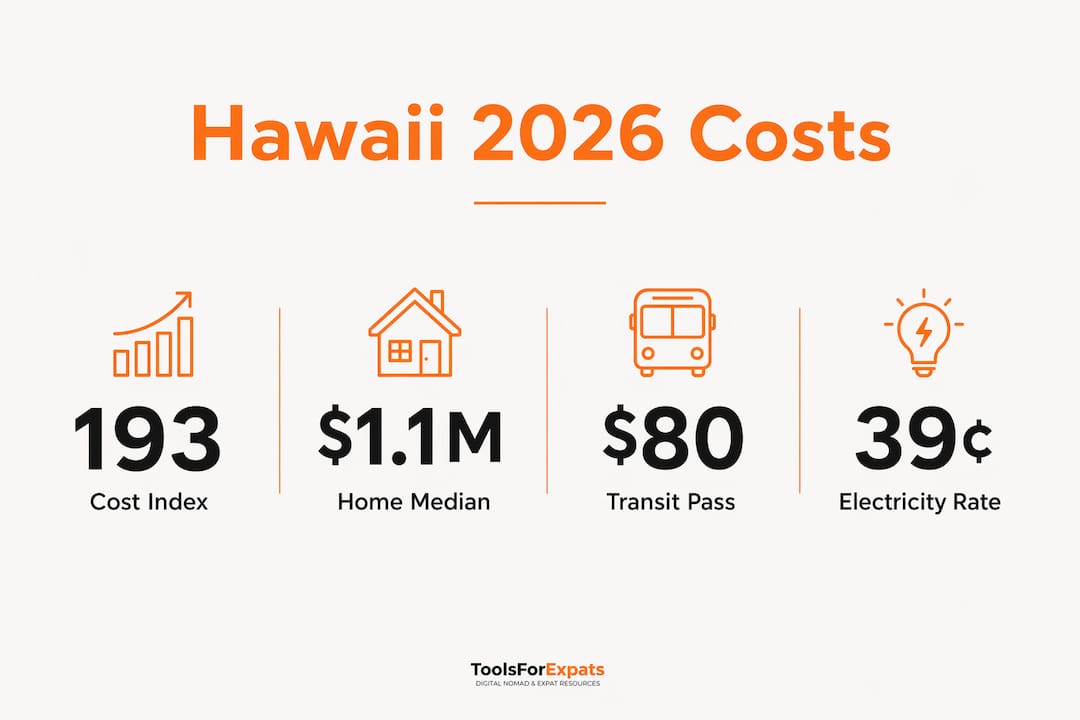
Hawaii's cost-of-living index in 2026 remains nearly double the U.S. national baseline. That single number tells you almost everything you need to know before you plan your move. A frugal single person should budget a moderate amount per month; a comfortable single person a higher range; couples and families should budget accordingly, depending on size and lifestyle. Those figures assume a modest apartment, one car, and careful grocery shopping.
Three cost drivers dominate every Hawaii budget:
- Housing — median rents start around typical costs for a studio and rise quickly; Oahu single-family home medians exceed one million dollars.
- Groceries and food — Hawaii imports most of its food supply, pushing grocery prices significantly above the mainland average.
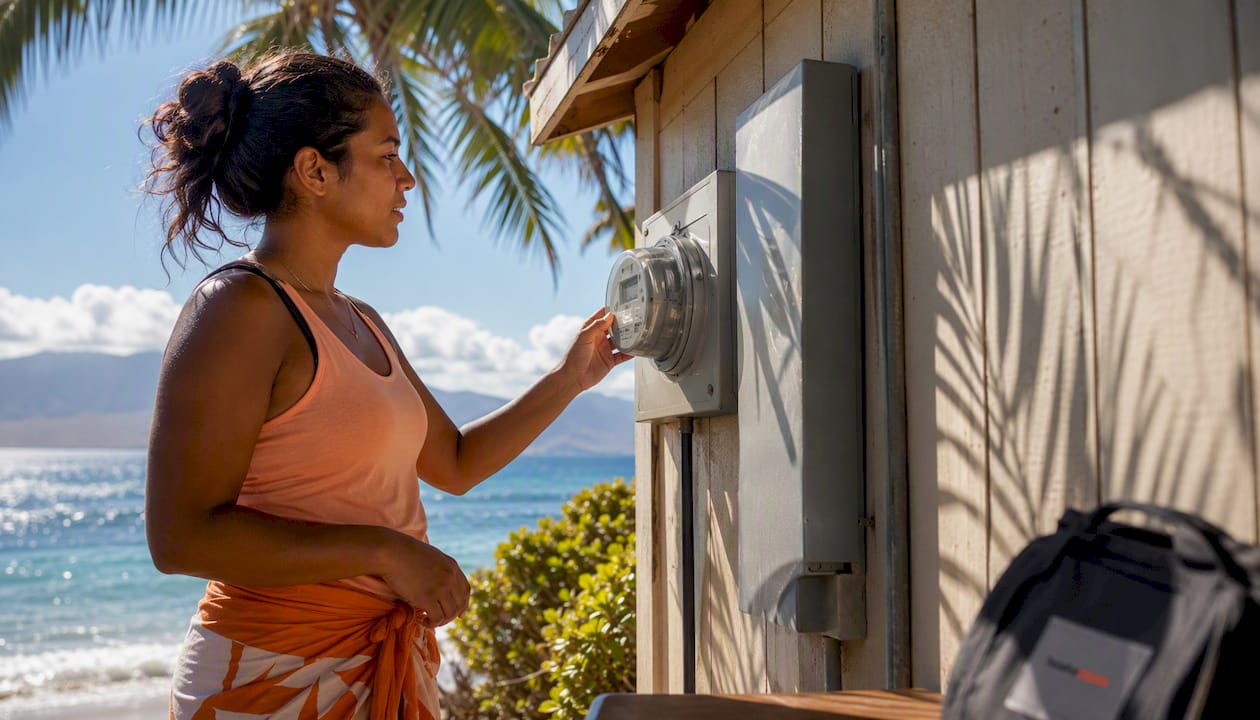
- Electricity — at roughly 39–41 cents per kWh, Hawaii has some of the highest residential electricity rates in the country, with a typical 3-bedroom home running $300–$450 per month.
Before you read further, plug your household type into the ToolsForExpats cost-comparison tool to get a personalized city-to-city estimate, or use the moving-abroad budget calculator to map your full relocation costs.
How much does housing cost in Hawaii?
Housing is the single largest line item in any Hawaii budget, and the numbers vary significantly by island and neighborhood type.

Rent medians by unit size (statewide, 2026):
| Unit Type | Typical Monthly Rent |
|---|---|
| Studio | ~$1,524 |
| 1-bedroom | $1,840–$2,260 |
| 2-bedroom | $2,380–$2,620 |
| 3-bedroom | $3,380–$3,830 |
Honolulu and urban Oahu sit at or above the top of those ranges. Neighbor islands like the Big Island and parts of Maui can offer 10–20% lower rents in rural areas, but access to grocery stores, healthcare, and employment is more limited. Kauai is consistently expensive across the board, often matching or exceeding Oahu prices despite fewer amenities.
On the purchase side, Oahu single-family home medians exceed $1.1 million, while the statewide condo median sits around $520,000. Buying makes financial sense only if you plan to stay long-term and can absorb the upfront costs.
Upfront rental cash requirements catch many newcomers off guard. Most landlords require first month, last month, and a full security deposit at signing. That means you should plan for $5,000–$8,000 in move-in cash before you even unpack. Pet-friendly rentals are scarce and typically carry a premium on top of that.
Key trade-offs to weigh:
- Honolulu/urban Oahu: Higher rent, but you get access to TheBus public transit, Costco, major hospitals, and a dense job market.
- Neighbor islands: Lower rent is possible in rural pockets, but you'll likely need a car, pay more for groceries, and travel to Oahu for specialty medical care.
- Inland vs. beachfront: Moving even a few miles inland on any island can cut rent by $200–$500 per month.
Pro Tip: Lease timing matters. Hawaii's rental market tends to loosen slightly between October and January when fewer mainland transplants are actively searching. Starting your housing search in that window can give you more negotiating room on price and move-in terms.
What do utilities cost in Hawaii each month?
Utilities in Hawaii are a budget line that surprises almost every newcomer, and electricity is the main reason.
Typical monthly utility costs:
- Electricity: $150–$250 for a 1-bedroom; $300–$450 for a 3-bedroom home
- Water/sewer: $60–$100 per month for a standard household
- Internet (broadband): $60–$100 per month depending on provider and location
- Cell phone service: $50–$90 per month for a standard plan
The statewide residential electricity rate averages roughly 39–41 cents per kWh, which is among the highest in the United States. The reason is structural: Hawaii generates most of its electricity from imported petroleum, and that dependency gets priced into every bill.
Central air conditioning is uncommon in Hawaii homes. Most residents rely on trade winds and ceiling fans to stay comfortable, which keeps bills manageable. Add a window AC unit in a humid summer month, and your electricity bill can jump $80–$120 in a single billing cycle. Remote workers running multiple monitors and home office equipment should factor in an additional $30–$60 per month over a typical residential baseline.
One infrastructure reality worth knowing: short-duration power outages occur more frequently than on the mainland, especially on neighbor islands. A small UPS (uninterruptible power supply) unit for your home office is a practical, low-cost investment.
Pro Tip: If you're renting long-term, ask the landlord whether the property has solar panels or a solar water heater already installed. Solar-equipped rentals are increasingly common on Oahu and can cut your electricity bill by 30–50% compared to a standard grid-only unit.
Why are grocery prices so high in Hawaii?
The short answer: almost everything you eat was shipped here. Hawaii imports roughly 85–90% of its food supply, and that dependency shows up directly in the grocery price index, which runs about 31% above the mainland baseline.
Sample per-item price comparisons (approximate, 2026):
- Gallon of milk: $6–$8 on Oahu; $7–$10 on Kauai or rural Maui
- Loaf of bread: $5–$7 on Oahu; $6–$9 on neighbor islands
- Dozen eggs: $5–$7 statewide, with consistent premiums on Kauai and parts of Maui
- 5 lb bag of rice: $7–$10 depending on brand and island
Oahu generally offers the lowest grocery prices because it has the highest concentration of large-format stores, including multiple Costco and Walmart locations. On Kauai and more remote parts of Maui or the Big Island, identical items can cost $1–$2 more per unit simply because of the additional inter-island shipping leg.
Practical shopping tactics that actually work:
- Warehouse club membership (Costco or Sam's Club): Can save 25–40% on bulk staples versus local chains. On Oahu, this is one of the fastest ways to reduce your monthly grocery bill.
- Multi-store strategy: Buy staples at Costco or Walmart, produce at local farmers markets, and specialty items at the chain nearest to you. Splitting your shopping across three stops sounds tedious, but it's how long-term residents manage the cost.
- Farmers markets: Fresh, locally grown produce is often cheaper and fresher than supermarket imports. The KCC Farmers Market in Honolulu and the Hilo Farmers Market on the Big Island are two of the most established.
How much does transportation cost in Hawaii?
Transportation costs in Hawaii depend heavily on which island you live on and whether you can realistically avoid owning a car.
Typical monthly transportation costs:
- Gas: Hawaii gas prices regularly run $0.50–$1.00 per gallon above the national average. Budget $150–$250 per month for a single-car household with average commuting.
- Car insurance: $120–$180 per month for standard coverage; rates vary by island and driving record.
- Vehicle maintenance: Salt air accelerates rust and corrosion on brake lines, undercarriage, and body panels. Budget an extra $300–$600 per year above what you'd spend on the mainland.
- Parking: In urban Honolulu, monthly parking can add $100–$200 to your costs.
On Oahu, TheBus is a genuinely functional public transit system. A single ride costs $3, and a monthly pass runs $80. If you live and work in Honolulu's urban core, you can realistically skip car ownership and save $500–$700 per month in combined car payment, insurance, gas, and parking. The Skyline rail extension is also expanding transit access along the Oahu west corridor.
On every other island, a car is not optional. Maui, the Big Island, and Kauai have minimal or no meaningful public transit. You will need a vehicle.
Inter-island travel runs $80–$200 per roundtrip on Hawaiian Airlines or Mokulele Airlines, depending on how far in advance you book. If you live on a neighbor island and need to visit Oahu regularly for medical appointments, Costco runs, or work, those flights add up quickly. Some neighbor-island households make one monthly Oahu trip specifically to stock up at Costco and offset the airfare with per-item savings.
What should you budget for healthcare in Hawaii?
Hawaii has a unique healthcare mandate: employers are required by state law to provide health insurance to employees working 20 or more hours per week, which means many full-time workers have access to employer-sponsored coverage. Self-employed residents and remote workers need to plan more carefully.
Typical monthly costs:
- Employer-sponsored plan (employee share): $100–$300 per month depending on plan tier and employer contribution
- Individual marketplace plan: $350–$600 per month for a mid-tier plan
- Out-of-pocket visit costs: $25–$50 for a primary care copay; $150–$300 for a specialist visit without insurance
Specialist care is heavily concentrated on Oahu. If you live on a neighbor island and need cardiology, oncology, or other specialty services, you may need to travel to Honolulu, which adds airfare and lodging to your healthcare costs. Budget $300–$500 per specialist trip if you're on Maui, Kauai, or the Big Island.
Practical ways to manage healthcare costs:
- Health Savings Account (HSA): If you're on a high-deductible plan, an HSA lets you set aside pre-tax dollars for medical expenses.
- Federally Qualified Health Centers: Hawaii has several community health centers that offer sliding-scale fees for uninsured or underinsured residents.
- Telehealth: For routine follow-ups, prescription renewals, and minor concerns, telehealth platforms can eliminate the need for an in-person visit and the associated travel on neighbor islands.
What does childcare and education cost in Hawaii?
Childcare in Hawaii is expensive and, in many areas, genuinely hard to find. Infant care at a licensed center typically runs $1,800–$2,500 per month. Preschool for a 3–4-year-old averages $1,200–$1,800 per month. These figures put Hawaii among the most expensive states for early childhood care in the country.
Waitlists at quality centers are common, especially on Oahu. Families planning a move with young children should start researching childcare options six to twelve months before their planned arrival date.
For K–12, Hawaii's public school system is a single statewide district, which means quality varies significantly by school zone rather than by district. Private school tuition ranges from $15,000 to $25,000+ per year at established institutions. Punahou School in Honolulu, one of the most well-known private schools in the state, has tuition in that upper range and a competitive admissions process.
Budgeting approaches for families:
- Co-op childcare: Some communities organize parent-cooperative childcare arrangements that reduce per-family costs significantly.
- Extended family support: Families with relatives already in Hawaii sometimes share childcare informally, which can eliminate or reduce formal care costs.
- Early waitlist enrollment: Get on waitlists at multiple centers as soon as you have a confirmed move date. Spots at quality centers fill 6–12 months out.
How do Hawaii's taxes affect your take-home pay?
Hawaii has a progressive state income tax with rates ranging from 1.4% to 11%, making it one of the higher state income tax states in the country. The top bracket of 11% applies to taxable income above $200,000 for single filers.
Simplified bracket overview for single filers (2026):
- 1.4% on the first $2,400 of taxable income
- 3.2% on income from $2,401 to $4,800
- 5.5% on income from $4,801 to $9,600
- 6.4% on income from $9,601 to $14,400
- 6.8% on income from $14,401 to $19,200
- 7.2% on income from $19,201 to $24,000
- 7.6% on income from $24,001 to $36,000
- 7.9% on income from $36,001 to $48,000
- 8.25% on income from $48,001 to $150,000
- 9% on income from $150,001 to $175,000
- 10% on income from $175,001 to $200,000
- 11% on income above $200,000
Hawaii does not have a traditional sales tax. Instead, it has a General Excise Tax (GET) that businesses pay on gross revenue. In practice, most businesses pass the GET on to consumers, so you'll see it embedded in prices at restaurants, retail stores, and service providers. The effective rate consumers experience is typically 4–4.5% on most purchases.
Worked example: A gross salary of $90,000 in Hawaii, after federal income tax (roughly $15,000), Hawaii state income tax (roughly $6,500–$7,000), and FICA (roughly $6,885), leaves approximately $61,000–$62,000 in annual take-home pay, or about $5,100–$5,200 per month. That's a meaningful gap from the gross figure and directly affects how you should read the sample budgets below. For digital nomads navigating state tax residency questions, the ToolsForExpats guide on tax residency covers the key considerations.
This article provides general information, not tax or financial advice. Confirm your specific situation with a qualified tax professional or the Hawaii Department of Taxation.
What does everyday life cost in Hawaii?
Dining out and entertainment in Hawaii reflect the same import-driven premium as groceries, but the range is wide depending on your lifestyle choices.
Typical price points:
- Plate lunch (local staple: two scoops rice, mac salad, protein): $12–$16 at a local lunch spot
- Casual sit-down restaurant: $18–$30 per person, before tip
- Fine dining: $60–$120+ per person at a Honolulu restaurant
- Coffee shop latte: $6–$8
- Movie ticket: $14–$18
- Gym membership: $40–$80 per month at a standard gym; $100–$150 at a boutique fitness studio
The lifestyle trade-off most long-term residents make is spending less on indoor entertainment and more on outdoor activities — many of which are free. Hiking, snorkeling, surfing, and beach time cost nothing beyond gear. That shift genuinely changes monthly spending patterns for people who embrace it.
Streaming subscriptions, software, and online services cost the same as on the mainland. A typical bundle of two to three streaming services runs $30–$50 per month. If you're a remote worker, factor in a dedicated coworking space at $200–$400 per month in Honolulu if you need a professional environment outside the home.
Sample monthly budgets with line-item math
These three budgets reflect realistic 2026 spending for different household types. All figures assume Oahu/Honolulu as the base; neighbor-island residents should add 5–15% to grocery and utility lines.
| Expense Category | Solo Frugal | Solo Comfortable | Couple | Family of 4 |
|---|---|---|---|---|
| Rent | ~$1,524 | $1,840–$2,260 | $2,380–$2,620 | $3,380–$3,830 |
| Electricity | $120 | $150–$250 | $200 | $350 |
| Water/internet/phone | $180 | $150–$250 | $150–$250 | $300–$450 |
| Groceries | $500 | $600 or less | — | — |
| Transportation | $200 | $400 | $600 | $700 |
| Healthcare | $200 | $300 | $500 | $700 |
| Dining out/lifestyle | $200 | $400 | $600 | $600 |
| Misc/personal | $150 | $200 | $300 | $400 |
| Monthly Total | $3,000 or more | $3,000 or more | $3,000 or more | $3,000 or more |
To cover these budgets comfortably, the pre-tax annual salary ranges you should target:
- Solo frugal: $65,000–$75,000 gross
- Solo comfortable: $85,000–$100,000 gross
- Couple (combined): $120,000–$140,000 gross
- Family of four: $170,000–$200,000+ gross
These are starting points, not guarantees. Use the ToolsForExpats nomad cost calculator to adjust for your specific housing choice, commute, and lifestyle preferences.
Practical ways to lower your cost of living in Hawaii
The "paradise tax" is real, but it's not fixed. Long-term residents consistently identify the same set of tactics that make a meaningful difference.
- Get a Costco membership immediately. On Oahu, the Costco locations in Iwilei and Kapolei are among the busiest in the country. Bulk buying at warehouse clubs can save 25–40% on staples like cooking oil, rice, canned goods, and paper products versus local chains.
- Run a multi-store grocery strategy. Costco for bulk staples, Walmart or Foodland for mid-range items, and a farmers market for fresh produce. This approach is how most budget-conscious residents shop.
- Choose your neighborhood deliberately. Living 10–15 minutes inland on Oahu can reduce rent by $300–$500 per month with minimal lifestyle impact.
- Skip the car if you live in urban Honolulu. TheBus at $80 per month versus $600–$800 in combined car costs is a significant monthly saving for residents who work and live in the urban core.
- Time your lease renewal. Negotiate in the October–January window when demand is softer and landlords are more willing to hold rates.
- Use solar-equipped rentals or invest in solar if you own. Solar installations on Hawaii homes have strong payback periods given the high electricity rates.
- Consolidate neighbor-island Costco trips. If you live on Maui, Kauai, or the Big Island, a monthly Oahu trip to stock up can offset the airfare cost through per-item savings on bulk goods.
- Leverage telehealth for routine care. Especially on neighbor islands, telehealth eliminates travel costs for non-urgent medical needs.
- Watch weekly store circulars. The Retail Merchants of Hawaii has consistently emphasized that checking weekly circulars and planning purchases around sales is now a standard budgeting practice for long-term residents, not an optional money-saving tip.
Why neighbor-island prices can be significantly higher
The price gap between Oahu and the neighbor islands isn't random. It's the direct result of Hawaii's inter-island shipping structure, which adds a second freight leg on top of the already-expensive transpacific haul from the mainland.
2026 reporting links a significant grocery price spike to instability at the primary inter-island shipping operator, which has created measurable per-item premiums on Kauai, Maui, and parts of the Big Island. When that shipping link is disrupted, neighbor-island stores face supply shortages and price increases that Oahu's larger, more diversified supply chain absorbs more easily.
Concrete per-item examples:
- Milk: $1–$2 more per gallon on Kauai versus Honolulu
- Bread: $1–$2 more per loaf on remote Maui locations versus Oahu
- Fresh produce: 15–25% premium on many items on neighbor islands, depending on season and shipping frequency
The BLS Consumer Price Index for Urban Hawaii showed food prices rising 3.0% for the 12 months ending in May 2026, with energy prices up 28.8% over the same period. Those headline figures are statewide, but the neighbor-island experience of both trends is more acute.
How to factor island premiums into your budget:
- Add 10–15% to the grocery line in any sample budget if you're planning to live on Kauai or a rural part of Maui.
- Add 5–10% for most Big Island locations outside of Hilo, which has better retail access than the Kona side.
- Treat Oahu grocery prices as the floor, not the average, when comparing islands.
How we calculated the sample budgets and the data sources we used
Primary data sources and dates:
- Living in Hawaii cost-of-living guide (2026): rent medians, electricity rates, cost-of-living index, upfront rental requirements, grocery price index, home-price medians.
- How to Live in Hawaii grocery price guide: per-item price comparisons by island (milk, bread, eggs, rice).
- KHON2 big-box store pricing report: multi-store strategy evidence and big-box pricing data.
- Hawaii Estates grocery cost guide: warehouse club savings estimates.
- BLS Consumer Price Index, Honolulu Area, May 2026: official inflation data for Urban Hawaii.
- Honolulu Civil Beat, 2026: inter-island shipping disruption and grocery price spike reporting.
Key assumptions in the sample budgets:
- Rent figures use statewide medians from the 2026 data; Oahu/Honolulu rents are at or above the upper end of those ranges.
- Electricity costs use the ~39–41 cents/kWh statewide average; solar-equipped units would be lower.
- Grocery budgets assume a mix of Costco and local chain shopping; farmers market use is not assumed but would reduce costs.
- Transportation assumes one car for the frugal and comfortable solo budgets; the couple and family budgets assume one to two vehicles.
- Healthcare assumes employer-sponsored coverage for the solo budgets and a marketplace plan for the family budget.
Important caveats:
- All figures are statewide or Oahu-based unless noted. Neighbor-island residents should apply the 5–15% premium discussed in the research section.
- Rent medians reflect available inventory at the time of data collection; actual available units may be higher or lower depending on market conditions at your move date.
- Tax calculations are simplified illustrations. Your actual take-home will depend on filing status, deductions, and federal bracket.
- Use the ToolsForExpats cost-comparison tool to update these numbers with current data and personalize them for your household.
Key Takeaways
Hawaii's living costs in 2026 are nearly double the U.S. national average, driven by housing, electricity, and an import-dependent food supply that adds roughly 30% to grocery bills across every island.
| Point | Details |
|---|---|
| Cost-of-living index | Hawaii's index sits at 193 in 2026, nearly double the U.S. baseline of 100. |
| Housing dominates the budget | Median rents range from ~$1,524 (studio) to $3,830 (3-bedroom); plan $5,000–$8,000 in upfront move-in cash. |
| Electricity is the utility shock | At roughly 39–41 cents/kWh, a 3-bedroom home typically costs $300–$450 per month in electricity alone. |
| Groceries cost ~30% more | Hawaii imports 85–90% of its food; warehouse club membership and multi-store shopping are the most effective offsets. |
| ToolsForExpats calculators | Use the free cost-comparison and moving-budget tools to personalize these figures for your household and island. |
The numbers are only half the picture
Hawaii's cost data is clear and, frankly, sobering. But the mistake most people make when reading a cost-of-living breakdown like this is treating the numbers as fixed. They're not. The gap between a $3,400 monthly budget and a $5,500 one for a single person in Honolulu is almost entirely explained by housing choice, car ownership, and grocery habits. Those are decisions, not destiny.
What I'd encourage you to take from this guide is the habit of running scenarios, not just reading averages. The statewide index of 193 is a useful anchor, but it doesn't tell you what a 1-bedroom in Kaimuki costs versus one in Pearl City, or how much you'd save by skipping a car and living near a TheBus route. That's where personalization matters, and it's exactly what the calculators are built for.
The other thing worth saying plainly: the neighbor-island premium is real and growing. The 2026 shipping disruptions have made Kauai and rural Maui noticeably more expensive than they were two years ago. If you're drawn to a quieter island lifestyle, budget conservatively and plan your shopping strategy before you arrive, not after.
Plan your Hawaii budget with free ToolsForExpats tools
Knowing the averages is a solid starting point. Knowing your numbers is what actually helps you decide.
ToolsForExpats offers three free tools that take the sample budgets in this guide and make them personal. The cost-of-living comparison tool lets you compare Honolulu or any Hawaii city directly against your current city, so you can see the real gap in dollars, not index points. The moving-abroad budget calculator walks you through one-time relocation costs alongside recurring monthly expenses, so you know exactly how much you need in savings before you book a flight. No account required, no subscription, no cost. Run your numbers now and see what Hawaii actually looks like for your household.
Useful sources and next reads
These are the primary sources behind this guide, with a note on what each is most useful for:
- BLS Consumer Price Index, Honolulu Area, May 2026: The most authoritative source for official inflation data in Urban Hawaii. Check this quarterly for updated food, energy, and shelter index movements.
- Living in Hawaii cost-of-living guide, 2026: Comprehensive island-by-island breakdown of rents, utilities, grocery index, and home prices. Best for overall budget benchmarking.
- How to Live in Hawaii grocery price guide: The most detailed per-item, per-island grocery price comparison available. Use it to estimate your specific grocery budget by island.
- KHON2 big-box store pricing report: Local news reporting on how Costco and Walmart compare to local chains on staple prices. Useful for validating the multi-store strategy.
- Honolulu Civil Beat, 2026 grocery price spike report: Best source for understanding the 2026 inter-island shipping disruption and its effect on neighbor-island grocery prices.
- Hawaii Estates grocery cost guide: Practical breakdown of warehouse club savings and grocery cost management strategies for Hawaii residents.
- ToolsForExpats cost-comparison tool: Run your own city-to-city comparison to personalize the figures in this guide. Updated regularly and free to use without an account.