
Every international money transfer carries three cost buckets you need to know: the visible transfer fee, the exchange-rate markup (the spread between the rate you get and the mid-market rate), and intermediary or receiving-bank deductions. Live transfer tests found total costs for a $1,000 transfer ranged roughly from 0.5% to 9.8%, and the exchange-rate markup was often the largest portion of that cost. The single fastest way most U.S. senders save money is to compare the recipient amount across at least two providers, not just the advertised fee.
Three things you can do right now:
- Compare recipient amounts, not headline fees. A "zero-fee" provider with a 3% FX markup costs more than one charging $5 with a 0.5% markup on a $1,000 transfer.
- Fund by ACH or bank debit. Credit-card funding commonly adds 1.5–2.5 percentage points to your total cost and can trigger cash-advance fees on top.
- Avoid dynamic currency conversion (DCC). Always choose the local destination currency, never your home currency, when given the option.
Pro Tip: Before confirming any transfer, look up the current mid-market rate on Xe or Google (search "[currency pair] exchange rate"). The gap between that rate and what your provider offers is your FX markup. That gap is often larger than the fee line.
Later sections cover US-specific cost ranges for banks vs. digital providers, a step-by-step comparison method, a shortlist of 15 named providers, and a methodology note explaining how "true cost" is measured.
Key Takeaways
Comparing recipient amounts across at least two providers, funding by ACH, and choosing a digital-first provider with local payout rails are the three steps that consistently deliver the largest savings on international money transfer fees.
| Point | Details |
|---|---|
| FX markup is the biggest cost | The exchange-rate spread often exceeds the flat fee; always compute it against the mid-market rate. |
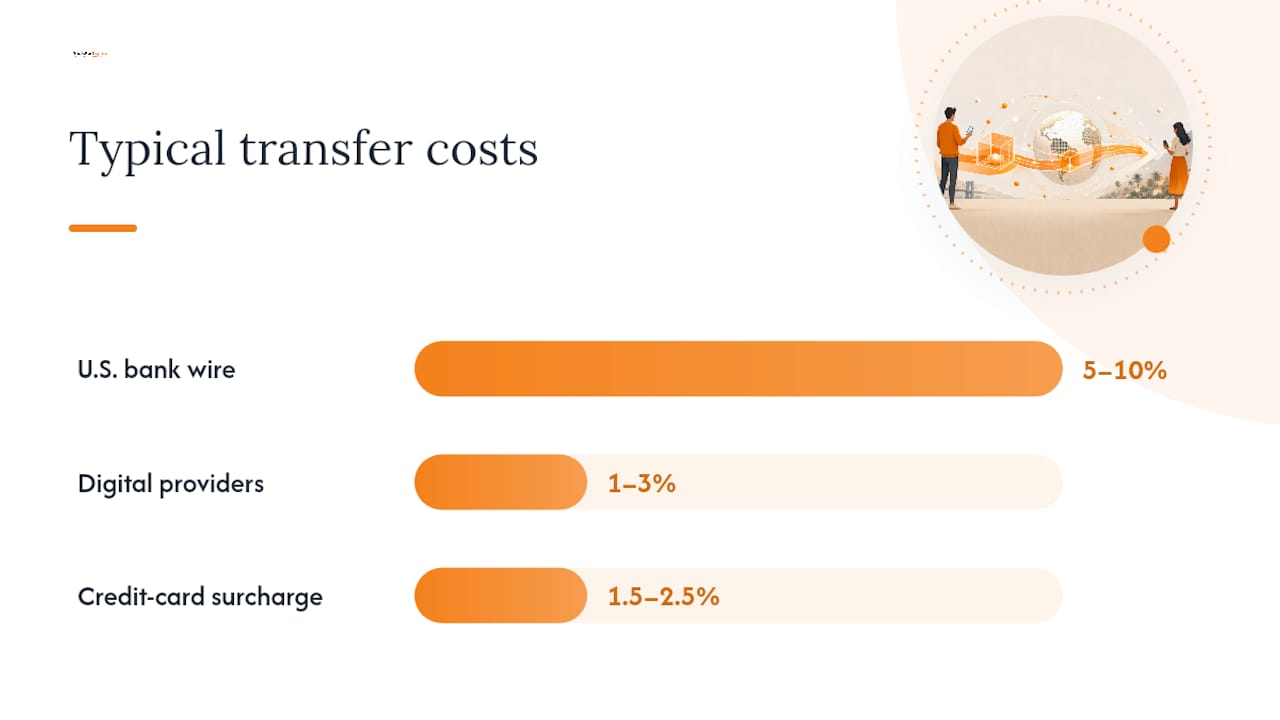
| Banks cost significantly more | U.S. bank wires typically run 5–10% total cost; digital providers often land at 1–3% on the same corridor. |
| Credit cards add 1.5–2.5% | Fund by ACH or bank debit to avoid surcharges and potential cash-advance fees from your card issuer. |
| Recipient amount is the metric | Compare what the recipient actually receives in destination currency, not the advertised fee line. |
| ToolsForExpats budget calculator | Model recurring transfer costs alongside living expenses at toolsforexpats.com/moving-abroad-budget. |
What are the real components of international money transfer fees?
Most people look at the fee line and stop there. That's where providers want your attention. The actual cost of a cross-border transfer involves up to five separate charges, and the ones you can't see easily are usually the biggest.
- Upfront transfer fee. A flat dollar amount (common at banks: $30–$50 for outgoing international wires) or a percentage of the transfer amount. Digital providers often charge $0–$5 flat or a small percentage.
- Exchange-rate markup (FX spread). The difference between the mid-market rate and the rate your provider actually gives you. On a $1,000 transfer, a 2% markup costs $20 and never appears as a fee line. This is typically the largest cost component.
- Intermediary/correspondent bank deductions. On SWIFT routes, one or more correspondent banks may deduct $15–$30 each from the transfer amount before it reaches the recipient. Using providers with local payout rails avoids most of these deductions.
- Receiving/incoming fees. Some recipient banks charge the beneficiary $10–$20 to receive an international wire. You often can't control this, but you can warn the recipient to check.
- Funding-method surcharges. Paying by credit card adds a premium and may be treated as a cash advance by your card issuer, triggering a separate 3–5% fee plus immediate interest.
Regulatory compliance costs (AML screening, OFAC sanctions checks) are real operational expenses that providers build into their pricing. They don't appear as a line item, but they're part of why even digital providers can't get to zero.
Sample: What happens to $1,000 sent from the U.S. to India
Start with $1,000. A major U.S. bank charges a $45 outgoing wire fee, leaving $955 in transfer value. One intermediary bank deducts $20.
Pro Tip: Flat fees favor large transfers; percentage-based markups hurt small ones proportionally more. Know which structure your provider uses before you decide how much to send.
What do international transfers actually cost? U.S. banks vs. digital providers
The gap between what a U.S. bank charges and what a digital-first provider charges is significant, and it widens on smaller transfers.

The World Bank's Remittance Prices benchmark puts the global average total cost of sending $200 at about 6.36% (Q3 2025). Digital channels come in well below that average on most corridors.
| Provider type | Typical fee ($200 transfer) | Typical fee ($1,000 transfer) | FX markup | Speed |
|---|---|---|---|---|
| U.S. major bank (wire) | $30–$50 flat (15–25% of $200) | $30–$50 flat (3–5% of $1,000) | 2–4% | 1–3 business days |
| Digital-first (Wise, Remitly) | $0–$5 | $3–$12 | 0.5–1.5% | Minutes to 2 days |
| Cash operator (Western Union) | $5–$15 | $5–$20 | 1–3% | Minutes to 1 day |
| FX broker (OFX) | $0 | $0 | 0.5–1.5% | 1–2 business days |
How a $1,000 transfer breaks down with a major U.S. bank:
- Outgoing wire fee: $45
- FX markup at 3%: $29 (on the remaining $955)
- Intermediary bank deduction: $20
- Recipient receives: ~$906 equivalent
- True total cost: ~$94 (9.4%)
The same $1,000 with a digital provider (e.g., Wise on a common corridor):
- Transfer fee: ~$6
- FX markup at 0.5%: ~$5
- No intermediary deduction (local rails)
- Recipient receives: ~$989 equivalent
- True total cost: ~$11 (1.1%)
The difference isn't small. On a $1,000 transfer, that's roughly $83 more in the recipient's pocket. Multiply that across 12 monthly transfers and you're looking at nearly $1,000 a year in avoidable costs.
Transfer size changes which cost component dominates. On a $5,000 transfer, the FX markup becomes the bigger number in absolute dollars. Knowing this helps you choose the right provider for each transfer size.
How do you compare providers the right way?
The comparison method matters as much as the providers you're comparing. Here's a repeatable process that cuts through marketing noise.
- Get a live quote from your provider. Enter the exact amount, corridor, and funding method you plan to use. The quote must show the exchange rate and recipient amount.
- Look up the mid-market rate. Go to XE.com or Google and search for your currency pair (e.g., "USD to MXN"). Note the rate shown.
- Compute the FX markup. Divide your provider's rate by the mid-market rate, subtract 1, and multiply by 100. Example: mid-market is 17.50 MXN/USD; your provider offers 17.15. Markup = (17.50 − 17.15) / 17.50 × 100 = 2%.
- Calculate the total cost in dollars. Add the flat fee to the FX markup cost. On $1,000 with a $5 fee and 2% markup: $5 + $20 = $25 total cost.
- Factor in intermediary and receiving fees. If you're sending via SWIFT, add an estimated $15–$30 for correspondent deductions. Ask the provider whether they use local rails.
- Use recipient amount as your final metric. The provider that delivers the most to your recipient wins, regardless of how the fee is labeled.
A "zero-fee" provider charging a 3% FX markup on $1,000 costs you $30. A provider charging a $5 fee with a 0.5% markup costs you $10. The zero-fee option costs three times as much.
Pro Tip: Build a simple three-column spreadsheet: Provider | Recipient Amount | Total Cost %. Run two providers for every corridor you use regularly. You'll often find the cheapest option shifts by corridor and by transfer size.
The World Bank's 6.36% global average is a useful benchmark. If your provider's total cost exceeds that on a common corridor, you're overpaying and should test an alternative.
Practical ways to cut your transfer costs right now
These tactics are ranked by impact. Start at the top.
- Compare recipient amounts across at least two providers. This single step catches the most savings. Run a quote on Wise and one other provider for your corridor before every transfer.
- Fund by ACH or bank debit, not credit card. Credit-card funding adds 1.5–2.5 percentage points and risks a cash-advance charge. ACH is almost always free or minimal.
- Avoid credit cards entirely for international transfers. Even if the transfer platform doesn't flag it, your card issuer may classify it as a cash advance and charge 3–5% plus daily interest from day one.
- Batch transfers when it makes sense. Sending $500 twice a month instead of $250 four times halves the number of flat fees you pay. This works best when the recipient can manage a larger, less frequent deposit.
- Use providers with local payout rails. Wise, Remitly, and OFX often use in-country payment networks to deliver funds, bypassing SWIFT correspondent banks and their $15–$30 deductions.
- Match the provider to the corridor. The cheapest provider for USD→MXN is often different from the cheapest for USD→PHP or USD→INR. Test your specific route.
Before you hit send, run this quick checklist:
- Did you compare the recipient amount (not just the fee) on at least two platforms?
- Are you funding by ACH or bank debit?
- Did you check the mid-market rate and compute the FX markup?
- Is the payout method the recipient actually needs (bank deposit, cash pickup, mobile wallet)?
- Have you confirmed whether SWIFT intermediary fees apply?
Pro Tip: Weekday transfers generally get better FX rates than weekend ones. Some digital providers lock in rates at the time of booking, but others apply the rate at settlement. If your provider settles on Monday for a Friday booking, you're exposed to weekend rate moves. Check the provider's rate-lock policy before sending large amounts. For transfers above $5,000, an FX broker or currency arbitrage strategy can save more than any flat-fee waiver.
Which provider is right for your transfer?
The right choice depends on your corridor, transfer size, speed needs, and payout method. Here's how the major U.S.-available options compare.
A few things worth noting about specific categories:
Wise stands out for FX transparency because it shows the mid-market rate and the markup separately before you confirm. On many common U.S. corridors (USD→EUR, USD→GBP, USD→INR), its total cost runs among the lowest tested. OFX is the stronger pick for transfers above $5,000 because its volume pricing and negotiated FX rates reduce the markup in absolute dollar terms. Western Union's cash pickup network is genuinely hard to match for recipients without bank accounts, particularly in rural areas of Latin America, Africa, and Southeast Asia.
U.S. bank wires (Bank of America, Chase, Wells Fargo, Citibank) make sense when the recipient's bank requires a SWIFT wire, when a legal or contract deadline demands a bank-sourced transfer, or when the amount is large enough that the bank relationship provides negotiating leverage. For routine family support or recurring freelancer payments, a digital provider almost always delivers more to the recipient.
Capital One, Charles Schwab, Ally Bank, Varo Bank, and Forbright Bank all offer international wire services through their standard banking platforms. Schwab is worth noting for travelers because its debit card reimburses ATM fees globally, which is a different use case from sending a wire. For pure international transfers, none of these five have publicly listed FX markups that compete with the digital-first providers.
Pro Tip: The cheapest provider for USD→MXN is often not the cheapest for USD→PHP. Run a live quote on your specific corridor every few months. Providers adjust their FX margins and fee structures regularly, and the rankings shift.
What hidden fees should you check before you send?
Red flags are easy to miss when you're in a hurry. These are the most common traps.
- "Zero fee" with a wide FX markup. A provider advertising no transfer fee may apply a 2–4% FX spread. On $1,000, that's $20–$40 in hidden costs.
- Dynamic currency conversion (DCC). If a foreign ATM or payment terminal offers to charge you in U.S. dollars instead of local currency, decline. The conversion rate applied is almost always worse than your bank's rate, and you pay twice.
- Credit-card cash-advance treatment. Some transfer platforms process credit-card payments as cash advances. Your card issuer charges a 3–5% advance fee plus interest from day one, with no grace period.
- Unexpected intermediary deductions. On SWIFT routes, correspondent banks may deduct $15–$30 from the transfer amount. The recipient gets less than quoted, and the sending provider may not warn you.
- Unclear receiving fees. Some recipient banks charge an incoming wire fee of $10–$20. Ask the recipient to check with their bank before you send.
- Weekend FX surcharges. Some providers apply wider spreads on weekends when interbank markets are closed. A transfer booked Saturday may settle at a worse rate than one booked Monday.
Run this checklist on the quote screen before confirming:
- Does the quote show the exact exchange rate and the mid-market rate for comparison?
- Is the recipient amount clearly stated in the destination currency?
- Does the provider disclose whether SWIFT intermediary fees may apply?
- Are you funding by bank/ACH (not credit card)?
- Is the payout method confirmed with the recipient?
- If the quote lacks any of the above, ask the provider directly: "What is the total amount my recipient will receive, and does that include all fees?"
Pro Tip: If a provider's quote screen doesn't show the recipient amount in destination currency before you confirm, treat that as a red flag. Reputable providers (Wise, Remitly, OFX) show the recipient amount prominently. If you have to calculate it yourself from a rate and a fee, the provider is making comparison harder on purpose.
How do transfer timing, limits, and large amounts affect your cost?
Speed and settlement rails are directly connected to cost. Here's what each rail typically means for your transfer.
- ACH/bank transfer: 1–3 business days; lowest funding cost; standard for digital providers.
- SWIFT/international wire: 1–3 business days; higher fees; may include intermediary deductions; used by banks and some digital providers for certain corridors.
- Provider local rails: Minutes to 1 business day; avoids correspondent banks; used by Wise, Remitly, and OFX on supported corridors.
- Instant/cash pickup: Minutes; higher FX markup typical; used by Western Union and Xoom.
Most U.S. banks have wire cutoff times around 4:00–5:00 PM ET on business days. Transfers submitted after cutoff process the next business day. Digital providers often accept transfers 24/7 but may hold funding until the next ACH settlement window.
Large transfers ($10,000 and above) require extra planning:
Transfers at or above $10,000 trigger mandatory Currency Transaction Reports (CTRs) filed by the sending institution with FinCEN. This is routine compliance, not an accusation of wrongdoing. However, you should expect:
- Additional identity verification from the provider.
- Possible holds of 1–3 business days while the transfer is reviewed.
- Requests for documentation of the transfer's purpose (property purchase, business payment, family support).
- Negotiated FX rates may be available at this size. Ask OFX, Wise, or your bank's FX desk directly.
On large transfers, the FX markup dominates in absolute dollars. For transfers above $10,000, consider contacting an FX broker or the provider's dedicated large-transfer team before booking.
How is "true cost" measured, and how can you check it yourself?
The methodology behind any honest provider comparison matters. Here's how total cost is properly calculated, and how you can replicate it.
The all-in test method:
- Initiate a real transfer (or get a live quote) for a fixed amount (e.g., $1,000) on a specific corridor (e.g., USD→INR) on the same day.
- Record the provider's quoted exchange rate and the upfront fee.
- Look up the mid-market rate from XE at the same moment.
- Compute FX markup: (mid-market rate − provider rate) / mid-market rate × 100.
- Compute FX cost in dollars: transfer amount × FX markup %.
- Add: upfront fee + FX cost + known intermediary deductions = total cost.
- Divide total cost by transfer amount for total cost percentage.
Methodology caveats to keep in mind:
- Rates change throughout the day. Tests on different days or times are not directly comparable.
- Intermediary deductions vary and are not always predictable. Treat them as estimates.
- Provider pricing changes frequently. Data from six months ago may not reflect current rates.
- Corridor matters. A provider that's cheapest for USD→MXN may not be cheapest for USD→PHP.
Simple calculator you can use in a spreadsheet:
Pro Tip: Paste this table into Google Sheets and update the exchange rates for each provider you're comparing. Change the transfer amount and the formula recalculates instantly. It takes about three minutes and can save you $50–$90 on a single $1,000 transfer.
The ToolsForExpats moving abroad budget calculator is a practical place to model recurring transfers and see how fees compound over months of regular sending.
What should you do if a transfer is delayed, short, or charged unexpectedly?
Problems happen. When they do, speed matters. Here's the action sequence.
- Gather your transaction reference number. Every transfer has one. Find it in your confirmation email or the provider's app.
- Contact the sending provider immediately. Ask for the transfer status and whether funds have left their system. Get a case number.
- Request a SWIFT MT103 trace. For bank wires, this is the standardized message that tracks a payment through the SWIFT network. Your bank can request it. It shows every hop the payment took and any deductions applied.
- Contact the recipient's bank. Ask them to check for incoming funds using the MT103 reference. Sometimes funds arrive but aren't credited immediately.
- Ask for intermediary fee details. If the recipient received less than expected, request a breakdown of which correspondent bank deducted what amount.
- File a dispute or complaint if needed. In the U.S., you can file a complaint with the Consumer Financial Protection Bureau (CFPB) for international remittances covered under the Remittance Transfer Rule. Providers are required to investigate and respond within specific timeframes.
What to have ready when you contact support:
- Full name and account details of sender and recipient
- Transaction reference number
- Date and amount sent
- Expected recipient amount and currency
- Screenshot of the original quote
Realistic timing expectations: Investigations for delayed wires typically take 3–10 business days. Intermediary deductions are rarely refunded because they were applied by a third-party bank. If a transfer was sent to the wrong account due to provider error, recovery is possible but not guaranteed. Document everything in writing.
The real trade-off between cost and convenience
There's a version of this conversation that treats every dollar in fees as a failure. That's not quite right.
Speed and reliability have genuine value. If you're sending money to cover a medical emergency, a $45 bank wire that arrives in 24 hours is worth more than a $5 digital transfer that takes three days. If a contract deadline requires a bank-sourced SWIFT wire, the fee is the cost of doing business. Accepting a higher fee in those situations is rational, not wasteful.
Where most people overpay is on the routine transfers: monthly family support, regular freelancer payments, recurring rent for a property abroad. These are predictable, plannable, and price-sensitive. Over five years, that's $900 in avoidable cost. For that use case, spending 10 minutes comparing providers is one of the highest-return financial decisions you can make.
The ToolsForExpats cost comparison tool is genuinely useful here. If you're planning a relocation or managing regular transfers as part of an expat budget, modeling those costs alongside living expenses gives you a clearer picture of what you're actually spending. The best banks for digital nomads guide at ToolsForExpats also covers account types that minimize foreign transaction fees on the funding side, which compounds the savings.
Free tools to plan and compare your transfer costs
Sending money abroad regularly? The fees add up faster than most people expect, and the math changes every time your corridor, amount, or provider changes. ToolsForExpats offers free calculators built specifically for expats and digital nomads who need to plan around recurring international transfers.
The moving abroad budget calculator lets you model monthly transfer costs alongside housing, food, and living expenses so you can see the full picture before you commit to a destination or a sending schedule. No account required. No paywalls. Every tool is free and works in your browser.
If you're comparing destinations and want to factor in how transfer fees affect your real purchasing power abroad, the cost of living comparison tool pairs naturally with the transfer cost math covered in this article. ToolsForExpats also partners with international payment services, so some links on the site may be affiliate links. That never affects the editorial guidance here.
Start with the budget calculator to see how your transfer costs fit into your full expat financial plan.
Sources
- International Money Transfer Fees Explained: The Complete 2026 Guide
- Wire transfers: How they work, security & fees | J.P. Morgan
- What Are Wire Transfer Fees? | Chase
- International money transfer fees are rarely the whole cost — PayAngel
- Foreign transaction fees vs currency conversion fees | Bankrate
Data in this article reflects publicly available provider pricing and World Bank benchmark figures as of Q3 2025. Exchange rates and provider fees change frequently. Verify current rates directly with your chosen provider before sending.
This article is general information, not a substitute for advice from a qualified financial advisor. Consult a qualified financial professional about your own circumstances before acting on anything here.