
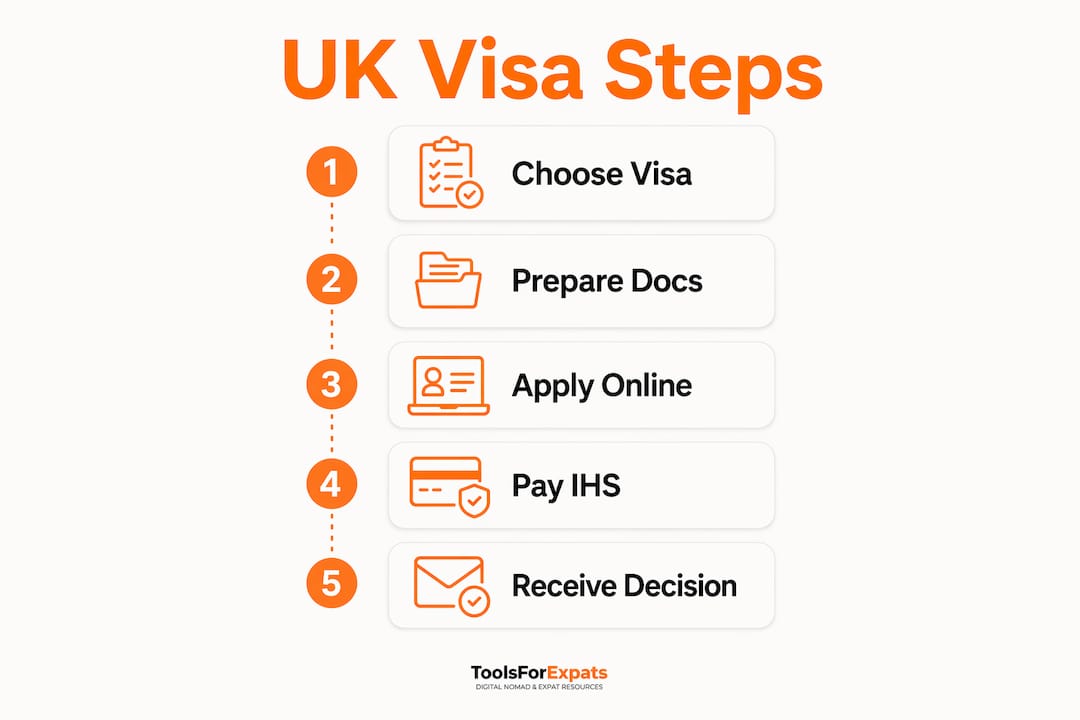
Yes, an American can move to and live in the UK. Your single most important first step is choosing the correct visa route and starting your application on GOV.UK. Everything else, from housing to healthcare to taxes, flows from that decision.
Your TL;DR checklist:
-
Confirm your visa route on GOV.UK and check your initial eligibility with the ToolsForExpats Visa Checker before you pay any fees.
-
Budget for the Immigration Health Surcharge (IHS) upfront — it's paid as part of most visa applications and covers NHS access for the duration of your visa.
-
Book 4–8 weeks of short-term furnished housing before you arrive; you'll need a UK address to open a bank account, and a bank account to pass rental referencing.
-
Start your National Insurance number (NIN) application as soon as you land and have the right to work.
-
Register with an NHS GP within your first 30 days — it's free, doesn't require proof of address, and opens access to all NHS primary care.
Which UK visa fits you as an expat?
The UK offers several long-term visa routes for Americans, and picking the right one early saves you weeks of wasted effort. GOV.UK is the authoritative source for every application, eligibility check, and document list.
| Visa Route | Who It's For | Key Documents Needed |
|---|---|---|
| Skilled Worker | Americans with a job offer from a licensed UK sponsor | Certificate of Sponsorship, passport, English language proof, salary evidence |
| Family (Spouse/Partner) | Spouses or partners of British citizens or settled persons | Relationship evidence, financial requirement proof, passport |
| Student | Full-time degree or course enrollment at a licensed institution | Confirmation of Acceptance for Studies (CAS), financial evidence, passport |
| Graduate | Recent UK university graduates (post-study work) | UK degree completion evidence, passport |
| Ancestry | Americans with a UK-born grandparent | Proof of ancestry, passport, evidence of intention to work |
| Global Talent | Recognized leaders in tech, science, arts, or academia | Endorsement from a designated body (e.g., Tech Nation, British Academy) |
| Visitor | Short stays only — no work, no long-term residence | Passport; no formal application for most nationalities under 6 months |
Processing times vary significantly by route. A Skilled Worker visa typically takes several weeks once you have a job offer and complete documents. Family visas can take multiple weeks to several months, so plan well ahead. Priority processing is available for an additional fee on most routes, which can cut standard timelines roughly in half.
The Immigration Health Surcharge (IHS) is paid upfront as part of most work and family visa applications. The IHS rate is £1,035 per year for adults, paid for the full visa duration at the time of application. For a three-year Skilled Worker visa, that's £3,105. Budget for this early.
Pro Tip: Run a quick pre-check with the ToolsForExpats Visa Checker before you spend time gathering documents. It won't replace GOV.UK's official guidance, but it gives you a fast read on which routes are likely open to you.
How long does a UK move take, and what does it cost?
Realistically, plan for a 3–6 month runway from decision to settled housing. Here's how that timeline typically breaks down:
- Months 1–2: Research visa route, gather documents, secure job offer (if Skilled Worker), submit visa application.
- Months 2–3: Visa processing period; book short-term housing, arrange international shipping, notify U.S. institutions.
- Month 3 (arrival): Collect Biometric Residence Permit (BRP) within 10 days, move into short-term housing, open bank account.
- Weeks 4–8 post-arrival: Secure long-term tenancy, apply for NIN, register with GP, enroll children in school if applicable.
Sample monthly budgets: London vs. regional cities
Average rent in London tends to be notably higher than in regional cities, where rental, grocery, transport, and utility costs are generally lower. Budgeting for city-specific living expenses is important.

One-off moving costs to budget for
Typical one-off costs include visa application fees (which depend on the route), the Immigration Health Surcharge per adult, security deposit equivalent to several weeks' rent, the first month's rent in advance, international shipping costs for household goods, and short-term housing expenses. Costs vary by circumstance.
Use the Moving Abroad Budget Calculator on ToolsForExpats to run your personalized numbers. Input your target city, household size, and shipping volume to get a realistic one-off and monthly cost picture before you commit.
How do you find housing as a newcomer in the UK?
The biggest practical trap for new arrivals is the circular reference: landlords want bank statements, banks want a UK address, and tenancy referencing requires both. The solution is a deliberate two-stage approach.
Stage 1: Short-term furnished housing (weeks 1–8)
Book serviced accommodation, a furnished Airbnb, or a short-let apartment before you fly. This gives you a legitimate UK address on day one, which you'll use to open a bank account and start the referencing process for a long-term tenancy. Relocation guides consistently recommend 4–8 weeks in short-term housing as the standard workaround for this problem.
Stage 2: Long-term tenancy (from week 4 onward)
Once you have a UK bank account and at least one month of statements, you can pass standard referencing checks. Here's what most landlords and letting agents will ask for:
- Passport and visa/BRP as proof of right to rent (legally required under UK law)
- Employment letter or contract confirming your salary and start date
- Bank statements (typically 3 months, though you may only have 1–2 at this stage)
- Previous landlord reference (a letter from your U.S. landlord works)
- Guarantor or advance rent if your UK credit history is thin — offering 3–6 months' rent upfront is a common workaround
Choosing the right city matters more than most people expect. London is the default for many Americans, but Manchester, Birmingham, and Edinburgh all offer strong job markets in tech, finance, and creative industries at significantly lower rents. Use the Cost of Living Comparison Tool to run a side-by-side before you decide.
Pro Tip: Rental scams are common on Gumtree and Facebook Marketplace. Always verify a property through a registered letting agent or a landlord who can show you the title deed. Never transfer a deposit before you've physically seen the property or verified ownership.
How does healthcare work for expats in the UK?
The NHS is one of the genuine advantages of living in the UK. For most Americans on work or family visas, access is straightforward once you understand how the IHS works.
- Pay the IHS as part of your visa application. Most work and family visa holders pay the IHS upfront and then access NHS services on the same basis as UK residents for the duration of their visa. You don't pay separately each time you use the NHS.
- Register with a GP within your first 30 days. Find a surgery near your address using the NHS website and complete a registration form. GP registration doesn't require proof of address in principle — bring your passport and BRP. Registration is free.
- Understand what the NHS covers and what it doesn't. Primary care (GP visits, referrals, prescriptions at a standard charge) is covered. Dental and optical care are partially subsidized but not fully free for most adults. Waiting times for specialist referrals can be long.
- Consider private health insurance for the gap. If you need faster access to specialists or private hospital care, a private health insurance policy is worth pricing before you travel. Many employers include private cover as part of a relocation package, so check your employment contract first.
- Keep your U.S. health coverage active until you land. There's typically a gap between your U.S. policy ending and your NHS GP registration completing. A short-term travel or international health policy covers that window.
What do you need to know about UK banking and money?
Opening a UK bank account is one of the first administrative tasks after arrival, and it's also one of the most frustrating without the right preparation. Traditional high-street banks (Barclays, HSBC, NatWest, Lloyds) typically require more documentation than newer digital banks.
Documents most banks require:
- Valid passport and visa/BRP
- Proof of UK address (short-term accommodation booking confirmation often works for digital banks)
- Employment letter or contract
- Sometimes: a utility bill or bank statement from your home country
Digital banks like Monzo and Starling have more flexible onboarding for newcomers and can often be set up within days of arrival using just your passport and BRP. They're a practical first account while you wait for a traditional bank to process your application.
Your National Insurance number (NIN) is the UK equivalent of a Social Security number. You need it to work legally, pay tax, and access certain benefits. Apply online through GOV.UK as soon as you arrive and have the right to work. Your employer can pay you before your NIN arrives, so don't let a delayed application hold up your start date.
Moving money internationally: Avoid using your U.S. bank's international wire service for regular transfers. The exchange rates and fees are typically poor. Compare specialist transfer providers for monthly transfers. The difference in fees and exchange rates adds up quickly over a year.
Tax registration: If you're employed on a UK payroll, your employer handles PAYE (Pay As You Earn) tax deductions automatically. If you're self-employed or have additional income sources, register for self-assessment with HMRC promptly after arrival.
What are your tax obligations in the UK and the U.S.?
Living in the UK as an American means you have two tax systems to manage simultaneously. Neither one is optional.
UK tax: HMRC, PAYE, and self-assessment
UK employees pay income tax through PAYE, which your employer deducts automatically. You also pay National Insurance Contributions (NICs), which fund the NHS and state pension. The current basic rate of income tax is 20% on earnings above the personal allowance (£12,570 for the 2025/26 tax year, per HMRC guidance). Higher and additional rates apply at higher income bands.
Self-assessment is required if you're self-employed, earn above £100,000, have rental income, or have other untaxed income. Register with HMRC as soon as any of these apply to you. Missing the registration deadline triggers penalties.
U.S. tax: IRS filing requirements for Americans abroad
The U.S. taxes its citizens on worldwide income regardless of where they live. As an American expat in the UK, you must still file a U.S. federal tax return with the IRS every year. The Foreign Tax Credit (Form 1116) lets you offset UK taxes paid against your U.S. tax liability, which prevents most Americans from paying double tax on the same income. The Foreign Earned Income Exclusion (FEIE, Form 2555) is another option for qualifying earned income.
Two practical scenarios worth knowing:
- Employee on a UK payroll: You pay UK income tax via PAYE and file a U.S. return claiming the Foreign Tax Credit. In most cases, your U.S. liability is zero or minimal.
- U.S. citizen with U.S.-source passive income (dividends, rental income): This income may be taxable in both countries. The U.S.-UK tax treaty provides relief in many cases, but the specifics depend on the income type. A cross-border tax professional is worth the cost here.
Pro Tip: Keep synchronized records from day one: payroll slips, bank statements, and dated proof of UK residence. HMRC and the IRS both want documentation of where you were and when. A simple folder with monthly statements and your BRP entry date saves hours of reconstruction later.
How do you find work and navigate UK professional life?
The UK job market is accessible for Americans, but a few adjustments make a real difference in how you're perceived by employers.

UK CVs (resumes) are typically two pages, don't include a photo, and omit personal details like age or marital status. Tailor your U.S. experience to UK job titles and salary expectations, which are quoted annually. Salary negotiation is more reserved in the UK than in the U.S., so research market rates on sites like Glassdoor UK or Reed before any conversation.
Professional qualification recognition varies by field. Regulated professions (medicine, law, engineering, teaching) require formal recognition from the relevant UK body before you can practice. The UK Centre for Professional Qualifications (UK ENIC) handles most academic credential assessments. Contact the specific professional body for your field early, as some processes take months.
Self-employment and contracting are permitted on several visa routes, including the Skilled Worker visa in some circumstances and the Global Talent visa. If you plan to contract through a limited company, you'll need to register with Companies House and understand IR35 rules, which determine whether HMRC treats you as an employee for tax purposes.
Workplace culture in the UK tends toward understatement. Directness is valued but delivered more indirectly than in the U.S. Meetings often end without explicit decisions being stated aloud. Building relationships through informal conversations matters more than many Americans expect. Joining local expat communities and professional networks accelerates both your social integration and your professional visibility.
What everyday practicalities should you sort in your first month?
The first 30 days in the UK are mostly administrative, but getting these tasks done quickly makes everything else easier.
First-month checklist:
- Collect your BRP within 10 days of arrival from the Post Office branch listed in your visa approval letter.
- Get a UK SIM card on arrival at the airport; pay-as-you-go SIMs from major networks (EE, Vodafone, O2) are available immediately.
- Set up an Oyster card or contactless payment for London transport; outside London, most cities use contactless or app-based ticketing.
- Check your driving license rules: U.S. licenses are valid for 12 months after you become a UK resident. After that, you must exchange at the DVLA. If your U.S. state has a reciprocal agreement with the UK, you can exchange without retaking a test.
- Apply for a school place through your local council if you have children. Timing matters; popular schools fill up, and the council allocates places on a term-by-term basis.
- Register for Council Tax with your local council once you have a long-term address. Single adults are entitled to a 25% discount but must apply for it — it isn't applied automatically.
- Get a TV Licence if you watch live TV or use BBC iPlayer. The annual fee is £169.50 (as cited in public guidance). Skipping it carries a fine.
Pro Tip: Switch your utility suppliers as soon as you're in a long-term property. Newcomers often stay on the default tariff and overpay for months. UK price comparison sites let you switch gas, electricity, and broadband in minutes once you have your account details.
What's the path to permanent residency in the UK?
The standard route to Indefinite Leave to Remain (ILR) requires five continuous years of lawful residence in the UK. ILR is the UK's equivalent of permanent residency and removes the time limit on how long you can stay.
The standard 5-year route
Most Skilled Worker visa holders qualify for ILR after five years on the same visa category. Key requirements include:
- Continuous lawful residence (no gaps that breach absence rules — generally no more than 180 days outside the UK in any 12-month period)
- Meeting the salary threshold at the time of application
- Passing the Life in the UK test (a multiple-choice exam on British history, culture, and law)
- Holding a valid English language qualification
Accelerated routes
The UK offers an accelerated ILR route for high-earning Skilled Workers. Applicants who meet a higher salary threshold can apply after three years rather than five. The exact threshold is set by the Home Office and updated periodically, so verify the current figure on GOV.UK before planning around it.
Milestone timeline example: Year 0: Skilled Worker visa granted → Year 3: Eligible for accelerated ILR (if salary threshold met) → Year 5: Standard ILR eligibility → Year 6: British citizenship eligibility (1 year after ILR)
After holding ILR for 12 months, most applicants can apply for British citizenship through naturalization, subject to additional residence and character requirements.
What should you do before you leave the U.S.?
An ordered pre-departure checklist prevents the most common last-minute scrambles.
- 6+ months before departure: Confirm visa route and start application; check passport validity (must be valid for the full visa period); gather employment, financial, and relationship documents; research schools if you have children.
- 3 months before departure: Book short-term furnished housing for weeks 1–8; get quotes from international shipping companies; apply for Transfer of Residence (ToR1) customs relief if you've lived outside the UK for 12+ months (this lets you import personal belongings free of VAT and customs duty, but you must apply before your goods arrive).
- 6–8 weeks before departure: Arrange pet travel documentation if applicable (UK requires microchipping, rabies vaccination, and a health certificate; the process takes at least 4 months, so start earlier if you have pets); notify your U.S. bank and credit card companies of your move; set up mail forwarding from your U.S. address.
- 1 month before departure: Obtain medical and dental records; get copies of school records and transcripts; confirm international health coverage for the gap period; close or convert U.S. accounts you won't need.
- Days before departure: Download the GOV.UK View and Prove app to share your immigration status digitally; confirm your BRP collection Post Office branch; carry printed copies of your visa approval, accommodation booking, and employment letter in your carry-on.
Which free tools help you plan your UK move?
ToolsForExpats offers a suite of free planning tools that give you real numbers before you commit to anything. No account required, no fees.
Tools to use right now:
-
Moving Abroad Budget Calculator: Input your target UK city, household size, and estimated shipping volume. The calculator outputs a one-off moving cost estimate and a monthly living budget. Run this before you set your savings target.
- Step 1: Select the UK as your destination country and choose your target city.
- Step 2: Enter household size, current location, and estimated belongings volume.
- Step 3: Review the one-off and monthly cost breakdown; adjust inputs to compare London vs. a regional city.
-
Cost of Living Comparison Tool: Compare two UK cities side by side on rent, groceries, transport, and utilities. Useful when you're deciding between London and Manchester, or Edinburgh and Birmingham.
- Step 1: Enter your current U.S. city and your target UK city.
- Step 2: Review the category-by-category cost difference.
- Step 3: Use the output to set a realistic monthly budget for your chosen city.
-
Visa Eligibility Checker: Answer a short set of questions about your nationality, employment status, and purpose of move. The tool flags which visa routes are likely available to you before you spend time on GOV.UK documentation.
- Step 1: Select your nationality and intended activity in the UK.
- Step 2: Review the suggested visa routes.
- Step 3: Follow the GOV.UK links for the routes flagged as eligible.
-
Nomad Cost Calculator: Useful for flexible workers or those evaluating multiple UK cities at a neighborhood level before committing to a long-term address.
Use ToolsForExpats as your free first stop before paying for a relocation consultant. The tools won't replace GOV.UK for official visa guidance, but they give you a grounded cost picture and a visa shortlist in under 10 minutes.
Key Takeaways
Americans can move to and live in the UK by choosing the right visa route on GOV.UK, budgeting realistically for the IHS and housing deposits, and following a two-stage housing approach to resolve the bank-account-address circular reference on arrival.
| Point | Details |
|---|---|
| Visa is the first decision | Choose your route on GOV.UK; Skilled Worker, Family, Ancestry, and Global Talent are the main long-term options for Americans. |
| Budget for IHS and deposits early | The IHS costs £1,035/year per adult, paid upfront; add a 5-week deposit and first month's rent to your pre-move savings target. |
| Two-stage housing approach | Book 4–8 weeks of short-term furnished housing first; use that address to open a bank account and pass tenancy referencing. |
| Register with a GP within 30 days | GP registration is free, doesn't require proof of address, and opens access to all NHS primary care immediately. |
| ToolsForExpats for free planning | Use the Moving Abroad Budget Calculator and Cost of Living Comparison Tool to set realistic budgets before you commit to a city or timeline. |
What actually surprises Americans most after moving to the UK?
Most Americans who relocate to the UK expect the big adjustments: the weather, driving on the left, the NHS. What they don't expect are the small, persistent friction points that nobody warns them about.
Housing speed is the first one. The UK rental market moves fast, especially in London and Edinburgh. Properties are listed and gone within days, sometimes hours. Americans used to a slower U.S. rental process often lose their first three or four choices before they realize they need to be ready to sign on the same day they view. The fix is simple: have your documents ready before you start viewing. That means your passport, BRP, employment letter, and a reference letter from your U.S. landlord, all in a folder you can email within the hour.
The cost of deposits catches nearly everyone off guard. A five-week deposit on a £2,100/month London flat is over £2,400, on top of your first month's rent. Budget 40–60% more for initial housing costs in London than your monthly rent figure suggests.
The cultural adjustment is subtler than most people expect. UK workplace culture values understatement and indirectness in a way that reads as vagueness to many Americans. Feedback is often delivered obliquely. Enthusiasm that's normal in a U.S. office can read as overconfidence in a UK one. The adjustment is real, but it's fast once you're aware of it.
Social integration takes longer than professional integration for most expats. The fastest route is to get involved before you feel settled. Local expat groups, Meetup events, and volunteering connect you to people who've already navigated the same learning curve and are usually generous with practical advice. Don't wait until you feel at home to start looking for community.
Plan your UK move with ToolsForExpats's free tools
Before you spend money on a relocation consultant or commit to a city, run your numbers for free. ToolsForExpats gives you three tools that answer the three questions every American asks before moving to the UK: Can I get a visa? What will it cost? And which city actually fits my budget?

The Moving Abroad Budget Calculator takes your target city, household size, and shipping estimate and outputs a realistic one-off and monthly cost breakdown. The Cost of Living Comparison Tool lets you run London against Manchester or Edinburgh in under two minutes. And the Visa Eligibility Checker gives you a fast shortlist of likely routes before you dig into GOV.UK documentation.
All three tools are free, require no account, and work on any device. Head to ToolsForExpats and run your moving budget today.
Useful sources and official resources
Bookmark these pages. They cover the official rules for visas, healthcare, and taxes, and the free tools for planning your budget and city choice.
-
GOV.UK: Skilled Worker Visa — The official application page for the most common work visa route. Use this to check current salary thresholds, document requirements, and processing times. Relevant to the visa and ILR sections of this guide.
-
GOV.UK: Indefinite Leave to Remain (Skilled Worker) — Official guidance on ILR eligibility, the 5-year standard route, and the accelerated 3-year route for high earners. Relevant to the residency path section.
-
GOV.UK: Living in the UK — Applying from Overseas — Step-by-step guidance for applying from outside the UK, submitting biometrics, and using the View and Prove eVisa service. Relevant to the visa and pre-departure checklist sections.
-
NHS website — Use the GP finder to locate a surgery near your address and complete online registration. Relevant to the healthcare section.
-
HMRC — Register for self-assessment, manage PAYE, and access National Insurance guidance at gov.uk/government/organisations/hm-revenue-customs. Relevant to the taxes section.
-
IRS: U.S. Citizens and Resident Aliens Abroad — The IRS publishes guidance on filing requirements, the Foreign Tax Credit (Form 1116), and the Foreign Earned Income Exclusion (Form 2555) at irs.gov/individuals/international-taxpayers/us-citizens-and-resident-aliens-abroad. Relevant to the U.S. tax obligations section.
-
ToolsForExpats Moving Abroad Budget Calculator — Free tool to estimate one-off and monthly costs for your UK move. Use before setting your savings target.
-
ToolsForExpats Cost of Living Comparison — Compare UK cities side by side on rent, groceries, transport, and utilities. Use when choosing between London and a regional city.
-
ToolsForExpats Visa Eligibility Checker — Quick pre-check of likely visa routes before you start gathering documents for GOV.UK.
This guide is general information, not legal, tax, or immigration advice. Visa rules, tax thresholds, and fees change regularly. Confirm current requirements on GOV.UK, HMRC, and the IRS website, or consult a qualified professional for your specific situation.