
The fastest way to choose an expat city is to build a weighted shortlist across five core criteria (cost, visa, healthcare, safety, and remote-work viability), verify each with real data, then test your top pick with a 2–6 week trial stay. Here's where to start right now:
- Check visa feasibility. Before you fall in love with a city, confirm you can legally stay there. The Visa Eligibility Checker screens digital nomad and residency routes across 20+ countries in minutes.
The rest of this guide walks you through the full decision process, from defining your priorities to booking a trial stay with confidence.
Key Takeaways
Choosing the right expat city comes down to a weighted shortlist built on visa certainty, real cost data, and a trial stay to confirm what the numbers can't measure.
| Point | Details |
|---|---|
| Visa and health coverage first | Confirm a legal stay pathway and health insurance before evaluating any other criteria. |
| Use a weighted scoring matrix | Score each shortlisted city across your top criteria and multiply by priority weight to remove gut-feel bias. |
| Affordable cities are viable | Research indicates comfortable expat living is achievable at around $2,000/month in certain smaller cities. |
| Trial stay before committing | A 2–6 week stay reveals language friction and neighborhood fit that no index score can replicate. |
| ToolsForExpats tools are free | The Best City Quiz, Cost Comparison, Moving Budget Calculator, and Visa Checker require no account and cover the full shortlist process. |
How do you choose the right expat city for your situation?
The short answer: measure the things that actually affect your daily life, not just the things that look good in a travel blog photo. Below is the checklist every expat should work through before committing to a city.
Cost of living
Monthly costs vary wildly between cities, even within the same country. Look at rent, groceries, utilities, transport, and dining out as separate line items, not a single blended number. Numbeo's quality-of-life indices give you crowdsourced scores for rent, cost of living, and healthcare perceptions across hundreds of cities. For European destinations, Eurostat's price-level indices let you compare relative consumer prices across EU countries, which is especially useful when adjusting budget estimates between, say, Lisbon and Amsterdam.
Stat to know: A synthesis of three recent studies found that comfortable expat living is achievable at around $2,000/month in certain smaller cities and affordable destinations, a figure that global hubs like Zürich or Singapore can easily triple.
Visa and residency options
This is the criterion most people research last and should research first. Confirm the visa route exists, that you qualify, and what the processing timeline looks like before you invest time in any other research. Official immigration portals for each country are the only reliable source here.
Housing availability and rent
Check local listing sites (Idealista for Spain and Portugal, Immoscout24 for Germany, Domain for Australia) to verify that advertised rents match your budget. Short-term furnished rentals cost more per month but reduce your upfront commitment during a trial period.
Healthcare quality and cost
For US expats, this means understanding what your domestic health insurance covers abroad (usually very little) and what a local or international policy costs. Look at public healthcare access for residents versus private options, and factor the premium into your monthly budget from day one.
Safety and security
Use Numbeo's safety index as a quick filter, then cross-check with the U.S. State Department's travel advisories for a more grounded picture. William Russell's 2026 index ranked Zürich as the most welcoming city for expats, citing very high safety and low social friction, which illustrates how "welcoming" and "safe" can be measured as distinct dimensions.
Job market and remote-work viability
If you're working remotely, check time-zone overlap with your clients or employer, coworking space availability, and internet reliability scores. If you need local income, research work permit requirements and the local job market for your field.
Language and cultural fit
Daily friction from a language barrier is easy to underestimate. English proficiency scores (EF EPI rankings cover most countries) give a useful proxy for how smoothly you'll handle banking, healthcare appointments, and landlord negotiations.
Climate and environment
Look at air quality indices (IQAir publishes city-level data), seasonal temperature ranges, and natural disaster risk. A city that looks perfect on paper can feel miserable if you hate humidity or need four seasons.
Transport and infrastructure
Check flight connections to your home country, public transit quality, and whether you need a car. For digital nomads, airport access and reliable rail links matter more than most people admit until they're stranded.
Expat community and schools
A strong expat network accelerates settling in, especially in the first three months. For families, international school availability and fees are often the single biggest budget variable after rent.
Pro Tip: Weight your criteria by archetype. Digital nomads should prioritize internet reliability, visa flexibility, and coworking access. Families should weight schools, safety, and healthcare most heavily. Retirees typically benefit most from low cost of living, healthcare quality, and a welcoming local culture.
A 5-step process to build your personalized shortlist
This workflow takes you from a vague idea ("somewhere in Europe?") to a ranked, tested shortlist you can act on.
-
Define your priorities and budget (1–2 hours). Write down your top five criteria in order of importance. Set a firm monthly budget ceiling, including rent, food, insurance, and a 15% contingency. Be honest about non-negotiables: if you need English-language healthcare, that eliminates a large portion of the map immediately.
-
Build a longlist and apply quick filters (2–4 hours). Start with 8–12 cities that broadly match your archetype. Run the Best City for Digital Nomads Quiz to surface cities you may not have considered. Then apply hard filters: visa feasibility, budget ceiling, and any climate or language requirements. You should exit this step with 4–6 cities remaining.
-
Quantify costs and visa routes (3–5 hours). For each remaining city, run a side-by-side budget estimate using the Cost of Living Comparison Tool. Pull Numbeo data and local listing prices to cross-check the outputs. Confirm visa eligibility and processing times via the Visa Eligibility Checker and each country's official immigration portal. Drop any city where the visa route is uncertain or the budget doesn't work even optimistically.
-
Score and rank with a weighted matrix (1–2 hours). Assign each city a score from 1–5 on each of your top criteria, then multiply by the weight you assigned in Step 1. The city with the highest weighted total becomes your primary candidate. The second and third become your backup options. This step removes gut-feel bias and forces you to confront trade-offs explicitly.
-
Plan and execute a trial stay (2–6 weeks on the ground). Book a furnished short-term rental rather than a hotel. Live as a local: shop at the grocery store, use public transit, visit a clinic if possible, and attend at least one expat meetup. A trial stay reveals day-to-day fit more reliably than numeric models alone, especially for language friction and neighborhood feel. After the stay, revisit your scores and adjust before committing to a lease or visa application.
Which city type fits your expat profile?
Not every great expat city works for every expat. Matching your profile to a city archetype narrows the field faster than any ranking list.
Budget-friendly smaller cities
Best for: Digital nomads and solo expats on a tight budget. Trade-offs: Smaller expat communities, fewer English-language services, potentially slower visa processing. Typical monthly budget: $1,500–$2,500. Visa complexity: Low to moderate; many offer straightforward residency or digital nomad visa routes. Examples: Tbilisi (Georgia), Medellín (Colombia), Chiang Mai (Thailand). These cities consistently appear in affordability-focused rankings, and the Forbes synthesis of three studies confirms that comfortable living around $2,000/month is realistic in destinations like these.

Global hubs
Best for: Professionals who need strong networking, world-class infrastructure, and international schools. Trade-offs: High cost of living, competitive housing market, bureaucratic visa processes. Typical monthly budget: $4,500–$8,000+. Visa complexity: High; many require employer sponsorship or significant financial thresholds. Examples: Singapore, Dubai, Amsterdam. These cities score well on multi-indicator indexes but demand a budget to match.
English-first cities
Best for: Expats who need English for work or healthcare and want minimal language friction. Trade-offs: Often higher costs than non-English-speaking alternatives; less cultural immersion. Typical monthly budget: $2,500–$5,000. Visa complexity: Moderate to high, depending on country. Examples: Dublin (Ireland), Auckland (New Zealand), Cape Town (South Africa). English proficiency removes a significant daily friction point, which matters more than most people expect.
Remote-work havens
Best for: Location-independent workers who prioritize fast internet, coworking culture, and a digital nomad community. Trade-offs: Can feel transient; long-term residency options vary widely. Typical monthly budget: $1,800–$3,500. Visa complexity: Low to moderate; several countries have introduced dedicated digital nomad visas. Examples: Lisbon (Portugal), Tallinn (Estonia), Bali (Indonesia). Lisbon topped a 2026 Global Citizen Solutions index of 35 cities, scoring 88.49/100 across cost, safety, healthcare, air quality, and ease of settling in.
Retirement-friendly cities
Best for: Retirees seeking low cost of living, warm climate, and accessible healthcare. Trade-offs: Job market irrelevant, but healthcare quality and political stability matter more. Typical monthly budget: $1,800–$3,200. Visa complexity: Low; many countries offer dedicated retirement or passive-income residency visas. Examples: Algarve region (Portugal), Penang (Malaysia), Oaxaca (Mexico).

Family-oriented cities
Best for: Families with school-age children who need international schools, safety, and family infrastructure. Trade-offs: International school fees can add $10,000–$30,000/year per child; housing needs are larger. Typical monthly budget: $4,000–$7,000 (family of four). Visa complexity: Moderate; family visas usually follow the primary applicant's route. Examples: Vienna (Austria), Zürich (Switzerland), Barcelona (Spain). Zürich's top ranking in the William Russell 2026 index reflects its combination of safety, social integration, and quality of life that families consistently value.
How to use tools and public data to compare cities objectively
The goal at this stage is to replace gut feel with a decision matrix you can defend. Here's how to use ToolsForExpats tools alongside public datasets to build one.
ToolsForExpats tools by decision stage
- Visa stage: Run the Visa Eligibility Checker for each remaining city. It screens digital nomad and residency visa routes across 20+ countries and flags eligibility gaps before you invest further time in a destination.
Example decision matrix: Lisbon vs. Medellín
| Dimension | Lisbon | Medellín |
|---|---|---|
| Estimated monthly budget | $1,800–$3,500 | $1,500–$2,500 |
| Visa route (US passport) | D8 Digital Nomad Visa | Digital Nomad Visa (2+ years) |
| Safety index (Numbeo) | Moderate-high | Moderate |
| Healthcare access | Strong public + private | Good private, limited public |
| English proficiency | High | Low-moderate |
| Expat community | Very large | Large and growing |
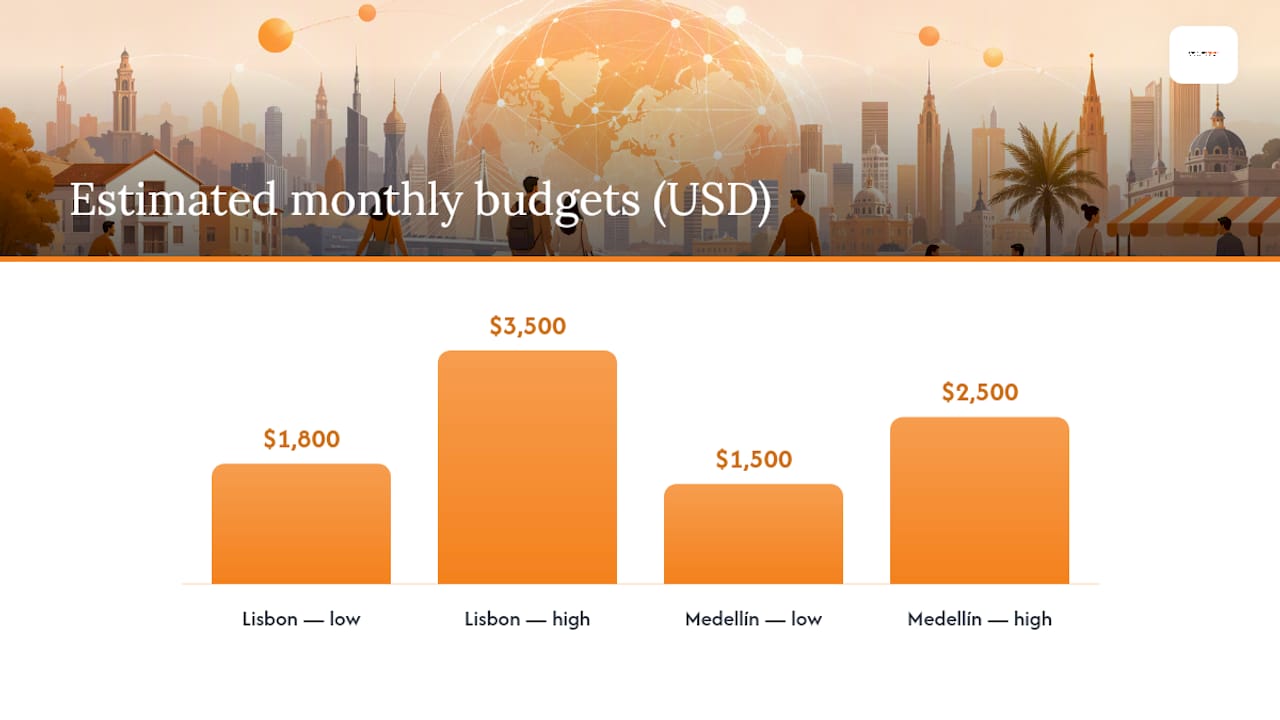
How to read this: Lisbon scores higher on language ease and healthcare, while Medellín wins on cost. If your weighted criteria place language above budget, Lisbon ranks first. If budget is your top weight, Medellín pulls ahead. The matrix makes that trade-off explicit rather than leaving it as a feeling.
Combining ToolsForExpats outputs with public data
Numbeo's crowdsourced indices are fast and useful for initial filtering, but they reflect user perceptions rather than verified prices. Cross-check rent estimates against local listing sites, and use Eurostat price-level indices for EU city comparisons to adjust for purchasing-power differences. For safety, layer the U.S. State Department's country advisories on top of Numbeo's index rather than relying on either alone.
Pro Tip: Multi-indicator indexes that weight safety and healthcare heavily tend to favor established European capitals. If you're comparing cities across different index rankings, check which dimensions each index weights most before treating its top-10 list as universal.
What do you need to do before you move?
A solid pre-move checklist prevents the most common and costly mistakes. Work through this in the order shown.
Timeline and lead times
| Task | When to start | Typical lead time |
|---|---|---|
| Research and shortlist | 6+ months before move | 2–4 weeks of active research |
| Visa application | 4–6 months before | 4–12 weeks processing (varies by country) |
| Housing search | 2–3 months before | 2–6 weeks to secure a lease |
| International health insurance | 2–3 months before | 1–2 weeks to compare and bind |
| Bank account setup | 1–2 months before | 1–4 weeks (some require in-person visit) |
| Tax and financial planning | 3–6 months before | Ongoing; consult a cross-border tax advisor |
| Shipping and logistics | 4–6 weeks before | 2–6 weeks depending on destination |
Cost buckets to plan for
One-time relocation costs:
- Flights and excess baggage: $500–$2,500 depending on destination and volume
- Security deposit on housing: typically 1–3 months' rent
- International shipping (if applicable): $1,500–$5,000 for a partial household
- Visa application fees: $100–$1,500 depending on country and visa type
- Initial insurance setup and health exam (if required): $200–$600
Ongoing monthly costs:
- Rent, utilities, and internet: the largest variable; use the Moving Abroad Budget Calculator to model this for your specific city
- International health insurance: $100–$400/month for a healthy adult, more for families
- Local transport, food, and leisure: varies significantly by city archetype
Red flags that should pause your move
- Visa uncertainty: If you cannot confirm a legal pathway to stay for your intended duration, stop and resolve this before booking anything.
- Housing costs exceed 40% of your budget: This leaves too little margin for healthcare, emergencies, and the unexpected costs of settling in.
- No health coverage plan: Moving without confirmed insurance is a financial risk that can undo an otherwise well-planned relocation.
- No trial stay completed: Committing to a 12-month lease in a city you've never visited is one of the most common and avoidable expat mistakes.
What the data doesn't tell you about picking a city
The weighted shortlist method works. The calculators are genuinely useful. But after working through this process with dozens of city comparisons, one pattern keeps showing up: the expats who regret their choice almost always skipped the trial stay, not the spreadsheet.
Numbers can tell you that Lisbon scores 88.49/100 on a livability index, that Zürich ranks first for social integration, or that your monthly budget works on paper. What they can't tell you is whether you'll feel at home in a neighborhood, how you'll handle the bureaucratic friction of opening a bank account in a second language, or whether the local pace of life matches yours. Those things only reveal themselves on the ground.
The tools ToolsForExpats built are designed to be transparent and repeatable. Run the same comparison six months later and you'll get the same output, because the methodology doesn't change. That consistency is what makes them useful for planning. But the output is a starting point for a decision, not the decision itself. Use the data to eliminate bad fits and surface strong candidates. Use the trial stay to confirm the winner.
One more thing worth saying directly: visa certainty and health coverage are not optional criteria to weigh against lifestyle preferences. They are prerequisites. A city that scores a perfect 5 on culture and cost but where you have no legal right to stay or no access to healthcare is not a candidate. Filter for those two things first, every time.
ToolsForExpats makes the shortlist process free and fast
You've done the research. Now it's time to run the numbers on your actual shortlist, and ToolsForExpats gives you four free tools to do exactly that, with no account required.
Start with the Best City for Digital Nomads Quiz to get a ranked top-3 match based on your priorities. Then use the Cost of Living Comparison Tool to convert those matches into real monthly budget estimates. When you're ready to plan the move itself, the Moving Abroad Budget Calculator estimates your one-time costs and runway, and the Visa Eligibility Checker confirms which residency routes are open to you. Every tool at ToolsForExpats is free, requires no sign-up, and is built specifically for expats and digital nomads making real relocation decisions. Run your shortlist today.
Sources
These are the sources worth bookmarking as you build and verify your shortlist.
- Revealed: the world’s most expat-friendly countries and cities in 2026
- Lisbon tops global study of the world’s most livable cities for expats
- The Best Places For Expats, According To 3 New Studies
- Price level indices — Eurostat infographic